Circulation appointments are short and the history does most of the diagnostic work. Twenty minutes of preparation genuinely changes what comes out of the visit.
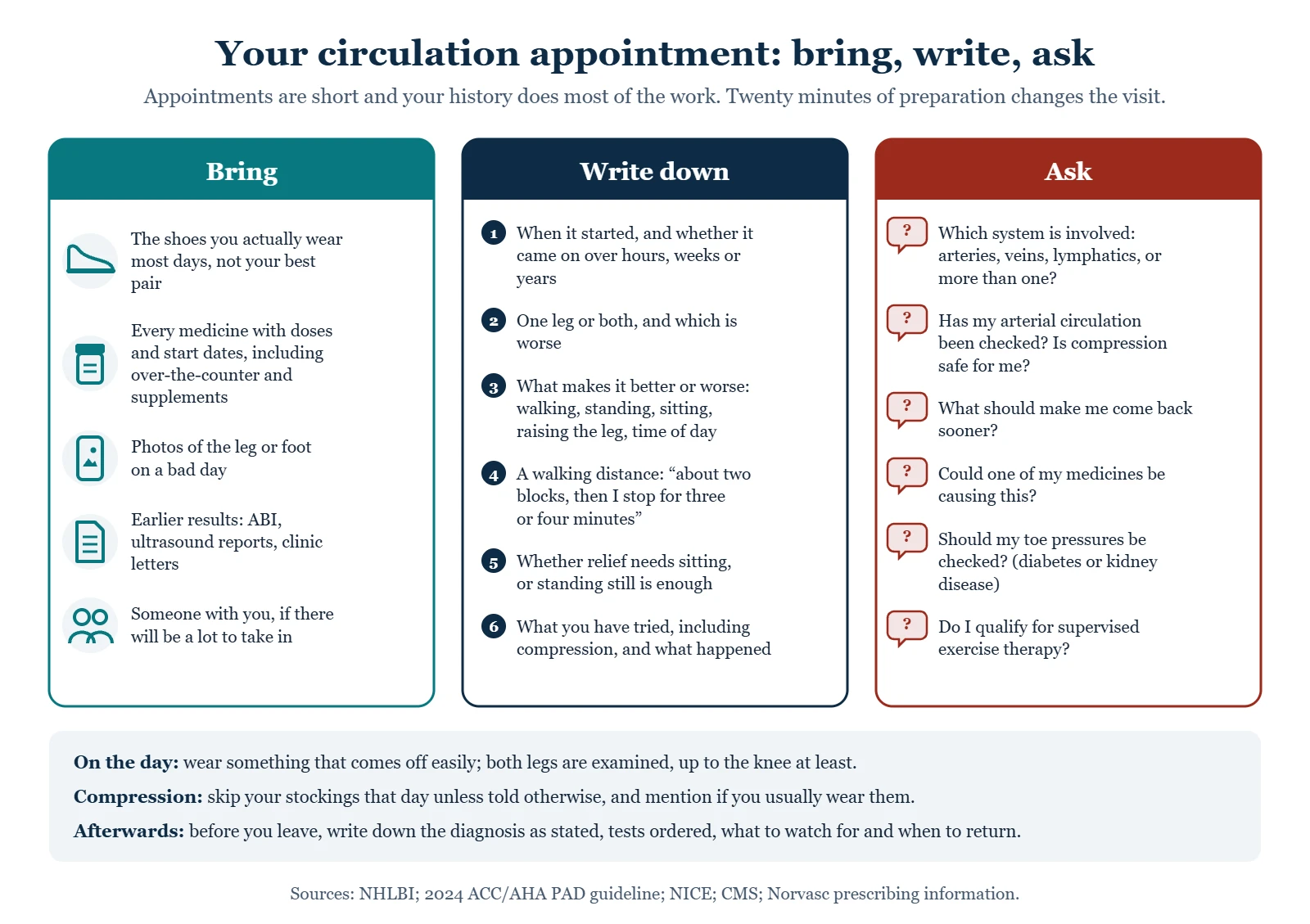
What to write down before you go
- The timeline. When it started. Whether it came on over hours, weeks or years. Whether it is getting worse, staying the same, or fluctuating.
- One leg or both, and if both, whether one is worse.
- What makes it better and what makes it worse. Walking, standing, sitting, lying down, raising the leg, heat, cold, time of day. This is the highest-value item on the list.
- A distance, if walking is involved. “About two blocks and then I have to stop for three or four minutes” is worth more than any adjective.
- Whether relief needs you to sit, or whether standing still is enough. This one question helps separate arterial from spinal causes.
- Any wound, blister, or color change, however minor — with a photograph, because it may look different on the day.
- What you have already tried, including compression, supplements and devices, and what happened.
What to bring
- Your actual medicine list with doses, including anything over the counter, supplements and hormone therapy. Several medicine classes cause leg swelling, and this is the easiest cause to find and the easiest to miss.
- Previous results — ABI, ultrasound reports, vascular clinic letters, relevant blood tests. If they are in another system, bring copies rather than assuming they will be visible.
- Your other diagnoses: diabetes, kidney disease, heart disease, previous clots, cancer treatment, previous surgery on the leg, groin or pelvis.
- Family history of clots, aneurysms or early heart disease.
- Your smoking history, including how much and for how long if you have stopped.
- The shoes you wear most days, if feet are part of the problem. Not your best pair — the ones you actually live in.
- Someone with you, if a lot of information is likely.
Wear something that comes off easily
Both legs need to be examined and compared, up to the knee at least. Tight trousers that will not roll above the knee, and tight boots, make this awkward. Skip compression stockings on the day unless you were told otherwise, and mention if you have been wearing them.
Questions worth asking
- Which system do you think is involved — arteries, veins, lymphatics, or more than one?
- What is this test measuring, and what will the result change?
- Has my arterial circulation been checked? Is compression safe for me?
- What should make me come back sooner, or go to the emergency department?
- What is the plan if this does not improve?
- Who is coordinating — you, my primary care clinician, or someone else?
- Can I have a copy of the report?
That third one is worth asking even if compression has not been mentioned, because it is the question whose answer changes what you can safely do at home.
Three questions people forget
- Could one of my medicines be causing this? Several common prescriptions swell the ankles — amlodipine at 10 mg did so in about 11% of people in its label data, against under 1% on placebo — and it is one of the most fixable causes there is. Medicines that cause swelling →
- Should my toe pressures be checked? In diabetes or kidney disease, stiff arteries can make the ankle-brachial index read normal or high when blood flow is poor, and NICE warns against ruling out PAD in diabetes on a normal reading alone. What the ABI measures →
- Do I qualify for supervised exercise therapy? If walking pain turns out to be PAD, the 2024 guideline gives supervised exercise its strongest recommendation, and Medicare covers up to 36 sessions over 12 weeks with a referral. Many people are never offered it. How a walking program works →
From the clinic
The most useful things a patient can bring me fit in a bag: the shoes they actually wear, a full list of medicines with start dates, and photographs of the leg or foot on a bad day. With those, a short visit can answer most of the questions that matter. Without them, we spend the appointment reconstructing a history that a five-minute list would have captured.
Afterwards
Write down what you were told before you leave the parking lot — people reliably forget most of a consultation. Note the diagnosis as it was actually stated, the tests ordered, what to watch for, and when to come back. If a result was given as a number, write the number down. If something did not make sense, say so at the time rather than looking it up later.
Common questions
What if I forget to mention something?
That is what the written list prevents, which is the argument for making one. If you do remember afterwards, contact the office — a detail like a previous clot or a new medicine can change the plan, and it is worth a phone call.
Should I bring photographs?
For anything that changes — a wound, a color change, swelling that comes and goes — yes. Take them in good light with something for scale, and date them. A photograph of the leg on a bad day is often more useful than the leg on a good one.
Can I ask for a specific test?
You can, and describing why is more effective than naming the test. “My symptoms come on after the same walking distance and stop when I stand still, and I want to know whether my arteries are part of it” is a request a clinician can act on.
What if I disagree with what I am told?
Say so at the time, and say what does not fit. “That does not explain why only one leg is swollen” is a legitimate and useful thing to raise, and a reasonable clinician will welcome it rather than bristle.
Where to go next
Sources
- National Heart, Lung, and Blood Institute. PAD — Diagnosis.
- NHS. Oedema.
- NHS. Leg ulcer — diagnosis.
- Gornik HL, et al. 2024 ACC/AHA multisociety guideline for the management of lower extremity peripheral artery disease. Circulation 2024.
- Centers for Medicare & Medicaid Services. Supervised Exercise Therapy for Symptomatic PAD.
- NICE. Peripheral arterial disease: diagnosis and management (CG147).
- Norvasc (amlodipine) prescribing information, DailyMed.
Written by Tom Biernacki, DPM, FACFAS. Published 20 September 2026. Updated 16 October 2026. General education, not medical advice.