Medication is one of the most common causes of leg swelling and one of the most frequently missed. It is also, uniquely on the list of causes, often completely fixable — provided someone lines up when the swelling started against when the prescription changed.
Do not stop anything on your own
Several of the medicines below are preventing strokes, heart attacks, transplant rejection or severe inflammation. Stopping them abruptly carries real risk, and some cause rebound problems on withdrawal. The action here is a conversation with the prescriber, not an experiment.
And do not assume a medicine explains everything. Call 911 for swelling with shortness of breath or chest pain. Get seen the same day for one leg that is newly swollen, red or warm, or for swelling that is getting worse when you already have heart, kidney or liver disease. One swollen leg →
Why some medicines cause swelling
They do it by different mechanisms, which is why the pattern and the fix differ:
- Widening the small arteries but not the veins. Calcium channel blockers such as amlodipine relax the arterioles feeding the capillaries while the veins draining them stay as they were, so pressure builds in the capillaries and fluid is pushed into the tissue. The body is not holding extra water — the nifedipine label describes the swelling as a local effect, not heart failure or general fluid retention — which is why water pills do so little for it.
- Making the body keep salt and water. Anti-inflammatories, corticosteroids, oral minoxidil and hydralazine work this way. Oral minoxidil retains so much that it is normally prescribed together with a diuretic.
- Less well understood routes. The glitazone diabetes medicines and the nerve-pain medicines gabapentin and pregabalin cause swelling by mechanisms that are not fully settled, and the pregabalin label notes its swelling was not linked to signs of kidney or liver damage.
Medicines commonly linked to leg swelling
| Medicine | How often, in label and trial data | Worth knowing |
|---|---|---|
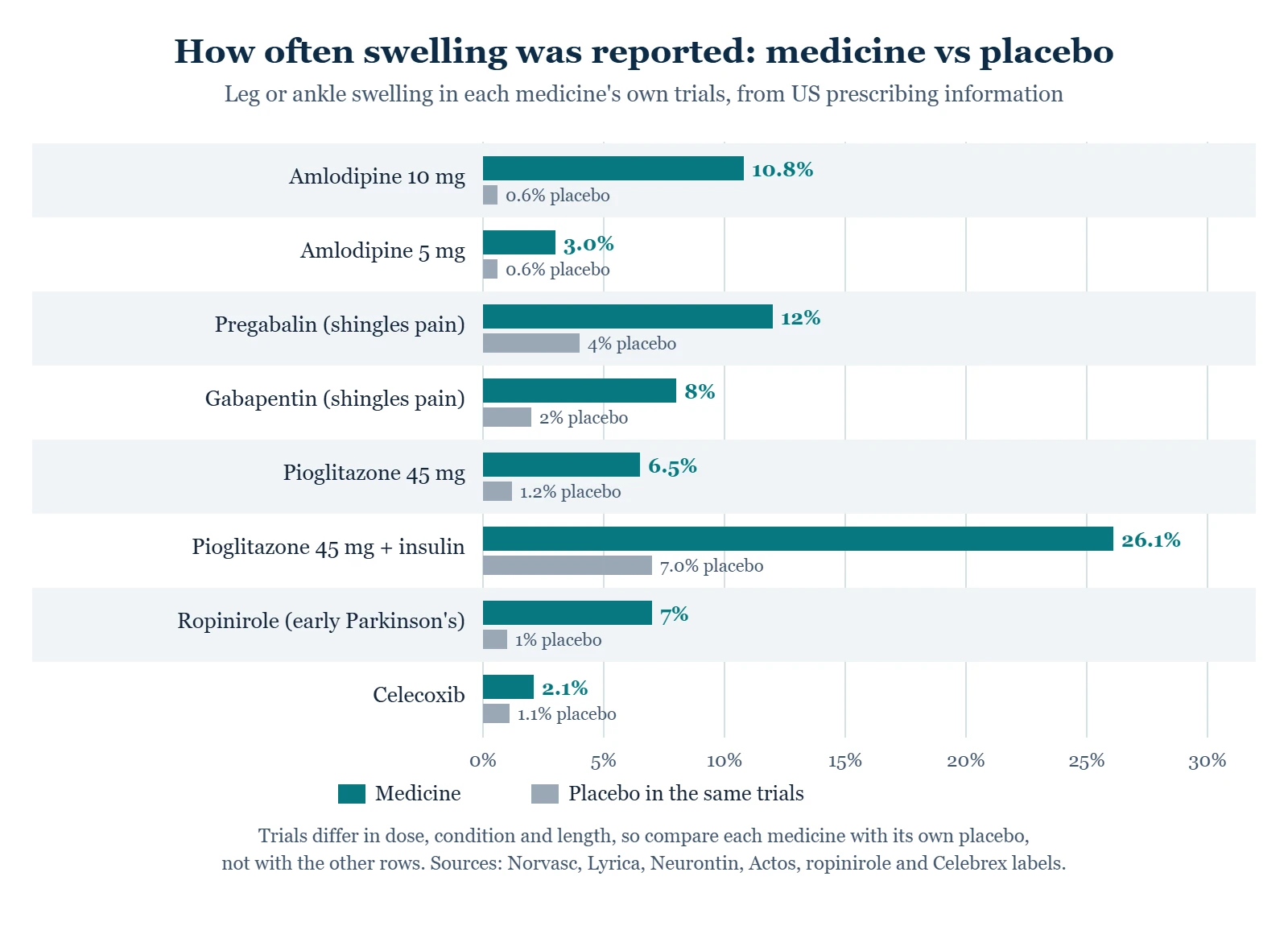
| Amlodipine, nifedipine and similar calcium channel blockers | Amlodipine: 1.8% at 2.5 mg, 3.0% at 5 mg and 10.8% at 10 mg, against 0.6% on placebo. Nifedipine extended-release: about 10%, rising to about 30% at the highest dose | The most common culprit. Dose-related, and far more common in women: 14.6% against 5.6% in men on amlodipine |
| Verapamil and diltiazem | Swelling in 3.1% against 12.3% for the amlodipine-type drugs, in a pooled analysis of 106 trials | Same broad class, much less swelling — one of the switches a prescriber may consider |
| Pregabalin and gabapentin | Pregabalin: 6% against 2% on placebo overall, 12% against 4% in shingles pain. Gabapentin: 8% against 2% in shingles pain | Prescribed for nerve pain, so common in people already being seen for their feet. Swelling with pregabalin reached 19% when combined with a glitazone |
| Pioglitazone and rosiglitazone (glitazones) | Pioglitazone: 2.5% to 6.5% by dose against 1.2% on placebo, and up to 26.1% with insulin | Boxed warning: can cause or worsen heart failure. Report rapid weight gain or breathlessness. Reversible when stopped |
| Anti-inflammatories (ibuprofen, naproxen, celecoxib) | Celecoxib: 2.1% against 1.1% on placebo; overall, roughly double the rate of swelling | Salt retention. Labels cite about a two-fold rise in heart-failure hospital admissions, and they can blunt blood pressure medicines and diuretics. Often bought without a prescription |
| Corticosteroids such as prednisone | Listed in the label as sodium retention with swelling | Salt restriction may be advised; can tip susceptible people into heart failure |
| Estrogens (hormone therapy and combined contraception) | Labels warn of some fluid retention, although in one hormone-therapy trial swelling was 1% to 2%, the same as placebo | Estrogen also raises clot risk, so one swollen leg is a clot question first |
| Oral minoxidil and hydralazine | Oral minoxidil for blood pressure: temporary swelling in 7% in trials; about 2% at low hair-loss doses | The opposite mechanism to amlodipine: true salt and water retention |
| Pramipexole and ropinirole | Ropinirole: leg swelling in 7% against 1% in early Parkinson’s disease. Pramipexole: 5% against 4% | Also prescribed for restless legs |
| Others in family-medicine references | Beta blockers, clonidine, some chemotherapy drugs, antipsychotics, MAOIs, trazodone, testosterone, progesterone, tamoxifen, aromatase inhibitors and proton pump inhibitors | Less common, but worth having on the list you bring |
This is not a complete list, and being on one of these does not mean it is the cause. What it does mean is that the possibility deserves to be on the table before anyone concludes the swelling is “just circulation”.
The timeline is the diagnostic test
Medicine-related swelling usually appears weeks to months after a medicine is started or its dose is raised, and rarely in the first few days. With calcium channel blockers it can keep building for months: in a pooled analysis of 106 trials, about a quarter of people on them had swelling by six months. Once the culprit is stopped, the swelling often clears within days to two weeks.
So write down when the swelling started, as precisely as you can, and bring a full medicine list with doses and when each was started or changed — including anything bought over the counter. A medicine started six weeks before the swelling appeared is a strong lead. A medicine you have taken unchanged for nine years is a weak one. Nobody can make that comparison without both timelines, and it is the single most useful thing you can bring. Preparing for the appointment →
What the prescriber can do
- Confirm the timing fits, and rule out the causes that need excluding first — heart, kidney, liver, and a clot if it is one-sided. The whole-body causes →
- Reduce the dose, where the effect is dose-related. In amlodipine’s label data, swelling fell from 10.8% at 10 mg to 3.0% at 5 mg.
- Switch to a medicine that treats the same problem without the same effect. For blood pressure this is often straightforward, including moving to verapamil or diltiazem, or to another class altogether.
- Add something that counteracts it. Adding an ACE inhibitor or an angiotensin receptor blocker to a calcium channel blocker cut swelling by 38% across 25 trials with more than 17,000 patients, because these drugs relax the veins as well.
- Decide it is worth tolerating, if the medicine is doing something important and nothing else suits. That is a legitimate answer, arrived at deliberately.
What does not usually work
Water pills for calcium-channel-blocker swelling are usually ineffective, because the problem is fluid pushed into the tissue while the circulating volume is normal. Reaching for one anyway is common enough to have a name, a “prescribing cascade”: older adults starting amlodipine or nifedipine are about twice as likely to be prescribed a diuretic, and people starting gabapentin or pregabalin are more likely to be given a loop diuretic. The exception is oral minoxidil, where the diuretic is part of the treatment from the start.
Compression may improve the appearance and the heaviness, and it does nothing about the cause. It also needs an arterial assessment first. Why →
From the clinic
Some of the swollen ankles I can help fastest turn out to be on the prescription list. I ask when the swelling began and then read down the medicines looking for anything started or increased in the months before: amlodipine at the higher dose, gabapentin or pregabalin for nerve pain, an anti-inflammatory taken every day for a sore knee. Take that list back to whoever prescribed it. A dose change or a swap often settles the swelling within a couple of weeks, without adding a water pill.
Common questions
How quickly does swelling settle after stopping the medicine?
Often within days to two weeks, though it varies by medicine and by how long the swelling has been there. If it does not settle at all, that is useful information too — it suggests something else is contributing.
My blood pressure medicine causes it but my blood pressure is well controlled. What now?
That is a common and solvable situation. A lower dose, a switch to verapamil, diltiazem or another class, or adding an ACE inhibitor or angiotensin receptor blocker can each keep the control while reducing the swelling. Worth asking about directly rather than assuming the trade-off is fixed.
Will a water pill fix it?
Usually not, if the swelling comes from a calcium channel blocker: the fluid is being pushed into the tissue rather than retained by the body, and diuretics are usually ineffective for it. A diuretic does have a place when a medicine like oral minoxidil causes true salt and water retention, or when heart, kidney or liver disease is part of the picture.
Can gabapentin or pregabalin cause swollen feet?
Yes. In the prescribing information, gabapentin caused leg and foot swelling in 8% of people with shingles pain against 2% on placebo, and pregabalin in 6% against 2% overall. Mention it to your prescriber rather than stopping it yourself, because both need to be reduced gradually.
Could an over-the-counter medicine be doing it?
Yes — anti-inflammatories such as ibuprofen and naproxen are a frequent contributor, and people often do not think to mention them. They make the body hold on to salt and can also blunt blood pressure medicines. Include everything you take, including supplements, on the list you bring.
Is drug-induced swelling harmful?
The swelling itself is usually more uncomfortable than dangerous. What matters is that it is not mistaken for something else, and that skin under chronically swollen tissue is more fragile and more prone to breaking down. The exception is the glitazone diabetes medicines, where new swelling with rapid weight gain or breathlessness can be a sign of heart failure and needs prompt attention.
Where to go next
- Thick ankles: build, medicine-related swelling or lipedema?
- Red dots on the legs: medicines, platelets and bleeding
- Both legs swollen: the other causes
- Swelling from the heart, kidneys, liver or thyroid
- The full swelling guide
- Preparing for the appointment
- How to reduce swelling in the feet, ankles and legs
Sources
- Norvasc (amlodipine) prescribing information, DailyMed.
- Procardia XL (nifedipine extended-release) prescribing information, FDA.
- Makani H, et al. Peripheral edema associated with calcium channel blockers: incidence and withdrawal rate. J Hypertens 2011.
- Makani H, et al. Effect of renin-angiotensin system blockade on calcium channel blocker-associated peripheral edema. Am J Med 2011.
- Sica DA. Calcium channel blocker-related peripheral edema: can it be resolved? J Clin Hypertens 2003.
- Weir MR. Incidence of pedal edema formation with dihydropyridine calcium channel blockers. J Clin Hypertens 2003.
- NHS Specialist Pharmacy Service. Managing peripheral oedema caused by calcium channel blockers.
- Lyrica (pregabalin) prescribing information, FDA.
- Neurontin (gabapentin) prescribing information, FDA.
- Actos (pioglitazone) prescribing information, DailyMed.
- Celebrex (celecoxib) prescribing information, DailyMed.
- Prednisone tablets prescribing information, DailyMed.
- Premarin (conjugated estrogens) prescribing information, DailyMed.
- Minoxidil tablets prescribing information, DailyMed.
- Jimenez-Cauhe J, et al. Safety of low-dose oral minoxidil for hair loss. Dermatol Ther 2020.
- Ropinirole prescribing information, FDALabel.
- Mirapex (pramipexole) prescribing information, FDA.
- Therapeutics Initiative. Therapeutics Letter 162: Drug-induced peripheral edema: a common, overlooked, reversible harm (2026).
- StatPearls. Peripheral Edema.
- Patel AR, et al. Peripheral edema: evaluation and management in primary care. Am Fam Physician 2022.
- MedlinePlus, National Library of Medicine. Foot, leg, and ankle swelling.
Specific medicine effects should be checked against the current prescribing information for the product you take, and with your prescriber or pharmacist.
Written by Tom Biernacki, DPM, FACFAS. Published 21 September 2026. Updated 16 October 2026. General education, not medical advice. Never change or stop a prescribed medicine without speaking to the prescriber.