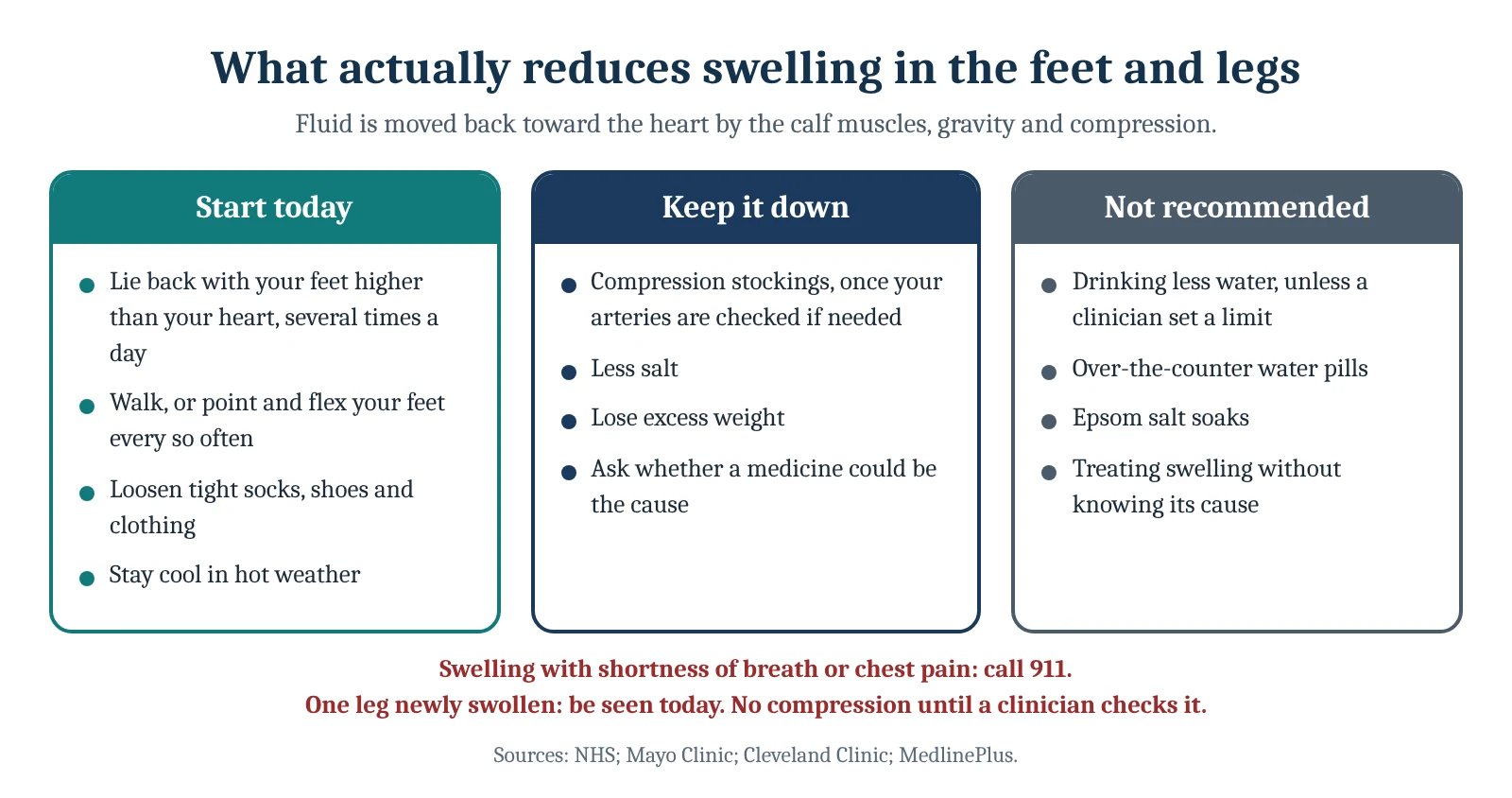
How to reduce swelling in feet and ankles depends on the cause, but the measures that actually move fluid are much the same for most people. Lie down with your feet above heart level several times a day, keep your calf muscles working, and wear compression once someone has confirmed it is safe for your legs. Less salt and a medicine review help some people; a few patterns, starting with one newly swollen leg, need a doctor today rather than home remedies.
First, make sure it is not urgent
- Call 911 if swelling comes with shortness of breath, chest pain or tightness, coughing up blood, a racing heart, or feeling faint or confused. These can be signs of a blood clot in the lungs.
- Be seen today if one leg, ankle or foot has newly swollen and the other has not, particularly with pain, warmth or a change in skin color. A clot is one of the possibilities. Do not massage the leg or start compression until a clinician has checked it.
- Be seen today if the swollen skin is red and hot or the redness is spreading, or you have a high temperature or feel hot and shivery.
- Get medical care right away if you are pregnant or had a baby in the past year and swelling comes with a headache that will not go away, changes in your vision, or extreme swelling of your hands or face.
Outside the United States, use your local emergency number. Full care thresholds →
How to reduce swelling in feet and ankles today
For the common kind of swelling (both feet and ankles, worse by the end of the day), these are the measures the major patient guides agree on. None of them cures the cause, and raising your legs is the wrong advice for a few people, covered in the box below.
- Lie down and raise your feet above your heart. Rest your calves on pillows so your ankles sit clearly higher than your chest, several times a day. Gravity then helps fluid drain out of the lower legs instead of pooling there. Feet on a footstool while you sit are barely raised at all. How to set it up, and for how long.
- Keep your calf muscles working. Walk when you can. When you have to sit, point and flex your feet and circle your ankles every so often. Working leg muscles help push fluid back toward the heart, which is why long spells of standing still make swelling worse.
- Break up long spells of sitting or standing. Cleveland Clinic’s advice is not to sit or stand for long periods without going for a short walk. On a long drive or flight, stop or get up and move around often.
- Loosen anything tight. Sock tops that dig in, tight shoes and tight clothing around the thighs all get in the way. Wide, comfortable shoes with a low heel and a soft sole are easier on swollen feet.
- Get out of the heat. Mild swelling of the lower legs is common in warm weather, especially after a lot of standing or walking. Cooling down and putting your feet up often helps. Why feet swell in hot weather.
- Look after the skin. Swollen skin is more easily damaged and infected. Wash, dry and moisturize your feet, and wear socks or shoes rather than going barefoot.
When raising your legs is the wrong advice
If lying down with your legs raised makes you short of breath, stop and see a doctor instead; breathlessness that comes with swelling needs assessing, not more pillows. And if raising your legs makes foot pain worse, or the pain eases when you hang your foot over the edge of the bed, that pattern can mean advanced artery disease: Cleveland Clinic and StatPearls both describe rest pain that is worse with the leg raised and eased by letting the foot hang down. Stop raising it and get it checked the same day or the next.
Compression: often the biggest help, once it is safe
Compression socks and stockings keep steady pressure on the leg so fluid does not build up again. Mayo Clinic notes they are usually worn after the swelling has gone down, to stop it returning. A 2022 review for family physicians calls compression helpful for most causes of lower-leg swelling.
The catch is the arteries. The same review says compression is contraindicated in peripheral artery disease (PAD) and that people at risk should have an ankle-brachial index (ABI) first. On this site the rule is simple: if you have diabetes, leg pain when walking or other PAD symptoms, numb feet, a wound on the leg or foot, kidney disease or heart failure, have your arterial circulation checked before you start. Cleveland Clinic’s advice is to ask your clinician before using them at all. Who needs a check first, and why.
Strength, length and how many hours a day to wear them depend on the cause: what compression socks do, and how long to wear them.
Draining edema fluid: what actually moves it
A great many people search for how to drain edema fluid, so it is worth being plain: you cannot drain it out of your leg at home. Edema is a buildup of fluid in the tissues themselves, not in a pocket that can be emptied. It has to be moved back toward the heart, and four things do that:
- Your calf muscles. Walking and ankle exercises push fluid back toward the heart.
- Gravity. Raising the legs above the heart lets fluid drain from them.
- Outside pressure. Compression stops fluid building up again once it has gone down.
- A specialist program, for lymphedema. When the lymph system is the problem, a therapist combines compression, a hands-on technique called manual lymphatic drainage, exercise and skin care. What lymphatic drainage can and cannot do.
Mayo Clinic also suggests stroking the swollen area toward the heart with firm but not painful pressure, which it says might help. Do not do it on a leg that might have a clot or an infection, such as one that has newly swollen or has red, hot skin: Cleveland Clinic lists blood clots, deep vein thrombosis, cellulitis and infection among the reasons to avoid lymphatic massage.
Water pills (diuretics) help the body get rid of extra fluid through urine, and they work for the right cause. The 2022 family-physician review says they are part of treatment when the whole body is holding too much fluid, as in heart failure, liver cirrhosis or a kidney condition called nephrotic syndrome, and that no evidence supports them for swelling with other causes. Whether you need one is a prescription decision that follows a diagnosis.
Check your medicines
The NHS lists certain medicines among the common causes of swollen feet and ankles. Between them, Mayo Clinic and MedlinePlus name blood pressure medicines (MedlinePlus specifies calcium channel blockers), anti-inflammatory painkillers (NSAIDs), steroids, estrogen and testosterone, a group of diabetes medicines called thiazolidinediones, some nerve-pain medicines and some antidepressants.
If the swelling started after a new medicine or a dose change, tell the prescriber. They can lower the dose or switch to another medicine, and for swelling from a calcium channel blocker, adding an ACE inhibitor or angiotensin receptor blocker (other kinds of blood pressure medicine) may reduce it. Do not stop anything on your own. Medicines that can cause swelling.
Salt, fluids and weight
Salt can increase fluid buildup and make edema worse, so cutting down is sensible for anyone whose feet swell, and it is part of the treatment for heart failure. Who it helps most, and where the salt actually is: food, salt and swelling.
Water is different. Some people with heart failure are asked by their care team to limit how much they drink, and if that is you, follow it. Otherwise, drinking less is not a remedy: none of the patient guides we checked suggest it, and in hot weather the CDC’s advice runs the other way, toward staying well hydrated.
Weight matters too. Cleveland Clinic and MedlinePlus both list losing excess weight, and in people with vein disease, weight loss after weight-loss surgery has been shown to reduce swelling and leg ulcers.
Edema treatment by cause: what helps and who to see
Treating swelling without knowing its cause is how people end up raising their legs for months while the real problem carries on. The cause decides what works.
| Cause | What helps | Who to see |
|---|---|---|
| Long sitting or standing, travel, hot weather | Movement, breaks, raising the legs, cooling down | No one, unless it has not improved after a few days or keeps getting worse |
| Vein problems (chronic venous insufficiency, varicose veins) | Walking, raising the legs, compression after an arterial check; vein treatment for some | Primary care, then a vein or vascular specialist |
| A medicine | A lower dose, a switch or an added medicine, decided by the prescriber; water pills have little effect on swelling from a calcium channel blocker | The prescriber |
| Heart failure | Prescribed diuretics, less salt, sometimes a fluid limit, and weight checks as your team advises | Primary care or cardiology |
| Kidney or liver disease | Treatment of the condition, less salt, diuretics if prescribed | Primary care, then a kidney or liver specialist |
| Lymphedema | Decongestive therapy: compression, manual lymphatic drainage, exercise and skin care. Diuretics have no role | A certified lymphedema therapist |
| Pregnancy | Less time on your feet, legs up, lying on your left side; knowing the warning signs. Swelling in pregnancy | Your midwife or obstetrician |
| A minor injury | Cold packs or ice, and raising the leg | Urgent care if the swelling is large or getting worse |
| A clot, or infection | Not home care | Today |
More than one cause can be at work at once, so finding one does not rule out the others.
What does not work, or is not proven
| Remedy | What we found |
|---|---|
| Epsom salt foot soaks | Not in any of the clinical guidance we checked, and we know of no good evidence that they reduce swelling. A soak may feel pleasant; raising your feet is what the guidance actually recommends |
| Over-the-counter water pills | Not recommended in any of the guidance we checked; see below |
| Someone else’s prescribed water pills | Unsafe. Diuretics can cause dehydration and upset the body’s salt balance, leading to fainting and falls |
| Herbal “natural diuretic” teas and supplements | None of the clinical guidance we checked recommends herbal teas or supplements sold as water pills. The family-physician reviews mention horse chestnut seed extract and ruscus extract only as options for vein disease |
| Drinking less water | Not a remedy, unless a clinician has set a fluid limit, as for some people with heart failure |
The honest answer about water pills
People ask which over-the-counter water pill is best for swollen feet. None is recommended, because a water pill is the wrong tool for most swollen feet. Where swelling comes from the veins, standing, heat or the lymph system, there is no evidence diuretics help, they have little effect on swelling from calcium channel blockers, and they bring real risks: dehydration, disturbed blood salts, fainting and falls. Where swelling does come from fluid overload, the cause is usually heart, kidney or liver disease, which needs to be found and treated, not masked with a pill from the pharmacy shelf.
How long should swelling take to go down?
Mild swelling often goes away on its own, and the useful question is whether yours is improving. If both feet are swollen and a few days of the measures above have not helped, or the swelling is getting worse, book an appointment.
Beyond that, the timeline follows the cause. Swelling caused by a medicine usually needs the medicine adjusted before it settles. Swelling from heart, kidney or liver disease improves as that condition is treated. Vein disease and lymphedema need ongoing care, so the aim is control, kept up with daily compression, rather than a one-off fix.
When to see a doctor about swollen feet
- Book a routine appointment if both feet or ankles are swollen and not improving after a few days of home care, if the swelling keeps slowly getting worse, or if you have been diagnosed with a heart, kidney or leg-vein condition.
- Be seen the same day or the next if the swelling is severe, painful or came on suddenly, if there is a lot of swelling after an injury, if the swelling also affects your face or abdomen, if you have heart or kidney disease and the swelling is worsening, or if you have diabetes and your feet have swollen.
- Contact your clinician right away if you are pregnant and the swelling is more than mild or has suddenly increased.
- Today, or 911, for anything in the box at the top of this page.
For which patterns are actually dangerous, and why: when leg swelling is dangerous.
Common questions
What is the fastest way to reduce swelling in feet?
Lie down with your feet raised above heart level and move your ankles while you are there. For ordinary swelling from standing, sitting or heat, that is the first thing to try. Compression then keeps the swelling from coming back, if your arteries have been checked where needed. Nothing makes swelling from a clot, an infection or heart failure go down fast at home; those need a doctor.
How do you drain fluid from swollen legs?
Not at home. Edema fluid sits in the tissue, and it is moved rather than drained: by walking and ankle exercises, by raising the legs above the heart, and by compression. Lymphedema needs a therapist-led program. Diuretics help the body pass extra fluid in urine, but they belong to causes where the whole body is overloaded, such as heart failure, and need a prescription.
What is the best home remedy for swollen feet and ankles?
The free ones: feet up above heart level several times a day, regular walking, not standing or sitting still for long, loose shoes and socks, and less salt. Compression is often the most effective addition once it is known to be safe for your legs. If a few days of this has not helped, the swelling needs a cause found, not a stronger remedy.
Does Epsom salt help swollen feet?
None of the major patient guides we checked recommend it, and we know of no good evidence that it reduces swelling. A soak may feel soothing, but it is not a treatment. Lying down with your feet raised is the measure the guidance actually recommends.
What is the best over-the-counter water pill for swollen feet?
None is recommended. A 2022 review for family physicians found no evidence for diuretics in swelling that does not come from whole-body fluid overload, and they can cause dehydration, salt imbalances and falls. When swelling does come from fluid overload, the cause is usually heart, kidney or liver disease, which needs diagnosing and a prescription, not a product off the shelf.
Should I drink less water if my feet are swollen?
No, unless a clinician has given you a fluid limit, as some people with heart failure are given. Drinking less is not a recognized treatment for swelling, and in hot weather the advice is to stay well hydrated. Cutting salt is the dietary change that matters.
When should I worry about swollen feet?
When one leg swells and the other does not, when swelling comes with breathlessness or chest pain, when the skin is red, hot or spreading, when you are pregnant with a headache that will not go away or vision changes, or when swelling is not improving after a few days of home care. The first four need care today or a 911 call; the last needs a routine appointment.
Where to go next
- Why are my legs swollen? Causes and patterns
- Both ankles swollen: common causes
- One swollen leg: why it needs attention today
- Swelling from the heart, kidneys, liver or thyroid
- Lymphedema treatment: what actually works
- Compression socks for swelling: how to choose
- Near Howell or Bloomfield Township, Michigan: a foot and ankle evaluation (the author’s own practice)
Sources
- NHS. Swollen ankles, feet and legs (oedema).
- Mayo Clinic. Edema — Symptoms and causes, and Diagnosis and treatment.
- Cleveland Clinic. Edema, Chronic Venous Insufficiency (CVI), Chronic Limb-Threatening Ischemia, and Lymphatic Drainage Massage.
- MedlinePlus, National Library of Medicine. Foot, leg, and ankle swelling, and Swelling.
- American Academy of Family Physicians. Peripheral Edema: Evaluation and Management in Primary Care (American Family Physician, 2022), and Edema: Diagnosis and Management (2013).
- National Heart, Lung, and Blood Institute. Heart Failure — Treatment, and Living With Heart Failure.
- American Academy of Family Physicians. Heat-Related Illnesses (American Family Physician, 2019).
- Centers for Disease Control and Prevention. Urgent Maternal Warning Signs and Symptoms.
- Centers for Disease Control and Prevention. About Heat and Your Health, and Heat and Medications – Guidance for Clinicians.
- StatPearls, NCBI Bookshelf. Peripheral Arterial Disease.
- NHS Specialist Pharmacy Service. Managing peripheral oedema caused by calcium channel blockers.
Written by Tom Biernacki, DPM, FACFAS. Published 18 October 2026. General education, not medical advice.