Can edema kill you? Swelling in the feet and legs is rarely dangerous in itself, and most of it has an ordinary cause: long hours sitting or standing, salt, pregnancy, a medicine or leaky leg veins. The danger lies in the few serious causes, chiefly a clot that can travel to the lungs, heart failure, infection, kidney or liver disease and preeclampsia, and what comes with the swelling says far more than its size.
When swollen legs need help now
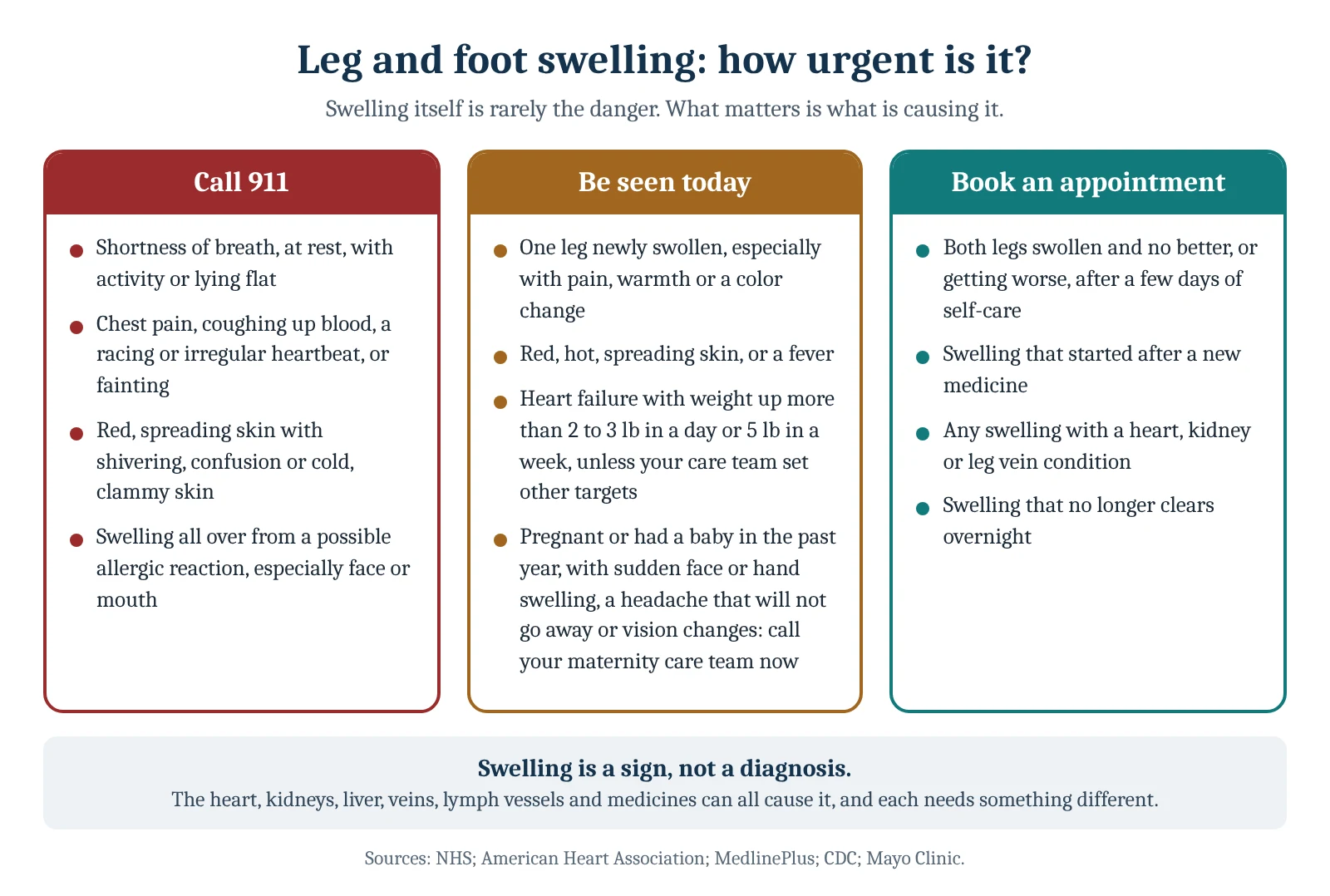
Call 911 if swelling comes with:
- Shortness of breath, at rest, with activity or when lying flat, or waking at night unable to catch your breath
- Chest pain, coughing up blood, a racing or irregular heartbeat, or fainting
- Red, spreading skin with shivering, confusion, dizziness, fast breathing, or cold, clammy skin
- Swelling throughout the body from a possible allergic reaction, especially around the face or mouth
Be seen today, somewhere that can arrange an ultrasound, if one leg has newly swollen and the other has not, especially over hours to days or with pain, warmth or a color change. Also today for swelling with fever or spreading redness, swelling that came on suddenly for no clear reason or after an injury, swelling that is severe or painful, swelling that has spread to the face or abdomen, new swelling if you have diabetes, and worsening swelling if you have heart or kidney disease.
Pregnant, or had a baby in the past year? Call your maternity care team now, or go to an emergency department if you cannot reach them, for sudden swelling of the face or hands, a headache that will not go away, vision changes, pain under the ribs, or, in pregnancy and up to 6 weeks after the birth, a swollen, red or painful leg. Care thresholds →
Can edema kill you? The honest answer
Edema is fluid trapped in the body’s tissues. What can be dangerous is the condition that put it there, and swelling can be one of its visible signs.
Most swelling has an everyday cause. The NHS lists standing or sitting still for too long, salty food, extra weight, pregnancy, some medicines, varicose veins and thyroid problems as the common ones, and notes that swollen ankles, feet and legs often settle on their own. The life-threatening causes are fewer:
- A clot in a leg vein. The risk is to the lungs rather than the leg: a piece can break off and travel there as a pulmonary embolism, which the National Heart, Lung, and Blood Institute (NHLBI) says can cause death when the clot is large or there are many. About half of people with a deep vein clot have no symptoms at all. More on DVT.
- Heart failure. Swollen feet, ankles and legs are among its warning signs, and the NHLBI notes it can lead to life-threatening complications, including fluid building up in or around the lungs.
- Infection. Swollen skin is stretched thin, which lets bacteria in more easily. Untreated cellulitis can spread to the bloodstream and cause sepsis.
- Kidney and liver disease. Nephrotic syndrome, in which damaged kidneys leak protein, causes swelling and can lead to blood clots, infections and kidney failure. In cirrhosis, swelling of the lower legs and abdomen tends to appear as the liver worsens.
- Preeclampsia. A blood pressure disorder of pregnancy and the weeks after birth, in which sudden swelling, especially of the face and hands, can be one sign among several.
When “edema” means the lungs
The most directly dangerous edema is not in the legs. Pulmonary edema is fluid in the lungs: StatPearls calls it the only life-threatening form of generalized edema, and Mayo Clinic says that when it comes on suddenly it is a medical emergency, and that it can sometimes cause death. Heart failure is its most common cause, which is why swollen legs with breathlessness are never a wait-and-see problem.
The patterns that change the urgency
How fast it came on, whether one leg or both, and what comes with it sort the harmless from the serious. Pitting, the dent a pressing thumb leaves, is a separate question: what pitting does and does not tell you.
One leg, or both
Both ankles swelling through the day and easing overnight usually has an everyday cause: long hours upright, a medicine, pregnancy, or leaky leg veins, which StatPearls names as the most common cause of swelling in the limbs in people aged 50 or older. One leg swelling while the other stays normal is different. A clot is one possibility, it takes an examination and usually an ultrasound to sort out, and Mayo Clinic advises getting care right away. Why one swollen leg needs attention today.
Sudden, or slowly over months
Swelling that starts suddenly for no clear reason needs to be seen today: Mayo Clinic advises getting care right away, and the NHS lists swelling that starts very suddenly among the reasons to ask for an urgent GP appointment or call 111. StatPearls notes that limb swelling within 72 hours is more often linked to conditions such as a clot. Swelling that crept up over months is usually worked out at a routine appointment, unless it comes with the signs below.
With breathlessness, or trouble lying flat
Shortness of breath with swollen legs is a 911 call. The NHS and MedlinePlus both say to call emergency services for swelling with shortness of breath, and Mayo Clinic lists breathlessness with activity or when lying flat among the signs that need emergency help, because they can point to a clot in the lungs or a serious heart condition. With swollen legs, breathlessness can also mean fluid is building up because the heart is not keeping pace.
With rapid weight gain
The American Heart Association (AHA) says many people first realize their heart failure is getting worse when they notice a gain of more than 2 to 3 pounds in a day, or 5 pounds in a week. It advises knowing how much gain your own clinician considers a problem, which replaces these figures if your care team has set other targets, and contacting them right away about any sudden change. Without known heart disease, sudden weight gain can be a sign that heart failure is developing.
With fever, redness or heat
Skin that is red, hot, painful and spreading is how cellulitis behaves, and it needs treatment today, with or without a fever. Call 911 if it comes with shivering, confusion, dizziness, fast breathing, or cold, clammy skin.
In pregnancy and the year after birth
Some swelling of the feet and ankles is normal in healthy pregnancy. Warning signs include sudden swelling of the face, hands or feet, a headache that will not go away, vision changes, pain under the ribs, and breathlessness. Preeclampsia usually begins after 20 weeks, and it can also appear after birth: Mayo Clinic says most cases develop within 48 hours of delivery, and some up to six weeks later or beyond. The risk of a clot is raised in pregnancy and after the birth: the CDC counts the 3 months after delivery, and ACOG lists the 4 to 6 weeks after giving birth. Swelling in pregnancy · Swelling after birth.
After surgery, an injury, time in bed or a long journey
The risk of a clot is highest after major surgery or a major injury, and lack of movement, in bed or on a journey of more than four hours, raises it. New swelling in one leg after any of these needs to be seen today; breathlessness or chest pain is a 911 call.
When to worry about swollen feet: how fast to act
| How soon | Swelling together with | Why it matters |
|---|---|---|
| Call 911 | Shortness of breath, at rest, with activity or lying flat, or waking unable to breathe; chest pain; coughing blood; a racing or irregular heartbeat; fainting. Red, spreading skin with shivering, confusion, dizziness, fast breathing or cold, clammy skin. Swelling throughout the body from a possible allergic reaction, especially around the face or mouth | A clot in the lungs, fluid in the lungs, sepsis, or a severe allergic reaction |
| Be seen today | One leg newly swollen; sudden swelling with no clear reason or after an injury; severe or painful swelling; fever, or red, hot, spreading skin; swelling spreading to the face or abdomen; new swelling with diabetes; worsening swelling with heart or kidney disease, or weight gain past the AHA figures with heart failure; a break in the skin of the foot with diabetes or artery disease; the pregnancy and after-birth warning signs | A clot in the leg, infection, worsening heart failure, or preeclampsia |
| Same day or the next day | Skin that is weeping or leaking fluid; a sore or break in the skin of a swollen leg that has not closed or is getting bigger, wetter or more painful | Skin breakdown and infection |
| Book an appointment | Both legs swollen and no better, or getting worse, after a few days of self-care; swelling that no longer clears overnight; swelling that started after a new medicine; any swelling with a heart, kidney or leg vein condition | Veins, medicines, or a heart, kidney, liver or thyroid cause that needs tests |
| Mention at your next routine visit | Mild ankle swelling that has been looked into, settles overnight and has not changed | A known, stable cause. Anything new moves it up this table |
What swollen ankles can be a sign of, from harmless to serious
| Cause | Typical clues | How serious |
|---|---|---|
| Long hours sitting or standing, salt, extra weight | Both ankles, worse by evening, better by morning | Usually harmless, and worth addressing |
| Pregnancy | Feet and ankles, building through pregnancy | Usually normal; sudden swelling of the face or hands is not |
| Medicines | Began after starting some blood pressure medicines, anti-inflammatories, steroids, estrogens, or some diabetes or nerve-pain medicines | Raise it with the prescriber; do not stop a medicine without advice |
| Leaky leg veins | Worse by evening; varicose veins; dry, discolored skin around the ankles over time | Not urgent, but damages skin over years |
| Lymphedema | Can include the foot and toes; early swelling may ease overnight, but untreated it becomes persistent | Not an emergency; raises infection risk |
| Cellulitis | Red, hot, painful, spreading; fever or feeling unwell | Today; 911 with shivering, confusion or cold, clammy skin |
| Deep vein thrombosis | One leg, over hours to days; pain, warmth, color change, or nothing else at all | Today; 911 with breathlessness or chest pain |
| Heart failure | Both legs; breathless with activity or lying flat; weight gain; tiredness | Serious; 911 with breathlessness, otherwise today if new or worsening |
| Kidney disease (nephrotic syndrome) | Puffy eyelids, foamy urine, swelling of the legs and lower abdomen | Serious; needs prompt tests |
| Liver disease | A swollen abdomen as well as the legs | Serious; needs prompt tests |
| Preeclampsia | After 20 weeks of pregnancy or after birth; sudden face or hand swelling, headache, vision changes | Urgent; call your maternity care team now |
The heart, kidney, liver and thyroid causes, and the tests that check them, are covered in when swelling comes from the heart, kidneys, liver or thyroid.
What long-standing swelling does to the legs
Mild swelling that never quite goes away is not an emergency, but over months and years it can bring:
- Pain and stiffness. Swelling that becomes increasingly painful, stiffness and difficulty walking.
- Itchy, fragile skin. Stretched skin can itch, and with leaky veins the skin around the ankles can become dry, discolored and eventually hard.
- Infection. Swollen areas carry a higher infection risk, and cellulitis is the most common complication of lymphedema.
- Ulcers. Mayo Clinic lists a greater risk of skin ulcers among the complications of untreated edema.
- Leaking skin. Severe swelling can push fluid out through the skin or raise blisters. Weeping legs: what to do.
That is the case for getting persistent swelling explained, even when nothing about it is urgent.
What a doctor checks
- The story. When it started, one leg or both, what makes it better or worse, past clots or varicose veins, and every medicine you take.
- An examination of the heart, lungs, abdomen, lymph nodes, legs and feet.
- Blood tests: a blood count and blood chemistry, kidney and liver function, albumin (a blood protein), and BNP, a marker of heart strain, if heart failure is possible.
- A urine test, looking for protein leaking through the kidneys.
- An ECG and chest X-ray, and an echocardiogram if the heart is in question.
- A Doppler ultrasound of the leg veins if a clot is possible.
- An arterial check, usually an ankle-brachial index, before any compression.
Treatment follows the cause. Diuretics, for example, are the usual treatment for swelling from heart, liver or kidney disease, and do little for swelling from sitting with the legs down.
While you wait to be seen
- Raise your legs above heart level when you lie down, if comfortable. Not if lying flat makes you breathless: sit up and call 911. And stop if it makes toe or forefoot pain worse; in advanced artery disease that pain comes on with the legs raised and eases when the foot hangs down. Elevation, done safely.
- Keep moving. Gentle walking helps; standing or sitting still for long spells makes swelling worse.
- Loosen anything tight: socks, shoes and clothing.
- Do not start compression socks on your own. The arterial circulation should be checked first, usually with an ankle-brachial index, in anyone with diabetes, symptoms of artery disease, numbness, a wound, kidney disease or heart failure, because compression is unsafe on a leg with poor arterial supply. Who needs the check.
- Do not stop a prescribed medicine you suspect, and do not start water pills on your own: MedlinePlus notes that a provider may prescribe diuretics and that they can have side effects.
- Leave a swollen calf alone if a clot is possible. Cleveland Clinic says to avoid lymphatic drainage massage if you have a blood clot or DVT.
Day-to-day measures, once anything urgent is ruled out: how to reduce swelling.
Common questions
Can edema kill you if it is not treated?
The swelling itself rarely does, though left alone it can lead to painful, stiff legs, skin damage, infection and ulcers. What can be fatal is an untreated cause, such as a clot that travels to the lungs, fluid building up in the lungs from heart failure, or a skin infection that spreads to the bloodstream. Untreated kidney and liver disease can also lead to serious complications.
Are swollen feet dangerous?
Usually not. Both feet swelling by evening and settling by morning is most often down to time on your feet, salt, pregnancy, a medicine or leaky veins. Swollen feet become a concern when only one leg is affected, when the swelling came on suddenly, or when it comes with breathlessness, chest pain, fever, red and hot skin, or rapid weight gain.
When should I go to the ER for swollen feet?
Call 911 for swelling with shortness of breath, including with activity or lying flat, chest pain, coughing blood, a racing heart or fainting; for red, spreading skin with shivering, confusion or cold, clammy skin; and for swelling throughout the body from a possible allergic reaction, especially around the face or mouth. A newly swollen single leg needs to be seen today, and an emergency department is reasonable if it is the place that can arrange an ultrasound today.
What is swollen ankles a sign of?
Most often of time upright, salt, extra weight, pregnancy, a medicine, leaky leg veins or a thyroid problem. Less often of heart, kidney or liver problems, a clot or an infection. One leg or both, how fast, and companions such as breathlessness, weight gain, fever, foamy urine or a swollen abdomen separate them.
Are swollen feet a sign of heart failure?
They can be, and the companions matter more than the swelling: breathlessness with activity or lying flat, waking at night short of breath, tiredness, and weight gain over days. The AHA flags a gain of more than 2 to 3 pounds in a day, or 5 pounds in a week, as a common sign of worsening heart failure, unless your own care team has given you other targets. Breathlessness with swollen legs is a 911 call. Without those companions, an everyday cause is more likely.
Where to go next
- One swollen leg: why it needs attention today
- When swelling comes from the heart, kidneys, liver or thyroid
- DVT: symptoms and why timing matters
- How to reduce swelling in feet, ankles and legs
- Weeping legs: why swollen legs leak fluid
- Near Howell or Bloomfield Township, Michigan: a foot and ankle evaluation (the author’s own practice)
Sources
- NHS. Swollen ankles, feet and legs (oedema).
- Mayo Clinic. Edema — Symptoms and causes, and Leg swelling — When to see a doctor.
- MedlinePlus, National Library of Medicine. Foot, leg, and ankle swelling.
- Cleveland Clinic. Edema, and Lymphatic Drainage Massage.
- StatPearls, NCBI Bookshelf. Peripheral Edema, and Peripheral Arterial Disease.
- American Heart Association. Warning Signs of Heart Failure, and Managing Heart Failure Symptoms.
- National Heart, Lung, and Blood Institute. Heart Failure — Symptoms, Living With Heart Failure, and Venous Thromboembolism.
- Centers for Disease Control and Prevention. About Venous Thromboembolism (Blood Clots), and Understanding Your Risk for Blood Clots with Pregnancy.
- American College of Obstetricians and Gynecologists. Preventing Deep Vein Thrombosis.
- NHS. Deep vein thrombosis (DVT).
- Mayo Clinic. Pulmonary edema — Symptoms and causes.
- NHS. Cellulitis, and Lymphoedema.
- Mayo Clinic. Lymphedema — Symptoms and causes.
- National Cancer Institute. Lymphedema and Cancer Treatment.
- National Institute of Diabetes and Digestive and Kidney Diseases. Nephrotic Syndrome in Adults, and Symptoms and Causes of Cirrhosis.
- Centers for Disease Control and Prevention. Urgent Maternal Warning Signs.
- Mayo Clinic. Preeclampsia — Symptoms and causes, and Postpartum preeclampsia — Symptoms and causes.
- NHS. Pre-eclampsia.
- American Academy of Dermatology. Stasis dermatitis: Signs and symptoms.
- Wounds UK, Wound Essentials (Whayman, 2015). The causes and treatment of wet, weeping legs.
Written by Tom Biernacki, DPM, FACFAS. Published 18 October 2026. General education, not medical advice. This page has not yet been through the independent clinical review described on our medical review page.