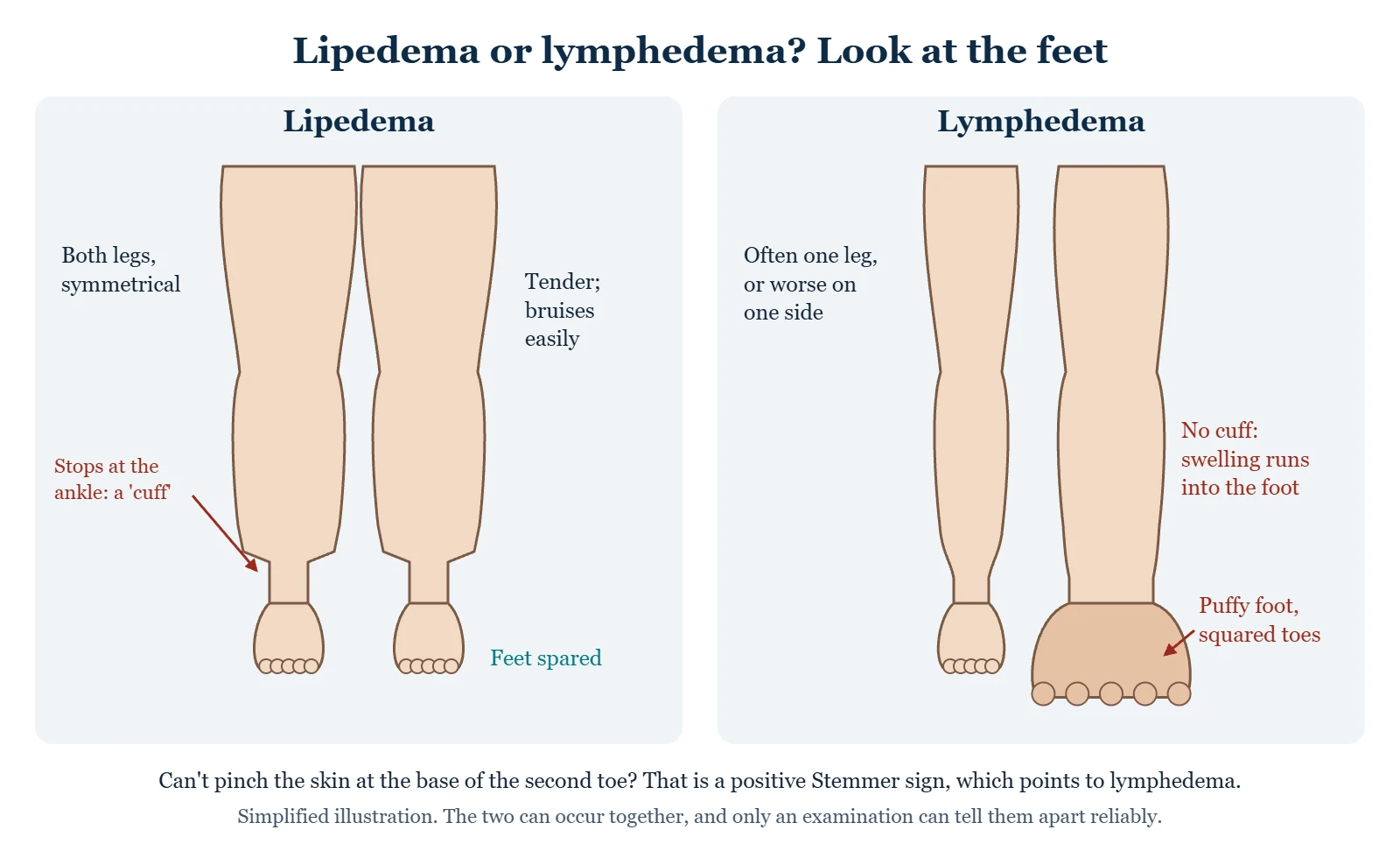
These two get confused constantly, including by clinicians, and the confusion costs people years. They look similar from across a room, they are treated differently, and one of the clearest ways to tell them apart costs nothing: look at the feet.
The one-minute version
| Lipedema | Lymphedema | |
|---|---|---|
| What it is | A disorder of fat tissue, laid down in a symmetrical pattern | A drainage failure — protein-rich fluid the lymphatic system cannot clear |
| Feet | Spared. The enlargement stops abruptly at the ankle, leaving a visible cuff or bracelet | Involves the foot and toes, which look puffed and squared off |
| Sides | Both legs, symmetrical | One leg or both, often worse on one side |
| Pressing on it | Little or no pitting. Tender, often painful, to press | Pits early on; becomes firm and non-pitting as the tissue hardens |
| Pinching the skin at the base of the second toe | Easy to pinch a fold | Hard or impossible — a positive Stemmer sign |
| Bruising | Bruises easily, often with no remembered injury | Not a typical feature |
| Pain | Aching and tenderness are characteristic | Heaviness and tightness rather than tenderness |
| Elevation overnight | Little change | Improves early on, much less once tissue has hardened |
| Skin and infection | Usually no skin changes and no history of infection | Skin thickens over time; cellulitis is the most common complication |
| Who | Almost entirely women; starts or worsens at puberty, pregnancy or menopause, and often runs in families | Anyone. In the US most often follows cancer treatment; also infection, injury or long-standing vein disease |
| Weight loss | The affected legs change much less than the rest of the body | Not the cause, though excess weight adds load |
| How it is confirmed | No specific test; diagnosed by examination and history | Usually by examination; lymphoscintigraphy is the reference test when there is doubt |
The two can happen together
Early lipedema is not a lymphatic disease, but lymphedema can develop on top of it at any stage — sometimes called lipo-lymphedema. So the honest answer for many people is not one or the other but how much of each, which is a question for examination rather than a checklist.
Lipedema, in more detail
Lipedema is a disorder of how fat tissue is laid down, not a weight problem and not a failure of willpower — which is the thing most worth saying, because people with it are frequently told to lose weight and then blamed when the legs do not change. In one series, dieting removed fat above the waist in nearly every patient and made no difference to the legs. The Cleveland Clinic puts it plainly: lipedema does not respond to diet and exercise like ordinary fat.
The pattern is distinctive once you know it: both legs enlarged symmetrically from hip to ankle, a sharp cut-off above the foot, tissue that often feels nodular under the fingers, easy bruising, and tenderness that makes leaning against a table edge unpleasant. In one series, 71% had pain on pressure and 82% bruised easily. The upper body is often noticeably smaller in proportion, and the arms can be involved, though the hands and feet are spared. It runs in families in a large share of cases, and fewer than ten cases in men have ever been documented.
Nobody knows how common it is. Published estimates run from 1 in 72,000 to 11% of women, because there is no test for it and it is so often mistaken for obesity or lymphedema — 10% to 20% of people referred to lymphedema clinics turn out to have lipedema instead.
What helps, according to the US standard of care for lipedema: compression, usually 10 to 20 mmHg in early stages and around 20 to 40 mmHg later, with the explicit note that a stronger class does not mean better results; regular, individually suited exercise, with water-based exercise often suggested because it is easy on the joints; manual lymphatic drainage where there is a fluid component; and attention to the psychological weight of years of being told the wrong thing. There are no medicines that specifically treat it, and water pills should be avoided. Conservative care reduces the limbs only modestly, by about 5% to 10%.
Liposuction done by specialist teams is a real option for some people and not a first step. Follow-up studies have reported less pain, bruising and need for compression lasting 8 to 12 years, but the evidence is observational and the Lymphatic Education & Research Network says it should not be considered a cure.
Lymphedema, in more detail
Lymphedema is a plumbing failure in the drainage network that runs alongside the blood vessels. Fluid and protein that normally leave the tissue cannot, so they accumulate. Estimates suggest 8 to 10 million Americans are affected. Inherited, or primary, lymphedema is rare — about 1 in 100,000 people — and in the United States it most commonly follows treatment for cancer, particularly where lymph nodes were removed or irradiated. In one group of cancer survivors, leg lymphedema affected about a third of those treated for ovarian, endometrial or colorectal cancer, and it follows 38% of groin node dissections for melanoma.
Early on it is soft, pits, and improves overnight. Left untreated it hardens, the skin thickens, and the whole thing becomes much harder to reverse. That trajectory is why early recognition matters more here than in almost any other swelling: treatment works far better at the start.
The standard treatment is complete decongestive therapy: a first phase of skin care, manual lymphatic drainage, exercise and multilayer bandaging, typically daily for a couple of weeks, followed by a maintenance phase in fitted compression garments. The National Cancer Institute calls it the standard of care for established lymphedema. Lymphedema cannot be cured, but it is very manageable, and selected people may be offered surgery such as lymph node transfer or lymph-vessel-to-vein bypass — which Johns Hopkins describes as a management tool rather than a cure. Long-term water pills are discouraged. The full lymphedema guide →
Cellulitis is the complication to know about
Any leg with impaired lymphatic drainage is at higher risk of skin infection, and infection in turn damages the lymphatics further. In one US analysis, 92% of hospital admissions for lymphedema were for cellulitis. Spreading redness, warmth or tenderness needs same-day attention; with a fever or chills, go to an emergency department now. If it has happened more than once, ask whether you should have a plan ready to start antibiotics quickly.
Getting the right assessment
- Photograph both legs, standing, from the front and the side, with the feet in frame. The foot question is the pivot, and photos make it undeniable.
- Try the Stemmer sign yourself. Try to pinch and lift a fold of skin at the base of the second toe. If you cannot, that points to lymphedema and is worth reporting.
- Note what pressing does. Does it leave a dent? Does it hurt?
- Note the history. When it started, what was happening in your life then, whether anyone else in the family has the same leg shape, and any surgery, radiation or infection.
- Ask for the other causes to be ruled out. Vein disease, heart, kidney, thyroid and medication causes all produce leg swelling and are far more common. Where swelling comes from →
- Ask for referral to a lymphedema therapist — usually a physical or occupational therapist with specific certification. It is one of the most useful referrals for either condition, and it is under-used.
From the clinic
Feet tell me a lot here. When the legs are large from hip to ankle but the feet are slim and normal, with a ridge of tissue sitting on the ankle like a cuff, lipedema goes on my list — especially if the legs bruise easily and hurt to press, and the patient has spent years being told to diet. When the foot and toes are puffy and I cannot pinch the skin on the second toe, I am thinking lymphatics. Either way, the next step is usually the same: a certified lymphedema therapist and properly measured compression, after the arteries have been checked.
Common questions
How can I tell the difference myself?
Look at your feet. Lipedema characteristically stops at the ankle, leaving the foot normal and a visible cuff above it. Lymphedema involves the foot and toes. Then try to pinch the skin at the base of the second toe: easy suggests lipedema, impossible suggests lymphedema. Neither is a diagnosis, but together they point strongly in one direction.
Will losing weight fix lipedema?
Weight loss improves general health, mobility and any coexisting lymphatic load, and it is worth pursuing for those reasons. But the lipedema tissue itself responds poorly — in one series dieting slimmed the upper body while the legs stayed the same — and the disproportion often becomes more obvious rather than less. Being told that weight loss will resolve it, and then being held responsible when it does not, is one of the most common experiences people with lipedema describe.
Is compression safe for both?
It is the mainstay for both, but the arterial supply has to be checked first, exactly as with any other leg. For lipedema, the US standard of care suggests about 10 to 20 mmHg in early stages and 20 to 40 mmHg later, and notes that stronger is not better. Flat-knit garments are usually preferred for lymphedema and for shaped limbs, and getting properly measured matters more here than almost anywhere else. The safety check and getting the fit right.
Can lipedema turn into lymphedema?
It can. Early lipedema is a fat disorder rather than a lymphatic one, but lymphedema can develop on top of it at any stage, which is one more reason to get the diagnosis right and start compression and exercise early.
Does liposuction cure lipedema?
It is not considered a cure, but for selected people it helps. In long-term follow-up, improvements in pain, bruising, swelling and the need for compression lasted 8 to 12 years, although the studies are observational and carry the usual surgical risks such as infection. It is done in specialist centers, usually after conservative treatment.
Why has nobody mentioned lipedema to me before?
It is under-recognized, it is not taught prominently, and it looks like obesity at a glance — 10% to 20% of people referred to lymphedema clinics turn out to have lipedema. Many people describe a decade or more of being treated for the wrong thing. If the pattern in the table above describes your legs, it is entirely reasonable to bring the word to the appointment yourself.
Is there a diagnosis code for lipedema?
Not yet in the United States. The ICD-10-CM code set that took effect on 1 October 2026 still has no specific lipedema code — its index refers lipedema to edema — and dedicated codes have so far only been proposed. That gap is part of why insurance coverage can be difficult, so ask your clinician to document the findings carefully.
Does lymphedema ever go away?
It is generally a long-term condition rather than one that resolves, but it is very manageable — and treatment started early, before the tissue hardens, works far better than treatment started late. The goal is to reduce the limb and then hold it there with compression and skin care, which most people can do.
Where to go next
- Cankles: when thick ankles are build, swelling or lipedema
- Lipodermatosclerosis: another cause of a hard, tender lower leg
- Lymphedema explained
- When both legs swell
- Compression fit and pressure labels
- Lymphatic drainage massage
- Lymphedema treatment: what actually works
- Wide-calf and plus-size compression socks
Sources
- StatPearls. Lipedema.
- StatPearls. Lymphedema.
- Cleveland Clinic. Lipedema.
- Cleveland Clinic. Lymphedema.
- Lomeli, et al. Lymphedema vs lipedema: similar but different. Cleve Clin J Med 2024.
- Herbst KL, et al. Standard of care for lipedema in the United States. Phlebology 2021.
- International Society of Lymphology. The diagnosis and treatment of peripheral lymphedema: 2023 consensus document (PDF).
- National Cancer Institute. Lymphedema (PDQ), health professional version.
- Mayo Clinic. Lymphedema: diagnosis and treatment.
- Johns Hopkins Medicine. Surgical treatment of lymphedema.
- NHS. Lipoedema and Lymphoedema.
- Baumgartner A, et al. Improvements in patients with lipedema 4, 8 and 12 years after liposuction. Phlebology 2021.
- Lymphatic Education & Research Network. Lipedema FAQs (PDF).
- Centers for Disease Control and Prevention. ICD-10 Coordination and Maintenance Committee, September 2025 topic packet (PDF).
- Centers for Disease Control and Prevention. About Cellulitis.
Written by Tom Biernacki, DPM, FACFAS. Published 21 September 2026. Updated 16 October 2026. General education, not medical advice.