Wide calf compression socks are knee-highs cut with extra room in the calf. The right pair fits both your ankle and your calf on that maker’s own chart, measured first thing in the morning. If no chart fits both, or your leg has an unusual shape, a made-to-measure garment or an adjustable wrap is a better route than a sock that does not fit.
Check two things before you buy
Your arteries. If you have diabetes, leg pain when you walk, numb feet, a foot or leg wound, kidney disease or heart failure, have your arterial circulation checked first, usually with an ankle-brachial index. The NHS is plain that compression is not safe when the artery pressures at the ankle are low. Who needs an assessment first.
A new change in one leg. One leg that has newly swollen, especially with pain, warmth or a change in color, needs to be seen today. So does a swollen leg that turns red, hot and painful, which can be cellulitis; with a fever or shivering, go to an emergency department. Call 911 for sudden breathlessness, chest pain or discomfort, coughing up blood, a racing heart or fainting, or for a leg or foot that suddenly becomes cold, pale or mottled, numb, weak or severely painful.
How this guide was made, and how the site is paid. This is a research-based comparison of wide-calf and plus-size compression socks, built from manufacturers’ published specifications and public guidance; we have not tested these products hands-on. Some links go to Amazon. As an Amazon Associate I earn from qualifying purchases. Commissions do not change which products are listed or what we say about them, and no manufacturer provided products, samples or payment for this guide. Our methodology · Disclosure
Why a sock that is too small is a problem
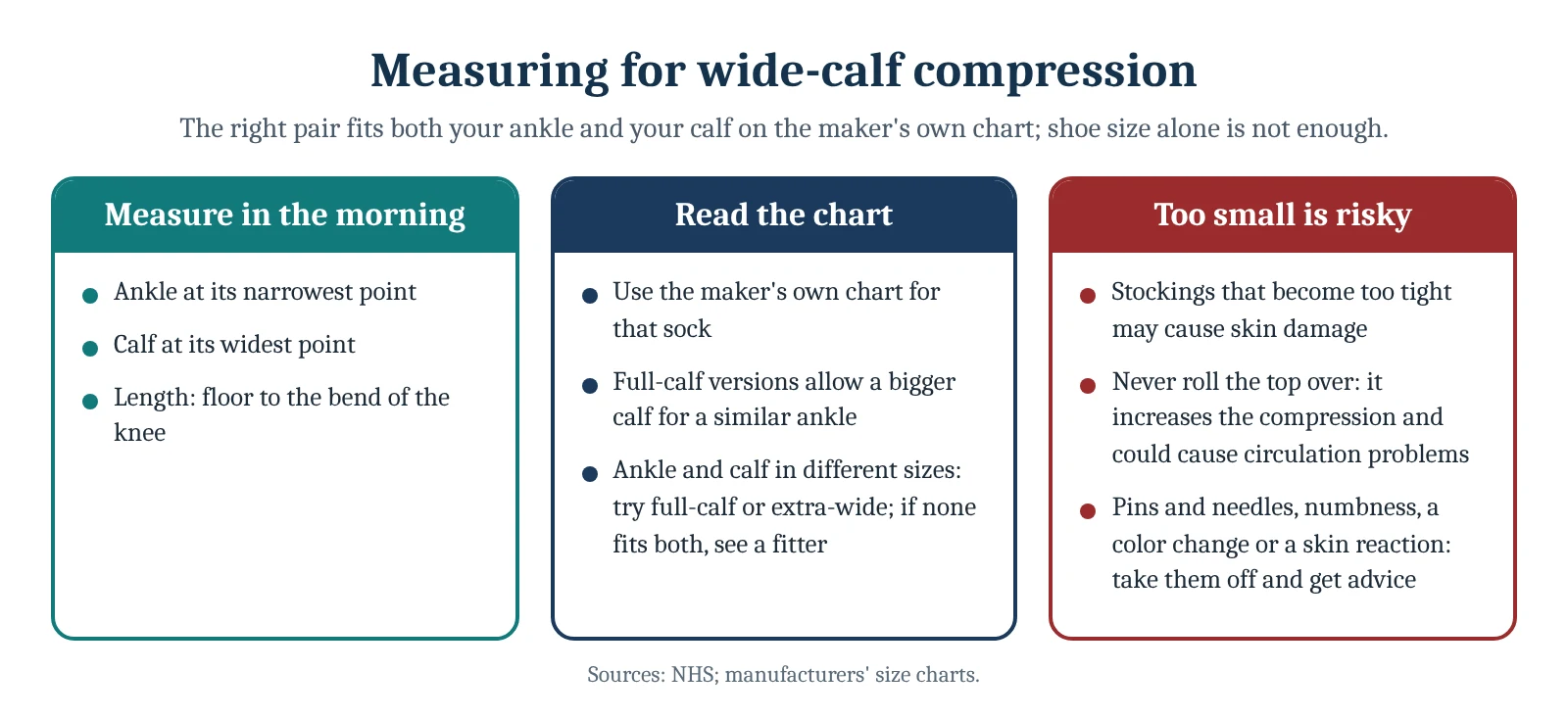
A compression sock is meant to press firmest at the ankle and less up the leg, and to lie smooth without creases. One NHS hospital’s guidance on compression hosiery is blunt about the top edge: never roll it over, because that increases the compression and could cause circulation problems. Cleveland Clinic gives the same instruction.
An NHS vascular leaflet warns that stockings that become too tight, for example when a leg grows larger, may cause skin damage. Stockings that become too loose may not work well either, which is why the leaflet asks people to be measured again whenever their legs change size or shape.
The strength on the box is tied to fit too. JOBST describes its mmHg figures as the mean pressure for an average ankle size, so the number is a guide, and the maker’s chart is how you find the size made for your leg. Wide-calf versions are sold at the same strengths as standard ones; what changes is the shape they fit.
Who should get advice before buying
Choosing a sock yourself is reasonable when your arteries are healthy and your ankles swell a little by evening. Get advice first if any of these apply:
- Diabetes, artery symptoms, numbness, a wound, kidney disease or heart failure. The arterial check above comes before any strength or size.
- Swelling that barely changes overnight, or that includes the feet and toes. That pattern can be lymphedema, where a lymphedema therapist chooses the garments and teaches you to use them.
- Fat build-up in both legs that stops short of the feet, often painful and bruising easily. Cleveland Clinic describes this as lipedema, notes a clear size difference between the unaffected feet and the affected legs, and lists compression stockings among its treatments. Ask about a measured garment (see below). Lipedema vs. lymphedema.
- Legs that are very swollen right now. Mayo Clinic notes that severely swollen legs may need compression bandages first, to bring the swelling down before a fitting.
- A recent change in weight or leg size. Measure again before you reorder.
How to measure for wide calf compression socks
- Measure soon after you get up, when swelling is at its least; Truform and Mayo Clinic both advise this.
- Keep your foot flat on the floor with your shin upright, at a right angle to the foot. Measure on bare skin, with the tape snug but not pulling in.
- Ankle: around the narrowest part, just above the ankle bone.
- Calf: around the widest part.
- Length: from the floor to the bend of the knee.
- Measure both legs and write the numbers down.
- Use the chart for that exact product. A JOBST sizing chart puts it plainly: shoe size alone is not an indicator of correct size. If your ankle and calf land in different sizes, look for a full-calf or extra-wide version; if none fits both, see a fitter.
What “full calf” and “extra-wide” mean
A standard chart pairs each ankle range with a calf range. Full-calf, extra-wide and wide-calf versions allow a bigger calf for a similar ankle, and plus sizes extend both. There is no shared standard; each maker draws its own lines.
| Product | Widest sizes | Calf | Ankle | Sized by |
|---|---|---|---|---|
| Comrad knee-high, wide calf | Small, medium and large “wide” | 12–15, 14–16 and 17–19 in | Not measured | Calf and shoe size |
| Sockwell, Wide Calf Fit | Two sizes each for women and men | No range published; the women’s page cites a 17½-in circumference | Not measured | Shoe size only |
| JOBST knee-highs, full calf | Large and extra-large full calf | 18–24 in | 10–11⅞ in (large), 12–14 in (extra-large) | Ankle and calf |
| mediven plus calf, extra-wide | Sizes I to VII | 13¼–15 in (I) up to 20½–24½ in (VII) | 6½–7¼ in (I) up to 12¾–13¾ in (VII) | Ankle and calf |
| Truform medical knee-high | 2X-large to 4X-large | 19½–22, 21½–24 and 23½–26 in | 12½–13¾ in, 4X-large 13–14¼ in | Ankle, calf and length |
| CircAid juxtalite wrap | Full-calf sizes and XXL | XXL 53–64 cm (about 21–25 in) | XXL 35–42 cm (about 13¾–16½ in) | Ankle and calf |
The differences are real. Take an ankle of 9 inches and a calf of 17 inches. JOBST’s size for a 9-inch ankle stops at a 16½-inch calf, and its full-calf sizes start at a 10-inch ankle. Truform’s matching size stops at a 16-inch calf. Size III of the mediven plus extra-wide, for ankles of 8½ to 9¼ inches and calves of 15¾ to 18 inches, covers both. Another leg will land the other way round, which is why the chart decides, not the label.
Wide-calf and plus-size options by need
These are examples of each type, not a ranking. Sizes, strengths and features come from each maker’s own page or size chart in October 2026, not from our measurements.
Calves up to about 19 inches, for everyday wear
Comrad Knee-High Compression Socks, wide calf sizes, 15–20 or 20–30 mmHg. A nylon-spandex everyday sock with silver-ion odor control, made in wide versions of small, medium and large. Comrad suggests a wide size once the calf passes 17 inches; large wide fits a 17 to 19 inch calf. See it on Amazon
Sockwell Women’s Full Flattery, Wide Calf Fit, 15–20 mmHg. A merino wool and bamboo rayon blend with a seamless toe and a more generous stretch in the calf, in women’s small/medium and medium/large. See it on Amazon
Sockwell Men’s High Rise Rib, Wide Calf Fit, 15–20 mmHg. The men’s equivalent in a ribbed merino blend, in medium/large and large/extra-large. See it on Amazon
May suit: people with healthy arteries whose calves are a little beyond standard charts and who want an ordinary-looking sock for long days, travel or mild evening swelling. Limits: neither maker measures the ankle. Sockwell sizes by shoe size alone and describes the extra room as “about 15–20% wider” on its size chart but “30% wider stretch” on the product page. Between sizes, Sockwell recommends sizing down, while Comrad says to size down for a tighter feel or up for more comfort. Comrad says its socks can go three or four wears between washes; JOBST advises washing daily or at least every other day.
Calves of 18 to 24 inches: medical full-calf sizes
JOBST Relief knee-high, full calf, 15–20, 20–30 or 30–40 mmHg. JOBST’s plain, unisex medical stocking with a reinforced heel and toe, in beige or black, open or closed toe, regular or petite length; at 20–30 and 30–40 mmHg it also comes with a silicone dot top band. Large and extra-large full calf fit calves of 18 to 24 inches. See it on Amazon
JOBST UltraSheer knee-high, full calf, 15–20 or 20–30 mmHg. A sheer women’s stocking; JOBST’s catalog lists the full-calf sizes in a few colors, closed toe or, at 20–30 mmHg, open toe, some with JOBST’s SoftFit band, which JOBST says stays up without digging in. For a men’s ribbed stocking that JOBST says looks just like regular socks, JOBST forMen also comes in full-calf sizes. See it on Amazon
May suit: large calves with an ankle that is also on the larger side. Limits: full-calf sizes start at a 10-inch ankle, so a slim ankle under a large calf will not fit. Our main compression sock guide covers the standard JOBST Relief and SIGVARIS’s plus-calf Essential Opaque.
A slim ankle under a much larger calf
mediven plus calf, extra-wide, 20–30, 30–40 or 40–50 mmHg. A strong, opaque stocking that medi says is intended for moderate to severe venous disease, in seven sizes, each with an extra-wide calf version, in beige or black, open or closed toe, standard or petite length, and with an optional beaded silicone top band. See it on Amazon
May suit: a large calf over a small or average ankle, once a clinician has advised at least 20–30 mmHg. Limits: there is no 15–20 mmHg version, so it is not a first try for unexplained swelling, and the stronger the stocking, the more effort it takes to put on.
Plus sizes to 4X-large
Truform Medical Knee High, 20–30 mmHg (model 8865), 2X-large to 4X-large. A latex-free, smooth-knit unisex stocking with a closed toe box that applies no compression to the toes; Truform lists an open-toe version on its own page, and this page lists 15–20 (8875) and 30–40 mmHg (8845) models. The 4X-large, for calves of 23½ to 26 inches, was the largest knee-high size on any chart we checked. See it on Amazon
May suit: large calves with larger ankles, from 12½ to 14¼ inches. Limits: these sizes are made for a leg of 22 to 24 inches from floor to knee, and Truform’s short length, for legs under 16 inches from floor to knee, stops at X-large. The 4X-large comes in black or beige only.
When no chart fits: made-to-measure garments and wraps
If your ankle and calf fit no chart, or the leg has an unusual shape such as a cuff of tissue above the ankle, a ready-made sock may be the wrong tool; NICE makes a similar point about anti-embolism stockings, advising against them when leg size or shape prevents a correct fit. Two routes are worth asking about:
- Made-to-measure flat-knit garments. StatPearls’ chapter on lipedema says flat-knit garments suit women with ankle cuffs or unusual shapes, while seamless circular-knit ones suit women with less lymphedema. Trained staff measure you for a custom garment, and JOBST describes made-to-measure garments as tailored to your unique measurements.
- Adjustable wraps. Inelastic wraps fasten with adjustable straps, and Cleveland Clinic notes that Velcro wraps may be easier to apply for people who have difficulty putting on socks. The CircAid juxtalite, for example, comes in full-calf sizes up to an XXL, with a card for checking the pressure you apply. An NHS leaflet notes that your nurse or doctor will advise whether wraps suit you, so we have not linked one.
If you have lymphedema, Medicare Part B may cover standard and custom-fitted garments and adjustable wraps your clinician orders; after the deductible you pay 20% of the Medicare-approved amount. Lymphedema products and lymphedema treatment go further.
Getting them on
medi big butler. A donning aid made for large stocking sizes. medi says ordinary aids are often too narrow for large calves, so this one has an extra-wide opening and a handle on each side. One size. See it on Amazon
May suit: anyone whose stocking is right but whose hands, hips or balance make it a struggle. Limits: it is a donning aid only. MedlinePlus suggests rubber dishwashing gloves to help adjust and smooth the stocking, and Mayo Clinic sitting in a chair for stability. Zipper socks and other donning aids covers the alternatives, and compression fit the technique.
Downsides and limits
- More room is not more benefit. If a standard size fits both your ankle and your calf, it is the right size.
- Charts disagree. The same leg can fit one maker and miss another, and everyday brands may never ask for an ankle measurement.
- Fit drifts. An NHS leaflet suggests replacing stockings every three to six months; Mayo Clinic says they may need replacing sooner if they bunch up, wrinkle, slide down or stretch out.
- Skin. Cleveland Clinic lists skin irritation, discomfort or pain, and bacterial or fungal problems among the mostly mild problems people have with compression. Stop and get advice for new numbness, tingling, color change or a skin reaction.
Alternatives, including not buying
- Find the cause first. Socks ease swelling; they do not explain it. How to reduce swelling covers the patterns and what else helps.
- Get measured. Cleveland Clinic and Mayo Clinic both describe trained staff measuring and fitting stockings, typically at a medical supply store.
- Lymphedema therapy. The NHS describes bandaging to reduce the swelling, then garments or Velcro wraps you are taught to put on yourself.
- Nothing. If your legs neither swell nor ache and no clinician has suggested compression, there is no fit problem to solve.
Questions to ask your clinician
- Have my arteries been checked, and is compression safe for my legs?
- What strength should I wear, and do I need a measured fitting?
- Does my leg shape call for a made-to-measure flat-knit garment or a wrap?
- Could this be lymphedema or lipedema, and should I see a lymphedema therapist?
Common questions
Do compression socks come in wide calf sizes?
Yes. Medical makers sell full-calf or extra-wide versions of their knee-highs, and several everyday brands make wide calf compression socks. On the charts we checked, ready-made knee-highs reach calves of 24 to 26 inches.
What size compression socks do I need for big calves?
Measure your ankle at its narrowest and your calf at its widest soon after you get up, then find the size on that product’s chart where both fit. If they fall into different sizes, look for a full-calf or extra-wide version. Shoe size alone is not enough.
Do wide calf compression socks have less compression?
No. They are sold at the same strengths, such as 15–20 or 20–30 mmHg. The extra room lets a larger calf sit inside the size’s range. JOBST describes its mmHg figures as the mean pressure for an average ankle size, so treat the number as a guide.
What happens if compression socks are too tight on your calves?
An NHS hospital leaflet warns that stockings that become too tight may cause skin damage, and NHS hospital guidance says a top rolled over increases the compression and could cause circulation problems. Take them off and get advice if you notice pins and needles in your feet, numbness, a change in color or a skin reaction.
Can you wear compression socks with lipedema?
Yes, and Cleveland Clinic lists compression stockings among lipedema treatments. Lipedema leaves a clear size difference between the feet and the legs, though, and StatPearls says flat-knit garments suit women with ankle cuffs or unusual shapes. Have your arteries checked first, and ask for a measured fitting from trained staff.
Does Medicare cover compression stockings for lymphedema?
Medicare Part B may cover standard and custom-fitted gradient compression garments, adjustable wraps and bandaging supplies for people with lymphedema when a doctor or other provider orders them. After the Part B deductible you pay 20% of the Medicare-approved amount. For other reasons for compression, ask your plan.
Where to go next
Sources
- NHS. Venous leg ulcer – diagnosis.
- NHS. Lymphoedema, Lymphoedema – treatment and Cellulitis.
- Centers for Disease Control and Prevention. About Venous Thromboembolism (Blood Clots).
- Society for Vascular Surgery. Acute Limb Ischemia.
- Cleveland Clinic. Compression Therapy: Types and Benefits.
- Mayo Clinic News Network. Mayo Clinic Q and A: Tips for using compression stockings.
- MedlinePlus. Compression stockings.
- East Sussex Healthcare NHS Trust. Guidelines for the use of compression hosiery/stockings.
- University Hospitals Birmingham NHS Foundation Trust. Compression Stockings and Wraps: Patient Information Leaflet.
- Cleveland Clinic. Lipedema.
- StatPearls, NCBI Bookshelf. Lipedema.
- National Institute for Health and Care Excellence. Venous thromboembolism in over 16s (NG89): recommendations.
- Medicare.gov. Lymphedema compression treatment items.
- JOBST (manufacturer information). JOBST Relief, JOBST UltraSheer, JOBST forMen and 2026–2027 compression catalog (sizing charts).
- medi USA (manufacturer information). mediven plus calf, mediven plus sizing chart, circaid juxtalite, juxtalite sizing chart and medi big butler.
- Truform (manufacturer information). Medical Knee High Compression Stockings / Unisex.
- Comrad (manufacturer information). Knee-High Compression Socks.
- Sockwell (manufacturer information). Women’s Full Flattery, Wide Calf Fit, Men’s High Rise Rib, Wide Calf Fit and size chart.
- SIGVARIS (manufacturer information). Essential Opaque Calf.
Written by Tom Biernacki, DPM, FACFAS. Published 18 October 2026. Research-based comparison; product details and retailer links checked 18 October 2026. General education, not medical advice.