Lymphedema treatment has two stages. First, a trained lymphedema therapist reduces the swelling with a few weeks of daily bandaging, gentle drainage massage, exercise and skin care; then you hold the reduction yourself with fitted compression garments, exercise and daily skin care. It controls lymphedema rather than curing it, it works best started early, and pumps and surgery are add-ons for some people, not replacements.

Infection and a newly swollen leg come before treatment
- Contact your doctor the same day if the leg becomes red, hot, more painful or more swollen than usual, or you have a fever of 100.4°F (38°C) or higher or the shivers. Cellulitis is the most common complication of lymphedema, and early antibiotics can stop it becoming serious. If your doctor cannot see you today, go to urgent care, or to an emergency department if you have a fever with chills or feel unwell.
- Call 911 if those signs come with feeling very unwell: confusion, dizziness or fainting, a fast heartbeat or fast breathing, cold, clammy or pale skin, or purple patches on the skin.
- Be seen today if one leg has newly swollen, especially with pain, warmth or a change in color. A clot needs ruling out first, and drainage massage should not be tried on a leg with a clot.
If your team has given you a plan for cellulitis, follow it. Care thresholds →
What lymphedema is, and how it is told apart from other swelling: lymphedema: assessment and daily management. This page is about treating it.
Lymphedema treatment at a glance
| Treatment | What it does | Where it stands |
|---|---|---|
| Complete decongestive therapy (intensive phase) | Reduces the limb with bandaging, manual lymphatic drainage, exercise and skin care | Standard of care for stage II lymphedema, though the best program has not been established |
| Compression garments and wraps | Hold the reduction day to day | Essential at every stage; the part you keep doing for years |
| Night garments or night bandaging | Keep compression going overnight, at a milder pressure | Used when your therapist advises it |
| Self-drainage, exercise, skin care | Daily maintenance and infection prevention | Core parts of every program |
| Pneumatic compression pump | Inflates a sleeve in cycles to move fluid | An add-on when garments alone are not enough |
| Surgery | Reroutes lymph, transfers lymph nodes, or removes excess tissue | For selected people with advanced or unresponsive lymphedema; not a cure |
| Diuretics (water pills) | Remove water from the bloodstream | Not a standard lymphedema treatment |
| Laser therapy, taping, supplements | Various claims | Laser and taping may give mild relief; no medicine is FDA-approved for lymphedema |
Lymphedema therapy: decongestive therapy step by step
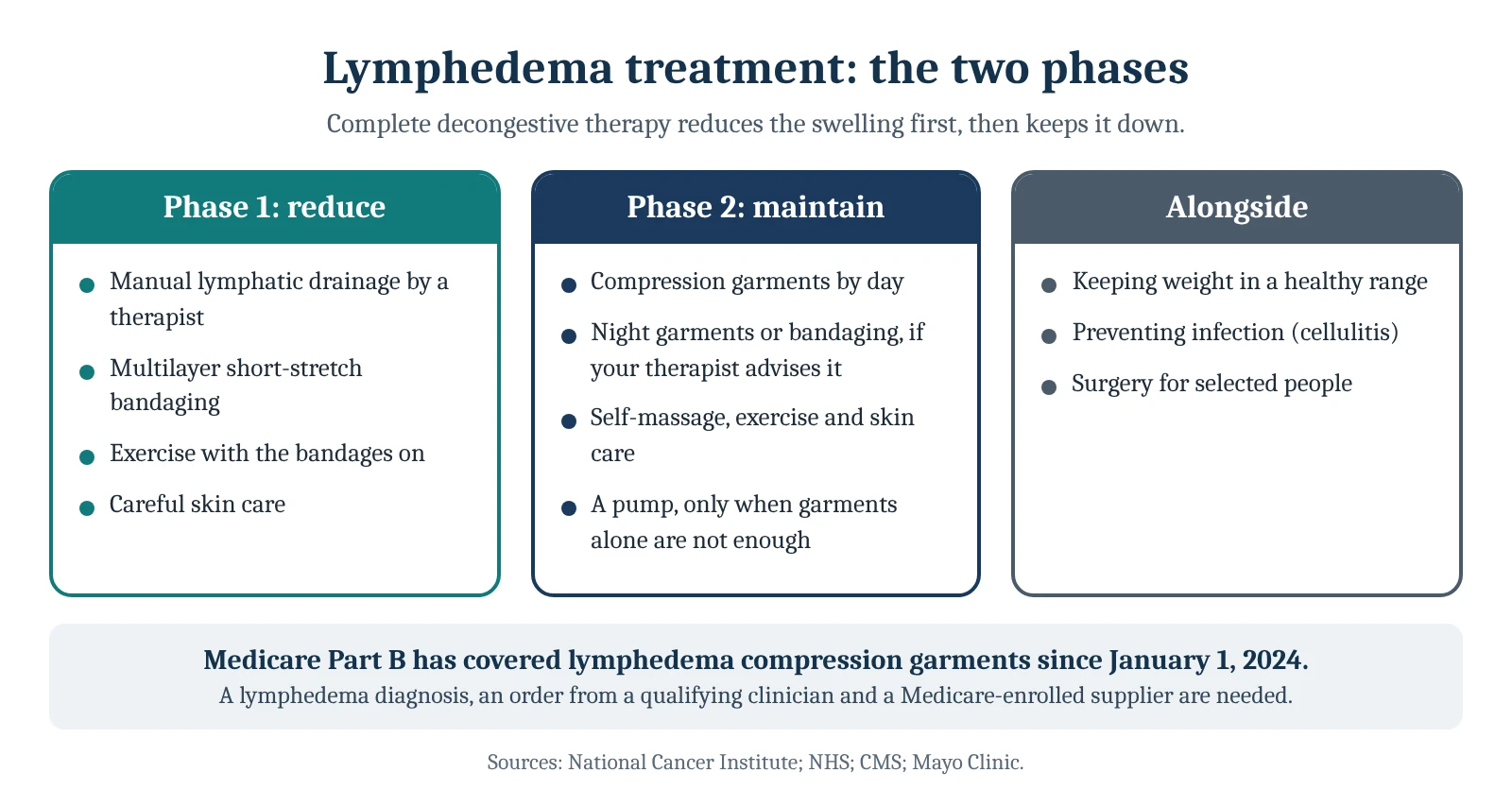
The core treatment is complete decongestive therapy (CDT), which the NHS calls decongestive lymphatic therapy. A therapist runs the intensive phase; you run most of the maintenance phase.
Before the first session
Expect an assessment: history, examination of the leg and skin, and measurements, by tape measure or methods such as water displacement, infrared scanning or bioimpedance. Those numbers track your progress.
Two checks come before anything is squeezed. The swelling needs a diagnosis, because lipedema, vein disease and heart or kidney problems can look similar (lipedema vs. lymphedema). And the arterial supply should be checked, usually with an ankle-brachial index, if you have diabetes, symptoms of peripheral artery disease, numbness, a wound, kidney disease or heart failure: the NHS notes that compression bandages and garments may not be suitable for people with arterial problems in their legs. Who needs that check, and why.
Mayo Clinic adds that you should not try manual lymphatic drainage if you have a skin infection, blood clots or active cancer in the affected area.
The intensive phase, visit by visit
The National Cancer Institute’s professional summary puts this phase at daily sessions for an average of 15 days; the NHS describes daily treatment for several weeks. A visit usually combines four things:
- Skin care. The skin is cleaned, moisturized and checked for cracks, athlete’s foot or any break that could let infection in.
- Manual lymphatic drainage. Gentle, light massage that moves fluid toward lymph nodes that still work. How MLD works, and how much it adds.
- Multilayer bandaging. Layers of low-stretch (short-stretch) bandage placed on the swollen areas after the massage, to move fluid out of the limb. Cleveland Clinic stresses using garments or bandaging after therapy to maintain its effect.
- Exercise. The NHS explains that exercise and compression work as a pair: muscles working against the compression of bandages or garments help move fluid out of the limb.
You are also measured for garments and shown how to put them on, or how to bandage yourself if that is part of your plan, so you can carry on at home.
The maintenance phase: your part
- Compression every day, when you are up and moving around, and at night as your therapist advises (NCI).
- Simple lymphatic drainage, the self-massage routine taught for home.
- Exercise and skin care, daily.
- Reviews every few months (NHS). The American Cancer Society suggests being re-fitted for garments every few months.
How much each part adds: the honest version
Decongestive therapy is the standard of care for stage II lymphedema, yet the NCI says its best version has not been established, and much of the trial evidence comes from arm lymphedema after breast cancer. In one trial it describes, adding 20 daily drainage sessions to compression garments removed more fluid in absolute terms, but not a larger share of the excess arm volume. A Cochrane review of six small trials in arm lymphedema after breast cancer found that intensive bandaging cut swelling by roughly a third, and that adding drainage massage gave about 7 percentage points more in the two trials that tested it, mainly in mild-to-moderate swelling, a finding its authors say needs confirming. People were likely to keep the reduction if they kept wearing a custom-made sleeve, which is why the garment you wear every day matters.
Compression garments for lymphedema
Lymphedema garments are specified differently from ordinary compression socks. Mayo Clinic notes that a prescription and professional fitting are often needed; the American Cancer Society says never to wear a compression garment that has not been fitted for you.
- Circular-knit garments resemble ordinary medical stockings and are widely sold ready-made. The NCI’s summary says elastic garments are best used for stage I, or for stage II once decongestive therapy has reduced the limb, and that circular-knit garments deliver more pressure in the narrow, lower part and suit vein disease better than lymphedema.
- Flat-knit garments are firmer and usually made to measure. The NCI says flat-knit (inelastic) garments work better than elastic ones in stages II and III, in both the reduction and maintenance phases, and makers say they are less likely to cut into skin folds.
- Adjustable wraps close with hook-and-loop bands that can be loosened or tightened as swelling changes. The NHS says they are easier to apply yourself and can replace bandages or garments; StatPearls notes they may help some people keep up with compression.
- Night garments are often padded sleeves. CMS describes them as giving milder compression and sitting less snugly than daytime garments. Wear them as your therapist advises.
Named examples, and what is sensible to buy yourself: lymphedema products.
Medicare and lymphedema garments since 2024
Medicare did not cover compression garments for lymphedema until the Lymphedema Treatment Act, enacted as section 4133 of the Consolidated Appropriations Act, 2023, created a Part B benefit that took effect on January 1, 2024. According to CMS, it covers medically necessary items for each affected body part:
- Gradient compression garments, standard or custom-fitted, for daytime and nighttime.
- Gradient compression wraps with adjustable straps.
- Compression bandaging systems and supplies, for the initial decongestion phase and maintenance.
- Accessories: donning and doffing aids such as lower-limb butlers or foot slippers, and zippers, linings, padding and fillers.
The limits are three daytime garments or wraps every six months and two nighttime garments every two years, per affected body part, with replacements sooner if an item is lost, stolen or irreparably damaged, or your condition changes, such as a change in limb size.
You need a lymphedema diagnosis and an order from a physician, or a nurse practitioner, physician assistant or clinical nurse specialist where state law allows, and the items must come from a Medicare-enrolled supplier. After the Part B deductible, you pay 20% of the Medicare-approved amount. Ask a supplier whether it bills Medicare before you buy a garment anywhere else. Pumps fall under a separate Medicare rule.
Pumps: an add-on, not a starting point
A pneumatic compression pump inflates a sleeve around the leg in cycles. In the NCI’s summary, pumps are used together with garments, and only when garments alone are not enough; StatPearls calls them an add-on in the maintenance phase. The NCI also mentions a theoretical concern that pressures above 60 mmHg and long-term use could injure lymph vessels. Who should not use one, and Medicare’s rules: leg compression machines.
Lymphedema surgery: who is a candidate
Surgery helps a small number of people and is done in specialist centers. The NCI’s summary says conservative treatment should be tried and exhausted first, and StatPearls reserves surgery for advanced or unresponsive lymphedema. MedlinePlus says it has limited success, and Cleveland Clinic says it is not a complete cure.
| Operation | What it does | Who it may suit |
|---|---|---|
| Lymphovenous bypass (lymphaticovenous anastomosis) | Microsurgery joining small lymph vessels to nearby veins so lymph drains into the bloodstream | Earlier-stage lymphedema in which imaging shows lymph vessels that still work |
| Vascularized lymph node transfer | Moves tissue containing healthy lymph nodes from elsewhere in the body to the affected limb | Later-stage lymphedema in which the lymph channels are blocked or no longer work |
| Liposuction (suction-assisted protein lipectomy) | Removes the excess fat and fibrous tissue of long-standing lymphedema | Swelling that no longer pits when pressed, which may be due to extra fat tissue. Garments are still needed afterward |
| Excision (debulking) | Removes skin, fat and tissue, then covers the area with a skin graft | Very severe cases where other treatment has failed; more risk of complications |
The NCI says there are limited data to guide the choice between liposuction and microsurgery, so read the table as one proposed approach, not a rule. In the studies the NCI summarizes, some operations reduced limb volume and skin infections, but much of that evidence comes from arms; StatPearls describes liposuction as particularly effective in the upper limb. Ask a surgeon which operation suits your stage and why, how many leg operations they do, and what compression you will need afterward.
Exercise, weight and skin care
Exercise. “Exercise is a natural pump for the lymph system,” in the NCI’s words, and the NHS describes plans combining specific exercises with walking, swimming or cycling. Early fears that exercise worsens lymphedema have not been confirmed: the NCI’s summary reports the American College of Sports Medicine’s advice that supervised, progressive resistance exercise is safe for people with or at risk of lymphedema after breast cancer, while data on unsupervised exercise are inadequate and safety in other cancers is unknown.
Weight. Excess weight can raise the risk of lymphedema (American Cancer Society), and the NHS says lymphedema teams will help you lose weight if you are overweight. The NCI advises a healthy weight to help keep lymphedema under control, while noting that trials have not settled the role of weight loss as a treatment.
Skin and feet: the infection-prevention piece.
- Wash and check the leg daily, dry well between the toes, and moisturize to prevent cracks.
- Treat athlete’s foot promptly; Mayo Clinic suggests an over-the-counter antifungal.
- Trim toenails straight across, or see a podiatrist, and do not walk barefoot outdoors.
- Wash cuts gently, apply antibiotic ointment and cover loosely.
- Keep extreme heat off the leg (hot tubs, saunas, hot packs), particularly if your feet are numb and cannot warn you.
- Do not cross your legs or stay in one position for more than 30 minutes, and avoid tight elastic bands.
If the skin starts leaking clear fluid, tell your lymphedema team promptly (weeping legs).
Elevation, with two exceptions. The NHS says raising the limb is usually advised, though the NCI notes that by stage II it no longer reduces the swelling. Ask first if you have severe artery disease, where raising the leg can make foot pain worse, or heart failure that makes you breathless lying flat. When elevation helps.
What does not work, or is not proven
| Treatment or product | What the evidence says |
|---|---|
| Diuretics (water pills) | Not a standard lymphedema treatment. StatPearls advises caution with diuretics in swelling from blocked vein or lymph drainage, because they may lower the volume of blood in the circulation without moving the fluid trapped in the tissue. If you take one for your heart or kidneys, do not stop it without asking. |
| Supplements, drops and teas sold for “lymphatic drainage” | No medicine is FDA-approved for lymphedema (StatPearls), and none of these products is part of the treatment programs described by the NHS or Mayo Clinic. |
| Low-level laser therapy, kinesiology taping | May give mild symptom relief (StatPearls); the NCI calls the role of laser therapy not established. |
| Saunas, hot tubs, hot packs | Advised against on a limb with lymphedema by the American Cancer Society. |
Can lymphedema be cured?
Not at present: the NHS, the NCI, Mayo Clinic and Cleveland Clinic all say so plainly. MedlinePlus calls it a chronic condition that usually needs lifelong management; it improves with time in some cases, but some swelling is usually permanent.
That is less bleak than it sounds. Mayo Clinic notes that treatment reduces swelling, improves comfort and helps prevent complications, and the NCI says lymphedema is easier to control when treatment starts early. Report new heaviness or swelling promptly rather than waiting for your next review.
Finding a lymphedema therapist
Look for a certified lymphedema therapist (CLT). The Lymphatic Education & Research Network recommends at least 135 hours of lymphedema training; the CLT-LANA credential adds an accredited board exam from the Lymphology Association of North America, which keeps a directory of certified therapists. Ask your primary care clinician, cancer team or vascular clinic for a referral (which clinician does what), and ask the therapist how many hours of lymphedema training they have, where they trained, and how much of their practice is lymphedema.
Common questions
How long does lymphedema treatment take?
The intensive phase usually takes a few weeks of daily sessions; the NCI’s summary gives an average of 15 days. Maintenance with garments, exercise and skin care continues long term, with reviews every few months.
What is the best treatment for lymphedema in the legs?
Complete decongestive therapy from a trained therapist, then well-fitted compression worn every day, with exercise and careful skin care. Pumps and surgery help some people on top of that. The same program works better started early.
Does Medicare cover lymphedema compression garments?
Yes, since January 1, 2024. Part B covers standard and custom-fitted day and night garments, adjustable wraps, bandaging supplies and accessories, within set limits, when you have lymphedema, a qualifying clinician orders them and a Medicare-enrolled supplier provides them. You pay 20% after the Part B deductible.
Who is a good candidate for lymphedema surgery?
Someone whose lymphedema has not responded enough to decongestive therapy and garments, assessed at a specialist center. The NCI says data to guide the choice are limited; one proposal is lymphovenous bypass when lymph vessels still work, lymph node transfer when they do not, and liposuction for firm, non-pitting swelling. None is a cure.
Do water pills help lymphedema?
Not as a standard treatment. StatPearls notes that lymphedema responds less to diuretics than venous or dependent swelling, and advises caution with them in swelling from blocked vein or lymph drainage, because they may lower blood volume without moving the fluid trapped in the tissue. Keep taking one prescribed for your heart or kidneys unless your prescriber says otherwise.
Can you treat lymphedema at home?
Most of the long-term work happens at home: garments, self-drainage, exercise and skin care. It should start with an assessment and a therapist’s plan, though, and self-bandaging only once you have been taught. Buying strong compression on your own for an undiagnosed swollen leg is the step to avoid.
Where to go next
Sources
- National Cancer Institute. Lymphedema (PDQ) — Patient Version and Lymphedema (PDQ) — Health Professional Version.
- NHS. Lymphoedema and Lymphoedema — treatment.
- NHS. Cellulitis and DVT (deep vein thrombosis).
- Mayo Clinic. Lymphedema — diagnosis and treatment.
- Cleveland Clinic. Lymphedema: Symptoms, Causes & Treatment.
- StatPearls, NCBI Bookshelf. Lymphedema and Physiology, Edema.
- American Cancer Society. Lymphedema.
- Cochrane. Manual lymphatic drainage for lymphedema following breast cancer treatment (Cochrane Database of Systematic Reviews, 2015).
- MedlinePlus. Lymphatic obstruction, Lymphedema – self-care and Peripheral artery disease – legs.
- Centers for Medicare & Medicaid Services. Lymphedema Compression Treatment Items, and MLN Matters MM13286, Lymphedema Compression Treatment Items: Implementation (PDF).
- Medicare.gov. Lymphedema compression treatment items and Lymphedema powered compression devices.
- OncoLink (Penn Medicine). News on the passing of the Lymphedema Treatment Act.
- Lymphatic Education & Research Network. Find a Certified Lymphedema Therapist (CLT).
Written by Tom Biernacki, DPM, FACFAS. Published 18 October 2026. General education, not medical advice.