Most lymphedema products should be chosen with a certified lymphedema therapist, because the right garment depends on your limb’s shape, the stage of the swelling and your skin, and one that fits badly can do harm. What you can sensibly buy yourself is narrower: a replacement for a wrap or stocking you have already been fitted for, aids for getting garments on, and skin care. Since January 2024, Medicare Part B has covered lymphedema garments, wraps and bandaging supplies ordered for diagnosed lymphedema.
Before you buy anything
- Contact your doctor the same day if a swollen leg turns red, hot and more painful, or you have a fever or the shivers. That can be cellulitis, which needs antibiotics, not a new garment. Call 911 if it comes with confusion, dizziness or fainting, a fast heartbeat or fast breathing, or cold, clammy or pale skin.
- Be seen today if one leg has newly swollen. A clot needs ruling out before any wrap, bandage or pump goes on it.
- Swelling nobody has diagnosed needs its cause found first. Care thresholds →
How this guide was made, and how the site is paid. This is a research-based comparison of lymphedema garments, wraps, night garments and supplies, built from manufacturers’ published specifications and public guidance; we have not tested these products hands-on. Some links go to Amazon. As an Amazon Associate I earn from qualifying purchases. Commissions do not change which products are listed or what we say about them, and no manufacturer provided products, samples or payment for this guide. Our methodology · Disclosure
Lymphedema products at a glance
Treatment has a reduction phase, usually with daily bandaging by a therapist, and a long maintenance phase in which garments hold the result (how lymphedema treatment works).
| Product | Its job | Buy it yourself? |
|---|---|---|
| Made-to-measure flat-knit garment | Daytime control of moderate to severe lymphedema, skin folds or an unusual limb shape | No. Measured and ordered through a fitter |
| Ready-made circular-knit stocking | Daytime control of early lymphedema | A repeat of the size and strength you were prescribed |
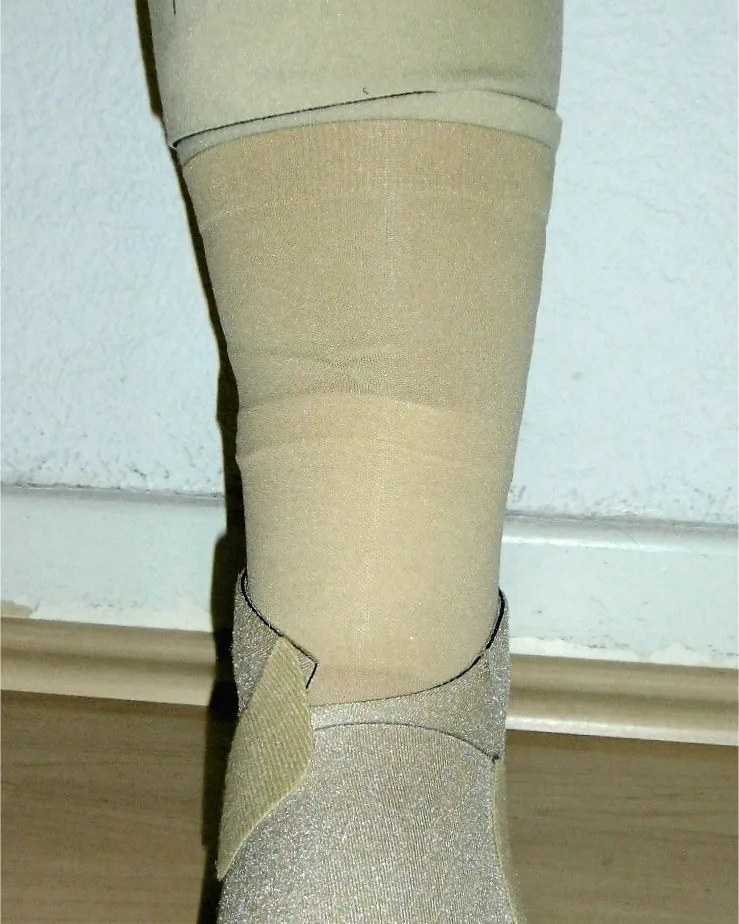
| Adjustable wrap | Daytime control when stockings are hard to put on or swelling changes through the day | After a therapist has sized it and shown you the tension |
| Night garment | Gentler overnight compression, when advised | After your therapist recommends one |
| Short-stretch bandaging kit | Reducing swelling, and self-bandaging for some people | Only the kit your therapist specifies, once you have been taught |
| Donning aids and skin care | Getting garments on; keeping skin intact | Yes |
| Pneumatic compression pump | An add-on when garments are not enough | No. A provider prescribes it |
Who should get advice before buying
The American Cancer Society’s advice is never to wear a compression garment that has not been fitted for you, and Mayo Clinic notes that a prescription and professional fitting are often needed. Get advice first in particular if:
- Your arteries have not been checked. With diabetes, symptoms of peripheral artery disease, numbness, a wound, kidney disease or heart failure, have the arterial circulation checked first, usually with an ankle-brachial index. The NHS notes that compression bandages and garments may not be suitable for people with arterial problems in their legs. Who needs an assessment first.
- A maker lists your condition as a contraindication. L&R’s list for its ReadyWrap wraps is typical: arterial insufficiency, moderate or severe peripheral arterial disease, acute deep vein thrombosis, untreated congestive heart failure, untreated infection, untreated cancer, absent or severely impaired sensation, severe cognitive impairment, and allergy to the materials.
- The skin is broken or leaking fluid. That needs a clinician’s plan, not an off-the-shelf garment (weeping legs).
- It might be lipedema, or both. Some wraps are sold for both conditions, but the assessment differs (lipedema vs. lymphedema).
What Medicare now covers
Since January 1, 2024, under section 4133 of the Consolidated Appropriations Act, 2023, Medicare Part B covers medically necessary standard and custom-fitted gradient compression garments for day and night, wraps with adjustable straps, compression bandaging systems and supplies, and accessories including lower-limb butlers, foot slippers, fillers, linings, padding and zippers. The limits are three daytime garments or wraps every six months and two nighttime garments every two years for each affected body part, with replacements sooner if an item is lost, stolen or irreparably damaged, or your condition changes, such as a change in limb size.
You need a lymphedema diagnosis and an order from a qualifying clinician, and the items must come from a Medicare-enrolled supplier; you then pay 20% of the Medicare-approved amount after the Part B deductible. Ask whether a seller is an enrolled Medicare supplier and bills Medicare before you buy a garment anywhere, Amazon included.
What matters when choosing
| Feature | Why it matters | What to check |
|---|---|---|
| Flat knit or circular knit | The NCI’s summary says flat-knit (inelastic) garments work better than elastic ones in stages II and III, and that elastic garments are best used for stage I, or for stage II once decongestive therapy has reduced the limb. Makers describe flat knit as less likely to cut into skin folds | Which your therapist prescribed, and why |
| Short-stretch (inelastic) material | Wraps and bandages stretch little. JOBST describes this as low pressure at rest and higher pressure when muscles work against it | “Short stretch”, “low stretch” or “inelastic” in the description |
| Pressure | Set by your clinician. With an inelastic wrap, the harder you pull the bands, the higher the compression, so some makers supply a guide card | The mmHg range on your prescription, and how to check it |
| Adjustability | Hook-and-loop bands can be tightened or loosened as swelling changes | Whether your hands can manage the straps |
| Foot and toe coverage | A leg piece alone leaves the foot uncovered, so wrap systems sell separate foot and toe pieces | Whether your plan includes the foot |
| Ready-to-wear, trim-to-fit or made to measure | Ready-made sizes suit regular limb shapes; some wraps can be trimmed in clinic as the limb shrinks | Measurements taken by a fitter, on the maker’s own chart |
| Liner | Protects skin under a wrap; L&R notes its liners add no compression | Included or sold separately |
| Washing | Care differs: JOBST’s FarrowWrap Classic is hand wash only, while its Lite and Strong versions are machine washable | The label, and a second set so one can be washed |
Lymphedema products by need
These are examples, not a ranking, from established compression makers whose own pages confirmed the details we give, as listed in October 2026. Made-to-measure garments are described for context, without shopping links.
Adjustable wraps for daytime
CircAid juxtafit essentials lower leg (medi). An inelastic, ready-to-wear lower-leg wrap whose bands can be adjusted without taking it off, sold as a system with an added compression band and a pair of compressive undersocks. medi lists it for mild to severe lymphedema and lipedema and moderate to severe venous disease. A Built-In-Pressure guide card checks the applied compression against settings from 20–30 to 50+ mmHg. Sizes S to XXL, including three full-calf sizes, in short or long, beige or black, with a 6-month warranty. An upper-leg piece extends it to the thigh. See it on Amazon
JOBST FarrowWrap Strong, leg piece, 30–40 mmHg. A short-stretch hook-and-loop wrap with an overlapping design and a soft inner layer, which JOBST recommends for moderate to severe edema; a skin liner is included. Ready-to-wear in XS to XXL, tall or long, with made-to-measure versions, and foot, knee and thigh pieces in the same line; the foot and leg pieces also come trim-to-fit. Machine washable at 30°C (86°F), dried flat. FarrowWrap Lite, at 20–30 mmHg, is made for mild to moderate swelling. See it on Amazon
ReadyWrap calf (L&R). A low-stretch modular wrap with color-coded straps and a 50% overlap that L&R says mimics bandaging; separate foot, toe, knee and thigh units build up to a full leg, and an extender strap adds 10 cm. The calf unit comes in S to XXL in average or tall lengths, and the foot unit is left- or right-specific and designed to fit inside most shoes. Liners are sold separately. L&R’s page gives no pressure range. See it on Amazon
May suit: people who cannot pull on a firm stocking, swelling that changes through the day, and limb shapes that ready-made stockings do not fit. The NHS notes wraps are easier to apply yourself, and StatPearls that they may help some people keep up with compression. Limits: a wrap and its liner are two layers to fit under clothes and inside shoes; they need sizing and a tension your therapist sets; and names matter. medi designs a different CircAid line, juxtalite, for vein problems and other edema, and says people with lymphedema, especially at later stages, see better outcomes with its juxtafit, profile and graduate lines.
A ready-made stocking for early leg lymphedema
mediven forte calf high, open toe, 30–40 mmHg. A firm, opaque circular-knit stocking that medi intends for advanced vein disease and stage 0–1 lymphedema; also made in 40–50 mmHg. Sizes III to VII, standard or petite length, black or caramel (not every color comes in every style), with a silicone-beaded top band. See it on Amazon
May suit: early, soft swelling for which this strength has been prescribed, when you prefer a stocking to a wrap. Limits: the NCI’s summary says elastic garments are best for stage I, or stage II once therapy has reduced the limb, and that flat knit works better in stages II and III, so firmer tissue or skin folds usually need flat knit or a wrap; the open toe leaves the toes uncompressed; and 30–40 mmHg needs that arterial check first.
Made-to-measure flat-knit garments
For moderate to severe lymphedema, skin folds or an unusual limb shape, the usual daytime garment is a flat-knit stocking made from your measurements. Examples are JOBST Elvarex, a flat-knit line in four compression classes and styles from knee-high to leggings, and mediven 550 leg, which medi calls the most robust garment in its mediven collection, for lymphedema up to stage 3 with skin folds or lobules. A fitter orders them, and Medicare’s custom-fitted category can cover them for lymphedema.
Night garments
JOBST JoViPak Leg. A foam-filled lower-leg sleeve with stitched channels, worn under a separate JoViJacket and designed by JOBST as an easy-to-use alternative to nighttime compression bandaging. Ready-to-wear in M to 2XL, regular length, blue or black, or made to measure; it ends just below the knee. Washed weekly. See it on the maker’s site
CircAid profile leg (medi). A foam sleeve that medi designed for night use or for people with sensitivity issues, worn with an oversleeve sold separately. Ready-to-wear in sizes II to IX, three lengths and standard or extra-wide widths, or custom-made, with a 30-day fit guarantee. See it on Amazon
May suit: people whose therapist wants overnight compression without bandaging. CMS describes night garments as milder and less snug than daytime ones. Limits: claims that foam channels “stimulate lymph flow” or soften tissue are the makers’ own; none of the independent sources we opened tests them. Ordinary daytime compression socks are not night garments (sleeping in compression socks).
Bandaging kits, once you have been taught
Rosidal Lymphset Deluxe Double Leg (L&R). Everything for multilayer leg bandaging, in two complete sets so one can be washed: tubular stockinette, conforming toe bandages, synthetic padding, 100% cotton Rosidal K short-stretch bandages in four widths, wider short-stretch bandages for the thigh, kidney-shaped foam ankle pads and tape. L&R says Rosidal K can be washed up to 50 times; the kit is latex free. See it on Amazon
May suit: people whose therapist has taught them to self-bandage and wants them to have their own set. Limits: bandaging is a skill. The padding exists to prevent constrictions and pressure spots, and a wound or ulcer under the bandage is a clinician’s job, not a kit’s.
Getting garments on
medi butler. A one-size donning aid with a handle on each side for a firm hold while the stocking is drawn evenly up the leg; medi lists an optimal 20-degree angle for ease of use and says it also suits nursing staff helping someone else. For open-toe stockings, medi’s easy-on foot slipper is a silky sleeve that lets the stocking slide over the foot and then pulls out through the open toe; it comes with mediven open-toe products. Medicare’s benefit lists both kinds of aid. See it on Amazon
Limits: a butler is for stockings, not wraps. More donning aids, and zipper options: zipper compression socks and donning aids.
Skin care
Skin care is about keeping the skin intact, since cellulitis is the most common complication of lymphedema. The basics are a plain moisturizer every day, an over-the-counter antifungal for athlete’s foot (Mayo Clinic), and antibiotic ointment for cuts, covered loosely (MedlinePlus). No cream treats the swelling itself. Browse options on Amazon
Shoes and pumps
Bandages and foot wraps take up room, so shoes need extra depth and adjustable closures: shoes for swollen feet. Pumps are prescribed devices used alongside garments when garments are not enough; we cover them separately in leg compression machines.
Downsides and limits
- Fit decides everything. A ready-to-wear wrap or stocking in the wrong size can dig in or slip, and limbs change; the American Cancer Society suggests being re-fitted every few months.
- Buying from a general retailer can skip the fitter and the Medicare benefit, and return policies for medical garments vary by seller.
- Marketing outruns evidence. Phrases such as “micro-massage” and “softens fibrotic tissue” are product copy, not findings.
- No product replaces the program. Garments hold a reduction; exercise and skin care still matter.
Alternatives, including not buying
- Use your coverage. If you have Medicare and diagnosed lymphedema, ask your clinician to order garments through an enrolled supplier; with other insurance, ask what it covers.
- Self-drainage, exercise and skin care cost little and are part of every program (lymphatic drainage massage).
- Nothing new, if your garments still fit, still feel firm and your measurements have not changed.
Questions to ask your therapist
- Flat knit, circular knit or a wrap for me, at what pressure, and does my foot need covering?
- Do I need a night garment, or should I learn to bandage myself?
- Which supplier can bill my insurance, and how often will you re-measure me?
Common questions
Which lymphedema products can I buy without a prescription?
Donning aids, skin care, and a repeat of a wrap or ready-made stocking you have already been fitted for. Many garments are sold online without a prescription, but a therapist should choose the type, size and pressure first, and your arteries may need checking before any compression.
Does Medicare pay for lymphedema compression garments?
Yes, since January 1, 2024. Part B covers day and night garments, adjustable wraps, bandaging supplies and accessories for diagnosed lymphedema, within set limits, when a qualifying clinician orders them from an enrolled supplier. You pay 20% after the Part B deductible. Medicare pays only for items from an enrolled supplier, so check before buying elsewhere.
What is the difference between flat-knit and circular-knit compression?
Flat-knit garments are firmer and usually made to measure; the NCI’s summary says they work better than elastic garments in stages II and III. Circular-knit stockings are more elastic and sold ready-made; the NCI’s summary says elastic garments suit stage I, or stage II once therapy has reduced the limb, and that circular knit is better for vein disease than for lymphedema.
Do I need a night garment for lymphedema?
Only if your therapist advises it. The NCI’s advice is to wear garments when you are up and moving, and at night as your therapist directs. Night garments are milder, padded products, not daytime socks worn to bed.
Are compression wraps better than stockings for lymphedema?
No source we opened compares how well wraps and stockings reduce swelling, but wraps can be easier for some people. The NHS notes that hook-and-loop wraps are easier to apply yourself, StatPearls says adjustable wraps offer better adherence for some patients, and the bands adjust as swelling changes. Your limb, your hands, how a garment sits under clothes and in shoes, and your therapist’s assessment decide.
What shoes are good for lymphedema?
Shoes with enough depth and adjustable closures to fit your foot plus any wrap or bandage. Our guide to shoes for swollen feet covers extra-depth and adjustable options.
Where to go next
Sources
- Centers for Medicare & Medicaid Services. Lymphedema Compression Treatment Items, and MLN Matters MM13286, Lymphedema Compression Treatment Items: Implementation (PDF).
- Medicare.gov. Lymphedema compression treatment items and Lymphedema powered compression devices.
- National Cancer Institute. Lymphedema (PDQ) — Patient Version and Lymphedema (PDQ) — Health Professional Version.
- NHS. Lymphoedema, Lymphoedema — treatment, Cellulitis and DVT (deep vein thrombosis).
- Mayo Clinic. Lymphedema — diagnosis and treatment.
- American Cancer Society. Lymphedema.
- StatPearls, NCBI Bookshelf. Lymphedema.
- MedlinePlus. Lymphedema – self-care.
- Manufacturer information, medi USA. circaid juxtafit essentials lower leg, circaid juxtalite, Inelastic compression wraps, mediven forte calf high, mediven forte, mediven 550 leg, mediven flat-knit compression, circaid profile leg, medi butler and easy on foot slipper.
- Manufacturer information, JOBST (Essity). JOBST FarrowWrap Strong Lower Extremities, JOBST FarrowWrap Lite, JOBST FarrowWrap Classic Lower Extremities, JOBST JoViPak Leg and JOBST Elvarex.
- Manufacturer information, Lohmann & Rauscher (L&R USA). ReadyWrap lower extremity garments and Rosidal Lymphset.
Written by Tom Biernacki, DPM, FACFAS. Published 18 October 2026. Research-based comparison; product details and retailer links checked 18 October 2026. General education, not medical advice.