Legs that feel heavy, tired and achy by the end of the day are so common they are usually dismissed. Most of the time that is fair. But the pattern — worse standing, better with the legs up, worse as the day goes on — is a specific clue, and it points somewhere.
When heaviness is not just heaviness
- One leg heavy and swollen and the other not, especially over hours to days — see someone today
- Heaviness with sudden breathlessness, chest pain or discomfort, coughing blood or fainting — call 911
- Heaviness with weakness, numbness, or difficulty walking that is new
- Cramping that comes on at a set walking distance and stops with rest — that is a different symptom entirely and needs an arterial assessment. More →
The pattern is the clue
Ask three questions:
- When is it worst? End of the day points venous. First thing in the morning points elsewhere.
- What relieves it? Putting the legs up points venous. Sitting down and leaning forward points spinal. Standing still for a few minutes points arterial.
- Is standing still worse than walking? If yes, that is close to a signature for a venous cause — the calf pump works when you walk and does nothing when you stand.
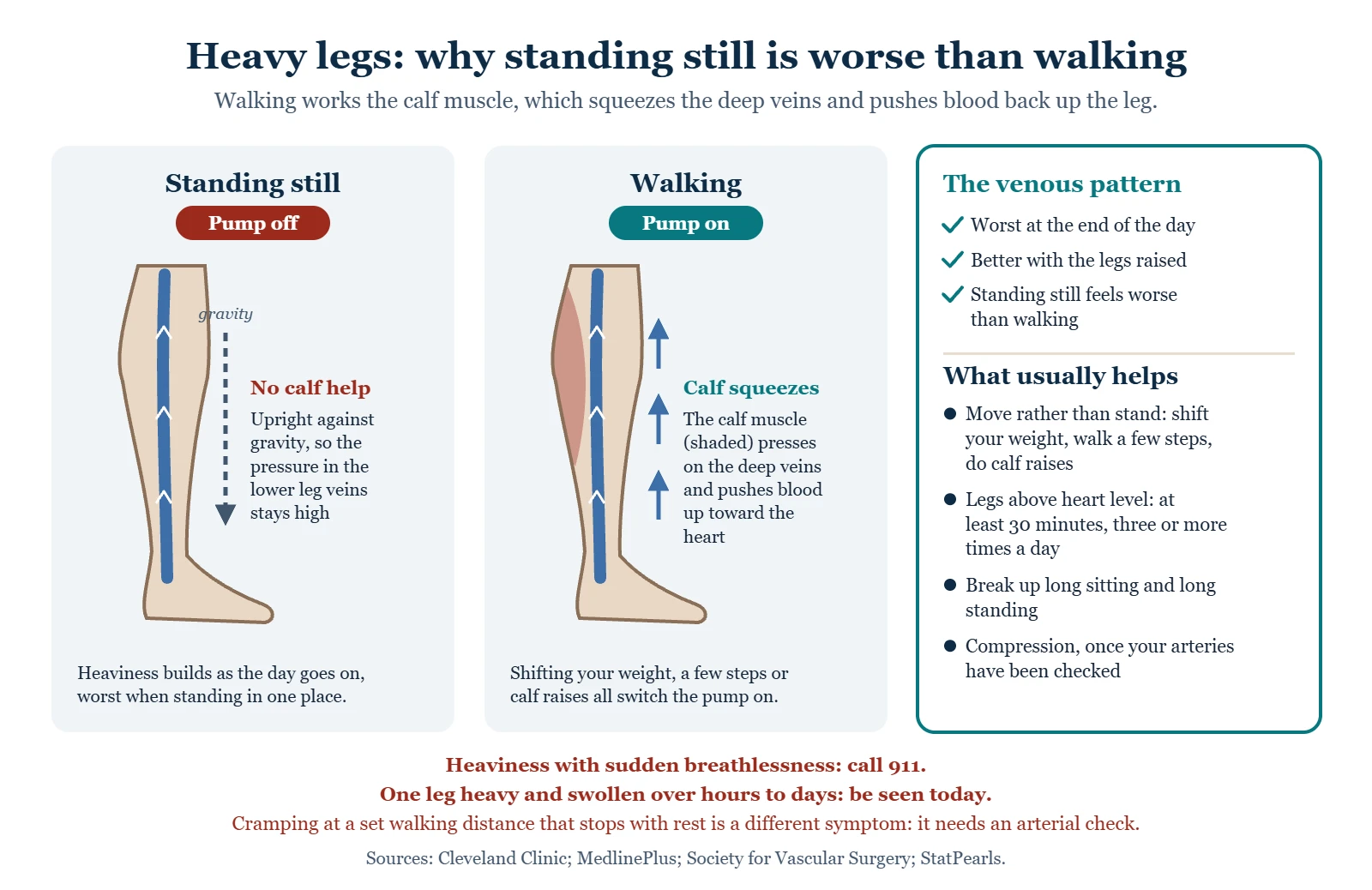
The venous pattern is common. Estimates of chronic venous insufficiency range from about 1 in 20 adults (Cleveland Clinic) to 10 to 35% of US adults (StatPearls), depending on how it is defined, and varicose veins affect about 1 in 3. MedlinePlus lists the typical symptoms as aching, heaviness, cramping, itching and tingling that are worse when standing and better with the legs raised; the Society for Vascular Surgery adds restless legs and painful cramps or spasms.
What causes it
| Cause | Pattern |
|---|---|
| Chronic venous insufficiency | Worse standing and by evening, better elevated, often with ankle swelling, visible veins or itching |
| Prolonged standing or sitting | Same pattern, no skin change, resolves fully with a rest day |
| Lymphatic swelling | Firmer, involves the foot and toes, improves less overnight |
| Restless legs | An urge to move rather than heaviness, worse at rest and in the evening, relieved by moving |
| Spinal stenosis | Heaviness or weakness on walking, relieved by sitting or bending forward rather than by standing still |
| Peripheral artery disease | Cramping at a reproducible distance, relieved by standing still; elevation makes it worse not better |
| Medicines | Onset tracking a new prescription; statin muscle aches affect about 5% or fewer of users in placebo-controlled comparisons. More → |
| Anemia, thyroid disease, low vitamin D | Generalized tiredness rather than legs specifically |
| Deconditioning and weight | Gradual, improves with activity |
For the venous pattern, the risk factors are well described: age over 55, a family history, excess weight, smoking, pregnancy, oral contraceptives, a previous clot or leg injury, long periods of standing or sitting, inactivity, and being female. Cleveland Clinic ranks a previous DVT as the most important of them.
What usually helps
- Move rather than stand. If your job involves standing, shifting weight, walking a few steps and doing calf raises every so often does real work. Cleveland Clinic calls the calf muscle the “second heart” for good reason.
- Elevate above heart level. Cleveland Clinic suggests at least 30 minutes, three or more times a day, for venous insufficiency. A footstool is not elevation. How →
- Calf exercises. Ankle circles, heel raises, pointing and flexing — especially during long sitting. Walking and cycling, which flex the ankle, work the calf pump well.
- Break up long sitting and long standing — both are worse than alternating.
- Weight loss, where it applies, which MedlinePlus lists alongside regular exercise as core self-care.
- Compression, once someone has checked your arterial circulation. For venous heaviness this is often the single most effective thing. The check comes first →
- Get the cause identified if it is persistent — the above manage symptoms, they do not address leaky valves.
What about vein supplements?
The 2023 US vascular guideline suggests some vein supplements, such as micronized purified flavonoid fraction (MPFF), Ruscus extract and, more tentatively, horse chestnut, for pain, heaviness, cramps and swelling from venous disease, while noting that none of them is an FDA-approved drug. In Cochrane reviews these “phlebotonics” slightly reduced swelling, and horse chestnut seed extract reduced leg volume and pain in short trials. They can take the edge off symptoms; they do not fix the valves, and they are worth mentioning to your prescriber if you take other medicines. Venous insufficiency →
Worth saying plainly
“Tired legs” is one of the most common reasons people buy compression socks without ever being assessed. For someone with healthy arteries and venous heaviness, that often works well. For someone whose heaviness is the first sign of something else — or whose arterial supply is marginal — it can delay a diagnosis or cause harm. A short visit with a clinician settles which group you are in.
From the clinic
The detail I listen for is “worse when I stand still than when I walk”. Teachers, nurses, hairdressers and cashiers say it all the time without realizing how specific it is. Combine that with ankles that are puffy by evening and gone by morning, and I am thinking about veins before I have even looked at the legs, and an ultrasound usually tells us exactly which ones.
Common questions
Why are my legs worse standing than walking?
Because walking engages the calf muscles, which squeeze the deep veins and push blood upward. Standing still keeps you upright against gravity with none of that help, so venous pressure in the lower leg stays high. It is one of the more useful distinguishing features you can report.
Is heaviness the same as restless legs?
No. Restless legs is an urge to move — often described as crawling or fizzing — that comes on at rest, is worse in the evening, and is temporarily relieved by moving. Venous heaviness is a weight or an ache that is relieved by elevation. They can coexist, and they are managed differently.
Should I take a magnesium supplement?
There is no good reason to expect it to help venous heaviness, and supplements can interact with prescribed medicines. If cramps rather than heaviness are the problem, that is worth raising with a clinician, who may check for causes including medication effects and electrolyte problems. Leg cramps: causes and what helps →
Do vein supplements like horse chestnut help?
Modestly, for some people. Horse chestnut seed extract reduced leg volume and pain in short trials, and the 2023 US vascular guideline suggests some vein supplements for symptoms such as heaviness and swelling. None of them is an FDA-approved drug, they do not treat the underlying valve problem, and they are not a substitute for walking, elevation and compression.
When should I stop putting it down to being on my feet?
When it stops resolving with a rest day, when it becomes asymmetrical, when swelling appears that is still there in the morning, or when the skin around your ankles starts to itch, darken or thicken. Any of those is the point at which it has become a medical question rather than an occupational one.
Where to go next
- Legs up the wall for heavy, tired legs
- Foot and leg cramps at night: causes and quick relief
- Leg cramps and charley horses: what helps
- Chronic venous insufficiency
- Leg elevation: when it helps
- Leg pain when walking — a different symptom
- Compression socks for swelling and aching legs
- Leg pain at night
- How to improve circulation in your legs and feet
- Compression socks for nurses and long shifts
Sources
- Society for Vascular Surgery. Chronic Venous Insufficiency.
- Society for Vascular Surgery. Chronic venous insufficiency (patient handout, PDF).
- NHS. Varicose veins.
- NHS. Oedema.
- National Heart, Lung, and Blood Institute. PAD — Symptoms.
- MedlinePlus. Venous insufficiency.
- Cleveland Clinic. Chronic venous insufficiency (CVI).
- StatPearls. Venous insufficiency.
- Society for Vascular Surgery, American Venous Forum and American Vein and Lymphatic Society. 2023 clinical practice guidelines for varicose veins of the lower extremities, part II.
- Cochrane. Phlebotonics for venous insufficiency.
- Cochrane. Horse chestnut seed extract for chronic venous insufficiency.
- Mayo Clinic. Statin side effects.
Written by Tom Biernacki, DPM, FACFAS. Published 21 September 2026. Updated 15 October 2026. General education, not medical advice.