Compression socks for swelling squeeze the lower leg, firmest at the ankle, so fluid and venous blood move back up instead of pooling. The best pair is the one at a pressure that suits the cause of your swelling, sized from morning measurements, that you can get on every day — and for some people the right first step is an artery check, not a purchase.
Two things to rule out before you buy
Poor arterial circulation. If nobody has ever checked the arteries in your legs, ask before you start — and have them checked first if you have diabetes, leg pain when you walk, numb feet, a foot or leg wound, kidney disease or heart failure, usually with an ankle-brachial index. Arterial blood has to reach the foot against the sock’s squeeze, and the NHS is plain that compression is not safe when the ankle artery pressures are low. Who needs an assessment first.
A clot. One leg that has newly swollen, especially with pain, warmth or redness, needs to be seen today, not treated with socks. Call 911 for sudden breathlessness, chest pain that is worse on breathing in, coughing blood, a racing heart or fainting. Why one swollen leg is different.
How this guide was made, and how the site is paid. This is a research-based comparison built from manufacturer specifications, checked on each maker’s own website in October 2026, and published clinical guidance; we have not tested these products hands-on. Some links go to Amazon. As an Amazon Associate I earn from qualifying purchases, and the SB SOX link can also earn a commission paid by the brand through an affiliate network. Commissions do not change which products are listed or what we say about them, and no manufacturer provided products, samples or payment for this guide. Our methodology · Disclosure
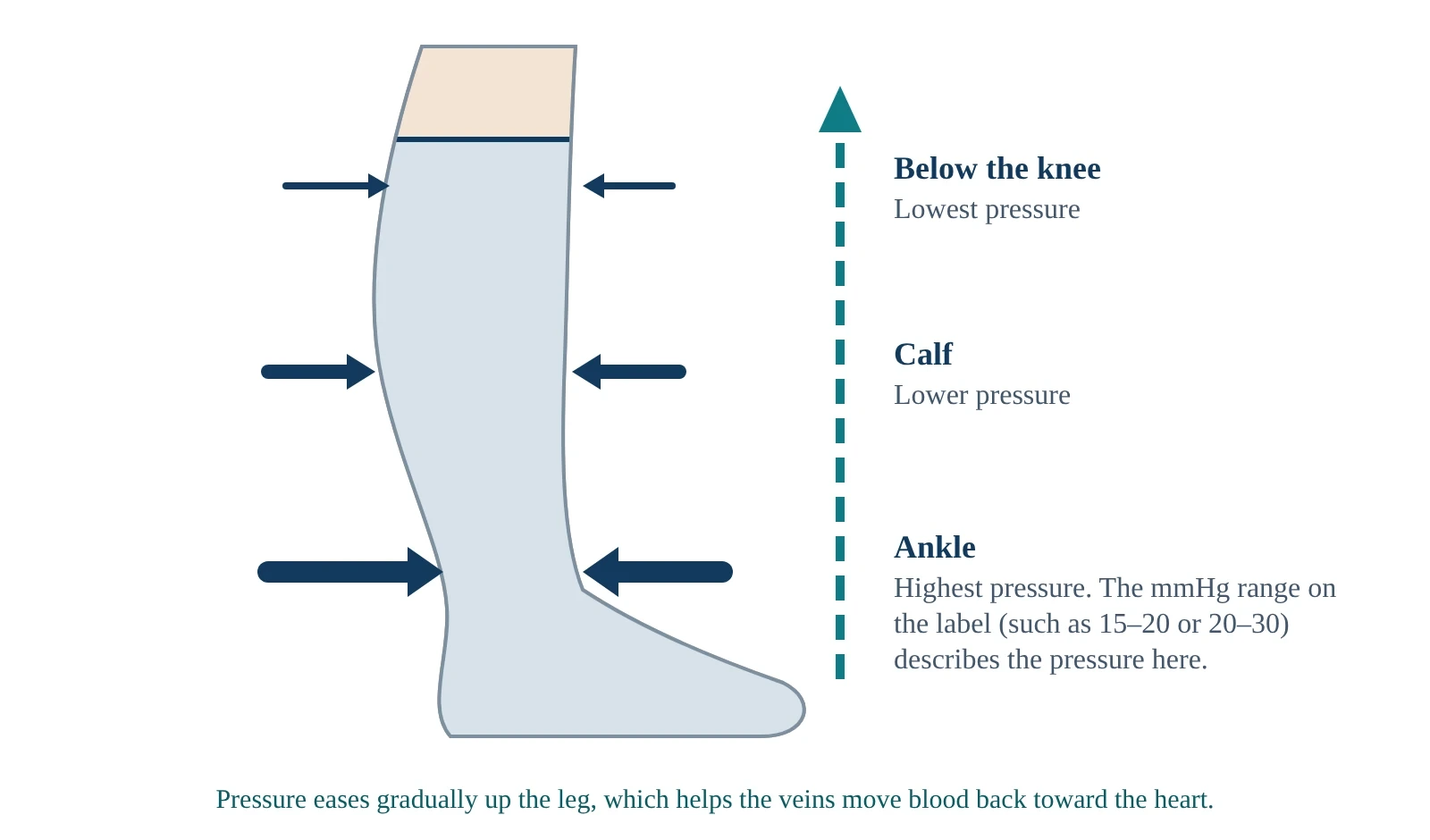
What compression does, and what it does not
Graduated compression is firmest at the ankle and eases off up the leg. That helps push venous blood back toward the heart and stop fluid collecting in the lower leg, which is why it is used for venous insufficiency, varicose veins, venous ulcers and several kinds of swelling.
It does not help blood get into the leg, so it cannot fix narrowed arteries or feet cold from artery disease, and with poor arterial supply it can do harm. Nor does it treat the cause of swelling that starts in the heart, kidneys, liver or a medicine. Swelling in both legs that is getting worse, or has not settled after a few days of self-care, needs a doctor rather than a stronger sock (when swelling starts elsewhere), and uncontrolled heart failure rules out compression without medical advice.
How the common uses stand, using the evidence labels in our methodology:
| Use | Evidence label | What it means |
|---|---|---|
| Swelling and aching from venous insufficiency or varicose veins | Established clinical use | A standard nonsurgical treatment that eases symptoms and aims to prevent severe swelling and ulcers |
| Keeping a healed venous ulcer from returning | Established clinical use | The NHS calls stockings worn whenever you are out of bed the most effective prevention |
| Lymphedema | Established clinical use | Part of specialist treatment to reduce the swelling and keep it down (lymphedema) |
| Mild ankle swelling from long standing or sitting, or pregnancy, with healthy arteries | Useful in selected circumstances | Lower-pressure socks are a reasonable comfort measure |
| Flights of five hours or more | Useful in selected circumstances | Fewer symptomless clots, on high-certainty evidence; see compression socks for flying |
| “Improves circulation” in artery disease, cold feet or neuropathy | Unsupported claim | Compression does not improve arterial supply, and none of our clinical sources lists neuropathy as a reason to wear it |
What matters when choosing
Once compression is the right tool, these features decide whether a pair works for you.
| Feature | Look for | Why it matters |
|---|---|---|
| Pressure | A stated mmHg range, labeled graduated | There is no standard rating scale, so the number at the ankle is the only fair comparison |
| Size | The chart for that exact product | Brands size differently; too loose does little, too tight can harm |
| Length | Knee-high, for ankle and lower-leg swelling | The most common and easiest style; thigh-highs or tights only if swelling extends above the knee or you were told to wear them |
| Toe | Closed for a sock-like fit; open for long or wide feet, or to see your toes | Toes get little or no compression in either style, and can swell where compression is lower |
| Top band | Soft, wide, dotted or grip | A band that rolls or digs concentrates pressure in one line |
| Fabric | Nylon–spandex for firm knits; cotton or merino blends for feel; “non-latex” if you need it | Comfort is what keeps you wearing them |
Socks sold “for women” or “for men” mostly differ in sizing and colors, not in compression, so choose by your measurements.
Choosing a strength
Compression is labeled by the pressure at the ankle in millimeters of mercury (mmHg); our fit and pressure labels page has the full scale. For swelling, the choice is usually between three bands.
15–20 mmHg: the usual starting point
For mild end-of-day ankle swelling with healthy arteries. Cleveland Clinic describes compression under 20 mmHg as sold over the counter and possibly a good choice for people who stand or sit for long periods or are pregnant.
20–30 mmHg: worth a clinician’s sign-off
The common strength for diagnosed venous insufficiency, varicose veins and moderate swelling. Cleveland Clinic classes 20 mmHg and above as prescription strength, yet it is easy to buy online without one. What matters is whether someone has checked the cause and your arteries, not whether the checkout lets you.
30–40 mmHg and above: prescribed and measured
For advanced venous disease, healed venous ulcers and lymphedema, chosen with a clinician and properly fitted; StatPearls gives 30–50 mmHg as the range believed to help established venous insufficiency. If you have lymphedema, Medicare Part B may cover compression garments your clinician orders.
Stronger is not better for unexplained swelling. A 15–20 mmHg sock you wear every day does more than a 30–40 mmHg stocking you cannot get past your heel.
Sizing: measure in the morning
Measure as soon as you get up, before your legs swell: the ankle at its narrowest, the calf at its widest, and the floor to just below the bend of the knee. Then use the chart for that exact product. A knee-high that fits sits about two finger-widths below the knee bend.
Sizes do not transfer between brands, and charts differ even in how many sizes they offer. If your ankle and calf land in different sizes, try a full-calf or plus version, or have your legs measured at a medical supply store.
Getting them on, and keeping them working
Put them on first thing in the morning: turn the sock inside out to the heel, ease your foot in, then work the rest up a little at a time and smooth out every wrinkle. Rubber gloves give grip, a stocking donner holds the sock open, and sitting down helps balance; zipper styles and hook-and-loop wraps are easier for some people.
Take them off at bedtime unless you were told otherwise. Wash them after each wear with mild soap, and dry them the way the label says; brands differ. Keep two pairs in rotation, replace them every three to six months or sooner if they slide on easily, and measure again if your weight or legs change.
Compression socks for swelling: options by need
These are examples of each type, not a ranking, each from an established compression maker that states its pressure in mmHg and publishes a size chart.
A standard medical knee-high
JOBST Relief knee-high, 20–30 mmHg, closed toe. A plain, unisex medical stocking with a reinforced foot, also made in 15–20 and 30–40 mmHg, open toe, petite length and “full calf” sizes.
May suit: anyone advised to wear 20–30 mmHg for venous swelling who wants the conventional version. Limits: it looks medical, and its sizes do not match other brands’ charts. See it on Amazon
Legs that are hard to fit, or toes that need room
mediven plus calf, 20–30 mmHg, open toe. A firm, opaque stocking that medi describes as intended for moderate to severe venous disease, in seven sizes with petite and extra-wide variants and a silicone top band; also 30–40 and 40–50 mmHg.
May suit: legs outside standard charts, long or wide feet, and anyone who wants to see their toes. Limits: there is no 15–20 mmHg version, so it is for someone already advised to wear at least 20–30. See it on Amazon
Wide calves
SIGVARIS Women’s Essential Opaque Plus Calf with Grip-Top, 20–30 mmHg. The plus-size version of SIGVARIS’s opaque medical knee-high, non-latex, with a grip-top band, in medium to extra-large, short or long. A men’s version is sold separately; both also come in 30–40 mmHg.
May suit: calves that are large in proportion to the ankle. Limits: there are no small sizes, and if your ankle and calf still fall into different sizes, a fitter or a made-to-measure garment is the next step. See it on Amazon
Something that looks like an ordinary sock
mediven active, 15–20 mmHg. A sport-style knee-high with a fully cushioned sole and odor-control fibers, in white, black or gray, standard or tall length. A 20–30 mmHg version is also made.
May suit: people who will wear an athletic-looking sock every day but would leave a beige stocking in the drawer. Limits: closed toe only, and a cushioned sole takes up room in a snug shoe. See it on Amazon
When pulling a stocking on is the problem
Truform 6665 knee-high zipper compression socks, 20–30 mmHg. A knee-high with a zipper and a fabric guard beneath it to stop pinching, in beige or black, sizes small to 4X-large. Truform’s own page describes this model as both closed and open toe; the Amazon listing we link is the closed-toe version.
May suit: people who cannot stretch a stocking over the heel, and carers dressing someone else. Limits: only 20–30 mmHg, which is not a starting strength for unexplained swelling, and a zipper does not rescue the wrong size. See it on Amazon
A no-frills medical option
Truform Medical Knee High, closed toe, 15–20 mmHg (model 8875) or 20–30 mmHg (model 8865). A latex-free, smooth-knit knee-high with a knit-in heel, roomy toe box and soft top band, from an American maker that markets the line as value-priced. Short lengths, a silicone-dot top (model 8864) and 30–40 mmHg also exist.
May suit: anyone who needs plain medical-grade compression and two pairs in rotation; check current price. Limits: Truform advises men with long feet for their size to choose its open-toe version. See it on Amazon
Several pairs for daily rotation
SB SOX compression socks, 15–20 mmHg, three-pair pack. A knee-high, sport-style sock sold in multi-packs, which the maker describes as graduated. We have not measured the pressure it delivers.
May suit: someone with healthy arteries and mild end-of-day ankle swelling who wants spare pairs to rotate between washes. Limits: sizing goes by calf measurement on the maker’s own chart, so measure first and confirm the size, color and seller on the listing; a multi-pack does not make the pressure or fit right for your legs. See it on Amazon
Help with any of them
SIGVARIS Doff N’ Donner Rolly. A soft, non-latex sleeve that guides any graduated compression sock or stocking up the leg and back down, for use on yourself or by a carer.
May suit: anyone with limited grip, reach or balance whose socks are otherwise right. Limits: if you cannot reach your feet at all, a carer or an adjustable wrap may be the realistic answer. See it on Amazon
Downsides and limits
Compression helps only while you keep wearing it. Common problems are skin irritation, discomfort, fungal or bacterial skin trouble, and swelling of the foot and toes where the compression is lower; nerve or soft-tissue damage is rare. Take them off and get advice if your toes tingle, go numb or change color, or the skin blisters or breaks.
Before buying, check whether your health plan has a durable medical equipment benefit, and check the seller’s return policy. And remember that a sock that shrinks swelling has not told you why you were swelling.
Alternatives, including not buying anything
For mild swelling of both ankles with a known, harmless cause, the NHS’s first advice costs nothing:
- Raise your legs on a chair or pillows when you sit, unless you have advanced artery disease, where raised legs can bring on foot pain (leg elevation).
- Walk, and when you have been still, point, flex and circle your ankles.
- Break up long spells of standing or sitting.
- Wear wide, comfortable shoes with a low heel and a soft sole, and nothing too tight.
- Cut back on salty food, and ask whether a medicine could be contributing.
If compression is right but socks are impossible to put on, adjustable wraps are a recognized alternative. If the swelling is new, one-sided or getting worse, the right purchase is an appointment.
Questions to ask your clinician
- Is compression right for the cause of my swelling, and have the arteries in my legs been checked?
- What strength (mmHg) and length should I wear, and do I need a prescription or a professional fitting?
- How many hours a day should I wear them, and should they come off at night?
- Which skin changes or symptoms mean I should stop wearing them?
- If they are prescribed, will my insurance cover them?
From the clinic
Most of the compression problems I see are fit problems: socks bought by shoe size, a strength chosen because stronger sounded better, or a top band rolled down behind the knee where it acts like a tourniquet. Measure the ankle and calf in the morning, start with the strength your clinician suggests, and take them off if your toes become numb, pale or painful. If you have weak foot pulses, diabetes with numb feet or any history of PAD, have your circulation checked before you buy.
Common questions
What are the best compression socks for swelling?
There is no single best pair. The best compression socks for swelling are at the right strength for the cause, sized from your morning measurements, in a style you will wear every day. Look for a stated mmHg range, the word “graduated” and a real size chart, and get your arteries checked first if you are in a higher-risk group.
What compression level is best for swollen ankles?
For mild end-of-day swelling with healthy arteries and a known, harmless cause, 15–20 mmHg is the usual starting point. For diagnosed venous insufficiency or varicose veins it is usually 20–30 mmHg, with a clinician’s sign-off. 30–40 mmHg and above is prescribed and fitted.
Do compression socks help with edema?
They help edema from vein problems or from long standing and sitting, and they are part of lymphedema treatment. They do not treat the cause of edema from the heart, kidneys, liver or a medicine, and with uncontrolled heart failure they need medical advice first. New or one-sided swelling needs its cause found.
Are compression socks good for poor circulation?
It depends which circulation. For veins that struggle to return blood from the legs, yes. For arteries that struggle to deliver it, as in peripheral artery disease, no: compression does not improve arterial supply and can reduce it further. That is why higher-risk groups have their arteries checked first.
Who should not wear compression socks?
People with severe artery disease or uncontrolled heart failure, unless a specialist advises otherwise. A suspected clot or a leg wound needs to be seen, not treated with socks. With diabetes, numb feet, kidney disease or leg pain on walking, have your arteries checked before starting, even at low pressure.
How tight should compression socks be?
Firm enough that you notice them, tightest at the ankle, and never painful. Take them off and get advice if your toes tingle, go numb or change color, or the skin blisters or breaks. A top band that rolls down usually means the wrong size or length.
Where to go next
- Compression safety: who needs an assessment first
- Fit, pressure labels and putting them on
- Compression socks for flying
- Why legs swell: the full guide
- Chronic venous insufficiency
- Compression socks for women
- Compression socks for men
- Wide-calf and plus-size compression socks
- Thigh-high compression socks and stockings
- Compression socks in pregnancy
- Zipper and open-toe compression socks, and donning aids
Sources
- NHS. Swollen ankles, feet and legs (oedema).
- NHS. Venous leg ulcer – diagnosis and treatment.
- NHS. Varicose veins.
- NHS. Lymphoedema – treatment.
- Cleveland Clinic. Compression Therapy: Types and Benefits.
- MedlinePlus. Compression stockings.
- Mayo Clinic News Network. Mayo Clinic Q and A: Tips for using compression stockings.
- StatPearls, NCBI Bookshelf. Venous Insufficiency.
- StatPearls, NCBI Bookshelf. Peripheral Arterial Disease.
- Society for Vascular Surgery. Chronic Venous Insufficiency.
- University Hospitals Birmingham NHS Foundation Trust. Compression Stockings and Wraps: Patient Information Leaflet.
- Medicare.gov. Lymphedema compression treatment items.
- Cochrane. Compression stockings for preventing deep vein thrombosis (DVT) in airline passengers.
Written by Tom Biernacki, DPM, FACFAS. Published 9 October 2026. Updated 18 October 2026. Research-based comparison; product details and retailer links checked 9 October 2026. General education, not medical advice.