COVID toes are swollen toes that turn pink, red or purple and may itch, burn or hurt. They look like chilblains, and dermatologists saw far more of them early in the COVID-19 pandemic, mostly in children, teenagers and young adults who had mild symptoms or none. Whether the virus causes them directly is still debated, and most people test negative by the time they appear. They usually clear up on their own. Here is what they look like, how long they last, what helps, and the signs that mean you should be seen.
When toe changes need urgent care
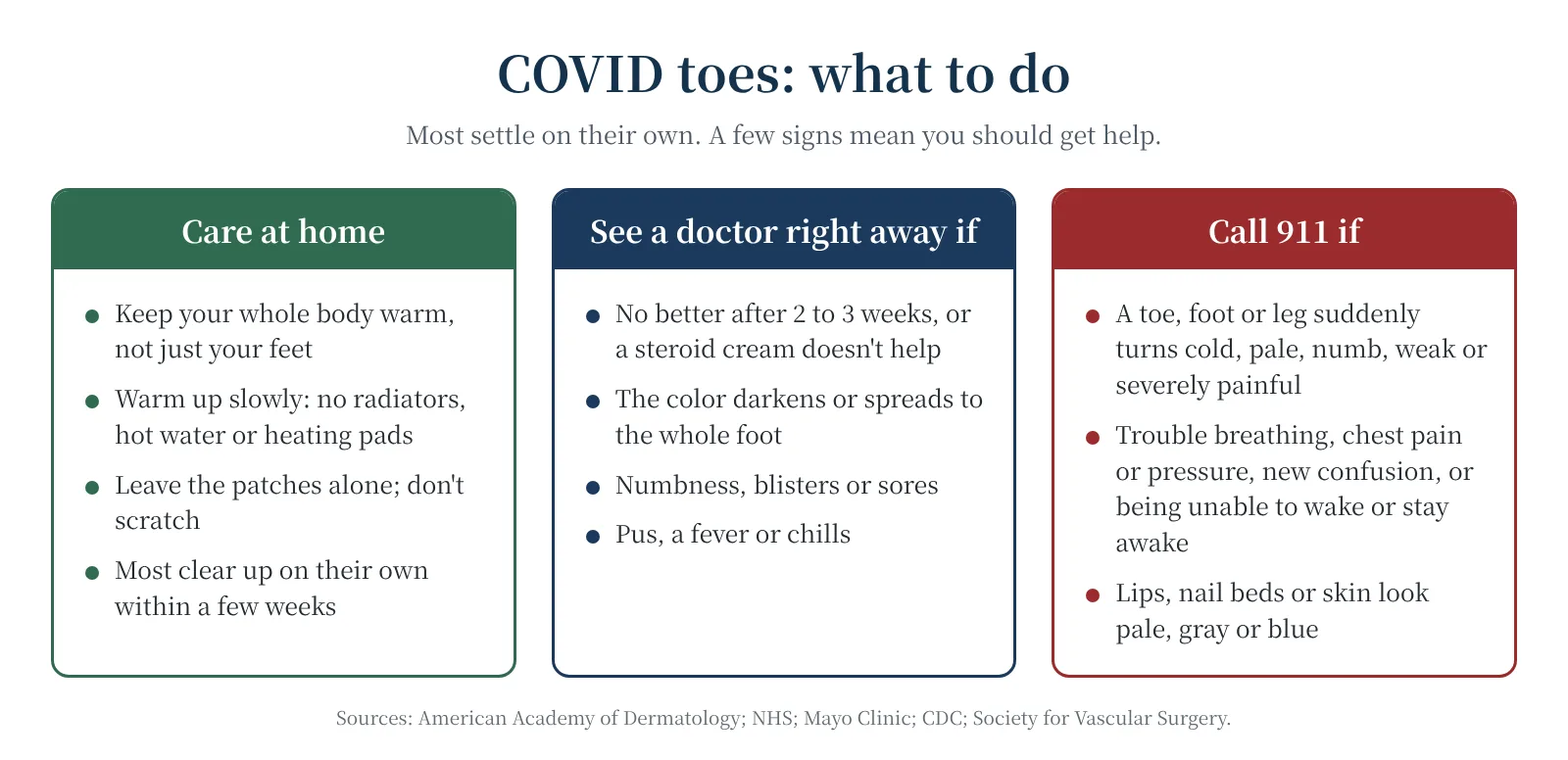
Call 911 if a toe, foot or leg suddenly becomes cold, pale or mottled, numb, weak or severely painful. This can mean the blood supply has been cut off, and time is critical. COVID toes are pink to purple and itchy or sore; they do not make a foot suddenly cold, white and numb.
COVID toes are not an emergency, but COVID-19 can be. Call 911 for trouble breathing, chest pain or pressure that does not go away, new confusion, being unable to wake or stay awake, or lips, nail beds or skin that look pale, gray or blue, depending on skin tone.
In a child, teen or young adult who had COVID-19, or was in close contact with someone who had it, in the past 6 weeks: an ongoing fever with two or more of stomach pain, diarrhea, vomiting, a rash, bloodshot eyes or dizziness needs a doctor right away. It can be MIS-C, a rare but serious delayed immune reaction to the virus. Get emergency care for any of the warning signs above, unusual behavior, or severe stomach pain.
See a doctor right away for pus, a fever or chills, new numbness, blisters or sores on the toes, or color that darkens or spreads to the whole foot. If you have diabetes or numb feet, have any toe sore or blister checked promptly. Care thresholds →
What COVID toes look like
The American Academy of Dermatology (AAD) describes one or more toes that swell and turn pink, red or purplish. Other features it lists:
- Spots and bumps: round, reddish-brown or purple spots, painful raised bumps, or patches of rough skin.
- Itching or pain in the affected toes. Blisters can form.
- Color on different skin tones. On lighter skin, the toes may look bright red at first and gradually turn purple, or start out purple. On darker skin, the AAD notes, COVID toes can cause purplish discoloration and swelling, and some people get round, brownish-purple spots.
- Fingers as well. Fingers can be affected instead of toes, or along with them, and the changes can start on one toe or finger or on several.
The pattern is the same as chilblains, which the NHS describes as itchy or burning patches that turn red or purple, mostly on the toes and fingers. The AAD calls COVID toes a form of chilblains, and doctors also use the terms chilblain-like or pernio-like lesions (pernio is another name for chilblains). For photos, see the AAD page listed in the sources below.
Who gets COVID toes
COVID toes can appear at any age, but children, teens and young adults seem most likely to get them, according to the AAD. Most were healthy and had mild COVID-19 symptoms or none at all. The AAD notes that COVID toes have also been reported in critically ill adults, and in a very few people after a COVID-19 vaccine.
The surge early in the pandemic was striking. Esther Freeman, a dermatologist in Boston, told Nature that she usually saw one or two such cases each winter, and in March 2020 was suddenly seeing 15 to 20 patients a day. Doctors elsewhere reported similar surges.
When they appear and how long they last
In young, healthy people, COVID toes may appear about 1 to 4 weeks after infection, the AAD says, and those affected usually feel well and test negative for the virus. DermNet describes them as a late sign after a mild illness, and notes that swab and antibody tests in these patients have mostly, but not always, been negative.
Most go away on their own. Cleveland Clinic says chilblain-like toe changes usually clear up within a couple of weeks, and the NHS says ordinary chilblains usually clear in 2 to 3 weeks. The AAD adds that toe changes can last much longer than most other COVID rashes, which typically last 2 to 12 days. Some people with long COVID develop COVID toes, and a rash that comes with long COVID may last as long as the other symptoms.
What causes COVID toes
Nobody is sure, and researchers disagree. The main ideas are:
- A strong immune response. One theory is that a powerful antiviral defense, called a type I interferon response, changes the small blood vessels in the skin. DermNet describes this idea, and Cleveland Clinic names this immune response as one reason COVID-19 can cause skin changes.
- Tiny clots or narrowed vessels. Frank Esper, MD, of Cleveland Clinic says it is possible that COVID toe results from a small clog or microclots in the blood vessels of the toes, and narrowing of those vessels is another possible explanation.
- Pandemic habits rather than the virus. A Kaiser Permanente study in JAMA Dermatology counted 780 chilblains cases in Northern California from April to December 2020, against 539 in the same months of 2016 to 2019 combined. Yet only 17 of 465 patients with chilblains tested positive for COVID-19, and just 9 within 6 weeks of their chilblains diagnosis. The authors suggested that people spending winter at home barefoot, and more people seeing a doctor about their toes, could explain the rise.
A 2022 study reported in Nature added to the evidence that the infection does not cause these chilblains, though it did not settle the question. In practice the answer matters less than it sounds: Cleveland Clinic notes that COVID toes are treated the same way as chilblains, whatever set them off.
COVID toes vs chilblains
They look the same. What differs is the story around them:
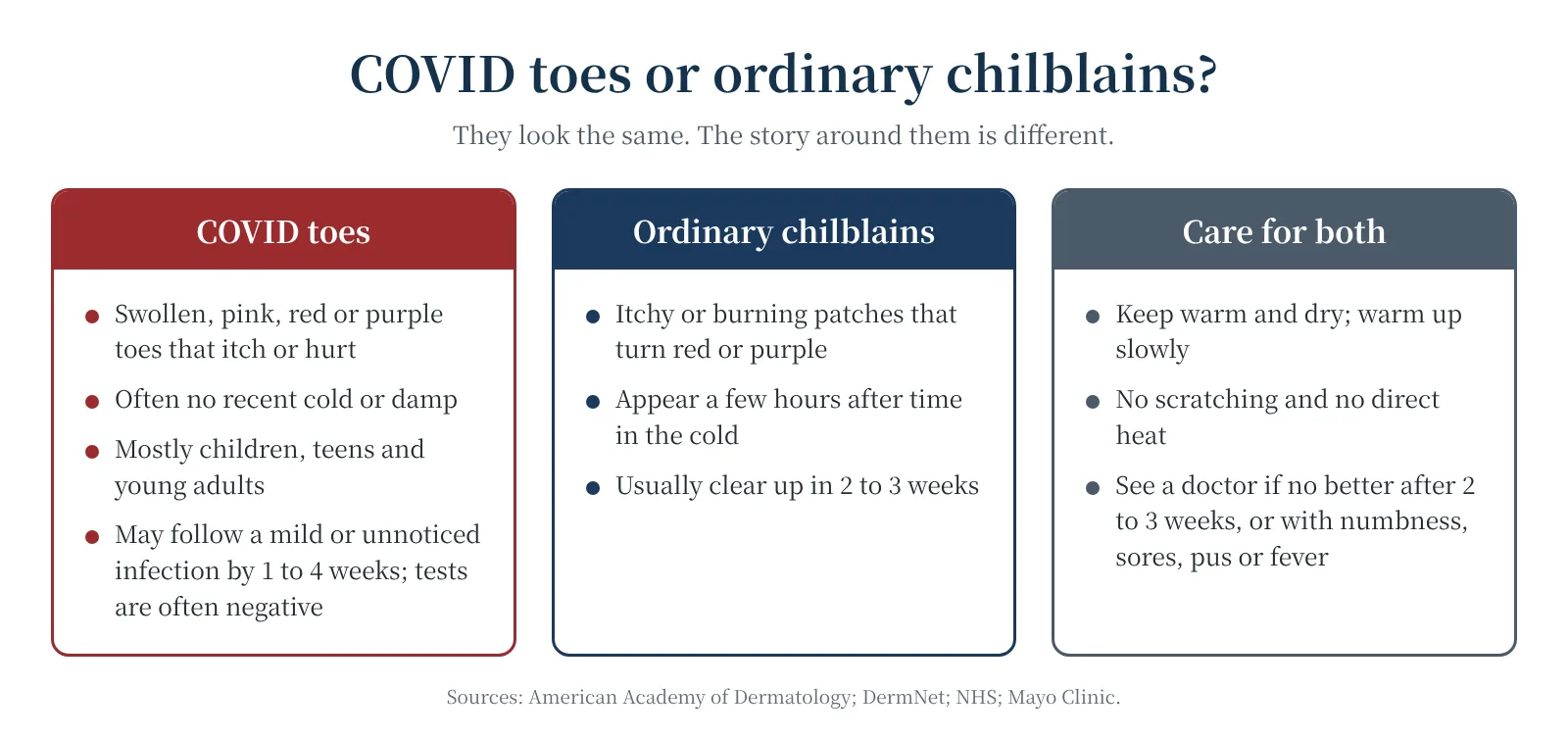
- Trigger. Ordinary chilblains appear a few hours after time in the cold, according to the NHS. Many people with COVID toes, DermNet notes, had no recent exposure to cold.
- Age. COVID toes have mostly affected children, teens and young adults.
- Infection. COVID toes may follow a mild or unnoticed infection by 1 to 4 weeks, and most people test negative by then.
- Course and care. Both usually settle on their own within weeks, and both are treated the same way.
Chilblains that keep coming back, or that last longer than expected, are worth a doctor’s visit. DermNet lists conditions that can cause secondary chilblains, including lupus (chilblain lupus), other connective tissue diseases and some bone marrow disorders, and the NHS advises seeing a doctor if you keep getting chilblains. More on the cold-triggered kind in chilblains on toes.
What helps
COVID toes usually need little treatment. These steps, drawn from AAD, NHS and Mayo Clinic advice on chilblains, ease symptoms while they settle:
- Keep your whole body warm, not just your feet, as the AAD advises: layers, warm socks and a comfortably warm home.
- Warm up gradually. Do not put your feet on a radiator or under hot water to warm them, the NHS says, and Mayo Clinic advises rewarming the skin slowly and gently, without massaging, rubbing or applying direct heat.
- Keep the skin dry, and change socks that get damp.
- Leave the patches alone. Do not scratch or pick at the skin, and keep any blisters or sores clean and covered.
- Soothe itching or pain. Mayo Clinic suggests a lotion such as drugstore hydrocortisone cream for itching. A dermatologist may recommend a corticosteroid cream or ointment, the AAD says. Check with a pharmacist before using any of these on a young child.
- Avoid things that narrow blood vessels: smoking, caffeinated drinks and decongestant cold medicines, which the NHS says can affect blood flow to the fingers and toes. Building a quit plan →
- Take dated photos as the toes change. They help a doctor if the changes have faded by the time of your appointment.
Keep heated socks and heating pads off affected toes
Mayo Clinic advises keeping chilblains warm but away from sources of heat. Heated socks and insoles press a heat source against the skin, so do not use them over active patches, and read heated socks and insoles before relying on them. With diabetes, numb feet or artery disease, ask your doctor before using them at all.
Should you take a COVID test?
The AAD suggests a COVID-19 test if you develop a rash or other COVID-19 symptoms, and Cleveland Clinic notes that a test is the only way to know whether a skin change is linked to COVID-19. Two things to keep in mind:
- A negative test does not rule it out. COVID toes often appear weeks after the infection, and swab and antibody tests in these patients have mostly been negative.
- A positive test means following the usual advice for COVID-19 itself. Cleveland Clinic suggests calling your provider if you test positive and have skin symptoms, and notes that a provider may suggest an antiviral medicine if your age or health puts you at higher risk of complications.
When to see a doctor
Most COVID toes can be watched at home. The AAD advises seeing a dermatologist or your primary care doctor right away if:
- the skin has not improved within 2 to 3 weeks
- a corticosteroid cream or ointment does not relieve the symptoms
- the discoloration darkens or spreads to the whole foot, leg, hand or arm
- numbness, blisters or sores develop
- you get a fever, feel hot or have chills
- pus comes from the toes or fingers
The NHS also advises seeing a doctor if you keep getting chilblains, or if you have diabetes, because foot problems can be more serious then. A podiatrist can help too, especially with a sore, a blister or a nail problem on the toes.
What a doctor may do
DermNet notes that tests are sometimes needed to rule out other conditions or to find a cause of secondary chilblains. They can include:
- a complete blood count
- blood tests for autoimmune conditions, such as antinuclear antibodies (ANA), rheumatoid factor and antiphospholipid antibodies, plus complement levels
- protein electrophoresis, and tests for proteins that react to cold (cold agglutinins and, in children, cryoglobulins)
- a small skin sample (biopsy)
- a close look at the tiny blood vessels at the base of the fingernails (nailfold capillaries), if a connective tissue disease is suspected
For treatment, a dermatologist may recommend a corticosteroid cream or ointment, as the AAD notes. For chilblains that do not settle, Mayo Clinic and the NHS mention prescription medicine that widens the blood vessels, such as nifedipine, a blood pressure medicine.
COVID toes vs Raynaud’s, frostbite and athlete’s foot
Other toe problems can look similar at first glance. What set the change off, and how long each episode lasts, are the most useful clues.
| Condition | What sets it off | What you notice | What it needs |
|---|---|---|---|
| COVID toes | Possibly a reaction linked to COVID-19, often 1 to 4 weeks after a mild or unnoticed infection; often no cold exposure | Swollen, pink, red or purple toes or fingers that itch or hurt; sometimes spots, bumps or blisters; usually clears within weeks | Warmth and time; a doctor if not better in 2 to 3 weeks, or with numbness, sores, pus or fever |
| Chilblains | A few hours after time in the cold | Itchy or burning patches that turn red or purple, mostly on the toes and fingers | Warming up gradually and keeping dry; most clear up in 2 to 3 weeks |
| Raynaud’s | Cold, anxiety or stress; each attack lasts minutes to hours | Fingers or toes change color; pain, numbness or pins and needles | Warmth and trigger control; a check-up if it starts after 30 or in a child under 12, affects one side only, or comes with joint pain, rashes or muscle weakness |
| Frostbite | Time in freezing temperatures | Cold, numb, painful skin that can turn white, blue or blotchy, harden and blister, and later turn black | Emergency care (911) for hard, frozen skin, swelling with loss of feeling, or blisters after the cold, and for constant shivering, slurred speech, slow breathing, tiredness or confusion |
| Athlete’s foot | A fungus, often picked up walking barefoot in shared showers or changing rooms | Itchy white patches between the toes; sore, flaky or cracked skin; sometimes blisters | An antifungal cream, spray or powder from a pharmacy |
A toe or foot that suddenly turns cold, pale, numb, weak or severely painful is a different and urgent problem: see the box at the top of this page. Other color changes in the feet are covered in red, blue, pale or purple feet, and Raynaud’s in more depth in Raynaud’s syndrome.
Common questions
How are COVID toes treated?
Usually with time and warmth. Keep your whole body warm, warm up gradually without direct heat, keep the skin dry and avoid scratching. A hydrocortisone lotion can ease itching, and a dermatologist may recommend a corticosteroid cream or ointment. Check with a pharmacist before using these on a young child. COVID toes are treated the same way as chilblains.
Do COVID toes go away?
Yes, in most people. They usually clear up on their own, often within a few weeks, though they can last longer than other COVID rashes, especially in people with long COVID. See a doctor if they have not improved after 2 to 3 weeks.
Are COVID toes dangerous?
Usually not. Most people who get them are young and healthy and feel well, and the toes settle on their own. Get checked right away for numbness, blisters, sores, pus, a fever or chills, or discoloration that spreads to the whole foot, and call 911 for a toe or foot that suddenly turns cold, pale, numb, weak or severely painful.
Can the COVID-19 vaccine cause COVID toes?
Reports are rare. The AAD notes that COVID toes have been reported in a very few people after a COVID-19 vaccine. If it happens, the toes are cared for in the same way, and it is worth telling your doctor.
Can adults get COVID toes?
Yes. They can appear at any age, though children, teens and young adults seem most likely to get them. They have also been reported in adults who were critically ill with COVID-19.
Can COVID toes affect the fingers?
Yes. The AAD notes that fingers can be affected instead of the toes, or along with them. The care is the same: keep the whole body warm and avoid direct heat.
Are COVID toes a sign of long COVID?
They can be. The AAD notes that some people with long COVID develop COVID toes, and that they may be one sign of it. Most people with COVID toes, though, have them only for a few weeks after a mild illness.
Where to go next
- Chilblains on toes: causes, treatment and when to worry
- Red, blue, pale or purple feet
- Raynaud’s syndrome: why fingers and toes turn white, then blue
- Cold feet: common causes and when to get checked
- Daily foot and leg skin checks
- When to seek care
- Near Howell or Bloomfield Township, Michigan: a foot and ankle evaluation (the author’s own practice)
Sources
- American Academy of Dermatology. COVID toes and other rashes COVID-19 may cause (includes photos).
- Cleveland Clinic. COVID Toes, COVID Rashes and Other Skin Complications: A Quick Guide.
- DermNet. Chilblains.
- NHS. Chilblains, Raynaud’s, Frostbite and Athlete’s foot.
- Mayo Clinic. Chilblains: Diagnosis and treatment and Raynaud’s disease: Symptoms and causes.
- Kaiser Permanente Division of Research. ‘COVID toes’ were likely not caused by COVID-19, in most cases (on a study in JAMA Dermatology, 2021).
- Willyard C. Are ‘COVID toes’ actually caused by the coronavirus? Nature, 2022.
- Centers for Disease Control and Prevention. Symptoms of COVID-19 and How to Recognize Multisystem Inflammatory Syndrome in Children (MIS-C).
- Society for Vascular Surgery. Acute Limb Ischemia.
Written by Tom Biernacki, DPM, FACFAS. Published 13 November 2026. General education, not medical advice.