Frostbite is the freezing of skin and the tissue under it, most often on the toes, fingers, ears and nose, after time at or below 32°F (0°C) or contact with frozen metal, ice or very cold liquids. Frostbitten skin first turns red or pale and stings or aches, then goes numb; frozen skin looks white, grayish-yellow, gray or blue and feels hard or waxy, and after warming it swells and may blister, while deep frostbite later turns black. Frostnip, the mildest form, is numb, pale or red skin that stays soft and returns fully to normal within minutes of warming. Anything more is an emergency, because the hospital drugs that can save frozen toes work only within hours to days. The feet are among the parts most often affected, and the most common in several hospital series; diabetes, numb feet or poor circulation raise the risk and hide the warning signs.
When frostbite needs emergency care
- Signs of hypothermia, such as shivering hard, or shivering that stops while the person is still cold, confusion, slurred speech, drowsiness or slow breathing, or a person you cannot warm up: call 911. Move them somewhere warm, replace wet clothes with dry layers, give warm drinks only if they are fully awake, never alcohol, handle them gently, and start CPR if they are not breathing or have no pulse.
- No quick, safe way to an emergency department, for example because the person would have to walk on frozen feet or drive with numb feet, is intoxicated or confused, or cannot be kept warm: call 911. Otherwise, have someone else drive.
- Signs of sepsis, such as confusion, fast breathing, a racing heartbeat, or cold, clammy, pale or blotchy skin: call 911.
- A foot or leg that suddenly turns cold, pale, numb or very painful without freezing cold to explain it: call 911, because a blocked artery is an emergency. If you cannot tell whether it is frostbite or a blocked artery, call 911.
- Possible frostbite: skin that stays numb, is white, grayish-yellow, gray, blue or waxy, or feels hard after freezing cold or contact with something frozen; any blisters, especially blood-filled ones; skin still numb or discolored after warming, including frostnip that does not fully recover; skin that has turned black, gray or dark purple, or looks dead, whether or not it froze; or intense pain despite a pain reliever after rewarming: go to an emergency department now. The hospital drugs that can save toes work only within hours to days: guidelines give clot-dissolving drugs within 24 hours of the injury and iloprost within 72 hours, both best as early as possible, so do not wait for blisters. Do not rub the skin, use dry heat, walk on thawed feet, or thaw it if it could freeze again.
- Red streaks, redness spreading fast, red skin or a wound with a fever or chills, or redness still spreading after 2 days of antibiotics while frostbite heals: go to an emergency department now.
- New red, hot, painful or swollen skin, pus, or a growing sore without a fever; or, when there was no freezing cold, a toe that stays dusky blue or purple or a new dark patch on a toe: get same-day care.
- Skin that recovered from frostnip but is pink, mildly swollen, itchy or tingling the next day, with normal feeling and no blisters: get same-day care, and go to an emergency department now if any of it turns numb, hard, white, gray, blue or purple, or blisters.
- Diabetes, numb feet or poor circulation: do not rely on feeling. After long cold exposure, look at your feet in good light; white, gray, waxy or blistered skin needs an emergency department now, and any new sore needs same-day care. Numb toes: causes and when to worry →
- One leg newly swollen, especially after a hospital stay, surgery or weeks off your feet: get same-day care and an ultrasound today to rule out a blood clot. Call 911 for chest pain or discomfort, sudden or at-rest breathlessness, coughing blood, fainting, or a leg that becomes massively swollen, very painful and blue or white.
- A sore that has not healed in 2 weeks: get prompt medical care, not a routine wait; if a clinician is already treating it, tell them.
On brown or black skin, color changes and the blackening of dying skin can be harder to see, so go by numbness, coldness, a hard or waxy feel, swelling and blisters, and compare with the other foot, remembering that both feet are often frozen, so matching feet do not rule frostbite out; the gray, blue or blotchy color of sepsis may show best on the palms or soles. If you are unsure which applies, choose the more urgent option.
What is frostbite?
The NHS, the UK’s health service, defines it: “Frostbite happens when your skin freezes after being in very cold temperatures.” For frostbite from cold air, the air itself must be at or below 32°F (0°C). The US National Weather Service (NWS) notes that wind chill alone cannot cause frostbite, but wind speeds it up: at 0°F (−18°C) with a 15 mph wind, the wind chill is −19°F (−28°C), and the NWS warns, “At this wind chill temperature, exposed skin can freeze in 30 minutes.” Bare skin on cold metal can freeze within seconds. Gloves and boots are no guarantee: toes freeze inside wet or tight boots.
Ice crystals form in and between cells and kill them. Nearby tissue is harmed too, because cold narrows small blood vessels and tiny clots form in them; as blood returns on thawing, inflammation adds damage, the Merck Manual explains. Those clots are what the hospital drugs below try to clear.
Frostbite symptoms
The CDC says redness or pain may come first, then a white or grayish-yellow area, skin that feels unusually firm or waxy, and numbness, which is the trap: “A person who has frostbite may not know they have it until someone else points it out because the frozen parts of their body are numb.” The NHS adds stinging, burning, aching or throbbing at first, then hard, frozen, white, blue or blotchy skin with swelling and loss of feeling. Mayo Clinic notes clumsiness from stiff joints, which in the feet means trouble walking, and warns that frostbitten skin that starts to feel warm is a sign of serious skin involvement.
Thawing hurts. The skin turns blotchy red, swollen and painful, and blisters can form within hours or up to a day or two later. Skin that stays numb after rewarming is a bad sign.
What frostbite looks like: frostbite pictures in words
- Frostnip: a pale or red, numb patch that is still soft.
- Superficial frostbite: white or grayish-yellow, waxy skin that turns red and swollen on warming, sometimes with blisters of clear or milky fluid. Of a photo of swollen gray toes with clear blisters, a Merck Manual caption notes: “The absence of blood in blisters suggests that frostbite is superficial (here, second degree) and that residual tissue loss is unlikely after healing.”
- Deep frostbite: blue-gray skin, or blisters of dark red or purple, blood-stained fluid. In the Merck Manual’s words, “Depth of injury is difficult to recognize initially, although blood-filled blisters indicate deep damage.”
- Weeks later: clear blisters dry and blacken by about 2 weeks and peel at 3 to 4 weeks; deep frostbite forms a hard black shell, which may peel away from living tissue, or the toes shrivel and mummify.
Frostbite on brown or black skin
Mayo Clinic cautions: “Changes in the color of the affected area might be difficult to see on brown and Black skin.” Burn-center specialists add that lost blood flow is hard for clinicians to judge by eye, particularly in darker skin. Go by numbness, coldness, a hard or waxy feel, swelling and blisters, and compare with the same toe on the other foot in daylight; matching feet do not rule frostbite out, because both are often frozen. Foot color changes: what they can mean →
Frostnip vs frostbite
The Merck Manual explains: “Frostnip is a nonfreezing tissue injury, often a precursor to frostbite, involving numbness and pallor of exposed skin.” The tissue does not freeze, so it stays soft, and a 2019 review in American Family Physician notes that “there is no tissue loss when the area is warmed, and symptoms resolve within 10 minutes.” Mayo Clinic calls frostnip the first stage of frostbite; the Wilderness Medical Society (WMS), whose guideline shapes most frostbite care, calls it a separate injury that often comes first.
| Feature | Frostnip | Frostbite |
|---|---|---|
| Tissue frozen? | No | Yes |
| How it feels | Cold, numb or tingling, but soft | Numb, firm, hard or waxy |
| Color | Pale or red | White, grayish-yellow, gray, blue or blotchy; later red, purple or black |
| After warming | Back to normal color and feeling within minutes | Swollen, painful, often blistered; may stay numb |
| How urgent | Self-care only if color and feeling return fully; otherwise treat it as frostbite | Emergency department now; 911 with signs of hypothermia |
To treat frostnip, get out of the wind, replace wet socks and warm the skin with body heat, such as a companion’s armpit, for about 10 minutes. If color and feeling return fully, it was frostnip. If numbness, hardness, discoloration or blisters remain, treat it as frostbite and go to an emergency department now. With diabetes, numb feet or poor circulation you cannot rely on feeling, so judge by the skin, and if in doubt, go now.
Frostbite stages
Frostbite is graded by depth, like a burn, after rewarming.
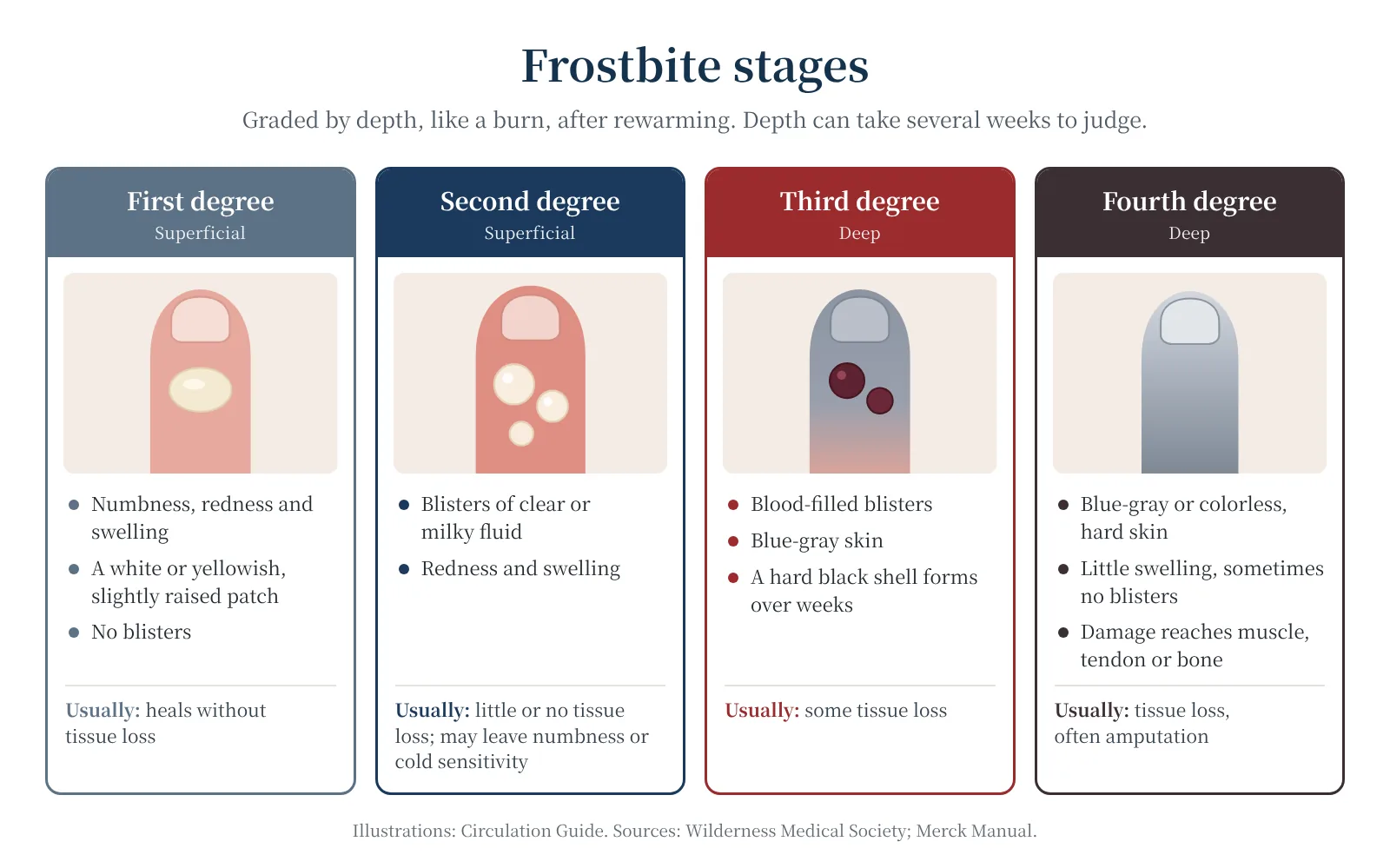
| Degree | What you see, mostly after rewarming | Depth | Usual outcome |
|---|---|---|---|
| First | Numbness, redness and swelling; a white or yellowish, slightly raised patch; no blisters | Superficial | Heals without tissue loss |
| Second | Blisters of clear or milky fluid, with redness and swelling | Superficial | Little or no tissue loss; may leave numbness or cold sensitivity |
| Third | Blood-filled blisters; blue-gray skin; a hard black shell over weeks | Deep | Some tissue loss |
| Fourth | Blue-gray or colorless, hard skin, little swelling, sometimes no blisters; damage reaches muscle, tendon or bone | Deep | Tissue loss, often amputation |
Depth can take several weeks to judge and can differ between toes on the same foot. Hospitals also use the Cauchy grading, which records how far up the toe blue-gray discoloration reaches after rewarming: grade 1 has none, and amputation is unlikely; grade 4 reaches the midfoot, with a historical amputation risk of 100%. The grade guides which drugs are given.
Frostbite on toes and feet
Feet alone were affected in 62% of 32 patients at one burn unit (both hands and feet in another 19%), and feet alone in 60.9% of 128 patients in eastern Turkey. A 2025 military review explains that feet have little muscle to make heat and a large surface to lose it. Feet also pose a dilemma hands do not: you may have to walk out on them, and thawed feet are fragile. Cold feet: common causes and when to get checked →
Who is at risk of frostbite?
The CDC lists older adults without proper food, clothing or heating, people outdoors for long periods, people who drink heavily or use illicit drugs, and babies sleeping in cold rooms. The Merck Manual’s consumer edition adds: “People at greatest risk of developing frostbite are those who have poor circulation because of diabetes or arteriosclerosis, blood vessel spasm (which may be caused by smoking, some neurologic disorders, or certain medications and drugs), or constriction of blood flow by gloves or boots that are too tight.”
- Diabetes, peripheral artery disease and numb feet. Narrowed arteries bring less warmth, and the CDC notes that diabetic nerve damage can lower your ability to feel pain, heat or cold.
- Raynaud’s phenomenon, smoking and some medicines; MedlinePlus lists beta-blockers. Never stop a prescribed medicine without asking your prescriber. Raynaud’s: symptoms, triggers and treatment →
- Older age and dementia. Mayo Clinic notes that infants and older adults have a harder time making and keeping body heat.
- Alcohol and drugs. Alcohol speeds heat loss and clouds judgment, and a Minneapolis study of 148 patients found that “Any history of drug and/or alcohol use independently predicted amputations.”
- Homelessness. Of 257 people with severe frostbite in Calgary and Edmonton, 54.5% were homeless, and they had 2.90 times the odds of reaching the emergency department late.
- Outdoor work and winter sport, such as snow cleanup, construction and climbing.
- A car crash or breakdown in winter, and a previous frostbite injury, which makes another more likely.
How to treat frostbite: first aid
These steps follow the WMS guideline, the CDC and MedlinePlus. The NHS, Mayo Clinic and the Merck Manual also suggest a warm soak while you wait; we follow the WMS rule of bathing only when care is more than 2 hours away, because in hospital the water temperature and pain are controlled and the drugs can start without delay. They are first aid on the way to an emergency department, not a replacement for one.

- Treat hypothermia first. Shivering hard or no longer shivering, confusion, slurred speech or drowsiness: call 911 and warm the whole body.
- Get out of the cold and wind. Take off wet socks, boots, rings and anything tight before swelling starts, unless you must walk out, because boots may not go back on.
- Do not rub it. The CDC says: “Do not rub the frostbitten area with snow or massage it at all.”
- Use no dry heat. The Merck Manual warns: “Rewarming with an uncontrolled dry heat source (eg, fire, heating pad) should be avoided because the affected area is numb and at risk of burns.” That includes stoves, heaters, hair dryers, car heaters, hot water bottles, heated socks and toe warmers.
- Do not thaw it if it could freeze again. A 2020 summary of the WMS guideline in American Family Physician states: “To prevent worsening tissue damage, a frostbitten extremity should be rewarmed only if there is no risk of refreezing.” Keep a frozen part clean, dry and padded until it can stay thawed.
- Do not walk on frostbitten feet unless you must. The CDC warns: “Unless absolutely necessary, do not walk on feet or toes that show signs of frostbite—this increases the damage.” Thawed feet are even more easily hurt, so if walking out is the only way to safety, a 2014 review advises walking on frozen feet rather than thawing them and risking refreezing.
- Get to an emergency department. The same summary advises: “Rapid rewarming in the field should be performed only if definitive care is more than two hours away and refreezing can be prevented.” If help is closer, keep the person warm and go, and let the part thaw on the way if it does. Never let a bath delay the trip.
- After any thawing, pat or air dry, put dry gauze between the toes and a loose dressing over them, raise the feet, leave blisters alone, avoid walking, and have a warm, non-alcoholic drink. For pain, the WMS suggests ibuprofen, if it is safe for you, because it may limit damage (a weak recommendation); the NHS suggests acetaminophen (paracetamol). Tell the hospital what you took.
The warm-water bath: exact numbers
Use a bath only if care is more than about 2 hours away, or you are stranded, and the part will not freeze again. The WMS guideline summary says: “Water should be heated to 98.6 to 102.2°F (37 to 39°C), with a thermometer used to maintain this range.” Numb skin cannot judge heat, so use a thermometer if you have one. Without one, the summary advises holding an uninjured limb in the water for 30 seconds to check that it is tolerable: use a hand or wrist with normal feeling, or ask a companion to test it, and never test with a foot if you have diabetes, numb feet or poor circulation. Immerse the whole foot, move it gently, keep it off the sides of the tub, and top up with warm water away from the foot. The summary adds: “Rewarming is complete when the injured extremity appears red or purple and becomes soft and pliable, typically within 30 minutes depending on the extent and depth of frostbite.” Expect burning pain and swelling as it thaws.
Hospitals sometimes use warmer water. The American Burn Association’s 2024 guideline states: “We conditionally recommend the use of rapid rewarming in a 38 to 42°C water bath and the use of thrombolytics for fewer amputations and/or a more distal level of amputation.” That is 100.4–107.6°F. Some first-aid advice is warmer still: the MedlinePlus encyclopedia, a US government site, suggests 104–108°F (40–42.2°C) for rewarming when help is not nearby. Outside hospital, use the WMS range and a thermometer: a 2014 review notes that it hurts less while only slightly slowing rewarming, and numb skin cannot tell when water is hot enough to burn.
Frostbite treatment in the hospital
The 2019 review advises that frostbite is ideally managed where rapid rewarming, imaging and clot-dissolving treatment are available; a 2014 review and the 2024 WMS guideline add that a hospital without them should start treatment and arrange an urgent transfer. At triage, say you think it is frostbite and when it happened, and do not leave before you are seen: in a Calgary and Edmonton study, 38 of 144 people who left without being seen came back more than 72 hours after the injury with grade 2 to 4 frostbite.
Rewarming and scans
The frozen part is thawed in circulating water, usually for 15 to 30 minutes, with strong pain relief. Ibuprofen, a tetanus shot if due, elevation and dry, bulky dressings follow; blood-filled blisters are left intact, and antibiotics are not routine. A technetium-99m bone scan, angiography or magnetic resonance angiography shows which tissue still has a blood supply.
Clot-dissolving drugs (tPA)
Tissue plasminogen activator (tPA, alteplase), given by vein or into an artery, can dissolve the small clots that starve thawed tissue. The 2024 WMS guideline suggests it for severe (grade 3 or 4) frostbite within 24 hours of injury, a strong recommendation from low-quality evidence, and the American Burn Association prefers starting within 12 hours of rewarming. In a 2007 study of 32 patients at one burn unit, the digital amputation rate was 41% in patients not given tPA and 10% in the 6 given it within 24 hours of injury. A 2023 systematic review of 978 cases, nearly all from observational studies and case reports, concluded: “The two meta-analyses we performed both found that patients treated with thrombolytics within 24 h had better outcomes than patients treated with other modalities.” Bleeding serious enough to change treatment occurred in 8% of patients in one study, so doctors avoid tPA after recent trauma or a stroke in the past three months, and with bleeding disorders, blood thinners or very high blood pressure.
Iloprost (Aurlumyn)
Iloprost widens small blood vessels and stops platelets clumping. On February 14, 2024, the FDA announced: “The U.S. Food and Drug Administration approved Aurlumyn (iloprost) injection to treat severe frostbite in adults to reduce the risk of finger or toe amputation.” It is given by vein in hospital.
The evidence is thin. The label states: “Effectiveness was established in young, healthy adults who suffered frostbite at high altitudes.” The trial randomized 47 people at one center, none with diabetes; a day-7 bone scan predicting amputation was abnormal in 60% of those given buflomedil, an older drug since withdrawn, 19% of those given iloprost with tPA, and none of those given iloprost. A Cochrane review concluded: “Very low-quality evidence from a single small trial indicates that iloprost, and iloprost plus rtPA, in combination with buflomedil may reduce the need for amputation in people with severe frostbite compared to buflomedil alone.” The American Burn Association could make no recommendation on iloprost.
In the Calgary and Edmonton study of 257 patients, iloprost was linked to about half the odds of any amputation, and treated grade 3 injuries led to amputation in 30%, against 52% untreated, although more than 80% of grade 4 injuries ended in amputation either way. According to a 2025 summary, the 2024 WMS guideline suggests iloprost for grade 2 to 4 frostbite “up to 72 h after injury but ideally as soon as possible”, a strong recommendation from low-quality evidence. Headache, flushing, a fast heartbeat, nausea and low blood pressure are common, and safety in children has not been established.
Why time to treatment matters
A 2026 review of protocols at 16 North American burn centers warns: “Unfortunately, many patients delay seeking care for their injuries and arrive outside treatment windows resulting in high rates of amputation and long-term disability.” In 73 patients with lost blood flow at one burn center, each hour of delay before clot-dissolving treatment cut tissue salvage by about 28%. In the Turkish series, every patient arrived more than 24 hours after exposure, too late for clot-dissolving drugs. The Calgary and Edmonton study found no link between arrival time and amputation, but guidelines still advise treatment as early as possible.
Can frostbitten toes be saved?
Often. Depth decides most: in the Turkish series, 81.5% of 65 patients with third-degree frostbite needed amputation, against 1 of 63 (1.6%) with first- or second-degree injury. Early treatment saves more deep injuries, while grade 4 injuries are often lost regardless. Across 4,786 US frostbite admissions in 2016–2020, 29.7% of patients had an amputation. Black skin is not always dead; the Merck Manual notes: “Usually, surgery is delayed as long as possible because the black carapace is often shed, leaving viable tissue.” A carapace is a hard shell. A toe that turns black still needs an emergency department now.
Frostbite surgery: when surgeons operate
The 2020 WMS guideline summary says the line between dead and living tissue may take up to three months to form, and advises amputation before then only for signs of sepsis; a 2014 review adds wet gangrene and overwhelming infection, and warns that premature amputation worsens later function. The traditional wait was 4 to 6 weeks, yet 68.7% of US amputations in 2016–2020 were early, and a 2022 review notes: “Recently, the standard has shifted to early surgical management ascertained through radiographic imaging.” Timing is now decided case by case. Meanwhile the 2014 review stresses: “During the demarcation period, it is important to provide adequate protection especially footwear.” It recommends working with podiatry and orthotics teams, and custom footwear if an amputation changes how the foot works.
How long does frostbite take to heal?
| Injury | Typical course |
|---|---|
| Frostnip | Back to normal within minutes of warming |
| Superficial frostbite | Blisters dry and blacken at about 2 weeks and peel at 3 to 4 weeks; the outlook is excellent if the deeper skin is spared |
| Deep frostbite | Mummified toes become clear at about 2 weeks; dead tissue is removed at 2 to 8 weeks; the full extent can take up to 3 months to show |
| After hospital | The average US stay is about 9 days; most people improve slowly over several months |
Long-term effects of frostbite
In a 2021 review, 341 of 493 patients (69%) had lasting effects. The Merck Manual notes: “All degrees of frostbite may cause faulty nail growth and long-term neuropathic symptoms: sensitivity to cold, excessive sweating, and numbness”, and no treatment fully relieves them. Arthritis resembling osteoarthritis can appear years later; in children, damage to growth plates can deform bones; and frostbite in the same part becomes more likely. Nerve pain medicines such as amitriptyline, gabapentin or duloxetine may help, on limited evidence. Do not stop or change a prescribed medicine without your prescriber.
Frostbite vs trench foot vs chilblains, and other look-alikes
Trench foot is a non-freezing cold injury (NFCI). Ken Zafren, an emergency physician, writes in a 2021 review: “Unlike frostbite, which is sharply demarcated between frostbitten areas distally and unfrozen areas proximally, sharp demarcation is not seen with NFCI.” The two can occur together.
| Condition | Brought on by | What you notice | How urgent |
|---|---|---|---|
| Frostnip | Brief freezing cold | Pale or red, numb, still soft; normal within minutes of warming | Self-care only if color and feeling return fully; otherwise emergency department now |
| Frostbite | 32°F (0°C) or below, or touching something frozen | Hard, numb, white, grayish-yellow, gray or waxy skin; blisters within a day or two; later black | Emergency department now; 911 with signs of hypothermia or no quick, safe way there |
| Hypothermia | Cold, even above 40°F (4°C) when wet | Shivering, confusion, slurred speech, drowsiness | Call 911 |
| Trench foot | Feet wet and cold for hours to days, up to 60°F (16°C) | Whole foot numb, pale and swollen, then red, hot and painful; no sharp edge | Same day; emergency department now if the skin may have frozen, for black, dark purple or gray skin, blood-filled blisters, red streaks, fast-spreading redness, or a fever or chills |
| Chilblains | Damp cold above freezing | Itchy or burning red to purple patches hours later; clear in 2 to 3 weeks | Self-care for itchy red or purple patches that are fading; same day if a toe stays dusky blue or purple, for pus or spreading redness, or for a sore with diabetes, numb feet or poor circulation; emergency department now for a toe that is black, gray or dark purple or looks dead, redness spreading fast, or a fever or chills |
| Raynaud’s phenomenon | Cold or stress | Toes white, then blue, then red, for minutes to hours | Routine; prompt appointment if only one side is affected; same day for a sore, a new dark patch, or a toe that stays dusky blue or purple after warming; emergency department now for a toe that is black, gray or dark purple or looks dead |
| Gangrene from poor circulation | Narrowed or blocked arteries, often with diabetes | A black, gray or dark purple toe, dry or swollen and oozing, without freezing | Emergency department now; 911 for signs of sepsis |
| Burn from rewarming or a warmer | Hot water, fire, a heating pad or a warmer on numb skin | Red, blistered skin where the heat touched | Same day; emergency department now if large or deep, for blood-filled blisters, or if it could be frostbite |
| Infection of thawed skin (cellulitis) | Bacteria in damaged skin | Hot, painful, spreading redness or swelling; pus | Same day; emergency department now if spreading fast, red streaks, blood-filled blisters, a fever or chills, or still spreading after 2 days of antibiotics; 911 for signs of sepsis |
| Sudden blocked artery | A clot or injury blocking an artery; no cold needed | A foot or leg that is suddenly cold, pale, numb or very painful | Call 911 |
- Trench foot is rewarmed slowly in air, not in a warm bath. Trench foot: stages, treatment and recovery →
- Chilblains appear hours after damp cold and itch rather than freeze. Chilblains: how they differ →
- Gangrene can follow deep frostbite or come from narrowed arteries with no cold at all. Gangrene of the feet and toes →
How to prevent frostbite on your feet
The 2024 WMS update counts any temperature below 32°F (0°C) as some risk, rising below 5°F (−15°C).
- Layer your socks. A 2025 military review notes: “Two pairs of thin socks insulate better than one pair of thick socks”, a thin inner pair against blisters and an insulating outer pair, in materials that wick moisture and dry quickly.
- Fit boots over those socks. Boots should be insulated and waterproof, fitted with the socks you will wear, with room to wiggle your toes; a second sock that makes a boot tight defeats the purpose.
- Stay dry. Avoid sweating through socks, carry a dry pair, and change damp socks at breaks and before sleep. Do not count on creams to protect against frostbite; the WMS says skin emollients do not protect and may increase the risk, so if you moisturize dry feet, as diabetes foot care advises, do it at bedtime rather than before going out.
- Watch the wind chill and the clock. Check forecasts, limit time outside, and warm your toes at the first numbness.
- Avoid alcohol and drugs, eat and drink regularly, keep moving without exhausting yourself, and stop smoking.
- Prepare the car. Mayo Clinic advises carrying emergency supplies and warm clothing in case you are stranded, such as spare socks, warm boots and a blanket.
Heated socks, insoles and toe warmers
The WMS lists foot warmers as prevention, but they put direct heat on skin that may not feel it. HotHands’ US website gives its toe warmers an average of 97°F (36°C) and a maximum of 115°F (46°C); warning text from HotHands packaging, as listed by a New Zealand pharmacy (which gives a maximum of 158°F, or 70°C), says not to use the warmers on anyone who cannot feel heat and, unless a physician allows, on people with circulatory problems, nerve damage or diabetes, or on frostbitten skin. The National Institute of Diabetes and Digestive and Kidney Diseases warns: “If you have nerve damage from diabetes, you may burn your feet and not know you did.” A news article from Joint Base San Antonio reports that every year many diabetic patients must be admitted to the burn unit after trying to warm cold feet, and a 2026 heated-sock recall cited 13 first- or second-degree burns.
Never use heated socks, insoles, toe warmers or heating pads to rewarm frostbitten or cold-numbed feet. With diabetes, numb feet or poor circulation, we advise against them altogether. Anyone else should follow the label: over a sock, never against bare skin, never while sleeping or in tight boots, and check the feet often. Heated socks and insoles: who should skip them →
If you care for an older adult, or someone with dementia, diabetes, numb feet or poor circulation, check their feet after time in the cold. Daily foot and leg skin checks →
When to see a podiatrist
After the emergency department, a podiatrist can help with wound and blister care, padding and footwear while the foot heals, care after a toe amputation, and lasting numbness, sweating, nail changes or nerve pain. Make a prompt appointment if numbness, tingling, pain or cold sensitivity lingers after healing, and follow the urgent box for anything new. When to seek care for leg and foot symptoms →
What to expect
Tell the clinician when it happened, how long you were out, whether your feet were wet, how they were warmed and whether they refroze, and about diabetes, circulation problems, smoking and your medicines.
Near Howell or Bloomfield Township, Michigan?
The author of this site practices podiatry at Balance Foot & Ankle, which he owns, so this is a disclosed option rather than an independent referral. Suspected frostbite needs an emergency department first. Afterward, a foot-and-ankle evaluation can care for healing blisters and wounds, protect the feet with padding and footwear while they recover, check circulation and sensation, and help with lasting numbness, nail changes or cold sensitivity alongside your other clinicians. Michigan evaluation →
Common questions
What does frostbite look like?
At first the skin is red or pale; frozen skin is white, grayish-yellow, gray or blue and feels hard, waxy and numb. After warming it swells and may blister: clear blisters suggest superficial frostbite, blood-filled ones deep frostbite, which later forms a hard black shell. On brown or black skin, go by numbness, hardness and blisters. Any of these needs an emergency department now.
How do you tell frostnip from frostbite?
Frostnip is numb, pale or red skin that stays soft and returns fully to normal color and feeling within minutes of gentle warming. Frostbite is frozen tissue: hard or waxy, white, gray or blotchy, and it stays numb, swells or blisters after warming. If color and feeling do not fully return, go to an emergency department now. With diabetes, numb feet or poor circulation, do not rely on feeling.
How do you treat frostbite?
Call 911 for signs of hypothermia or if you cannot reach care quickly and safely; otherwise go to an emergency department now. On the way, get out of the cold, remove wet socks and rings, do not rub the skin or use dry heat, avoid walking on the feet, and do not thaw them if they could freeze again. Hospitals thaw frostbite in warm water and may give clot-dissolving drugs within 24 hours or iloprost within 72 hours.
Should you put frostbite in warm or hot water?
Warm, never hot, and only if care is more than about 2 hours away and the part cannot freeze again. The Wilderness Medical Society advises 98.6–102.2°F (37–39°C), checked with a thermometer or an unaffected hand, for about 30 minutes, until the skin is soft and red or purple. Numb skin cannot judge heat. If you can reach an emergency department sooner, go now instead.
How long does it take to get frostbite?
It depends on the cold, the wind and wetness. At 0°F (−18°C) with a 15 mph wind, exposed skin can freeze in 30 minutes, and bare skin on frozen metal within seconds. Numb toes can freeze unnoticed inside wet or tight boots. If skin stays numb, white, gray or hard, go to an emergency department now.
How long does frostbite take to heal?
Frostnip recovers within minutes. Superficial frostbite usually heals in weeks: blisters dry and darken at about 2 weeks and peel at 3 to 4 weeks. Deep frostbite takes months, because the line between living and dead tissue can take up to 3 months to form. Any frostbite needs an emergency department now.
Can frostbitten toes be saved?
Often. Superficial frostbite rarely costs tissue, and fast treatment saves many deeply frozen toes: clot-dissolving drugs are given within 24 hours and iloprost within 72 hours, best as early as possible. Black skin can be a shell over living tissue, so surgeons wait for a clear line, or use scans, before deciding how much to remove. Go to an emergency department now; delay is a major reason toes are lost.
Can you get frostbite on your feet through socks and boots?
Yes. Frostbite can occur under clothing, and toes are among the parts most often affected. Wet socks, tight boots and standing still speed it up, and diabetes, numb feet or poor circulation hide the warning signs. Wear two thin pairs of socks, keep them dry, and fit boots over them. If your toes stay numb, white, gray or hard, go to an emergency department now.
Where to go next
- Trench foot: cold, wet feet without freezing
- Chilblains: itchy, burning toes after damp cold
- Gangrene of the feet and toes
- Raynaud’s: toes and fingers that change color in the cold
- Numb toes: causes and when to worry
- Cold feet: common causes and when to get checked
- Red, blue, pale or purple feet: what color changes can mean
- Daily foot and leg skin checks
- When to seek care for leg and foot symptoms
Sources
- NHS. Frostbite; Hypothermia; Chilblains; Raynaud’s; Sepsis.
- Centers for Disease Control and Prevention. Preventing frostbite; Preventing hypothermia; Cold-related illnesses in workers (NIOSH); Your feet and diabetes; About sepsis; About venous thromboembolism (blood clots).
- National Weather Service. Understanding wind chill; Occupational Safety and Health Administration. Winter weather: cold stress; Society for Vascular Surgery. Acute limb ischemia.
- Mayo Clinic. Frostbite: symptoms and causes; Frostbite: first aid.
- Merck Manual Professional Version. Frostbite; Merck Manual Consumer Version. Frostbite.
- MedlinePlus, US National Library of Medicine. Frostbite (medical encyclopedia).
- Armstrong C. Frostbite: recommendations for prevention and treatment from the Wilderness Medical Society. American Family Physician 2020;101(7):440–442.
- McIntosh SE, Freer L, Grissom CK, et al. Wilderness Medical Society clinical practice guidelines for the prevention and treatment of frostbite: 2024 update. Wilderness & Environmental Medicine 2024;35:183–197; Omidi A, Hawley GD, Kain D, et al. What is new in altitude- and cold-related illnesses of travel: appraisal and summary of the updated guidelines from the Wilderness Medical Society. International Journal of Environmental Research and Public Health 2025;22:284.
- Rathjen NA, Shahbodaghi SD, Brown JA. Hypothermia and cold weather injuries. American Family Physician 2019;100(11):680–686.
- Handford C, Buxton P, Russell K, et al. Frostbite: a practical approach to hospital management. Extreme Physiology & Medicine 2014;3:7.
- Wibbenmeyer L, Lacey AM, Endorf FW, et al. American Burn Association clinical practice guidelines on the treatment of severe frostbite. Journal of Burn Care & Research 2024;45:541–556.
- Nygaard RM, Colonna E, Poole A, et al. Synthesis of protocols for frostbite care from the FROST study sites. Journal of Burn Care & Research 2026;47:1405–1425.
- Bruen KJ, Ballard JR, Morris SE, et al. Reduction of the incidence of amputation in frostbite injury with thrombolytic therapy. Archives of Surgery 2007;142:546–551; Nygaard RM, Lacey AM, Lemere A, et al. Time matters in severe frostbite: assessment of limb/digit salvage on the individual patient level. Journal of Burn Care & Research 2017;38:53–59.
- Regli IB, Oberhammer R, Zafren K, Brugger H, Strapazzon G. Frostbite treatment: a systematic review with meta-analyses. Scandinavian Journal of Trauma, Resuscitation and Emergency Medicine 2023;31:96.
- US Food and Drug Administration. FDA approves first medication to treat severe frostbite (news release, February 14, 2024); DailyMed. Aurlumyn (iloprost) injection label.
- Lorentzen AK, Davis C, Penninga L. Interventions for frostbite injuries. Cochrane Database of Systematic Reviews 2020;12:CD012980.
- O’Dochartaigh D, Douma MJ, Picard C, et al. Comparison of iloprost therapy versus non-iloprost therapy for severe frostbite: a retrospective cohort study of two Canadian cities. BMJ Open 2026;16:e110475.
- Kindt L, Vang C, Lumbard DC, Schmitz K, Nygaard RM. Frostbite in January-amputate in July: is watchful waiting for surgical management following frostbite injury still standard? An examination of the National Readmission Database. Journal of Burn Care & Research 2026;47:817–823.
- Zaramo TZ, Green JK, Janis JE. Practical review of the current management of frostbite injuries. Plastic and Reconstructive Surgery Global Open 2022;10:e4618.
- Doğan İ, Karayıl AR, Deniz SS, et al. Early clinical predictors of amputation in frostbite: injury depth and extent for admission risk stratification. Scandinavian Journal of Trauma, Resuscitation and Emergency Medicine 2026;34:157.
- Obaidi N, Agee O, Yau I, Moritz R, Nuutila K. Frostbite: diagnosis, treatment, prognosis, and future directions. Military Medical Research 2026;13:100007.
- Regli IB, Strapazzon G, Falla M, Oberhammer R, Brugger H. Long-term sequelae of frostbite: a scoping review. International Journal of Environmental Research and Public Health 2021;18:9655.
- Valnicek SM, Chasmar LR, Clapson JB. Frostbite in the prairies: a 12-year review. Plastic and Reconstructive Surgery 1993;92:633–641; Endorf FW, Alapati D, Xiong Y, et al. Biopsychosocial factors associated with complications in patients with frostbite. Medicine 2022;101:e30211.
- Klous L, Teien H, Hollis S, et al. Cold weather operations: preventive strategies in a military context. Temperature 2025;12:8–27.
- Zafren K. Nonfreezing cold injury (trench foot). International Journal of Environmental Research and Public Health 2021;18:10482.
- National Institute of Diabetes and Digestive and Kidney Diseases. Diabetes and foot problems; Joint Base San Antonio. Diabetics: don’t heat the feet.
- HotHands. Toe warmers value pack; Net Pharmacy (New Zealand). HotHands toe warmers (retailer listing of label text); US Consumer Product Safety Commission. 32 Degrees recalls heated socks due to burn hazard.
Written by Tom Biernacki, DPM, FACFAS. Published 12 November 2026. General education, not medical advice.