Superficial thrombophlebitis is a clot with inflammation in a vein just under the skin, usually felt as a tender, red, hard cord in the leg. Most episodes settle within a few weeks with simple care. It is not always minor, though: a deeper clot is sometimes present at the same time, which is why an ultrasound is often advised.
When a sore, hard vein needs attention now
Be seen today — wherever can arrange an ultrasound — if:
- The red, hard area is in the upper inner thigh or groin, or around the back of the knee or calf, or is spreading toward the groin or knee
- The calf or the whole leg starts to swell
- The pain suddenly gets worse
- Redness is spreading and you have a fever or feel generally unwell
Call 911 for sudden breathlessness, chest pain that is worse when you breathe in or cough, coughing up blood, a racing or irregular heartbeat, lightheadedness or fainting. These can mean a clot has reached the lungs.
A tender, red cord lower down the leg, with none of the above, still needs to be checked the same day or the next — today if you have had a clot before, have cancer, or are pregnant or have recently given birth.
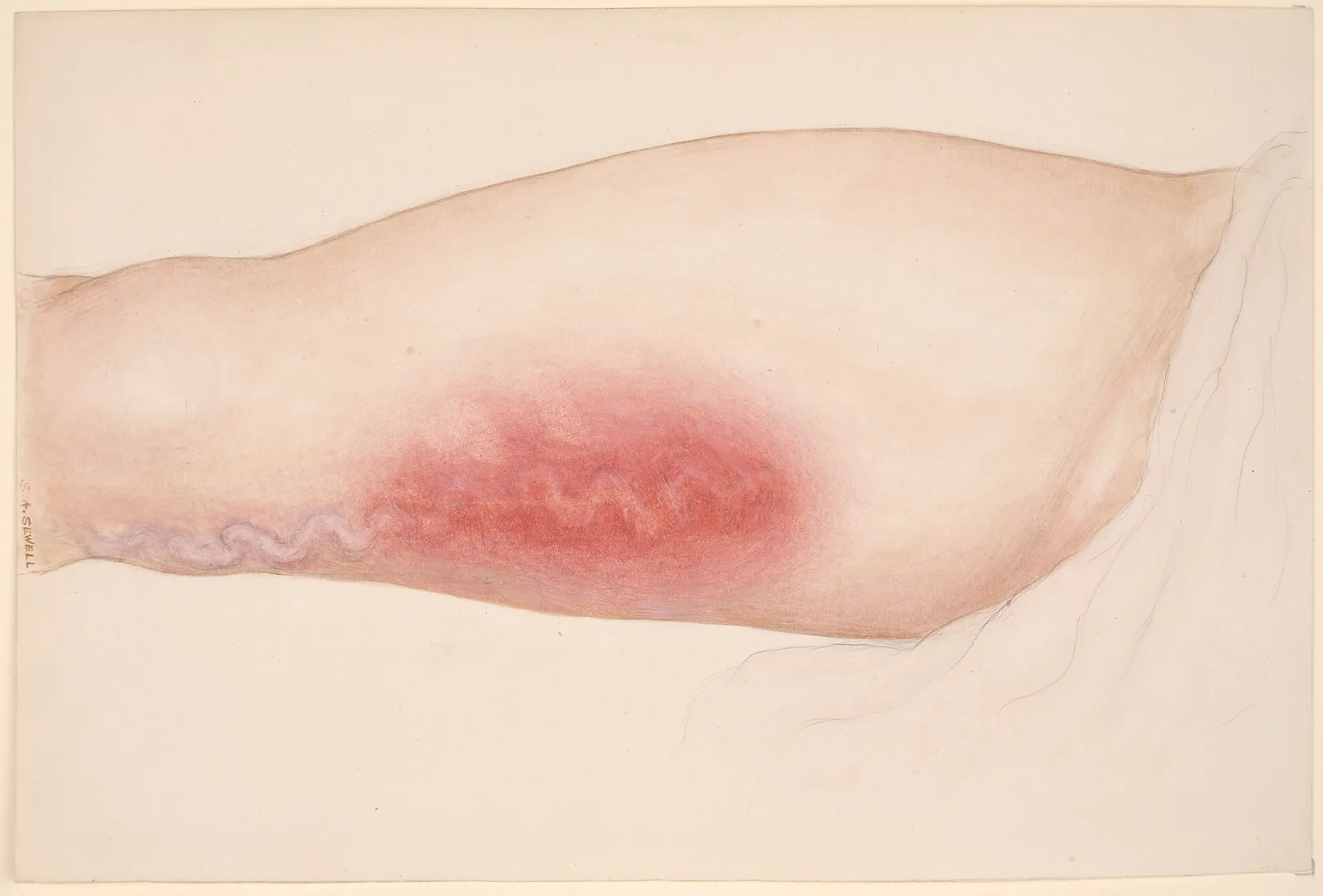
Thrombophlebitis, phlebitis and superficial vein thrombosis
The names overlap. Phlebitis means inflammation of a vein; thrombophlebitis means inflammation with a clot inside it. Superficial thrombophlebitis and superficial vein thrombosis are used interchangeably for the version in a surface vein, and the NHS calls the same condition phlebitis.
“Thrombophlebitis” on its own can also include deep vein thrombosis, so it is worth asking which kind is meant. Surface veins lie just under the skin; deep veins run within the muscles, and a clot there is the more dangerous kind because it can travel to the lungs.
In the leg, the vein most often involved — in 60% to 80% of cases — is the great saphenous vein, the long surface vein of the inner leg, which joins the deep system at the groin.
Phlebitis in the leg: how it looks and feels
It can come on within hours or over a few days. Typical signs:
- A firm, tender cord or knobbly line under the skin, following the course of a vein
- Red or darkened skin over it — the color change can be harder to see on brown and black skin
- Warmth, itching, pain and some swelling around the area
- Sometimes a raised temperature
A deep vein clot more typically causes swelling of the calf or whole leg with a throbbing pain. The two can occur together, though, and a visible surface clot does not rule out a deeper one. DVT: symptoms and why timing matters →
What triggers it
| Trigger | What to know |
|---|---|
| Varicose veins | The most important identifiable risk factor, present in 75% to 88% of cases. Repeat episodes are common |
| An IV line or injection | Cannulas and drips, especially in hand and arm veins. The line usually needs to come out |
| Injury | A knock or other minor injury to the vein |
| Pregnancy and after birth | Risk rises in pregnancy and is highest after delivery |
| Estrogen | Estrogen-containing contraception and hormone replacement therapy |
| A clotting tendency | Conditions that make blood clot more easily, some of them inherited |
| Cancer | Active cancer raises the risk |
| Other factors | Older age, obesity, smoking, immobility, long journeys, recent surgery, a previous episode or DVT, and some autoimmune conditions such as Behçet’s disease |
Sometimes no cause is found.
Superficial thrombophlebitis: when to worry
Most episodes are uncomfortable rather than dangerous. The attention this condition gets comes from what can sit alongside it.
A deep clot at the same time. Studies have found a DVT alongside a superficial clot in 6% to 36% of people, and in close to a quarter in one large study. Examination alone has been shown to underestimate how far a superficial clot extends in up to 77% of cases.
Spread into the deep veins. A surface clot can grow along the vein until it reaches a junction with a deep vein, at the groin or behind the knee. Spread is more likely when the clot is in the upper thigh or groin, behind the knee, in a vein that is not varicose, after a previous DVT, or when you are immobile. A clot within about 3 cm (just over an inch) of the junction at the groin is treated as a DVT, because between 14% and 70% of clots that close progress into the deep vein.
A higher risk later. A past episode raises your lifetime risk of a DVT or a lung clot four- to six-fold. That is worth mentioning before surgery, a long flight or drive, pregnancy, or starting hormone treatment.
This is why an ultrasound is so often recommended. It shows where the clot is, how long it is, how close it comes to the deep veins, and whether a DVT is already present.
The honest answer to “is it serious?”
Usually not — most people recover fully within a few weeks. But how the leg looks cannot tell you whether a deeper clot is also present, and that is the part that matters. If the whole leg is swollen rather than just the line of the vein, the advice on one swollen leg applies.
Treatment
Treatment eases pain and inflammation and, when the clot is long or close to the deep veins, aims to stop it spreading.
What helps at home
- Keep moving. Carry on with normal activities as far as pain allows. Long spells of immobility are themselves a clot risk.
- Warmth. A warm, moist cloth over the vein several times a day can ease the pain. Warm, not hot — and skip it on skin with reduced feeling, such as feet affected by diabetic nerve damage, which can burn without you noticing.
- Raise the leg when resting. Lying with the leg above heart level eases swelling and discomfort. The exception is artery disease with foot pain that eases when the foot hangs down, which elevation can make worse. Elevation: when it helps and when to ask first →
- An anti-inflammatory, if it is safe for you. Ibuprofen tablets or gel ease pain, and limited evidence suggests the tablets may also reduce spread. Do not take ibuprofen with a prescribed blood thinner unless your doctor advises it, avoid it in pregnancy unless advised, and check first if you have had a stomach ulcer or a stroke, or have asthma, a bleeding problem, or a heart, liver or kidney condition. Acetaminophen is an alternative for pain.
- Leave the cord alone. Do not massage or rub it; massage is generally avoided where there is a clot.
Compression stockings
Stockings can ease discomfort and swelling. The evidence is thin — UK practice often uses them, while there is no current recommendation for or against them in the United States — and they suit only some people, ideally recommended and fitted by a health professional.
Compression is unsafe when the artery pressures at the ankle are low. Anyone with diabetes, symptoms of artery disease, numbness, a wound, kidney disease or heart failure should have the arterial circulation checked first, usually with an ankle-brachial index. Compression safety: who needs an assessment first →
Blood thinners, in selected cases
For a short clot below the knee, simple measures are often enough, although a blood thinner is sometimes still used. The picture changes when the clot is higher-risk:
- It is at least 5 cm (about 2 inches) long
- It is above the knee, especially within about 10 cm (4 inches) of the junction at the groin
- It involves the great saphenous vein
- Symptoms are severe, or there has been a previous clot, active cancer or recent surgery
The best-studied treatment for these is a 45-day course of fondaparinux, a blood thinner injected under the skin at a low dose (2.5 mg) once a day. Some services use a blood-thinning tablet instead. A clot within about 3 cm of the groin junction is treated as a DVT.
In one large placebo-controlled trial of about 3,000 people — the strongest evidence for any treatment of this condition — 45 days of fondaparinux reduced symptomatic deep vein and lung clots, extension of the superficial clot and recurrence, and major bleeding was uncommon in both groups. The evidence for anti-inflammatories, creams, stockings and surgery is rated low or very low quality.
If an IV line or infection is involved
When a drip or cannula is the cause, it is usually removed. Antibiotics help only when there is a clear infection — spreading redness, worsening pain, fever or feeling generally unwell — which is more common with long-term drips, injected drugs or a weakened immune system.
Recovery: how long it takes
Pain and redness often settle within 1 to 2 weeks, and most episodes are over within 2 to 6 weeks. The hardness along the vein can last much longer, and a darker patch of skin may remain after everything else has settled.
What should not happen is the reverse: pain, redness or hardness spreading up the leg after the first few days, or new swelling of the leg. That is a reason to be seen again the same day.
When it keeps coming back
Repeat episodes are common in people with varicose veins. If they keep returning, treating the veins themselves is a reasonable conversation to have with a vein specialist: removing or closing varicose veins is a recognized option for repeated thrombophlebitis, although the evidence that surgery prevents later clots is limited. Varicose veins: symptoms and treatment choices →
A different pattern deserves a closer look: episodes in veins that are not varicose, clots that appear in one place after another, repeated episodes with no obvious trigger, or a first episode after about age 40 with no risk factor to explain it. These can point to a clotting disorder or, occasionally, another illness such as cancer, so further tests may be suggested. Experts disagree about routine testing after a single episode, which makes it an individual decision.
From the clinic
A tender, red cord along a surface vein is usually treated as a minor problem, and often it is. What I check is where it sits and how far it runs: one near the groin or behind the knee, one that keeps extending, or one that appears without an obvious cause needs an ultrasound, because a clot in a surface vein can lie close to the deep system. Phlebitis that keeps coming back in different places deserves a broader look as well.
Common questions
Is superficial thrombophlebitis dangerous?
Usually not, and most episodes settle within a few weeks. The risk is what can come with it: a deep vein clot alongside it in a meaningful minority of people, or spread into the deep veins from a clot near the groin or knee. That is why an ultrasound is often advised.
How long does superficial thrombophlebitis last?
Pain and redness often settle in 1 to 2 weeks, and most episodes are over within 2 to 6 weeks. A firm lump or darker mark along the vein can last longer. If you have been prescribed a 45-day course of a blood thinner, take it as directed even once the leg feels better.
Can I exercise with superficial thrombophlebitis?
Yes, within comfort. Keeping the leg moving is part of the standard advice, and hospital leaflets say to continue normal activities unless the pain is severe. If you have been prescribed a blood thinner, ask about activities with a high risk of falls or knocks, because these medicines raise the risk of bleeding.
Is thrombophlebitis the same as DVT?
Not quite. Thrombophlebitis means a clot with inflammation in a vein, and the word can refer to a surface vein or a deep one. Superficial thrombophlebitis is in a vein just under the skin and is usually less serious. A DVT is in a deep vein within the muscle and is the type more likely to send a clot to the lungs. The two can occur together.
Do you need blood thinners for superficial thrombophlebitis?
Not always. A short clot below the knee is often managed with warmth, an anti-inflammatory and staying active. A clot at least 5 cm long, above the knee or near the groin usually gets a 45-day course of a low-dose blood thinner, and one within about 3 cm of the groin junction is treated as a DVT. The ultrasound tells you which group you are in.
Where to go next
Sources
- NHS. Phlebitis (superficial thrombophlebitis).
- StatPearls, NCBI Bookshelf. Superficial Vein Thrombosis.
- Cochrane. Treatment for superficial thrombophlebitis of the leg.
- MedlinePlus, National Library of Medicine. Superficial thrombophlebitis.
- Mayo Clinic. Thrombophlebitis: symptoms and causes and diagnosis and treatment.
- Cleveland Clinic. Superficial Thrombophlebitis.
- Cambridge University Hospitals NHS Foundation Trust. Ultrasound proven superficial thrombophlebitis.
- Royal Berkshire NHS Foundation Trust. Superficial thrombophlebitis (patient leaflet).
- NHS. DVT (deep vein thrombosis).
- Centers for Disease Control and Prevention. About Venous Thromboembolism (Blood Clots).
- NHS. Ibuprofen for adults.
- NHS. Venous leg ulcer — diagnosis.
- National Institute of Diabetes and Digestive and Kidney Diseases. Diabetes & Foot Problems.
- American Family Physician. Chronic Critical Limb Ischemia: Diagnosis, Treatment and Prognosis.
- Cleveland Clinic. Lymphatic Drainage Massage.
Written by Tom Biernacki, DPM, FACFAS. Published 9 October 2026. Updated 16 October 2026. General education, not medical advice.