Long journeys make legs swell, and in a small number of people they contribute to a clot. Both are worth taking seriously and neither is a reason to stay home. The useful version of this advice is specific about who is actually at risk and what genuinely helps.
After a long journey, these need attention
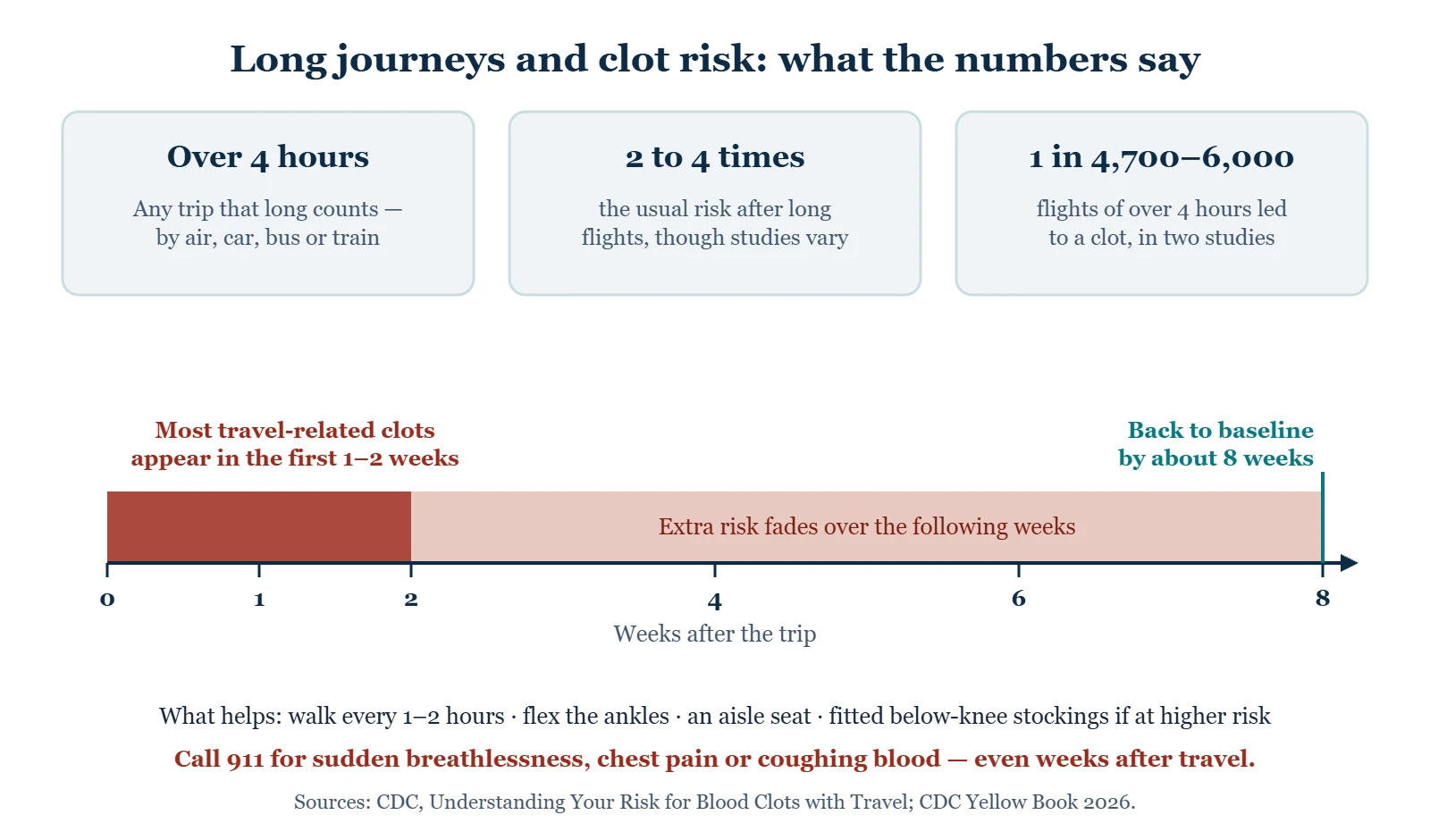
Call 911 for sudden shortness of breath, any chest pain or discomfort, coughing blood, a racing heart, or feeling faint. A clot that has traveled to the lungs is an emergency. Most travel-related clots show up within the first week or two, but the extra risk lasts up to about eight weeks after the trip.
Same day for one leg becoming swollen, painful, warm or red, particularly in the calf. A symptom list cannot exclude a clot — it needs an examination and usually an ultrasound. More on DVT →
Ordinary travel swelling
Sitting still for hours with the legs down means the calf muscle pump stops working, and the pump is what pushes venous blood back up the leg. Fluid accumulates in the lower legs and ankles. Both legs swell roughly equally, it appears gradually, it is uncomfortable rather than painful, and it settles within a day or two of normal movement. That pattern is benign.
What is not benign is one leg, sudden onset, calf pain or tenderness, warmth, or redness. Swelling of one leg after travel is a same-day assessment, not something to watch.
How much a long trip raises the risk
The CDC counts any trip longer than four hours, whether by air, car, bus or train, and notes that even over long distances the risk of a clot is generally very small. Its travel medicine guidance puts the increase from long-distance flying at roughly two to four times, while noting the studies are inconsistent, and two studies put the absolute risk at about one clot per 4,700 to 6,000 flights of more than four hours. The risk grows with the length of the journey and is back to baseline by about eight weeks afterward.
The CDC also notes that most people who develop a clot after travel have one or more other risk factors. That is where the attention belongs.
Who is actually at higher risk of a clot
- A previous DVT or pulmonary embolism, or a known clotting disorder
- Active cancer or recent cancer treatment
- Surgery, a hospital stay, or a leg injury or cast in the last three months
- Pregnancy, and the weeks after giving birth
- Estrogen-containing contraception or hormone therapy
- Significant obesity, reduced mobility, or older age
- A family history of clots in close relatives
If more than one of these applies, the conversation to have before booking is with your own clinician, not with a website. Some people are advised to use prescribed compression or, occasionally, a preventive injection around the journey. Neither is a general recommendation.
It is not really about flying
The risk comes from sitting still for a long time, not from being in the air. A ten-hour drive, a long coach or train trip, or a full day at a desk without getting up work through the same mechanism, and the CDC’s four-hour line applies to all of them. On a drive the temptation is to push on to the destination, so plan the stops before you leave.
What actually helps
- Get up and walk every hour or two. The CDC suggests walking around every one to two hours on long trips. It costs nothing and it works the calf pump directly. On a drive, stop and walk for a few minutes rather than stretching beside the car.
- Work the ankles in the seat. Point and flex the feet, circle the ankles, press the balls of the feet into the floor and lift the heels. Repeat them often; each one works the calf pump. Do it whether or not you feel like it.
- Drink water and go easy on alcohol. Staying hydrated is sensible, but the CDC finds no evidence that dehydration causes travel clots or that drinking more prevents them; alcohol mainly makes you less likely to get up.
- Wear below-knee graduated compression if you are in a higher-risk group or if your legs reliably swell. For travelers at increased risk, the American College of Chest Physicians suggests properly fitted below-knee stockings giving 15 to 30 mmHg at the ankle, and does not suggest them for travelers who are not. Fitted and below the knee — not tight socks bought at the airport, and not thigh-highs that roll down and constrict. Getting them right, and check the arteries first if you have any arterial history. Which socks, and what strength →
- Avoid crossing your legs for long stretches, and give yourself room to move your feet — a bag under the seat in front removes the space where your legs need to work.
- Take an aisle seat if you can. In the studies the CDC reviews, travelers in window seats had roughly double the risk, and about six times the risk with a BMI of 30 or more, most likely because they moved less.
- Do not take aspirin to prevent travel clots unless your own clinician has told you to. The American College of Chest Physicians advises against aspirin or blood thinners for travelers in general. The American Society of Hematology suggests aspirin only for travelers at substantially increased risk who cannot use compression stockings or a heparin injection, and it carries a bleeding risk.
If you already have a leg condition
A recent DVT or pulmonary embolism. The NHS advises delaying flights and long journeys until at least two weeks after starting blood-thinning medicine, and the British Thoracic Society advises delaying air travel for two weeks after diagnosis. Clear the trip with the team treating the clot, keep your tablets in hand luggage, and do not skip doses because the schedule is disrupted.
Venous insufficiency or varicose veins. Wear your compression for the whole journey, including the airport and the wait at the other end. Elevate the legs when you arrive. Expect a day or two of extra swelling and do not read it as deterioration. Venous insufficiency →
Lymphedema. Wear the garment throughout, keep the skin moisturized and protected, and be careful with insect bites, sunburn and scratches — infection is the thing that sets people back. Take a spare garment in hand luggage.
PAD. The issue on long journeys is less about swelling and more about feet. Wear shoes that fit and do not travel in new ones, check your feet at each stop and at the end of the day, and never use an in-seat or hotel heating device on your feet. Daily foot care →
Diabetes or reduced sensation. Do not walk barefoot through security or in the hotel. Pack a spare pair of socks. Check the feet, including between the toes, every single day of the trip — a blister that would be nothing at home becomes a real problem a long way from your own clinician.
From the clinic
The travel story I take most seriously is the one-sided one: back from a long trip with one calf that is tight, sore and bigger than the other. Both ankles puffy after a flight is ordinary; one leg is a same-day scan. For my patients with diabetes, the danger is usually the trip itself rather than the flight — new shoes, miles of airport corridors, and a blister discovered three days later. Break shoes in before you go, and look at your feet every night you are away.
Common questions
How long a journey counts as long?
The CDC uses four hours, by air, car, bus or train, and the risk rises with duration from there. But the practical line is simpler: any journey where you would otherwise stay seated for more than an hour or two at a stretch is one where getting up and moving the ankles is worth doing.
Do compression socks prevent clots on flights?
In a 2021 Cochrane review of trials on flights longer than five hours, properly fitted below-knee stockings cut symptomless calf clots found on scans from a few tens per thousand passengers to two or three per thousand, and they may reduce leg swelling, though that evidence is weaker. No trial recorded a clot that caused symptoms, so the effect on those is unknown. They are most worth wearing if you are in one of the higher-risk groups or your legs swell reliably. They are not a substitute for getting up and moving, and they do not make other precautions unnecessary for someone with a clotting history.
When should I worry after I get home?
Swelling in both legs that settles over a day or two is expected. Get seen the same day for one leg that is swollen, painful, warm or red. Call 911 for sudden breathlessness, any chest pain or discomfort, coughing blood, a racing heart or faintness. Most travel-related clots appear in the first week or two, but the extra risk lasts up to about eight weeks, so do not dismiss symptoms because the trip was two weeks ago.
Should I take a blood thinner before a long flight?
Not as a general precaution. The American College of Chest Physicians advises against aspirin or blood thinners for travelers in general. For people at substantially increased risk, the American Society of Hematology suggests compression stockings or a preventive heparin injection, with aspirin only if neither is possible — an individual decision made by someone who knows your history.
I had a DVT recently. When can I fly?
The NHS advises waiting at least two weeks after starting blood thinners before flying or making a long journey, and the British Thoracic Society says two weeks after diagnosis. Guidance varies a little between organizations and with your own situation, so clear the trip with the team treating your clot, and take your tablets in hand luggage.
My legs swell every single flight. Is something wrong?
Not necessarily — some people simply pool more. But swelling that is getting worse over the years, that no longer settles within a couple of days, or that comes with aching, visible veins, itching or skin changes around the ankle is worth having looked at, because that is what early venous insufficiency looks like. More →
Where to go next
Sources
- Centers for Disease Control and Prevention. Understanding Your Risk for Blood Clots with Travel.
- Centers for Disease Control and Prevention. CDC Yellow Book 2026: Deep Vein Thrombosis and Pulmonary Embolism.
- Centers for Disease Control and Prevention. About Blood Clots.
- NHS. Deep vein thrombosis (DVT).
- National Heart, Lung, and Blood Institute. Venous Thromboembolism.
- Cochrane. Compression stockings for preventing deep vein thrombosis in airline passengers (2021).
- National Institute of Diabetes and Digestive and Kidney Diseases. Diabetes and Foot Problems.
Written by Tom Biernacki, DPM, FACFAS. Published 21 September 2026. Updated 16 October 2026. General education, not medical advice.