Lymphatic drainage massage — manual lymphatic drainage, or MLD — is a very light, skin-stretching technique meant to move fluid toward lymph nodes that still work. It has a real place in treating lymphedema, as one part of a package built around compression. The detox, weight-loss and cellulite claims that made it popular online are not supported by evidence.
When not to massage, and to get seen instead
- One leg newly swollen, particularly with pain, tenderness, warmth or a change in skin color: be seen today, somewhere that can arrange an ultrasound. A clot is one of the possibilities, and nobody should massage that leg until it has been ruled out.
- Skin that is red, hot and spreading, with fever or chills: get care the same day, at urgent care or an emergency department. That pattern suggests cellulitis, which needs prompt antibiotics, not drainage.
- Call 911 for sudden breathlessness, chest pain that is worse on breathing in, coughing blood, a racing heart or fainting — or if red, spreading skin comes with confusion, dizziness, fast breathing, or cold, clammy skin.
Outside the United States, use your local emergency number.
What the lymphatic system does
Every day, about 20 liters of plasma — the liquid part of your blood — seep out of your smallest blood vessels into the surrounding tissue. Around 17 liters soak back in. The remaining 3 liters or so is collected by lymph vessels, filtered through lymph nodes (you have about 600), and returned to the bloodstream.
There is no pump like the heart. Squeezing muscles and pulsing arteries push lymph along, and one-way valves keep it moving the right way — which is why ordinary movement matters so much in the legs. In a healthy person, the system needs no help.
When lymph vessels or nodes are damaged, or did not develop normally, fluid collects in the tissue. Cancer surgery or radiotherapy, infection and injury are common reasons. That is lymphedema. At first the swelling may be soft and leave a dent when pressed (what that dent does and does not tell you). Without treatment it usually becomes more severe and persistent, and the skin can become hard, tight and thickened.
What manual lymphatic drainage actually is
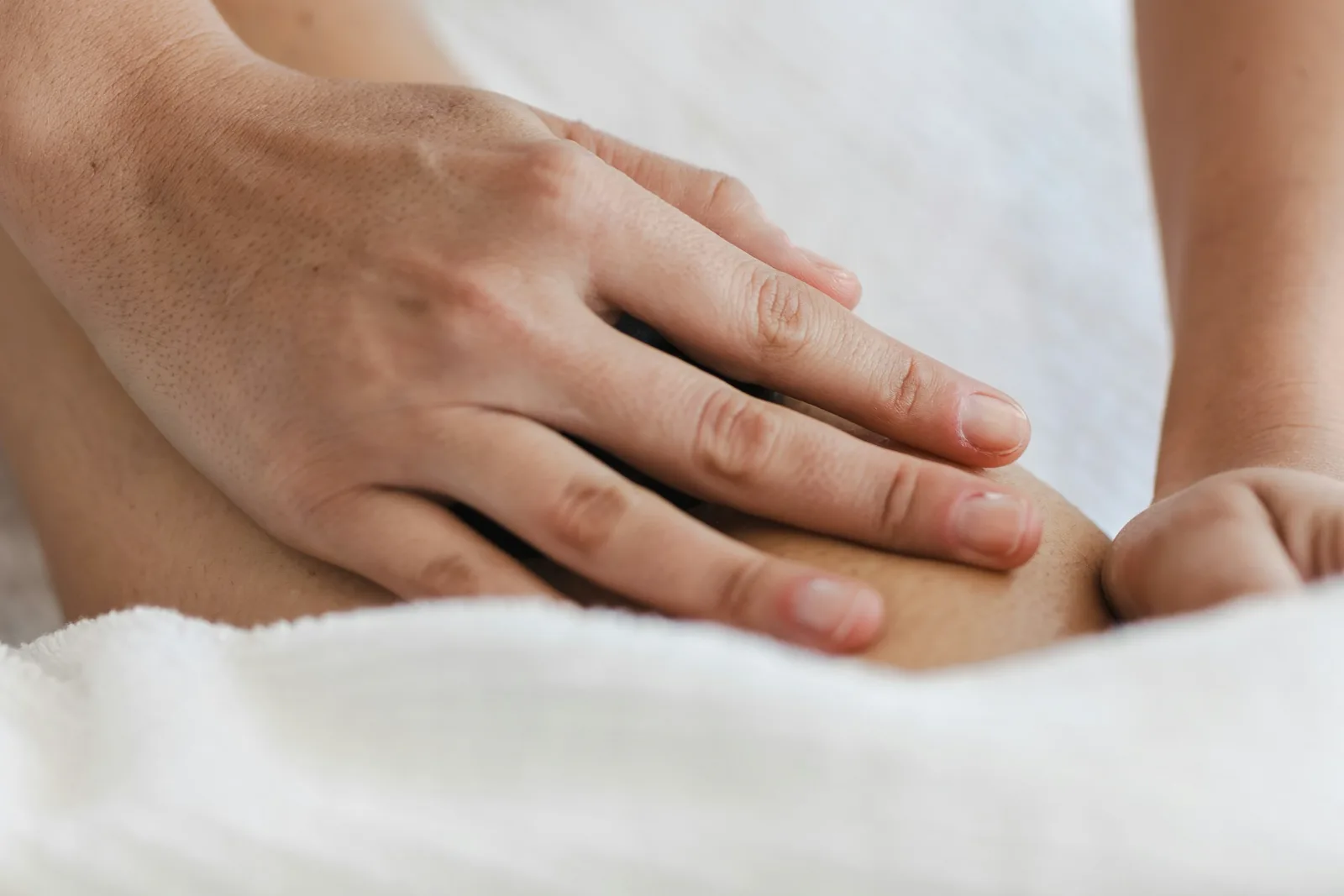
It is not a deep-tissue or sports massage. MLD uses very light, slow, rhythmic movements that gently stretch the skin in a set direction, and it should not hurt or leave the skin red. A therapist usually starts away from the swelling — at the neck, the trunk and lymph node areas such as the armpits and groin — so the fluid has somewhere to go, then works the swollen area toward lymph nodes that still function.
Where lymphatic drainage massage has an established role
Its established job is in lymphedema care, as one part of complete decongestive therapy — the treatment the NHS recommends for lymphedema, though the ideal version has not been settled. It has four parts:
- Manual lymphatic drainage by a trained therapist.
- Compression — multilayer bandaging to reduce the limb, then fitted garments to hold the reduction.
- Exercise to work the muscles that move lymph.
- Skin care, because cellulitis is the most common complication of lymphedema.
The intensive phase means daily treatment for several weeks (about 15 days on average, in the National Cancer Institute's summary), with bandaging or a garment applied afterward so the fluid does not return. In the maintenance phase you take over: garments, exercise, skin care and simplified self-massage, with reviews every few months.
Because compression carries much of the load, it has its own safety rule. If you have diabetes, symptoms of peripheral artery disease, numb feet, a leg or foot wound, kidney disease or heart failure, the arterial circulation should be checked first, usually with an ankle-brachial index: compression is not safe when the pressure in the ankle arteries is low. Who needs that check, and why.
What a session involves
Expect an assessment first. You usually lie down; the therapist starts at the neck and trunk, then works toward and along the swollen leg with gentle pressure. Some people feel tired, or get a headache or nausea, afterward. If several sessions bring no improvement, ask about other options.
The honest answer: how much does the massage itself add?
Less than its reputation suggests. A Cochrane review of six small trials (208 people with arm lymphedema after breast cancer) found that intensive compression bandaging alone reduced swelling by about 30 to 37 percent. Adding MLD took off roughly another 7 percent, with the extra benefit seen in mild-to-moderate cases rather than moderate-to-severe ones. In another trial, adding 20 daily MLD sessions to compression garments removed more fluid in absolute terms (250 vs 143 mL), but the groups started at different arm volumes, and the average reduction in excess arm volume did not differ.
For legs, a prevention trial in 120 women after cervical cancer surgery found that self-drainage, compression stockings and exercise together cut the share who developed lymphedema within a year from 24 to 14 percent — though reported symptoms did not differ, and a package cannot show what the massage contributed. MLD is safe and well tolerated; on current evidence, compression appears to do most of the measurable work.
Claimed benefits the evidence does not support
Online, lymphatic drainage is often sold as a detox, a slimming treatment or a fix for puffiness. Here is how those claims hold up.
| Claim | What the evidence says |
|---|---|
| "Detox," or an immune boost | No credible evidence of added detox or immune benefit in healthy people. A working lymphatic system does its job without help. |
| Weight loss | No evidence that it causes weight loss. Someone with real swelling may weigh slightly less as fluid moves, but that is fluid, not fat. |
| Cellulite | Mayo Clinic presents the idea that vigorous massage moves lymph and removes toxins as a concept, not a result; the massage device it discusses gives slight, short-lived improvement. MLD is not vigorous anyway. |
| Puffiness, including the face | It may reduce puffiness, according to Cleveland Clinic. Any slimmer, tighter look is temporary. |
| Recovery after cosmetic surgery | Early studies suggest possible benefit after some procedures. The evidence is preliminary; follow your surgeon's plan. |
| Drops, supplements and vibration plates sold for "lymphatic drainage" | Not part of the lymphedema programs described by the NHS, the National Cancer Institute or Mayo Clinic. Ordinary exercise is. |
For a healthy person a gentle massage carries very few risks. The problem is paying for a detox or slimming result the evidence does not show.
Lipedema is a different problem
Lipedema is an abnormal, often painful build-up of fat on both sides of the lower body that usually spares the feet, bruises easily and resists dieting. It is sometimes mistaken for lymphedema, and can eventually lead to it. Drainage massage, compression and exercise are used in its care, but the treatment Cleveland Clinic describes as removing the fat is liposuction. How to tell the two apart.
Who should not have it, or should ask first
Published lists differ slightly; this table combines them. "Ask first" means a clinician who knows your history agrees before anyone starts — including you, at home.
| Situation | What to do |
|---|---|
| A suspected or known blood clot (DVT) | No lymphatic drainage massage. New swelling in one leg needs assessment today. |
| Infection: cellulitis, red and hot skin, fever, or feeling unwell | Not until it has been treated and your clinician agrees. |
| Heart disease, including heart failure | Ask the clinician managing your heart first. |
| Kidney failure | Ask your kidney team first. |
| Active cancer, cancer in the area, or skin damaged by radiotherapy | Only with your cancer team's agreement. Therapists do not work directly over cancerous tissue or radiation-damaged skin. |
| Having had a stroke | Ask first. |
| Swelling nobody has explained | Find the cause first. Leg swelling has many causes, and drainage is aimed at lymphedema. Where swelling comes from. |
How to do lymphatic drainage massage on your legs
For the maintenance phase, lymphedema services teach a simplified routine called simple lymphatic drainage, or self-lymphatic drainage. Published NHS leaflets share an outline but differ in detail, including where the fluid is sent. The right route depends on which of your lymph nodes still work — after groin surgery or radiotherapy, not necessarily the nearest ones — so use this to understand what you are taught, not instead of being taught.
- Check it is a good day for it. Skip it if you feel unwell or have an infection. If the leg turns red, hot or more swollen, stop and get seen the same day.
- Use bare skin, with no oil or cream.
- Breathe first: about five slow, deep breaths, with your hands resting on your abdomen.
- Clear the drainage areas. Depending on your routine: gentle skin-stretching at the neck (below the ears and above the collarbones), then over the groin crease and up toward the hip and abdomen. Some routines send leg fluid up the side of the trunk toward the armpit instead.
- Work the leg from the top down, stroking upward. Start at the top of the thigh with light strokes that stretch the skin toward the cleared area, then move down in sections — thigh, knee (including behind it), calf, ankle, foot — always stroking toward the trunk.
- Finish the way you started. Work back up the leg, clear the groin or trunk again, and end with a few deep breaths.
Press only enough to stretch the skin, never enough to hurt or redden it. Published routines run from about 15 minutes once a day to at least 30 minutes twice a day. Some services teach self-drainage only over the areas that are not swollen, clearing a path for the leg; others include the leg itself. Follow the version you were given.
Other things that help lymph drainage in the legs
- Movement. Walking, cycling and swimming work the muscles that pump lymph.
- Compression, once assessed. It is the backbone of lymphedema care.
- Skin care. Wash, dry carefully between the toes, moisturize, and deal promptly with any cut; infection is the commonest complication. The daily skin check.
- Elevation, with a caveat. It is often advised, though established lymphedema responds to it less than venous swelling does. With advanced artery disease, raising the leg can make foot pain worse. When elevation helps.
- No heating pads on a swollen leg. Swelling can dull your sense of pain and raise the risk of burns.
Finding a qualified therapist
Look for a certified lymphedema therapist (CLT), usually a physical or occupational therapist with extra training. The Lymphatic Education & Research Network recommends at least 135 hours of lymphedema training or the CLT-LANA credential, which adds a board exam from the Lymphology Association of North America; LANA keeps a directory of certified therapists. Ask how many hours of training they have and where they trained, and how much of their practice is lymphedema. A spa menu offering "lymphatic massage" tells you none of that.
Insurance and Medicare
Medicare Part B helps pay for medically necessary outpatient physical therapy that a clinician certifies you need; after the Part B deductible you pay 20% of the Medicare-approved amount, with no annual cap. Part B may also cover compression garments, adjustable wraps and bandaging supplies if you have lymphedema and a clinician orders them. Private plans vary, so ask how sessions will be billed, and assume a detox or de-puffing session with no diagnosis behind it is out of pocket.
From the clinic
I am in favor of manual lymphatic drainage when it is part of a proper lymphedema plan: done by a certified therapist and followed by bandaging or a well-fitted garment. I am wary of drainage marketed as a detox or a cure-all for puffy legs. If your swelling is new, one-sided, painful, or comes with breathlessness, it needs a diagnosis before anyone massages it.
Common questions
Does lymphatic drainage massage really work?
For lymphedema, yes, as part of complete decongestive therapy, which reduces limb volume — though trials suggest compression does most of that work and the massage adds a modest, inconsistent extra. For detox, immunity or weight loss in healthy people, there is no credible evidence that it works.
Does lymphatic drainage help with weight loss?
No. There is no evidence that it causes weight loss. In someone with real swelling, any drop on the scale is fluid, not fat.
How often should you get a lymphatic drainage massage?
For lymphedema: daily sessions for several weeks in the intensive phase, then self-drainage on your therapist's schedule, with reviews every few months. For wellness there is no evidence-based schedule, because there is no proven benefit to schedule.
Can lymphatic drainage make you sick?
Serious problems are uncommon, though some people feel tired or get a headache or nausea afterward. The real risks are situational: it can potentially increase circulation, dislodge a clot or spread an infection, which is why clots, infection, heart disease and kidney failure are reasons to avoid it or ask first.
Does lymphatic drainage work on the face?
It may reduce puffiness, and any slimmer look is temporary. There is no credible evidence that it detoxifies anything. For someone who is well, gentle facial drainage carries little risk — a cosmetic choice, not a treatment.
Does insurance cover lymphatic drainage massage?
It can, when it is treatment for diagnosed lymphedema: Medicare Part B helps pay for medically necessary outpatient physical therapy and may cover compression garments, wraps and bandaging supplies. Cosmetic treatments, such as those for cellulite, usually are not covered.
Where to go next
Sources
- NHS. Lymphoedema and Lymphoedema — treatment.
- National Cancer Institute. Lymphedema and Cancer and Lymphedema (PDQ) — Health Professional Version.
- Cochrane. Manual lymphatic drainage for lymphedema following breast cancer treatment (plain language summary).
- StatPearls, NCBI Bookshelf. Lymphedema.
- Mayo Clinic. Lymphedema — diagnosis and treatment and Cellulite — diagnosis and treatment.
- Cleveland Clinic. Lymphatic Drainage Massage, Lymphatic System, Lipedema and Chronic Limb-Threatening Ischemia.
- UCLA Health. Lymphatic drainage massage — separating fact from fiction.
- Cancer Research UK. Manual lymphatic drainage (MLD) for lymphoedema.
- Gateshead Health NHS Foundation Trust. Simple Lymphatic Drainage for Legs.
- Calderdale and Huddersfield NHS Foundation Trust. Self-Lymphatic Drainage: Legs.
- West Suffolk NHS Foundation Trust. Simple lymphatic drainage — legs.
- Lymphatic Education & Research Network. Find a Certified Lymphedema Therapist (CLT).
- Medicare.gov. Physical therapy services and Lymphedema compression treatment items.
- NHS. Venous leg ulcer — diagnosis.
- NHS. Cellulitis and DVT (deep vein thrombosis).
- Centers for Disease Control and Prevention. About Venous Thromboembolism (Blood Clots).
Written by Tom Biernacki, DPM, FACFAS. Published 9 October 2026. Updated 16 October 2026. General education, not medical advice.