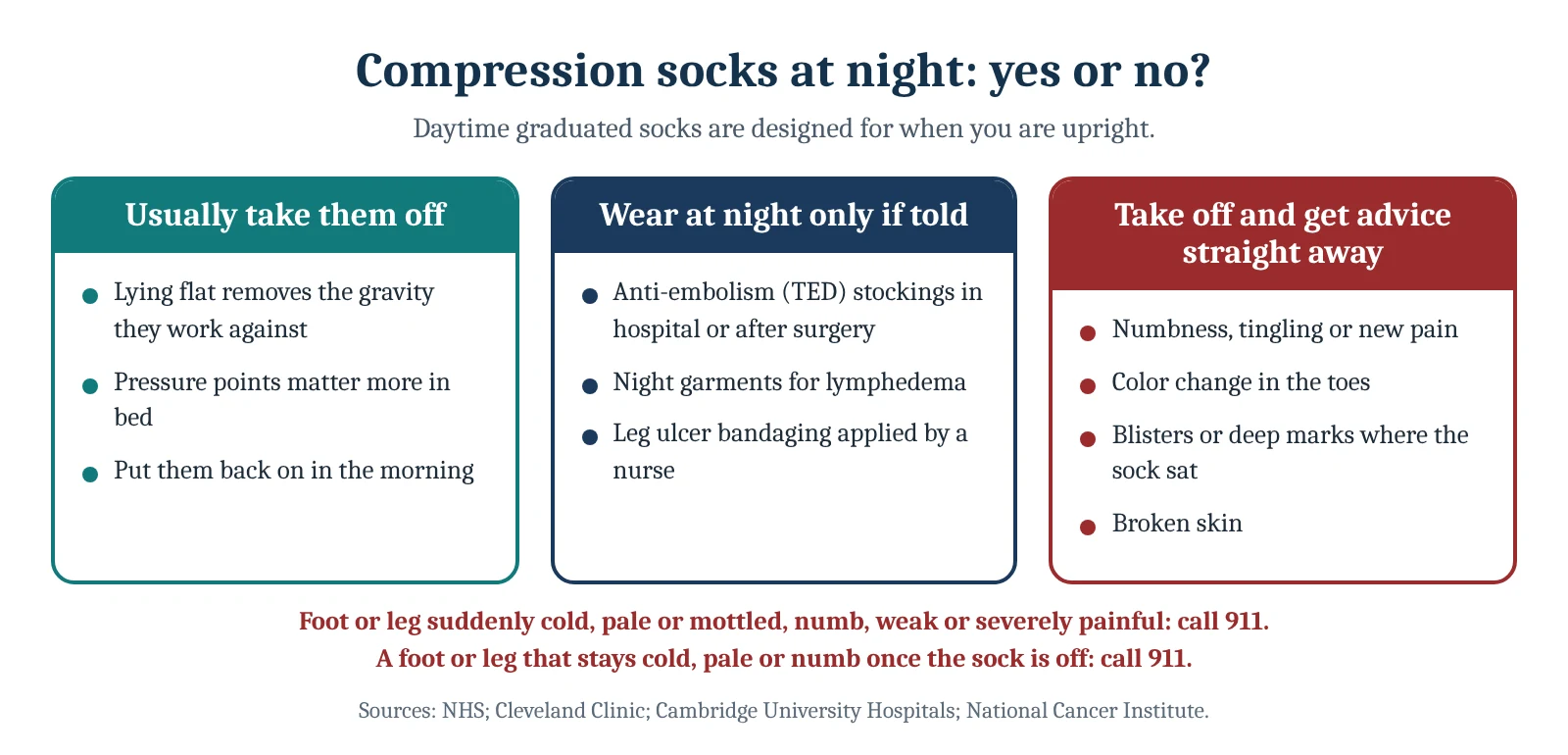
Can you sleep in compression socks? With ordinary daytime graduated socks there is usually no need, and the standard advice is to take them off at bedtime unless a clinician has told you otherwise. Compression is worn at night in a few specific situations: anti-embolism (TED) stockings in and after hospital, night-time garments for lymphedema, and leg ulcer bandaging applied by a nurse.
Take them off and get advice if you notice
Toes that are numb, tingling, pale, blue or cold; new pain in the foot or leg; or blisters, deep marks or broken skin where the garment sat. These can mean the compression is too tight, so contact your clinician straight away. Call 911 if a foot or leg suddenly turns cold, pale or mottled, numb, weak or severely painful, or if it stays cold, pale or numb once the sock is off.
One leg that is newly swollen, painful, warm or red needs to be seen today, at an emergency department, urgent care or a same-day clinic that can arrange an ultrasound. Call 911 for sudden breathlessness, chest pain, coughing blood or fainting.
Why everyday compression socks come off at night
Graduated compression is designed for a leg that is upright. Standing and sitting leave a column of blood pressing down on the leg veins, and the sock’s squeeze, firmest at the ankle, works against that pressure and with your calf muscles as you move. A Cleveland Clinic cardiovascular specialist puts it plainly: the benefit comes when you are up and moving and gravity is working on your veins, so there is no reason to wear them lying down or asleep. More on how they work: what compression socks do.
The guidance is consistent. The NHS says it is best to wear compression stockings during the day and remove them at bedtime. Guy’s and St Thomas’ NHS Foundation Trust tells patients not to wear them to bed unless a doctor or specialist nurse has said otherwise, and the American Venous Forum describes putting them on when you get out of bed and taking them off before bed.
Reasons not to sleep in them by default
- Your skin needs a break. Wearing compression around the clock can be hard on the skin. Cleveland Clinic suggests peeling them off at night, rubbing in some lotion and letting the skin breathe.
- Pressure points. Lying still for hours loads the heels and other bony areas. For hospital stockings, NICE asks for skin checks over these points two or three times a day in people who move little or have reduced feeling. A sock that wrinkles or rolls during the night can also form a tight band around the leg.
- Poor arterial supply. In advanced artery disease, lying flat takes away gravity’s help with blood flow to the feet, which is why rest pain in the toes comes on lying down and eases when the leg hangs over the side of the bed. Compression is not safe when the ankle artery pressures are low, and with numb feet you may not feel a problem developing overnight. With diabetes, leg pain on walking, numb feet, a wound, kidney disease or heart failure, have your arteries checked, usually with an ankle-brachial index, before wearing compression at any hour: compression safety.
When wearing compression at night is right
Night-time compression is not wrong; it is a clinician’s decision rather than a habit. The usual situations:
| Situation | What is worn at night | What the guidance says |
|---|---|---|
| In hospital and after surgery | Anti-embolism (TED) stockings | Day and night until you are back to your usual mobility, off once a day to wash and check the skin |
| Lymphedema | Garments chosen by your lymphedema therapist | At night only as your therapist advises |
| Venous leg ulcer | Compression bandaging applied by a nurse | Stays on between changes, usually one to three times a week |
| More advanced vein disease, or other causes of swelling | Stockings or bandages | Overnight only if your clinician recommends it |
| Tired legs, travel or mild swelling | Nothing | Off at bedtime, back on in the morning |
TED hose at night
Anti-embolism stockings are made for people who are lying down or moving much less than usual, so wearing them in bed is the point. Cambridge University Hospitals tells patients to wear them day and night until they get back to a normal or improved level of mobility, and for up to six weeks after recent hip or knee surgery. They come off once a day to wash and check the skin. NICE says to stop them if they mark, blister or discolor the skin. More in TED hose vs. compression stockings.
Once you are up and about as usual, ask your surgical team whether to stop.
Night-time garments for lymphedema
Some people with lymphedema wear compression at night as well. The National Cancer Institute’s advice is to wear compression garments daily when you are up and moving around, and at night as your certified lymphedema therapist advises, and it suggests asking whether there are special garments for day or night. A daytime stocking is not automatically suitable for bed, so leave that choice to your therapist. More: lymphedema treatment.
Bandaging for a leg ulcer
Venous leg ulcers are treated with compression bandages applied by a trained nurse. The NHS says they are usually changed one to three times a week, so they stay on overnight, and Cleveland Clinic also notes that bandages for ulcers or wounds may stay on through the night. If a bandage feels too tight at night, the NHS says a short walk usually helps. If your toes go numb or tingle, swell, or turn pale or blue, or you have unusual pain, remove or cut the bandage and contact your nurse or doctor as soon as possible.
What to do at night instead
- Take them off at bedtime and look. Mayo Clinic suggests checking your legs daily for irritation, redness or other skin changes, which can mean a poor fit or an infection. Check the band line and heels.
- Moisturize at night. That gives the lotion time to soak in, so your skin is dry when the socks go back on in the morning.
- Raise your legs if it suits you. Mayo Clinic lists lying down with your feet elevated as one way to diminish swelling. How to do it properly. Skip it if raising your legs brings on foot pain, and ask first if you have heart failure, because breathlessness when lying down is one of its symptoms.
- Keep moving in the day. Compression works together with the calf muscle pump, so walking and ankle circles do the rest of the job.
- Put them back on first thing. MedlinePlus suggests doing it before you get out of bed, while swelling is at its lowest.
If you fell asleep in them
Cleveland Clinic notes that wearing compression garments while sleeping is not necessarily harmful, especially for short periods; its specialist says there is simply no reason to. Take them off when you wake, check your toes and skin, and wear them as usual for the day if everything looks normal.
Be more careful if you have diabetes, numb feet, artery disease or fragile skin, because damage may not be felt. If anything in the box at the top of this page applies, get advice before wearing them again.
If you keep falling asleep in them because getting them off is a struggle, that is a solvable problem: rubber gloves for grip, a donning aid, or a zipper style. See compression fit and zipper socks and donning aids.
Common questions
Can you wear compression socks to bed?
Not usually. Standard graduated socks are meant to be worn from morning until bedtime, and the NHS advises removing them at bedtime. Wear them to bed only when a clinician has told you to, as with anti-embolism stockings after surgery, lymphedema night garments or ulcer bandaging.
Should I wear compression socks at night for swelling?
For everyday venous or end-of-day swelling, no. Lying down already takes away most of the pressure behind it, so raise your legs if that suits you and put the socks on again first thing. New swelling in one leg needs to be seen today.
Is it OK to sleep in TED hose?
Yes, while your mobility is reduced and if that is what your team advised. Anti-embolism stockings are usually worn day and night after surgery, coming off once a day to wash and check the skin. Ask when to stop; it is usually when you are back to your normal level of activity.
What happens if you accidentally sleep in compression socks?
Cleveland Clinic says wearing compression garments while sleeping is not necessarily harmful, especially for short periods. Check your toes and skin when you take them off, and get advice if you find numbness, color change, blisters or broken skin, especially if you have diabetes or artery disease.
Is it OK to nap in compression socks?
For most people with healthy arteries, a short nap in well-fitting socks is fine; Cleveland Clinic notes that short periods are not necessarily harmful. Smooth out any wrinkles first, and take them off if your toes start to tingle or change color.
How many hours a day should you wear compression socks?
Usually all day: on before your legs swell in the morning, off at bedtime. How many weeks or months depends on why you wear them.
Where to go next
Sources
- Cleveland Clinic. Health Essentials, Can You Sleep in Compression Socks?, and Compression Therapy: Types and Benefits.
- NHS. Varicose veins; Venous leg ulcer – diagnosis and treatment; Pulmonary embolism; Heart failure – symptoms.
- Guy’s and St Thomas’ NHS Foundation Trust. Compression stockings.
- Cambridge University Hospitals NHS Foundation Trust. Anti-embolic stockings (AES).
- National Institute for Health and Care Excellence. Venous thromboembolism in over 16s (NG89), recommendations.
- American Venous Forum. What is Compression Therapy?
- Mayo Clinic News Network. Mayo Clinic Q and A: Tips for using compression stockings.
- MedlinePlus. Compression stockings.
- National Cancer Institute. Lymphedema and Cancer.
- StatPearls, NCBI Bookshelf. Peripheral Arterial Disease.
- Society for Vascular Surgery. Peripheral Artery Disease, and Acute Limb Ischemia.
Written by Tom Biernacki, DPM, FACFAS. Published 18 October 2026. General education, not medical advice.