Zipper compression socks open down the leg, so you can set your heel in place without dragging a tight knit over it. They are no looser once closed: the zipper still has to be pulled shut against the compression, and the size still has to be right. If grip, reach or balance is the real obstacle, an open toe with a slippery liner, a donning aid or an adjustable wrap may suit you better.
Check two things before you buy
Your arteries. If you have diabetes, leg pain when you walk, numb feet, a foot or leg wound, kidney disease or heart failure, have your arterial circulation checked first, usually with an ankle-brachial index. Severe artery disease and uncontrolled heart failure are reasons not to use compression at all. Who needs an assessment first.
A clot. One leg that has newly become swollen, painful, warm or discolored needs to be seen today, not zipped into a sock. Call 911 for trouble breathing, chest pain that is worse when you breathe in or cough, coughing up blood, a racing or irregular heartbeat, or fainting. Why one swollen leg is different.
Once you are wearing compression, take it off and get advice if your toes tingle, go numb or change color, or the skin blisters or breaks.
How this guide was made, and how the site is paid. This is a research-based comparison of zipper and open-toe compression socks, donning aids and adjustable wraps, built from manufacturers’ published specifications and public guidance; we have not tested these products hands-on. Some links go to Amazon. As an Amazon Associate I earn from qualifying purchases. Commissions do not change which products are listed or what we say about them, and no manufacturer provided products, samples or payment for this guide. Our methodology · Disclosure
Why compression socks are hard to put on
Medical compression is knitted to grip, and it is usually tightest at the ankle, the narrowest point your heel has to pass. Cleveland Clinic notes that some people have trouble grasping socks and pulling them on, and Mayo Clinic singles out arthritis that makes it hard to grasp and pull.
Reach is the other half. After a hip replacement, MedlinePlus advises using an aid to put on socks and not dressing standing up. In a small 2015 study of older adults with severe vein disease, being able to reach the forefoot with a hand was linked to getting a stocking on correctly.
Timing matters too. Mayo Clinic warns that if you forget to wear them your legs may swell, making stockings difficult or impossible to get on again; MedlinePlus advises putting them on first thing in the morning, and Mayo Clinic says to make sure your skin is dry, especially after lotion. The step-by-step technique is on our fit and putting-on page; this guide is about the equipment.
Who should get advice first
A zipper changes how a sock goes on, not what it does to the leg, so the compression safety rules apply in full. Ask first if:
- Nobody has checked your arteries and you are in one of the groups in the box above. A 2020 international consensus statement lists severe peripheral artery disease and severe heart failure among the reasons not to use sustained compression, and recommends checking arterial circulation first.
- The skin is infected, inflamed or weeping. Therafirm’s product page lists skin infections, acute dermatitis, weeping skin conditions and skin irritation among its reasons not to wear compression.
- You were told to wear 20–30 mmHg or more. Cleveland Clinic says stockings rated 20 mmHg or higher require a prescription, and Truform’s own chart marks 20–30 mmHg as prescription recommended.
- You cannot reach your feet at all. The NHS says a nurse can help you find a stocking that fits and that you can manage yourself, and its rheumatoid arthritis advice says occupational therapy may help when everyday tasks become hard.
Zipper compression socks: what the zipper solves, and what it does not
A zipper turns the hardest step into a simpler one: open the sock, set your heel in the heel pocket, close it up the leg. The trade-offs:
- It still takes a firm pull. The two edges have to be drawn together against the compression. medi lists people who struggle to apply elastic stockings or zipper stockings among those who can benefit from its juxtalite adjustable wrap.
- Zippers can pinch. That is why Truform puts a protective fabric guard under the zipper. Check that a guard is there and lies flat before you zip.
- The choice is narrower. Truform’s zipper knee-highs come in 15–20 mmHg with an open toe or 20–30 mmHg with a closed toe, plus a 15–20 mmHg thigh-high; its ordinary knee-highs also come in 30–40 mmHg and in short lengths.
- The size still decides. A zipper does not rescue a sock that is too small or too big. Measure ankle and calf in the morning and use that product’s own chart.
Open-toe compression socks: who they help
Open-toe compression socks leave the toes out, which gives up little: Cleveland Clinic notes that compression is usually lower over the lower foot and toes, and Truform says the toe box of its closed-toe medical socks applies no compression to the toes. Mayo Clinic treats the choice as personal preference. An open toe makes sense if:
- Your feet are long for your size. Truform tells men to choose open toe if their shoe size is over 7 in a small, 9.5 in a medium, 11.5 in a large or 12.5 in an extra-large.
- You want to see your toes without taking the sock off, for example for the daily foot check.
- You want a slippery liner. A slick foot liner goes on first, the stocking slides over it, and the liner is pulled out through the toe opening. Truform describes this for its Slip Sock, and Juzo makes a similar Slippie for open-toe stockings.
An open toe does not make the heel easier on its own, and toes can swell in either style, so keep an eye on them. With lymphedema, or if you are largely immobile, the same consensus statement reports experts’ experience that toes left out of the compression can swell, so ask a therapist whether they need it too.
Compression sock aids: frames, sleeves, liners and gloves
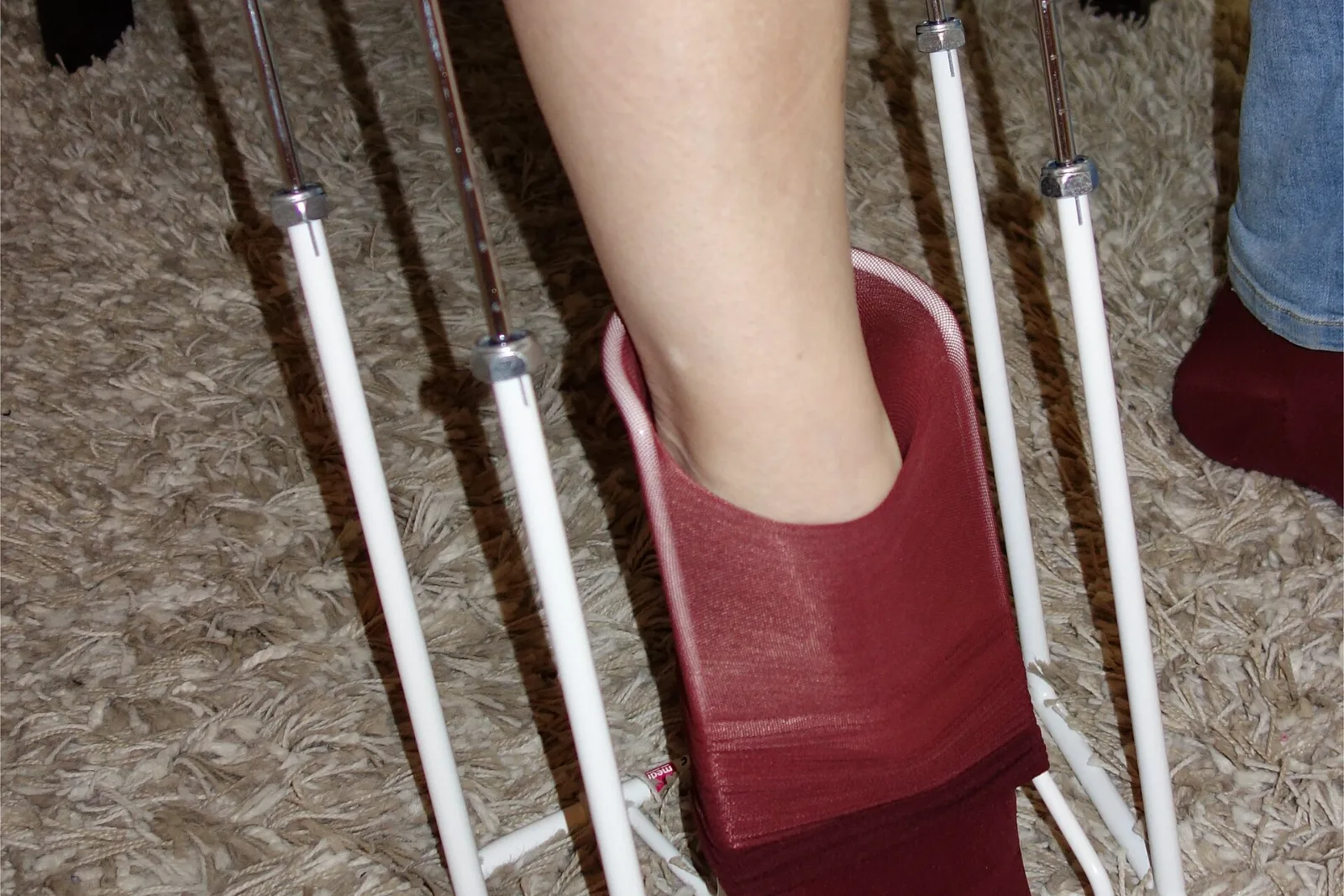
Mayo Clinic says a stocking donner can be particularly helpful when arthritis makes it hard to grasp and pull, and the NHS notes there are various accessories to help get stockings on and off. They solve different problems.
| Aid | How it works | Helps most with | Still needs |
|---|---|---|---|
| Frame donner | Holds the stocking open; you step in and pull it up by the handles | Bending; weak grip | Enough movement to lift the foot in; an opening wide enough for your calf |
| Rolling sleeve | The stocking is rolled onto a soft cuff, which then slides it over the foot and leg | Painful hands; carers | Practice |
| Slippery liner | A slick sock cuts friction over the heel, then comes out | The heel | A firm pull up the leg |
| Gloves | Rubber grip to work the fabric up and smooth wrinkles | Grip; snagging | Usually another aid as well |
Taking compression off at night is half the job. Ask whether an aid also helps with removal; some below do, and medi sells a separate doffing aid, the butler off.
What to check before you buy
| Feature | Why it matters | What to check |
|---|---|---|
| Pressure | Zipper lines can offer fewer strengths | The mmHg range matches what you were advised |
| Zipper guard | Keeps the zipper off your skin | A fabric guard between the zipper and your skin |
| Size chart | Charts differ between brands | Morning ankle and calf measurements against that product’s chart |
| Aid compatibility | Some liners suit only open toes; frames have a fixed opening | Toe style, length, and very large calves |
| Care | Heat and wringing damage elastic | The maker’s washing instructions; two pairs to rotate |
| Returns | Fit is hard to judge before wearing | The seller’s policy on opened compression items |
Options by need
Examples of each kind of help, not a ranking, each confirmed on the maker’s own product page in October 2026.
A zipper sock at 15–20 mmHg, open toe
Truform 0675 knee-high zipper compression socks, 15–20 mmHg, open toe. A unisex smooth-knit knee-high in beige or black, with a protective sleeve under the zipper; sizes follow Truform’s chart.
May suit: someone advised to wear 15–20 mmHg who cannot get a heel through a closed sock, or a carer helping. Limits: you still need grip to close the zipper. See it on Amazon
A zipper sock at 20–30 mmHg, closed toe
Truform 6665 knee-high zipper compression socks, 20–30 mmHg. Unisex, beige or black, with an inner fabric guard that Truform says helps prevent pinching and irritation. Wash gently in lukewarm or cold water; dry flat away from heat.
May suit: someone already prescribed 20–30 mmHg. Limits: not a starting strength for unexplained swelling, and Truform’s page calls it closed toe in one place and open toe in another, so check before you open the package. See it on Amazon
An open toe without a zipper
Therafirm EASE Opaque unisex open-toe knee high, 15–20 mmHg. Opaque, with a soft knit band, small to extra-large in short or long lengths; Therafirm says its very stretchy yarns make it easier to put on. Also made in 20–30 and 30–40 mmHg. Hand wash, lay flat to dry.
May suit: long feet, daily toe checks, or use with a slippery liner. Limits: “easier to put on” is the maker’s claim, not a measurement. See it on Amazon
A frame donner, for bending and grip
medi butler. A one-size donning aid with a handle on each side for a firm hold, so you can keep your balance while pulling the stocking evenly up the leg; medi lists an optimal 20-degree angle for ease of use. medi says it suits people with limited mobility and nursing staff.
May suit: people who can sit and lift a foot but cannot bend to it. Limits: one fixed size; with a large calf, compare openings first. Truform’s 0752 Stocking Donner, for example, comes in Regular, Tall and Large, with a 6-inch-wide donning zone on the Large against 4 inches on the others. See it on Amazon
A rolling sleeve, for painful hands or a carer
SIGVARIS Doff N’ Donner Rolly. A soft cuff that the stocking is rolled onto, which then slides the stocking over the foot and leg. SIGVARIS says it also helps take stockings off, works with knee-length and thigh-length stockings, open or closed toe, and can be used by you or a carer; a separate cone that sticks to a flat surface helps load it.
May suit: sore or weak hands, and carers. Limits: SIGVARIS says use may be limited with very large leg circumferences, and advises cleaning it after use. See it on Amazon
A slippery aid that also helps take them off
medi 2-in-1 donning and doffing aid. One size, foldable for travel; medi says it works with stockings of any length, open or closed toe, and with arm sleeves, letting the stocking glide over the heel.
May suit: people stuck at the heel who also struggle to get stockings off at night. Limits: it still takes a pull up the leg, and medi’s page shows how to use it only in videos. See it on Amazon
Gloves
Truform 0757 donning gloves. Latex-free, with a non-slip palm and fingers that also protect the fabric from rings and fingernails. Sized by palm circumference, from small (6.5–7 inches) to extra-large (9.5–10 inches).
May suit: almost anyone wearing compression. Limits: MedlinePlus suggests ordinary rubber dishwashing gloves for the same job. See it on Amazon
When a stocking is not workable: an adjustable wrap
circaid juxtalite leg wrap. Inelastic material closed by side-by-side adjustable straps, sold as a kit with two undersocks (15–25 mmHg at the foot and ankle) and a card for checking the pressure applied. medi says it is designed for venous disease and other swelling, lists people who struggle with elastic or zipper stockings among those who can benefit, and says the straps adjust without taking it off.
May suit: people who cannot pull a stocking on, and swelling that changes through the day. Limits: the pressure depends on how hard the straps are pulled, so have a clinician set it up. See it on Amazon
Downsides and limits
- No aid changes the prescription. If the strength or size is wrong, an easier way on just makes the wrong sock easier to wear.
- Aids add steps. A sleeve or frame has to be loaded and kept clean; SIGVARIS advises storing its Rolly away from light and heat.
- The usual problems remain. Cleveland Clinic lists skin irritation and discomfort among the usual, mostly mild problems, and nerve or soft-tissue damage as rare.
- Socks wear out. MedlinePlus advises replacing stockings every 3 to 6 months so they keep their compression; a zipper does not change that.
Alternatives, including not buying
- Use what you have. MedlinePlus suggests rubber dishwashing gloves, lotion that has fully dried, or a little powder on the legs; Mayo Clinic suggests sitting in a chair.
- Ask about another garment. A knee-high has far less fabric to pull than a thigh-high (when thigh-highs are needed), and if the strength you were given defeats you, ask what else would do.
- Get help with the job. A carer, a nurse or an occupational therapist can show you a method that suits your hands and hips. For caregivers.
- Check coverage. With lymphedema, Medicare Part B may cover gradient compression garments and wraps with adjustable straps that your clinician orders, and CMS lists zippers and donning aids among the accessories included; you pay 20% after the deductible. See lymphedema products.
- Do the free things. The NHS advice for swollen legs includes raising them on a chair or pillows, walking, and not standing or sitting still for long. With severe artery disease, raising the legs can make foot pain worse, and if heart failure makes you breathless lying down, ask your care team before lying with your legs raised (leg elevation).
For choosing strength and size, see compression socks for swelling.
Common questions
Are zipper compression socks as good as regular compression socks?
We found no published comparison. A zipper changes how the sock goes on, not the pressure the maker states for it, so choose strength and size as you would for any compression sock, and look for a fabric guard under the zipper.
How do you put on compression socks with arthritis?
First thing in the morning, sitting down, on dry skin, with rubber gloves for grip. Mayo Clinic says a stocking donner can be particularly helpful when arthritis makes it hard to grasp and pull. If that is still too hard, try a zipper sock, a rolling sleeve or an adjustable wrap, and ask about occupational therapy.
What is the easiest compression sock to put on?
It depends where you get stuck. The heel: a zipper sock or a slippery liner. Grip: gloves or a rolling sleeve. Bending: a frame donner. Pulling a stocking up the leg: an adjustable wrap set up by a clinician.
Are open-toe compression socks as effective as closed-toe?
The toes get little or no compression in either style, so the choice is mainly about fit and convenience, unless you have lymphedema or toe swelling, when a therapist should decide. Open toes suit long feet and daily toe checks; a closed toe feels more like a sock.
Do compression stocking donners work?
Often, yes. In a randomized-order study of 40 people over 65 with severe chronic venous insufficiency, the share who could put on a stocking correctly rose from 73% to 93% when they used donning devices (foot slips and frames). Reaching the forefoot and hand grip strength were linked to success, and some devices worked better than others. It was a small study. Mayo Clinic, Cleveland Clinic and the NHS also point to aids for people who struggle.
Does Medicare pay for zipper compression stockings?
Possibly, if you have lymphedema. Part B may cover gradient compression garments and wraps with adjustable straps when your clinician orders them, and CMS lists zippers and donning and doffing aids among the accessories included in that benefit. You pay 20% after the deductible, and the items must come from an enrolled Medicare supplier. For other conditions, ask your supplier and plan first.
Where to go next
Sources
- Mayo Clinic News Network. Mayo Clinic Q and A: Tips for using compression stockings.
- Cleveland Clinic. Compression Therapy.
- MedlinePlus. Compression stockings.
- MedlinePlus. Taking care of your new hip joint.
- NHS. Venous leg ulcer – prevention.
- NHS. Rheumatoid arthritis – treatment.
- NHS. Swollen ankles, feet and legs (oedema).
- NHS. Heart failure.
- University Hospitals Birmingham NHS Foundation Trust. Compression Stockings and Wraps: Patient Information Leaflet (PDF).
- StatPearls, NCBI Bookshelf. Venous Insufficiency.
- Rabe E, et al. Risks and contraindications of medical compression treatment: a critical reappraisal. An international consensus statement. Phlebology, 2020.
- Sippel K, et al. Donning devices (foot slips and frames) enable elderly people with severe chronic venous insufficiency to put on compression stockings. European Journal of Vascular and Endovascular Surgery, 2015.
- MedlinePlus. Peripheral artery disease – legs.
- Centers for Disease Control and Prevention. About Venous Thromboembolism (Blood Clots).
- Medicare.gov. Lymphedema compression treatment items.
- Centers for Medicare & Medicaid Services. Lymphedema Compression Treatment Items.
- Manufacturer information. Truform zipper socks, 0675, 6665, open-toe knee highs, closed-toe knee highs, Slip Sock, Stocking Donner and donning gloves; Therafirm EASE open-toe knee high; medi butler, butler instructions, butler off, 2-in-1 application aid, accessories catalog, circaid juxtalite and circaid adjustable wraps; SIGVARIS Doff N’ Donner system; Juzo Slippie.
Written by Tom Biernacki, DPM, FACFAS. Published 18 October 2026. Research-based comparison; product details and retailer links checked 18 October 2026. General education, not medical advice.