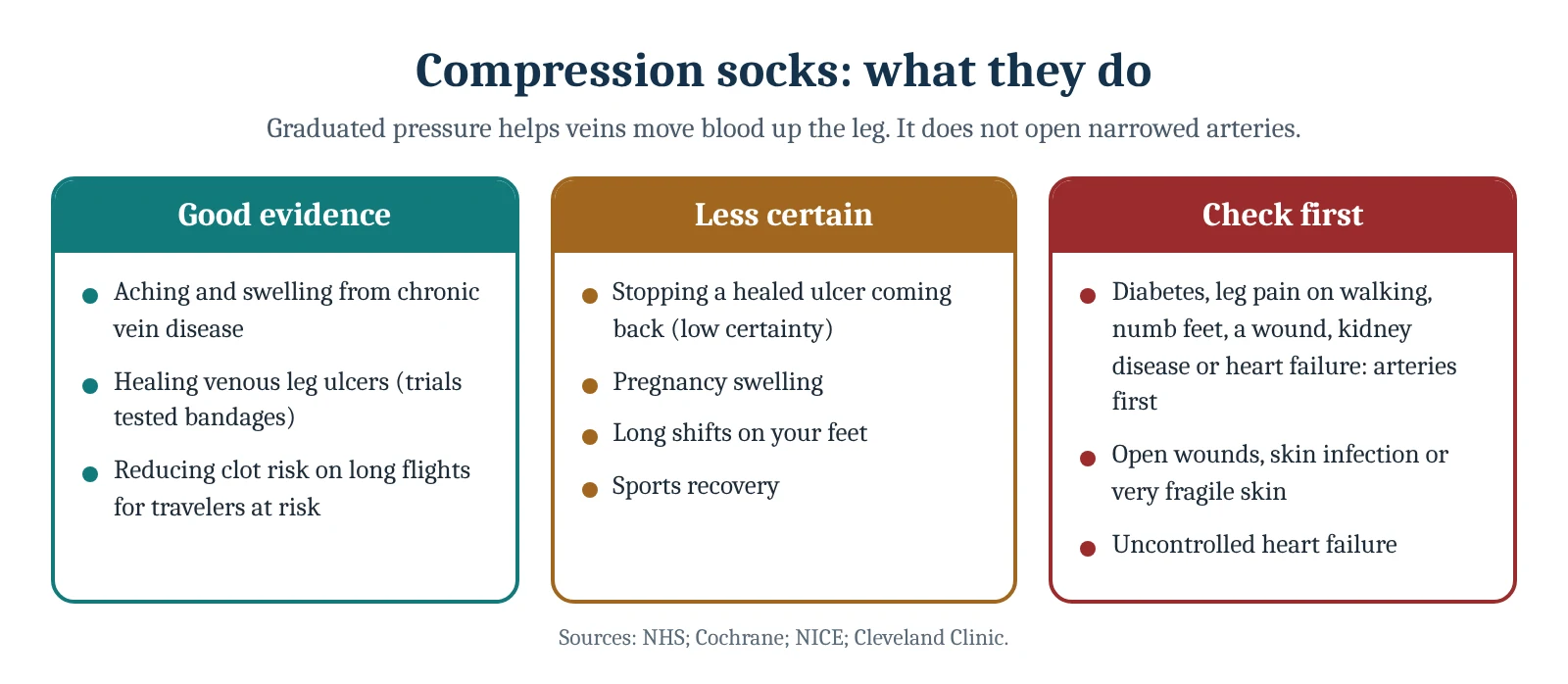
Compression socks squeeze the lower leg, firmest at the ankle, which helps your veins and calf muscles move blood back toward the heart and keeps fluid from collecting in the tissue. The benefits of compression socks that have good evidence behind them are for vein problems: venous leg ulcers heal faster, chronic venous swelling and aching ease, and fewer leg-vein clots are found after long flights and surgery. They do not improve blood flow through narrowed arteries, and on a leg with poor arterial supply they can do harm.
Check before you start, and know when to stop
Have the arteries in your legs checked first, usually with an ankle-brachial index, if you have diabetes, leg pain when you walk, numb feet, a foot or leg wound, kidney disease or heart failure. The NHS is plain that compression is not safe when the ankle artery pressures are low. Who needs an assessment first.
Take them off and get advice straight away if your toes turn pale, blue or cold, go numb or tingle, or the skin blisters or breaks. A foot or leg that suddenly turns cold, pale or mottled, numb, weak or severely painful, or that stays cold, pale or numb with the sock off, is a 911 call.
One leg that is newly swollen, painful, warm or red needs to be seen today, not treated with socks. Call 911 for sudden breathlessness, chest pain, coughing blood or fainting. Why timing matters with DVT.
How compression socks work
Standing upright leaves a long column of blood in the leg veins. One-way valves and the squeeze of your calf muscles as you walk keep it moving up toward the heart. When the valves leak, pressure in the lower leg stays high and fluid seeps into the tissue as swelling. How venous insufficiency develops.
Graduated compression pushes back from the outside. The pressure is strongest at the ankle and eases toward the knee, and it works together with the pumping action of the calf muscles, so it does most while you are up and moving. The squeeze also raises the pressure in the tissue under the skin, which limits how much fluid collects there.
The effect lasts only while the socks are on, and fit decides whether they help: too loose does little, while too tight, wrinkled or rolled can cause injury.
Pressure levels at a glance
Compression is labeled in millimeters of mercury (mmHg), the pressure at the ankle. There is no standard rating scale, so the mmHg figure tells you more than words such as “support” or “travel” on the box.
| Range | Usual label | Typical use |
|---|---|---|
| 8–15 mmHg | Mild | Tired, achy legs; comfort |
| 15–20 mmHg | Moderate | Mild swelling, travel, long hours standing or sitting, pregnancy; sold over the counter |
| 20–30 mmHg | Firm | Varicose veins and venous insufficiency, after some vein procedures; Cleveland Clinic classes it as prescription strength |
| 30–40 mmHg | Extra-firm | More severe venous disease, healed ulcers, lymphedema; prescribed and fitted |
Stronger is not better. It is a different prescription, harder to get on and riskier if your arterial supply is limited. Measuring, lengths and putting them on are covered in compression fit and pressure labels. Styles made for women and for men are compared in compression socks for women and for men.
Benefits of compression socks, use by use
The evidence is strong for some uses and thin for others. This is how it stands in the reviews and guidance listed at the end of this page.
| Use | What the evidence says | Typical strength |
|---|---|---|
| Healing a venous leg ulcer | Good. Compression probably heals ulcers faster and heals more of them (moderate certainty; 14 trials, mostly small, all testing bandages). It is the main treatment, once the arteries have been checked. | Bandaging applied by a trained nurse, then stockings |
| Stopping a healed ulcer coming back | Recommended by guidelines, but low-certainty evidence. In one trial of 153 people, about 21 in 100 in higher-compression (European class 3) stockings had an ulcer return within six months, against 46 in 100 with no compression, and Cochrane has little confidence in the evidence. The NHS calls stockings worn whenever you are out of bed the most effective prevention. | Prescribed; higher compression may work better but is harder to keep wearing |
| Chronic venous insufficiency: swelling, aching, skin changes | Established: the main nonsurgical treatment, used to ease symptoms and prevent severe swelling and ulcers. | 20–30 mmHg; 30–40 for more severe disease |
| Varicose veins without an ulcer | Unclear. People in the trials reported feeling better, but the evidence is low to very low certainty and cannot show whether stockings work as the only first treatment. NICE advises a procedure rather than stockings when one is suitable. | 20–30 mmHg |
| Lymphedema | Established, within treatment led by a lymphedema therapist: bandaging brings the swelling down, then garments help keep it down. Lymphedema | Garments fitted by a therapist |
| Long flights, if your clot risk is raised | Strong for symptomless clots: of 2,637 passengers in trials, 3 wearing stockings had one, against 47 not wearing them (high certainty). Not recommended for clot prevention without risk factors. Socks for flying | 15–30 mmHg, below the knee |
| In hospital after surgery | Strong. In surgical patients, clots were found in about 10% with stockings and 21% without (high certainty). After a stroke, stockings did not prevent clots and caused more skin problems. TED hose vs. compression stockings | Anti-embolism stockings, fitted in hospital |
| After a deep vein clot (DVT) | Not advised to prevent post-thrombotic syndrome. A 2017 Cochrane review found only low-quality evidence that stockings may lower the chance of it, and NICE advises against offering them for that purpose. They may still be used to manage leg symptoms after a DVT. Post-thrombotic syndrome | As your clinician advises |
| Swollen legs in pregnancy | Reasonable for comfort, with little trial evidence. NICE suggests considering them for swelling with varicose veins in pregnancy; a Cochrane review found too little research, stockings included, to say how well any treatment works. | Under 20 mmHg unless advised otherwise |
| Long hours standing at work | Reasonable for comfort, weak evidence: a single very small trial in 19 flight attendants found less leg fatigue, and Cochrane found too little evidence for firm conclusions. | 15–20 mmHg |
| Sports recovery | Limited and uncertain. Some endurance athletes wear them during or after exercise, and Cleveland Clinic says some research supports better muscle recovery and less soreness. A 2026 review of nine small trials of compression garments worn after endurance exercise found soreness leaning in favor of compression but very uncertain, and could not settle whether they improve later performance (very low certainty). | Varies; no standard |
| Narrowed arteries (PAD), cold feet, “poor circulation” | Not a use. Compression acts on veins and tissue fluid, not on narrowed arteries, and it is unsafe when ankle artery pressures are low. | None without specialist advice |
The honest summary
The strongest evidence is for vein disease that has already damaged the skin, and for clot prevention in specific high-risk settings. For tired legs, long shifts and pregnancy the trials are small, and the case rests mainly on comfort. That is a fair reason to wear them if your arteries are healthy. At most, “improves circulation” on a box means helping blood return through the veins; it does not mean more blood reaching your feet.
What compression socks do not do
- Treat narrowed arteries. The NHS says stockings are not suitable if you have problems with blood flow in your arteries, and that compression is not safe when the ankle artery pressures are low.
- Get rid of varicose veins. Stockings can help with the swelling and pain, but closing or removing a vein takes a procedure. NICE advises against offering stockings to treat varicose veins unless a procedure is unsuitable.
- Treat swelling that starts elsewhere. Swollen ankles can be a sign of heart failure, and uncontrolled heart failure is a reason not to use compression at all. Swelling from the heart, kidneys, liver or a medicine needs its cause found.
- Prevent clots in low-risk travelers. Guidelines summarized by the CDC do not recommend them for that, though they may ease ankle swelling on a long flight.
- Replace moving. They work with the calf muscle pump, so walking still matters.
Side effects and risks
Most problems are minor. Cleveland Clinic lists skin irritation, discomfort or pain, bacterial or fungal skin infection, and swelling of the foot and toes, where compression is lower. In trials of stockings for varicose veins, people reported sweating, itching, irritation, dry skin and tightness, with no severe or long-lasting side effects.
The serious problems come from pressure in the wrong place:
- Tight bands. A top that is rolled or folded down, or a knee-high that is too long, can form a tight band around the leg and cause skin sores. A vascular specialist quoted by the American Heart Association calls it a tourniquet effect.
- Wrinkles and bunching, which press one narrow line of skin much harder than the rest.
- Pressure damage over bony points. Heels and other bony areas are most at risk in people who move little or cannot feel their feet; NICE asks for skin checks two or three times a day in those groups when hospital stockings are used.
- Nerve and soft-tissue damage, which Cleveland Clinic lists as rare.
- Harm on a leg with poor arterial supply, the reason for the check at the top of this page.
Can compression socks cause blood clots?
The trials point the other way. On long flights and after surgery, people wearing stockings had fewer leg-vein clots, and in the flight trials surface-vein clots were not more common either (4 with stockings, 12 without). Cleveland Clinic does list a surface-vein clot among rare severe side effects. If one leg becomes swollen, painful, warm or red while you wear them, take them off and be seen today.
Who should not wear compression socks, or should ask first
For some people compression is the wrong treatment; for others it is fine once a clinician has looked. NICE’s guidance on hospital stockings, Cleveland Clinic and StatPearls name these groups:
- Peripheral artery disease, known or suspected, or a bypass operation on the leg arteries.
- Uncontrolled heart failure.
- Neuropathy or other loss of feeling in the legs, because damage may not be felt.
- Open wounds, skin infection or very fragile skin.
- An allergy to the material.
- Severe swelling, or a leg shape that standard sizes cannot fit.
- A suspected clot, which needs to be seen, not squeezed. If you already take blood thinners for a DVT, Cleveland Clinic advises checking with your provider before starting compression.
And one rule applies even to low-pressure socks: with diabetes, leg pain when you walk, numbness, a wound, kidney disease or heart failure, have your arterial circulation checked first. Feeling fine in them is not proof they are safe. Compression safety explains the assessment.
How long to wear compression socks
Each day
Put them on first thing in the morning, before your legs swell; MedlinePlus suggests doing it before you get out of bed. Wear them through the day and take them off at bedtime. That is the usual advice from the NHS, Cleveland Clinic and the American Venous Forum, though some people are prescribed compression day and night, and that instruction comes first.
Some discomfort while you get used to them is common. Pain, numbness or color change is not.
For how many weeks or months
That depends on the reason.
| Reason | Usual duration |
|---|---|
| After a vein procedure (ablation, foam or surgery) | About a week; NICE advises no more than 7 days |
| In hospital or after an operation (anti-embolism stockings) | Until you are moving about as usual; one NHS hospital says up to six weeks after hip or knee surgery |
| A long flight | For the journey |
| Varicose veins or chronic venous insufficiency | Long term; the benefit lasts only while you wear them |
| A healed venous ulcer | Whenever you are out of bed, long term |
| Lymphedema | Long term, as the maintenance part of treatment |
When to replace them
The elastic wears out. MedlinePlus advises replacing stockings every three to six months, and one NHS hospital trust says medi, Bauerfeind and SIGVARIS stockings usually need replacing after four to six months. Replace them sooner if they tear, bunch, slide down or have stretched. Washing after each wear and keeping two pairs in rotation helps.
Can you sleep in them?
Usually there is no need. Daytime graduated socks do their work while you are upright, and the standard advice is to take them off at bedtime unless a clinician has said otherwise. The exceptions are anti-embolism stockings after surgery, night-time garments prescribed for lymphedema, and ulcer bandaging applied by a nurse. Details: can you sleep in compression socks?
Signs compression socks are too tight or the wrong size
Firm is normal. These are not:
- Pain, rather than pressure.
- Numbness, tingling or pins and needles in the feet or toes.
- Toes that look pale, blue or swollen, or feel cold.
- Deep marks, blisters or broken skin where the sock sits, especially at the top band and over bony points.
- A top band that digs in or rolls down, or fabric that bunches at the ankle.
- Socks that slide down, bunch up or have stretched out, which can mean they are the wrong size or worn out and may need replacing.
Take them off if you notice any of the first four, and get advice before wearing them again. Being measured for the right size matters: the American Venous Forum says professional measurement helps prevent the injury or pain poorly fitted garments can cause. Measuring and fit explains how.
Common questions
What are the benefits of compression socks?
The best-supported benefits are for vein problems: faster healing of venous leg ulcers, relief of chronic venous swelling and aching, and fewer leg-vein clots on long flights and after surgery. They are also part of lymphedema treatment. For tired legs and long shifts they are a comfort measure with thinner evidence.
What do compression socks do to your legs?
They squeeze the lower leg, hardest at the ankle and less toward the knee. That helps your calf muscles move blood in the veins back toward the heart, and it raises the pressure in the tissue under the skin so less fluid collects there. The effect stops when you take them off.
How long should you wear compression socks a day?
Usually from when you get up until bedtime. Some people are prescribed day-and-night wear. How many weeks or months depends on the reason, from about a week after a vein procedure to long term for venous disease, a healed ulcer or lymphedema.
What are the side effects of wearing compression stockings?
Mostly skin irritation, itching, dryness, sweating, discomfort, skin infections and swelling of the toes, where the pressure is lower. A rolled or wrinkled band can cause sores. Rarely, pressure damages nerves or soft tissue, and on a leg with poor arterial supply compression can do serious harm.
Can compression socks cause blood clots?
In trials on long flights and after surgery, people wearing stockings had fewer clots, not more. Cleveland Clinic lists a surface-vein clot among rare severe side effects. A leg that becomes swollen, painful, warm or red needs to be seen today.
Who should not wear compression socks?
People with peripheral artery disease or uncontrolled heart failure, unless a specialist advises it, and people with open wounds, skin infection, very fragile skin, loss of feeling in the legs or an allergy to the fabric. With diabetes, leg pain on walking, numb feet, a wound, kidney disease or heart failure, have your arteries checked first.
Is it OK to wear compression socks every day?
Yes, if they suit your legs and fit well: daily daytime wear is how they are meant to be used for venous disease. Take them off at night, check your skin, and replace them every three to six months. For a healthy person without symptoms they are optional rather than necessary.
Where to go next
Sources
- Cochrane. Compression bandages or stockings versus no compression for treating venous leg ulcers (2021), and Compression therapy for preventing venous leg ulcers returning (2024).
- Cochrane. Wearing stockings to provide compression for the treatment of varicose veins (2021), and Compression therapy for prevention of post-thrombotic syndrome (2017).
- Cochrane. Compression stockings for preventing deep vein thrombosis (DVT) in airline passengers (2021); Graduated compression stockings for prevention of deep vein thrombosis during a hospital stay (2018); and Physical methods for preventing deep vein thrombosis in stroke (2022).
- Cochrane. Interventions for varicose veins and leg oedema in pregnancy (2015), and Prevention of poor blood flow in the veins in a standing worker population (2013).
- Frontiers in Physiology. Effects of post-exercise compression garments on subsequent endurance performance and delayed-onset muscle soreness in endurance athletes: a systematic review and meta-analysis (2026).
- NHS. Varicose veins; Venous leg ulcer – diagnosis and treatment; Lymphoedema – treatment; Pulmonary embolism; Heart failure – symptoms.
- National Institute for Health and Care Excellence. Varicose veins: diagnosis and management (CG168), recommendations; Venous thromboembolism in over 16s (NG89), recommendations; and Venous thromboembolic diseases: diagnosis, management and thrombophilia testing (NG158), recommendations.
- Cleveland Clinic. Compression Therapy: Types and Benefits, and Health Essentials, What You Need To Know About Compression Socks.
- Mayo Clinic. Varicose veins: diagnosis and treatment, and Mayo Clinic News Network, Mayo Clinic Q and A: Tips for using compression stockings.
- MedlinePlus. Compression stockings.
- American Venous Forum. What is Compression Therapy?
- American Heart Association News. Do you really need compression socks on long flights?
- Society for Vascular Surgery. Chronic Venous Insufficiency, and Acute Limb Ischemia.
- Johns Hopkins Medicine. Chronic Venous Insufficiency.
- StatPearls, NCBI Bookshelf. Venous Insufficiency, and Varicose Veins.
- Centers for Disease Control and Prevention. CDC Yellow Book 2026: Deep Vein Thrombosis and Pulmonary Embolism.
- National Cancer Institute. Lymphedema (PDQ®)–Health Professional Version.
- Cambridge University Hospitals NHS Foundation Trust. Anti-embolic stockings (AES).
- Guy’s and St Thomas’ NHS Foundation Trust. Compression stockings.
Written by Tom Biernacki, DPM, FACFAS. Published 18 October 2026. General education, not medical advice.