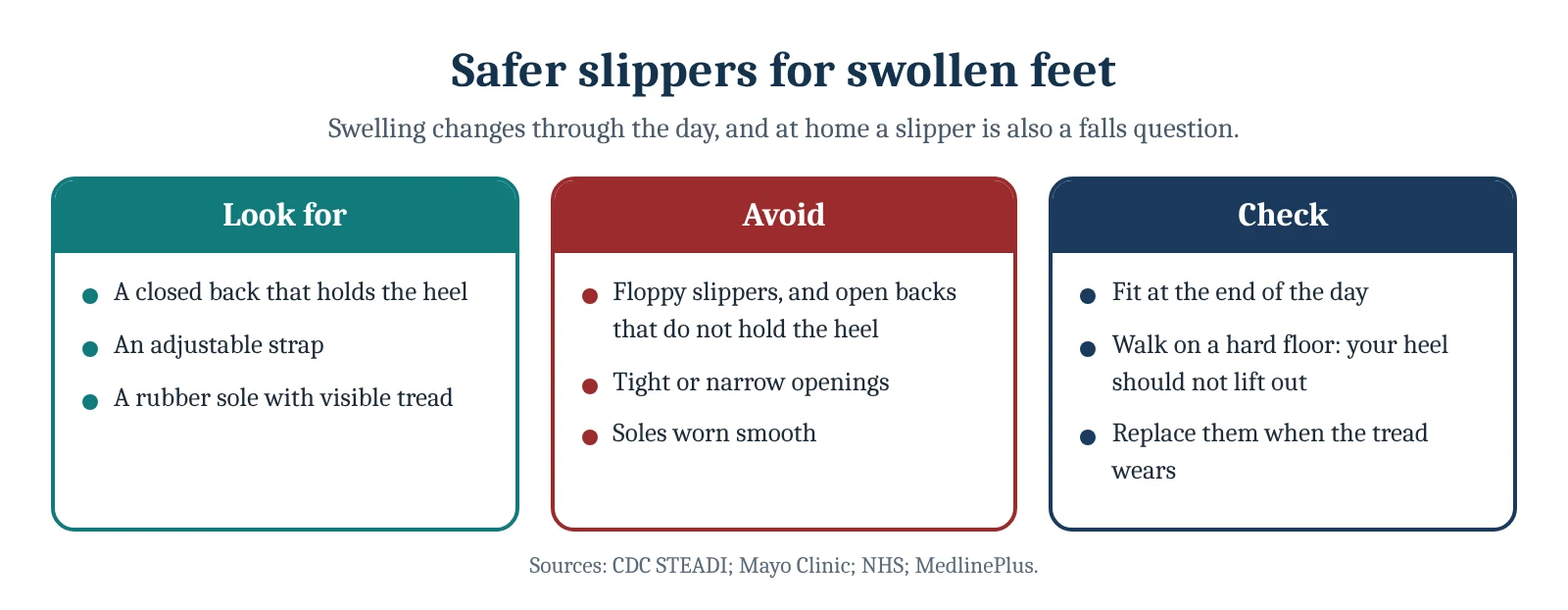
The best slippers for swollen feet open wide, fasten with a strap you can let out by evening, hold the heel with a closed back and grip the floor with a rubber sole: adjustability matters more than buying a bigger size. If you are unsteady on your feet, those features are fall prevention as much as comfort, and CDC advice is to wear well-fitting, supportive shoes inside the house as well as out.
Swelling that needs a clinician before new slippers
- Call 911 for swelling with sudden trouble breathing, chest pain or pressure, coughing up blood, a racing or irregular heartbeat, or fainting or near-fainting; for a foot or leg that suddenly turns cold, pale or mottled, numb, weak or severely painful; or for a wound with spreading redness plus fever, chills, confusion, a rapidly worsening appearance or a foul smell.
- Be seen today if one leg or foot has newly swollen and the other has not, particularly with pain, warmth or a change in color.
- Get seen the same day or the next day for a red, hot, swollen foot (especially with a fever), a break in the skin that is not closing or is getting bigger, or a dark or black patch on a toe or heel. With diabetes, dialysis or known artery disease the threshold for being seen is lower, so call the same day.
How this guide was made, and how the site is paid. This is a research-based comparison of slippers and sandals for swollen feet, built from manufacturers’ published specifications and public guidance; we have not tested these products hands-on. Some links go to Amazon. As an Amazon Associate I earn from qualifying purchases. Commissions do not change which products are listed or what we say about them, and no manufacturer provided products, samples or payment for this guide. Our methodology · Disclosure
Why swollen feet need a different kind of slipper
A swollen foot is not one size all day. MedlinePlus notes that gravity makes swelling most noticeable in the lower body, and NIDDK points out that feet are largest at the end of the day. A slipper that fits at breakfast can pinch by dinner; a strap that adjusts copes with both.
Tightness is what to avoid. The NHS advises wide, comfortable shoes with a low heel and soft sole for swollen feet, and nothing too tight. Cleveland Clinic lists shoes that feel a little tighter among the signs of pitting edema, and says special edema shoes exist for people who need adjustable footwear for swelling.
Then there is the floor. CDC’s STEADI brochure asks for well-fitting shoes with good support inside the house as well as out, and an older CDC pamphlet (2000) was blunter: avoid going barefoot or wearing slippers. The NHS says shoes or slippers should fit well, not slip off and have a good grip, and Mayo Clinic lists floppy slippers, slick soles and walking in stocking feet among the things that can make you slip, stumble and fall.
Who should get advice before buying
For ordinary end-of-day swelling with a known cause, choosing better slippers yourself is reasonable. Talk to a podiatrist or your doctor first if any of these apply:
- Diabetes or numb feet. NIDDK says that when feeling is lost you may not notice a pebble in your sock or a blister on your foot, so a slipper that rubs may not hurt. The UK’s NHS lists swollen feet with diabetes as a reason to ask for an urgent appointment. Ask your diabetes team or podiatrist whether a slipper is enough; extra-depth shoes and Medicare’s therapeutic-shoe benefit are covered in shoes for swollen feet.
- A red, warm, swollen foot with numbness. NIDDK notes that Charcot foot, a rare complication of diabetic nerve damage, may start with redness, warmth and swelling. That needs same-day assessment, not a roomier slipper.
- A wound, blister or sore. Get it looked at first; see a foot or leg wound that will not heal.
- Known or suspected artery disease. NIDDK notes that too little blood flow to the feet makes it hard for a sore or an infection to heal; see PAD symptoms and warning signs.
- Falls, near-falls or unsteadiness. CDC’s STEADI brochure suggests having your healthcare provider check your feet once a year, discussing proper footwear, and asking whether seeing a foot specialist is advised.
- Swelling nobody has explained. The cause decides what helps; the swelling guide covers the patterns.
If any of these apply, a daily look at your feet matters more than any slipper feature: see daily foot and leg skin checks, and the caregivers’ guide if you look after someone else’s feet.
What to look for in slippers for swollen feet
| Feature | Why it matters | What to check |
|---|---|---|
| Opens wide | A swollen instep is easier to step in than to squeeze through a narrow opening | The strap or opening folds back far enough for the whole foot |
| Adjustable strap | One slipper fits the morning foot and the evening foot | Hook-and-loop (Velcro-style) with room to loosen and to tighten |
| Closed back | The NHS says slippers should not slip off; Mayo Clinic lists floppy slippers among the causes of falls | The back stands up and your heel stays put as you walk |
| Rubber sole with tread | MedlinePlus notes that rubber soles can help keep you from slipping; Mayo Clinic lists slick soles among the hazards | Visible tread, not fleece or smooth suede underneath |
| Low heel | MedlinePlus advises low heels that fit well; the NHS says low heel and soft sole for swollen feet | Flat or nearly flat, and wide enough to feel stable |
| Depth as well as width | A wide slipper with no room above the foot can still press on the top of a swollen one | “Extra depth”, removable insoles or spacers, and your width on the maker’s chart |
| Smooth inside | NIDDK advises checking that the lining is smooth and free of pebbles | Run a hand around the inside before each wear |
How to fit a slipper for a foot that changes size
- Try them on late in the day, when feet are largest, with the socks you will wear, including compression socks if you use them.
- Fit the larger foot if one is always bigger, and leave enough strap to tighten in the morning.
- Walk on a hard floor. Your heel should not lift out, and you should not have to curl your toes to keep the slipper on.
- Break them in, then check your feet. MedlinePlus, in its advice for people with diabetes, says to wear new shoes 1 or 2 hours a day for the first 1 or 2 weeks. It warns that you may not feel pressure from shoes that fit badly, and that blisters and sores can develop where the foot presses against the shoe.
- Retire them when the tread is smooth, the back has collapsed or the strap no longer holds.
Options by need
These come from established therapeutic and comfort footwear makers, chosen because each maker’s own page confirmed the features listed. Widths and sizes are what those pages showed in October 2026, not our measurements. Silverts’ Easy Closure slippers and Dr. Comfort’s Breeze sandal are in our shoes guide, so they are not repeated here.
House slippers with adjustable straps that open fully
Orthofeet Asheville (men’s). A slipper with a faux-fur lining, suede in most colors, and adjustable straps on both sides that open completely, so you step in rather than squeeze in. Medium (D), Wide (2E) and X-Wide (4E), depending on color; sizes 7 to 14; two thin fitting spacers in every pair. Orthofeet says it fits large and suggests a half size smaller. See it on Amazon
Orthofeet Charlotte (women’s). A slip-on, suede in most colors, with a faux-fur lining, a roomy toe box and an adjustable side strap that opens wide. Medium (B), Wide (D) and X-Wide (2E), sizes 5 to 12, spacers included. For a snug fit Orthofeet suggests a half size smaller. See it on Amazon
May suit: swelling that changes through the day, in someone steady on their feet. Limits: both pages describe a heel lip, not a fully closed back; neither says what the outsole is made of or whether it resists slipping; the Charlotte stops at 2E.
A closed heel and a rubber sole, for milder swelling
Dr. Comfort Relax (men’s). A microfiber slipper with a fleece lining, a closed heel and a rubber outsole that Dr. Comfort says helps deliver traction; dual gussets add give for swollen feet. One width, Wide (E/EE), whole sizes 7 to 13. The maker advises hand washing. See it on Amazon
Dr. Comfort Cuddle (women’s). The same closed-heel, fleece-lined pattern, with a rubber and EVA outsole the maker calls slip-resistant. Wide (C/D), whole sizes 6 to 11. The maker advises hand washing. See it on Amazon
May suit: mild swelling, and anyone who wants a slipper that stays on. Limits: neither page describes a strap or other closure to loosen or tighten as the day goes on; one width, no half sizes. Dr. Comfort’s open-heel Easy (men’s) and Cozy (women’s) are easier to step into, but the heel is not held, and the NHS advises slippers that do not slip off.
Extra-wide slippers with extra depth, for heavy swelling
Drew Relax (men’s). A sweater-fabric slipper with a wide opening, a rubber outsole Drew labels slip-resistant, and two removable footbeds that let you switch between added and double depth or make room for a prescribed orthotic. Medium (D), Wide (EE), 4E and 6E, sizes 8 to 16. See it on Amazon
Drew Unwind (women’s). The same sweater-fabric, two-footbed design and outsole, from Medium (B/C) to Extra Wide (4E/5E), sizes 6 to 12. See it on Amazon
May suit: large or long-standing swelling, and anyone shopping for extra-wide slippers in 4E or wider. Limits: Drew’s pages describe a wide opening but name no strap or other closure, so do not assume these can be tightened for the morning foot, and they do not say whether the back is closed or open; check that your heel stays put.
Adjustable sandals for warm weather
Drew Warren (men’s). A nubuck and stretch-neoprene sandal with three adjustable hook-and-loop closures, a rubber outsole and a removable cushioned footbed; Drew calls it a double-depth sandal that accommodates prescribed orthotics. Medium (D), Wide (EE), 4E and 6E, sizes 7 to 16. See it on Amazon
Silverts Women’s Easy-Close Sandals, adjustable fit (regular to extra wide). A corduroy-mesh sandal slipper with a roomy toe box, a touch-fastening closure with a large overlap that opens fully, a rubber grip sole and a brushed lining. Machine washable; tumble on low or air dry. Sizes 5 to 12, with no width letters on the page. Silverts sells it for indoor and outdoor wear; it is not the Easy Closure slipper from our shoes guide. See it on Amazon
May suit: hot weather, when a closed slipper is too warm. Limits: neither page says whether a strap runs behind the heel, so check the photos. Sandals leave more skin exposed, and MedlinePlus advises people with diabetes not to wear flip-flops; ask your podiatrist whether sandals suit your feet. For a women’s sandal with a heel strap in wider fittings, browse options on Amazon.
After surgery, or over dressings
Post-operative shoes, and shoes worn over dressings or bandaging, are a clinical decision, chosen around the dressing and what your clinician wants protected. If swelling is so heavy that no slipper fits, ask a podiatrist for a fitting; see shoes for lymphedema and very swollen feet. We have not linked any products here.
Downsides and limits
- No slipper reduces swelling. It makes swelling easier to live with; the cause still needs attention.
- A slipper is not a shoe. CDC’s advice is supportive, well-fitting shoes inside and out. If you walk a lot at home, or have fallen, an adjustable shoe may be the better indoor choice; see shoes for swollen feet and extra-wide shoes compared.
- Width labels and sizing are not standard. One maker’s 4E is not necessarily another’s, some widths come only in some colors, and Orthofeet says the Asheville fits large. Check the return policy before you buy.
Alternatives, including not buying
- Wear a supportive shoe indoors. If you already own a pair that adjusts and leaves no marks, that matches CDC’s advice better than any slipper.
- Do not swap slippers for socks. NIDDK says not to walk barefoot or in just socks, even indoors. For what to wear inside your slippers, see socks for swollen feet.
- Make the floor safer. CDC’s home checklist suggests removing throw rugs or fixing them with double-sided tape or a non-slip backing, and putting in a nightlight if the path from bed to bathroom is dark.
- Treat the swelling itself. How to reduce swelling covers raising the legs (and who should ask first), movement and salt. Compression socks put gentle pressure on the body to keep fluid from building up, but Cleveland Clinic says to check with your provider first, and anyone with diabetes, PAD symptoms, numbness, a wound, kidney disease or heart failure should have their arterial circulation checked first, usually with an ankle-brachial index; see compression safety.
Questions to ask your podiatrist
- Is a slipper enough for my feet indoors, or do I need a shoe or therapeutic footwear?
- What is causing my swelling, and will it change?
- Am I at risk of falling, and what footwear would lower that risk?
Common questions
What are the best slippers for swollen feet?
Ones that open wide, fasten with a strap you can adjust through the day, hold the heel with a closed back, and have a rubber sole with tread. Fit them late in the day with the socks you usually wear.
What are the safest slippers for elderly people with swollen feet?
Closed-back slippers with a secure strap, a low heel and a rubber sole with tread, in a size that fits. CDC’s fall-prevention advice goes further and prefers well-fitting, supportive shoes inside the house. Floppy or smooth-soled slippers are the ones to replace first.
What are the best sandals for swollen feet?
Sandals with adjustable straps across the foot, a strap behind the heel, a rubber sole and a removable footbed for extra depth. Skip flip-flops, which MedlinePlus advises people with diabetes not to wear and which do not hold the heel. With diabetes or numbness, ask a podiatrist whether open toes suit you.
Should I buy slippers a size bigger for swollen feet?
Usually not a longer one. Swelling adds width and depth, so the answer is a wider fitting, extra depth and an adjustable strap in your normal length; a slipper that is too long leaves the heel loose. Read each maker’s sizing note, though: Orthofeet says its Asheville fits large and suggests a half size smaller.
Can I wear slippers if I have diabetes?
NIDDK advises people with diabetes to wear shoes and socks at all times and never to walk barefoot or in just socks, even indoors, and MedlinePlus likewise says to wear shoes at all times. Whether a slipper is enough protection for your feet is a question for your podiatrist or diabetes team, especially with numbness, a past ulcer or a change in foot shape.
What are edema slippers?
A sales term for slippers made with swelling in mind. Cleveland Clinic notes that special edema shoes exist for people who need adjustable footwear for swelling; among the slippers above, makers describe extra width or depth, a wide opening and, on some, an adjustable closure. The label shows what a maker intends, not how the slipper performs, so check the closure, the back and the sole.
Where to go next
- Shoes for swollen feet: adjustable, wide and deep options
- Socks for swollen feet: non-binding, wide and warm
- Shoes for lymphedema and very swollen feet
- Daily foot and leg skin checks
- For caregivers: looking after someone else’s feet
- How to reduce swelling in feet, ankles and legs
- Near Howell or Bloomfield Township, Michigan: a foot and ankle evaluation (the author’s own practice)
Sources
- Centers for Disease Control and Prevention, STEADI. What YOU Can Do to Prevent Falls (brochure, 2017).
- Centers for Disease Control and Prevention. What you can do to prevent falls (pamphlet, 2000; CDC Stacks).
- Centers for Disease Control and Prevention, STEADI. Check for Safety: A Home Fall Prevention Checklist for Older Adults (brochure, 2017).
- Mayo Clinic. Fall prevention: Simple tips to prevent falls.
- NHS. Falls.
- MedlinePlus. Preventing falls.
- National Institute of Diabetes and Digestive and Kidney Diseases. Diabetes & Foot Problems.
- MedlinePlus. Diabetes – taking care of your feet.
- NHS. Swollen ankles, feet and legs (oedema).
- MedlinePlus. Foot, leg, and ankle swelling.
- Cleveland Clinic. Pitting Edema.
- Orthofeet (manufacturer information). Asheville and Charlotte.
- Dr. Comfort (manufacturer information). Relax, Cuddle, Easy and Cozy.
- Drew Shoe (manufacturer information). Relax, Unwind and Warren.
- Silverts (manufacturer information). Women’s Easy-Close Sandals.
Written by Tom Biernacki, DPM, FACFAS. Published 18 October 2026. Research-based comparison; product details and retailer links checked 18 October 2026. General education, not medical advice.