The best socks for swollen feet do no harm: a top that stays up without digging in, enough width and stretch for the foot at its largest, a flat toe seam, and fibers that keep the skin dry. A non-binding sock does not reduce swelling; it only avoids adding a tight band. If you need something that pushes swelling down, that is compression, and some people need their arteries checked before they start.
Swelling that needs a clinician, not new socks
- Call 911 for swelling with sudden trouble breathing, chest pain or pressure, coughing up blood, a racing or irregular heartbeat, or fainting or near-fainting; for a foot or leg that suddenly turns cold, pale or mottled, numb, weak or severely painful; or for a wound with spreading redness plus fever, chills, confusion, a rapidly worsening appearance or a foul smell.
- Be seen today if one leg or foot has newly swollen and the other has not, particularly with pain, warmth or a change in color.
- Get seen the same day or the next day for a red, hot, swollen foot (especially with a fever), a break in the skin that is not closing or is getting bigger, or a dark or black patch on a toe or heel. With diabetes, dialysis or known artery disease the threshold for being seen is lower, so call the same day.
How this guide was made, and how the site is paid. This is a research-based comparison of socks for swollen feet, built from manufacturers’ published specifications and public guidance; we have not tested these products hands-on. Some links go to Amazon. As an Amazon Associate I earn from qualifying purchases. Commissions do not change which products are listed or what we say about them, and no manufacturer provided products, samples or payment for this guide. Our methodology · Disclosure
What a sock mark does and does not tell you
An elastic top can leave a faint line. Cleveland Clinic gives a deep, ring-like dent all around the leg where the top of the sock was as one easy way to see pitting edema, and its closing note lists shoes that feel a little tighter, or pressed-in skin that lasts a few minutes after you take your socks off, among the signs to call your provider about.
A sock mark does not name the cause. The NHS lists causes from standing or sitting too long, salty food, pregnancy and some medicines to varicose veins and kidney, liver or heart problems. See pitting edema for what an indentation does and does not mean, and swelling in both legs for the common causes.
Two patterns matter more than how deep the line is. A mark on one leg only, if that swelling is new, needs to be seen today; see why one swollen leg is different. Swelling in both legs that has not improved after a few days at home, or that gets worse, is a reason to see a doctor, the NHS says, not a reason to buy looser socks.
A looser top makes the line fainter without changing the fluid underneath, so a faint line is not proof that swelling has gone.
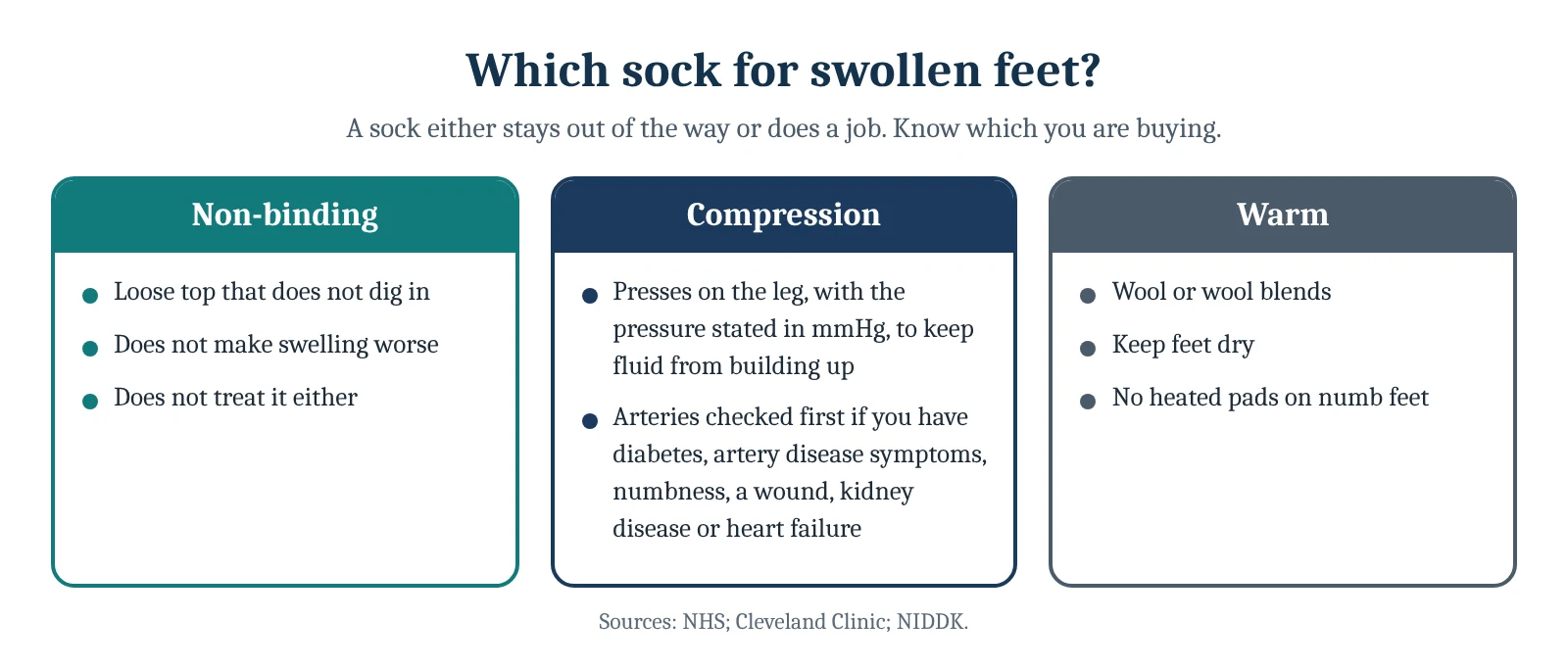
Non-binding, extra-wide or compression: which sock does what
| Type | What it does | May suit | Watch for |
|---|---|---|---|
| Ordinary sock | An elastic top holds it up | Feet that do not swell | A band that digs in by evening; the NHS says not to wear socks that are too tight |
| Non-binding sock, often labeled “diabetic” | A soft, loose top with little elastic grip; adds no squeeze | Mild swelling, sensitive skin, deep sock marks | Treats nothing, and can slide down and bunch |
| Extra-wide or bariatric sock | A wider leg, ankle and foot | Large calves or ankles, heavy swelling | Sizing differs by maker; check the stated stretch |
| Compression sock, often sold as a “circulation sock” | Presses on the leg, with the pressure stated in mmHg, to keep fluid from building up | Swelling a clinician agrees compression suits | Not for everyone; some people need an arterial check first |
| Wool or thermal sock | Adds warmth | Cold feet | Thick socks take up room in shoes and slippers |
A pressure in mmHg is what marks a compression garment. A packet that says “circulation” without one is, as far as the label shows, an ordinary or non-binding sock; if it does give a pressure, the rules in compression safety apply.
Who should get advice first
- Swelling nobody has explained, or that keeps getting worse. The cause decides what helps; start with the swelling guide.
- Diabetes or numb feet. NIDDK’s sock advice is short: clean, lightly padded socks that fit well, no seams if possible, nothing tight, and no walking in just socks, even indoors. The UK’s NHS lists swollen feet with diabetes as a reason to ask for an urgent appointment.
- Before any compression. Cleveland Clinic advises checking with your provider first, and anyone with diabetes, PAD symptoms, numbness, a wound, kidney disease or heart failure should have their arterial circulation checked, usually with an ankle-brachial index, before starting; see compression safety.
- Lymphedema. The National Cancer Institute lists clothes without tight bands or elastic among the ways to keep lymphedema from getting worse. Ask your therapist which socks suit your garments; see lymphedema.
- Cold, numb or color-changing feet. These need a cause before a remedy; see cold feet.
- A wound or blister. Get it looked at first; see a wound that will not heal.
The “diabetic sock” label
Many non-binding socks are sold as diabetic socks. On the Sockwell and Dr. Scholl’s pages below, the label comes with a non-binding top and seamless or smooth-seam construction. These match ordinary foot-care advice from NIDDK and MedlinePlus, and you do not need diabetes to benefit from a sock that does not dig in.
What the evidence shows
A 2026 systematic review of diabetic socks (nine studies and 17 commercial socks) reported in its abstract that the clinical studies were of poor quality and could not show significant outcomes, and that commercial socks advertising new types of fiber lack clinical evidence for their claims. Laboratory studies suggested that yarn finishes could prevent microbial growth. Judge a sock by its features, not by the word on the packet.
What to look for in socks for swollen feet
| Feature | Why it matters | What to check |
|---|---|---|
| Non-binding top | The NHS says not to wear socks that are too tight; NIDDK says not to hold up loose socks with rubber bands | A wide, soft cuff that leaves no groove by evening |
| Room in the foot and leg | Some makers size by shoe size alone, which can miss a swollen ankle or calf | The size chart and, for extra-wide socks, the stated stretch |
| Flat or seamless toe | NIDDK says socks with no seams are best; MedlinePlus warns that stockings with seams can cause pressure points | A toe seam you cannot feel with your fingertips |
| Fibers that move moisture | MedlinePlus: socks that move moisture away from the feet keep them drier | Wool, merino or synthetic wicking fibers |
| Light padding | NIDDK suggests lightly padded socks | Thick padding takes room in a shoe; fit footwear with the socks on |
| Warmth | MedlinePlus: warm socks in cold weather, and clean, dry socks to bed if your feet are cold | Wool or wool blends |
Options by need
These come from sock makers whose own pages confirmed the features listed. Fibers, sizes and care are what those pages showed in October 2026, not our measurements, and words such as “diabetic” and “circulatory” are marketing language, not test results.
Non-binding everyday socks
Sockwell Women’s Easy Does It (relaxed fit). A crew sock Sockwell lists as non-binding and diabetic-friendly, with a relaxed true-rib leg, a seamless toe closure and a light cushion sole. 33% merino wool, 33% bamboo rayon, 29% stretch nylon, 5% spandex. Sizes S/M (women’s shoe 4 to 7.5) and M/L (8 to 11). See it on Amazon
Sockwell Men’s Extra Easy (relaxed fit). The men’s version, with a non-binding turn-welt top, a seamless toe closure and a light cushion sole. 40% merino wool, 40% bamboo rayon, 15% stretch nylon, 5% spandex. Sizes M/L (men’s shoe 7 to 10) and L/XL (10.5 to 13). See it on Amazon
Dr. Scholl’s Women’s Diabetes & Circulatory Crew Socks, 4-pack. A polyester crew that the maker describes as having a non-binding comfort top, a seamless fit from Invisiseam technology, moisture-wicking technology and anti-microbial technology. 98% polyester, 2% spandex. Women’s 4 to 10 or 8 to 12; machine washable. See it on Amazon
Dr. Scholl’s Men’s Diabetes & Circulatory Crew Socks, 6-pack. A crew with cushioning through the footbed, a smooth toe seam and what the maker calls a truly non-binding stay-up top. 87% recycled polyester, 12% polyester, 1% spandex. Men’s 7 to 12 or 13 to 15; machine washable. See it on Amazon
May suit: mild swelling, sensitive skin, or a sock that leaves a deep groove. Limits: Sockwell says to size down when you are between sizes, which is not what you want for a foot that swells, so check the top after a full day. Despite the word “circulatory”, the Loops & Wales pages for the Dr. Scholl’s socks give no pressure in mmHg, and the men’s page calls them “an essential for diabetics and anyone with circulation concerns”, which is marketing language, not evidence. None of these pages states test results for swelling.
Extra-wide and bariatric socks
Extra Wide Sock Company Beyond Extra Wide Bariatric Socks. One size, which the maker says stretches up to 30 inches at the calf and up to a 14E width; 91% cotton, 7% nylon, 2% spandex; white or black. It has an inverted toe seam and a Microban treatment that the maker says helps inhibit odor-causing bacteria, and the maker says it fits over casts and Unna boots. The maker aims it at extreme lymphedema. See it on Amazon
Extra Wide Sock Company Loose Fit Stays Up Cotton Casual Crew Socks. Four sizes covering women’s 6.5 to men’s 19 up to a 3E width, the maker says, with a leg that stretches to 23 inches. 72% cotton, 27% nylon, 1% spandex, with a cushioned sole and a ring-toe design for a seam-free feel. White, black, navy or tan. See it on Amazon
May suit: swelling too large for ordinary socks, and anyone who needs a top that does not grip. Limits: the Beyond Extra Wide is one size, so check its stretch against your own measurements; “widest on the market” is the maker’s claim; the Loose Fit pages also call the design a fit for “a medium to wide width”; neither cotton page mentions moisture-wicking; and very loose tops can slide down. With lymphedema, ask your therapist which sock to wear with your garments. For other makers, browse options on Amazon.
Warm socks for cold feet
Extra Wide Sock Company Loose Fit Stays Up Solid Merino Wool Socks. The same loose pattern in 72% merino wool, 27% nylon and 1% spandex, with a cushioned sole and a ring-toe design. The maker says merino regulates temperature and wicks moisture. Four sizes, women’s 6.5 to men’s 19 up to 3E; black or navy. See it on Amazon
Sockwell Women’s Plush (relaxed fit). Full cushioning through the foot and leg, a non-binding relaxed-fit foot and a seamless toe closure. 40% merino wool, 40% bamboo rayon, 17% stretch nylon, 3% spandex. Sizes S/M and M/L. See it on Amazon
May suit: cold feet with normal feeling, and a top that does not dig in. Limits: full cushioning takes room inside shoes and slippers, so fit footwear with the socks on; Sockwell’s size-down advice applies here too; and warm socks do not treat the cause. New, one-sided or color-changing cold feet need a diagnosis; see cold feet.
Downsides and limits
- Non-binding socks treat nothing. They stop a sock adding to the discomfort of swelling; the swelling and its cause are unchanged.
- Thick socks change your shoe size. Fit shoes and slippers with the socks you will wear; see shoes for swollen feet and slippers and sandals.
- Labels are not standards. “Diabetic”, “circulation” and “edema” describe what a maker intends. Check the top, the toe, the fibers and the size chart instead.
Alternatives, including not buying
- Use socks you already own if the tops leave no deep groove and the toes are smooth. NIDDK advises against holding up loose socks with rubber bands.
- Compression, after an arterial check. Cleveland Clinic says compression socks put gentle pressure on the body to keep fluid from building up, which a loose sock cannot do. Read who needs an assessment first, then how to choose compression socks.
- Treat the swelling itself. How to reduce swelling covers raising the legs (and who should ask first), movement and salt.
- Socks in bed instead of heat. For cold feet at night, NIDDK and MedlinePlus suggest socks in bed. NIDDK warns people with diabetic nerve damage, who may burn their feet and not know it, against hot water bottles and heating pads, and heated socks carry burn risks if feeling is reduced.
Questions to ask your clinician
- Would compression help my swelling, and have the arteries in my legs been checked?
- Do my feet need padded or seamless socks because of numbness, a past wound or a change in foot shape?
Common questions
What are the best socks for swollen feet?
Socks with a soft, non-binding top, enough width for your foot and ankle at their largest, a flat toe seam and fibers that move moisture away from the skin. They make swelling more comfortable; they do not reduce it. Compression does that, after an arterial check if you are in a higher-risk group.
Do non-binding socks help with swelling?
They help you avoid making it worse, because a tight band is one less thing pressing on a swollen leg, and the NHS advises against socks that are too tight. They do not push fluid out of the leg; for that, ask about the cause and about compression.
Are diabetic socks good for swollen feet?
Often, because the label usually comes with a non-binding top and seamless construction, which suit a swollen foot whether or not you have diabetes. The label is not a standard, though, and a 2026 review found the clinical evidence for diabetic socks limited and of poor quality, so judge each pair by its features.
What are the best socks for poor circulation?
It depends which circulation. Swelling from vein problems may be helped by compression socks, often sold as circulation socks, once a clinician agrees. The NHS says compression stockings are not suitable if you have problems with blood flow in your arteries, which is why an arterial check comes first; until then, the right socks are warm, dry and non-binding.
Why do my socks leave marks on my legs?
An elastic top can leave a faint line. A deep, ring-like dent all around the leg, or pressed-in skin that lasts a few minutes after the socks come off, is a sign Cleveland Clinic describes for pitting edema; it says to call your provider if you notice signs of it. The mark does not give the cause, so new, one-sided or worsening swelling needs a clinician.
What are the best socks for cold feet?
MedlinePlus advises warm socks in cold weather, socks that move moisture away from your feet, and clean, dry socks to bed if your feet are cold. The merino and merino-blend socks above are examples. If your feet are often cold, one is colder than the other, or the color changes, have the cause checked.
Where to go next
Sources
- Cleveland Clinic. Pitting Edema.
- NHS. Swollen ankles, feet and legs (oedema).
- NHS. Varicose veins.
- National Institute of Diabetes and Digestive and Kidney Diseases. Diabetes & Foot Problems.
- MedlinePlus. Diabetes – taking care of your feet.
- National Cancer Institute. Lymphedema and Cancer.
- Diabetes/Metabolism Research and Reviews (Venkatraman and colleagues, 2026). Diabetic Socks: A Systematic Review of the Literature and Commercially Available Products (abstract).
- Sockwell (manufacturer information). Women’s Easy Does It, Men’s Extra Easy and Women’s Plush.
- Loops & Wales, part of Renfro Brands, which says it manufactures Dr. Scholl’s socks (manufacturer information). Women’s Diabetes & Circulatory Crew Socks and Men’s Diabetes & Circulatory Crew Socks.
- Extra Wide Sock Company (manufacturer information). Beyond Extra Wide Bariatric Socks, Loose Fit Stays Up Cotton Casual Crew and Loose Fit Stays Up Solid Merino Wool.
Written by Tom Biernacki, DPM, FACFAS. Published 18 October 2026. Research-based comparison; product details and retailer links checked 18 October 2026. General education, not medical advice.