Numbness, burning, cold feet and pain that is worse at night belong to both lists. Nerve damage and reduced blood supply produce overlapping symptoms, frequently occur in the same person, and are managed completely differently.
Why the overlap is dangerous
Nerve damage removes pain. That means a foot with genuinely poor arterial supply can develop an ulcer, get infected, and progress a long way without hurting — the Society for Vascular Surgery notes that diabetes can dull the usual pain of PAD, which is why it advises checking the feet daily for painless sores. “It does not hurt” is not evidence that nothing is wrong; in a numb foot it is the expected finding. If you have reduced sensation, looking at your feet daily is not optional. Daily checks →
What each one actually is
Peripheral neuropathy is damage to the nerves themselves. In the legs it usually starts in the toes and moves upward in a stocking pattern, affecting both feet roughly symmetrically. Diabetes is the most common cause in the United States — Mayo Clinic estimates that diabetic nerve damage may affect up to half of people with diabetes — and others include B12 deficiency, alcohol, chemotherapy, kidney disease, thyroid disease, some medicines, inherited conditions, and a substantial number of cases where no cause is found.
Peripheral artery disease is narrowing of the arteries supplying the leg, so less blood arrives. It is driven by the same plaque process as heart disease, and its risk factors are smoking, diabetes, age, high blood pressure, high cholesterol and kidney disease. Poor circulation, sorted by cause →
Where the symptoms diverge
| Neuropathy | PAD | |
|---|---|---|
| Sensation | Reduced, or abnormal — burning, tingling, electric, “walking on gravel” | Usually intact unless neuropathy is also present |
| Pattern | Both feet, symmetrical, starts at the toes | Can be one leg, or worse on one side |
| Pain and walking | Often no relationship; sometimes eases with movement | Brought on by walking at a fairly predictable distance, relieved by rest |
| Pain at night | Common, in bed, often burning; relieved by moving or walking around | In advanced disease, in the forefoot; relieved by hanging the foot down |
| Pulses | Normal | Reduced or absent |
| Skin and hair | Usually normal; may be dry from autonomic involvement | Thin, shiny, hairless; thickened slow-growing nails |
| Temperature | Feet may feel cold to the person while being warm to touch | Foot genuinely cool to touch |
| Wounds | Pressure points under the foot, painless | Toes, heel, bony points; painful unless neuropathy coexists |
| Key test | Clinical sensory testing, often with a monofilament; blood tests for cause | Ankle-brachial index, toe pressure, ultrasound |
The night-time difference is the most useful single clue
Both wake people. Neuropathic pain typically improves when you get up and walk around. Ischemic rest pain typically improves when you let the foot hang down over the edge of the bed, because gravity helps push blood into it — and raising the leg makes it worse. If your foot pain eases by dangling, mention that specifically; it is a significant finding. PAD symptoms →
They travel together
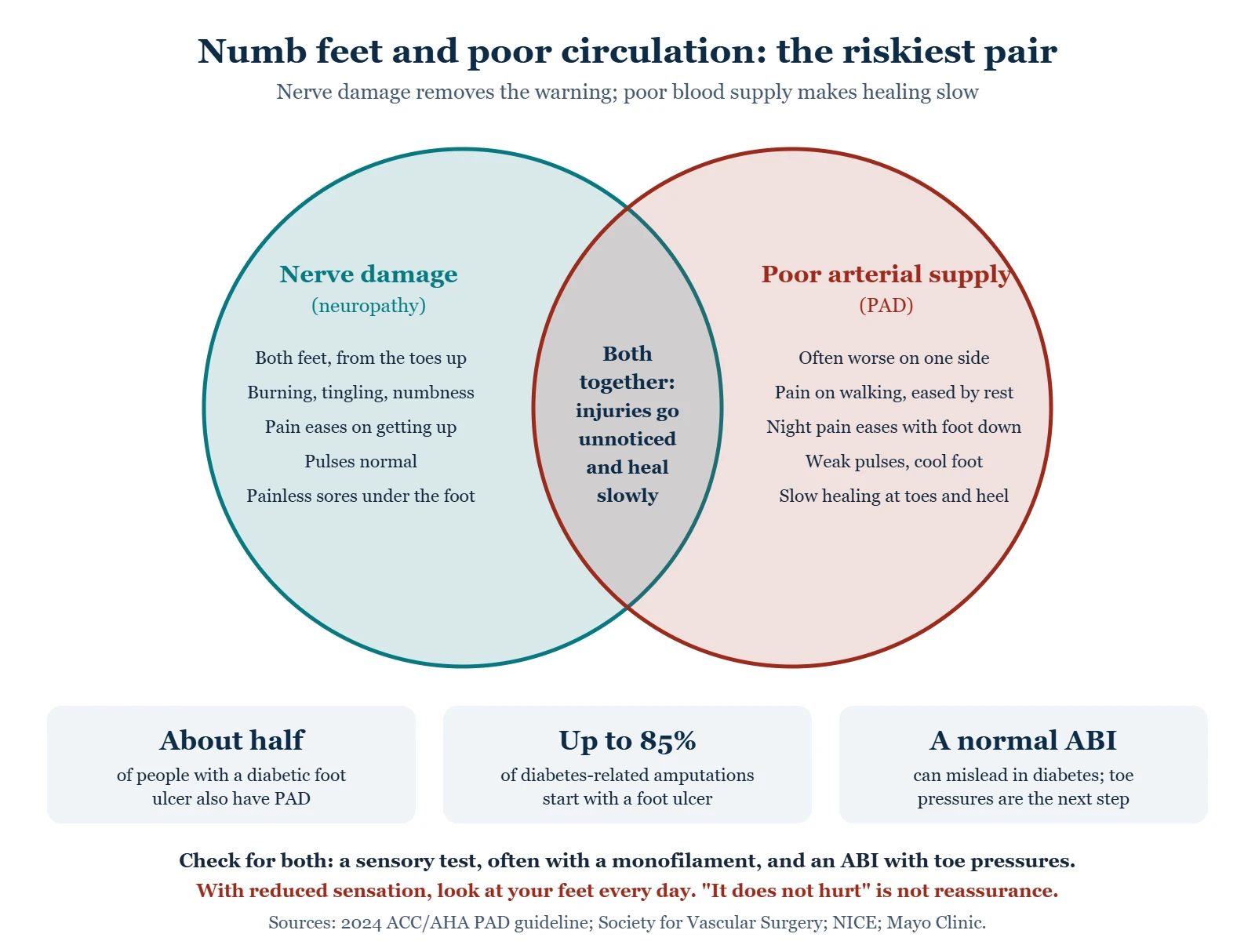
In diabetes both are common, and the combination is the highest-risk foot there is: no protective sensation to warn of injury, and not enough blood supply to heal it once it happens. The 2024 American College of Cardiology and American Heart Association guideline estimates that PAD affects up to 20% of people with diabetes over 40, 30% over 50 and 70% over 70. About half of people with a diabetic foot ulcer also have PAD, and foot ulcers come before up to 85% of diabetes-related amputations. That is why diabetic foot care puts so much weight on daily inspection and professional nail care — the usual warning system is offline.
Diabetes also makes the arterial test harder to read. Calcified ankle arteries can make the ankle-brachial index look normal or high when blood flow is poor, and NICE specifically warns against ruling out PAD in someone with diabetes on the strength of a normal or raised ABI. Toe pressures are the usual next step.
What gets done about each
- Find out whether both are present. Sensory testing and an ABI are quick and answer different questions. Having one diagnosis does not exclude the other, and assuming it does is a common error.
- Treat the cause where there is one. Blood sugar control, B12 replacement, alcohol reduction, medication review for neuropathy. Smoking cessation, lipid and blood pressure treatment, antiplatelet therapy for PAD.
- Manage neuropathic symptoms. Specific medicines exist for neuropathic pain; ordinary painkillers tend to work poorly on it.
- Protect the foot. Footwear, offloading, daily inspection, professional nail and callus care. This matters most when sensation is reduced. Daily foot care →
- Restore blood flow where needed. Revascularization is considered when a limb is threatened or symptoms are limiting despite medical therapy.
From the clinic
The most dangerous assumption I see is “it’s just my neuropathy”. Neuropathy is real and common, but it does not explain a foot that is cooler than the other, pulses I cannot find, or a sore that is not healing. In a numb foot, the arteries have to be checked on purpose, because the pain that would normally prompt the question never arrives.
Common questions
Can poor circulation cause neuropathy?
Severe, prolonged ischemia can damage nerves. But the far more common relationship is that the two share causes — diabetes in particular produces both — rather than one causing the other. In practice, finding one is a reason to check for the other.
My feet are cold and numb. Which is it?
That cannot be answered from those two symptoms. Cold feet that are genuinely cool to touch with weak pulses lean arterial; feet that feel cold to you but are warm to someone else’s hand, with burning or tingling, lean neuropathic. The ABI and a sensory examination settle it, and both are quick. Cold feet →
Does neuropathy mean I will get an ulcer?
No — but it means an injury can happen without you noticing, and that is the usual first step. Daily inspection, properly fitting shoes, never going barefoot, and professional nail care do most of the preventive work.
Will improving circulation fix the numbness?
Generally not. If the numbness is from nerve damage, restoring blood flow addresses the arterial problem and the healing capacity, but it does not repair the nerves. Treating the two together is the point, and expecting one treatment to fix both usually leads to disappointment.
My ABI was normal, but I have diabetes. Am I in the clear?
Not necessarily. Stiff, calcified ankle arteries in diabetes can make the ABI read normal or high when blood flow is reduced, which is why NICE warns against ruling out PAD on that basis alone. If your pulses are weak, a foot is cool, or a wound is slow to heal, ask about toe pressures.
Where to go next
- Numb toes: nerve, back or blood flow?
- Poor circulation in the legs and feet: signs and causes
- PAD symptoms and warning signs
- Daily foot and leg checks
- What the ABI measures
- Burning or numb feet: where to start
- Near Howell or Bloomfield Township, Michigan: a foot and ankle evaluation (the author’s own practice)
Sources
- National Institute of Neurological Disorders and Stroke. Peripheral Neuropathy.
- National Institute of Diabetes and Digestive and Kidney Diseases. Nerve Damage (Diabetic Neuropathies) and Diabetes and Foot Problems.
- National Heart, Lung, and Blood Institute. PAD — Symptoms.
- Mayo Clinic. Diabetic neuropathy.
- Society for Vascular Surgery. Diabetes and vascular disease.
- Gornik HL, et al. 2024 ACC/AHA multisociety guideline for the management of lower extremity peripheral artery disease. Circulation 2024.
- International Working Group on the Diabetic Foot. Guideline on peripheral artery disease and diabetes-related foot ulcers (2023, PDF).
- NICE. Peripheral arterial disease: diagnosis and management (CG147).
- Mayo Clinic News Network. Cold feet that aren’t cold to the touch may indicate a neurologic problem.
Written by Tom Biernacki, DPM, FACFAS. Published 20 September 2026. Updated 16 October 2026. General education, not medical advice.