“Poor circulation in legs and feet” is an everyday phrase, not a diagnosis. It covers at least four different problems — arteries letting too little blood in, veins letting blood pool on the way back, lymph vessels failing to drain fluid, and small vessels clamping down in the cold — plus nerve damage, which can feel similar but is not a blood-flow problem. Which one you have decides what helps, and what could do harm.
When poor circulation is an emergency
Call 911 if a leg or foot suddenly turns cold, pale or mottled, numb, weak or severely painful over minutes to hours: an artery may have blocked, and time matters. Call 911 too for sudden breathlessness, chest pain that is worse on breathing in, coughing up blood or fainting, which can mean a clot in the lungs, and for a wound with spreading redness plus fever, chills or confusion.
Be seen today if one leg has newly swollen, especially with pain, warmth or a change in color. A clot in a deep vein is one possible cause, and only testing can settle it.
Be seen the same day or the next for foot pain at rest or at night that eases when you hang the foot over the edge of the bed, a foot or leg wound that is not healing, or a dark or black patch on a toe or heel. With diabetes, dialysis or known artery disease, the threshold is lower, not higher. Full care thresholds →
What “poor circulation” actually means
Three networks run through each leg. Arteries carry oxygen-rich blood down to the toes. Veins carry it back up against gravity, with one-way valves to stop it falling back. Lymph vessels drain fluid from the tissues and return it to the bloodstream. How the three systems work →
- Not enough blood getting in: peripheral artery disease (PAD), where plaque narrows the leg arteries. More than 8 million Americans aged 40 and older have it.
- Blood pooling on the way back: chronic venous insufficiency, where the vein valves stop working properly. The Society for Vascular Surgery estimates it may affect up to 40% of people in the United States.
- Fluid not draining: lymphedema, where a lymphatic system that is not working properly leaves swelling behind.
- Small vessels overreacting: Raynaud’s phenomenon, where blood vessels in the hands and feet narrow in response to cold or stress.
The common look-alike is peripheral neuropathy: nerve damage that causes numbness, tingling, burning and trouble sensing heat and cold, even when blood supply is normal.
The distinction matters because the treatments conflict. Compression helps leaky veins but is not safe on a leg whose ankle artery pressures are low, so an ankle-brachial index should come first for anyone with diabetes, PAD symptoms, numbness, a wound, kidney disease or heart failure. Raising the legs eases vein symptoms but can make advanced arterial pain worse. And a heating pad that soothes cold toes can burn a numb foot without the person noticing. Who needs an arterial check before compression →
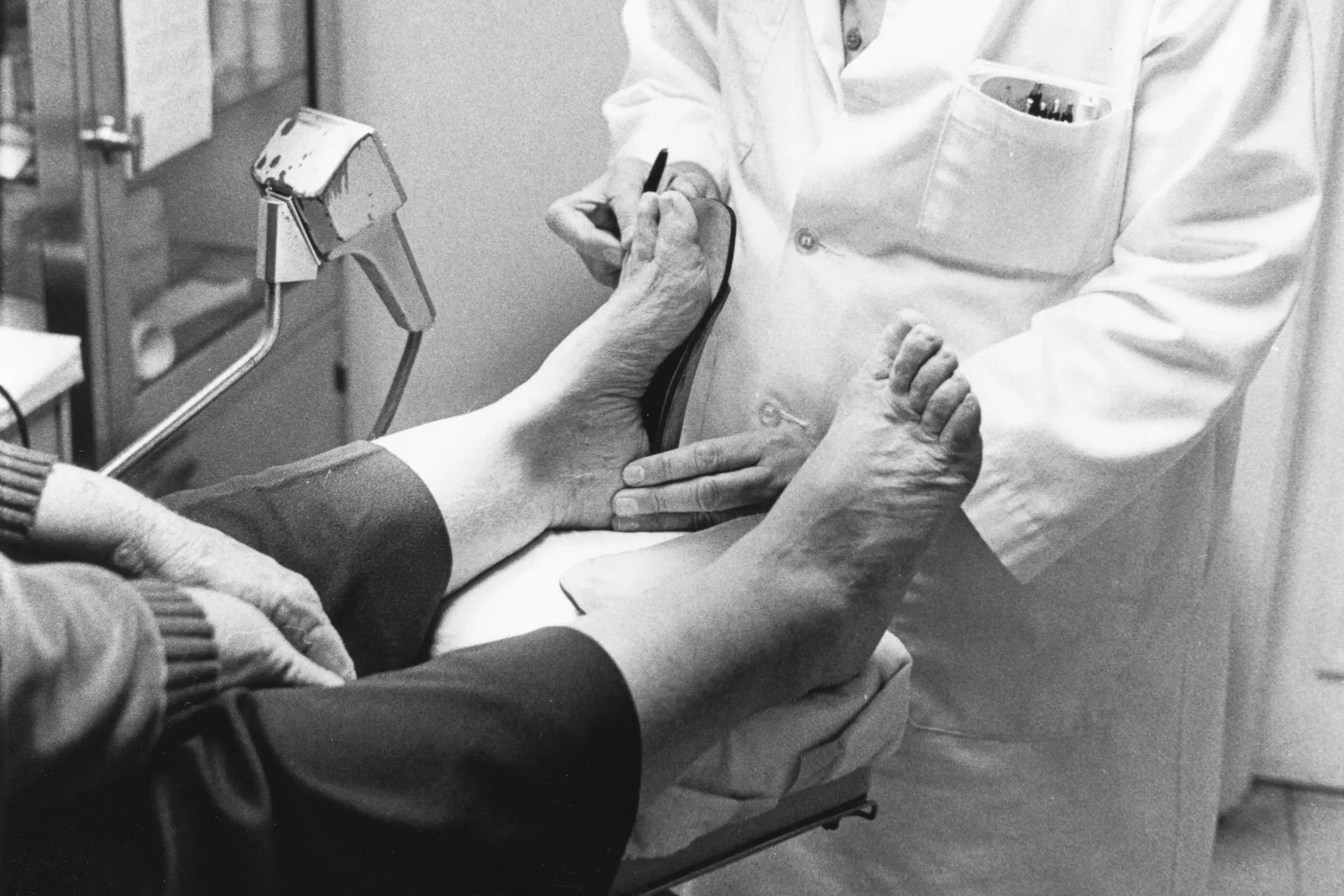
Signs of poor circulation in legs and feet, and the system behind each
Poor circulation symptoms are clues rather than answers: the systems overlap, and two can fail at once. But each has a recognizable pattern.
| What you notice | Usually points to | Worth knowing |
|---|---|---|
| Calf, thigh or buttock cramping or aching that comes on with walking and stops within minutes of rest | Arteries (PAD) | The classic sign, though only about 1 in 4 people with PAD have it |
| Foot or toe pain at rest or at night, eased by hanging the foot down | Arteries, advanced disease | Needs assessment the same day or the next |
| One foot colder than the other; pale, bluish or shiny skin; leg hair and toenails that stop growing | Arteries | Foot pulses are often weak or missing |
| A toe or foot sore that heals slowly or not at all | Arteries, often with nerve damage too | Can progress to gangrene; a black area is urgent |
| Heavy, aching legs that build through the day and ease with the legs up | Veins | Often with varicose veins, restless legs or cramps |
| Swollen ankles, worse after long standing and better with the legs raised | Veins, or the heart, kidneys, liver, thyroid or a medicine | Unexplained swelling in one leg needs prompt assessment |
| Itching, dry or scaly skin, brown staining around the ankles | Veins | Can lead to slow-healing leg ulcers |
| Leg swelling with a heavy, tight feeling; skin that hardens or folds over time | Lymph vessels (lymphedema) | Often follows cancer treatment, infection or injury; prone to cellulitis |
| Toes, and often fingers, turning white, then blue, then red with cold or stress | Small vessels (Raynaud’s) | Episodes last minutes to hours, often with numbness or pins and needles |
| Burning, tingling or numbness in both feet, often worse at night | Nerves (neuropathy), not blood flow | Diabetes is the leading cause in the United States |
| Leg pain or numbness on standing or walking that eases when you sit or bend forward | The spine (spinal stenosis) | Not a circulation problem |
| Feeling cold all over, with tiredness, weight gain and dry skin | The whole body, for example an underactive thyroid | Not specific to the legs |
Why no table can tell you that you are fine
Many people with real disease have none of these signs. About 1 in 5 people with PAD report no symptoms, and women are more likely than men to have PAD without them. About half of deep vein clots cause no symptoms. And about half of people with diabetes have some nerve damage, which can dull pain and let a foot injury go unnoticed. If you have risk factors, the way to know is to be measured.
For photographs and diagrams of each of these signs, see signs of poor circulation in the legs and feet, with pictures.
What causes poor circulation
Arteries: peripheral artery disease
Plaque builds up inside the leg arteries. This is atherosclerosis, the process that also narrows the arteries to the heart and brain, so PAD signals a higher risk of heart attack and stroke whether or not the legs hurt. What vascular disease covers →
Smoking is the main risk factor, and regularly breathing secondhand smoke also raises the risk. Others are diabetes, high blood pressure, unhealthy cholesterol, chronic kidney disease, a family history of PAD, heart disease or stroke, and age: most Americans with PAD are 65 or older. African American people have a higher risk. The PAD guide →
Veins: chronic venous insufficiency
The one-way valves in the leg veins stop working, so blood pools in the lower leg. The tendency is usually inherited, and a previous deep vein thrombosis (DVT) can damage the valves. Risk rises with age, pregnancy, excess weight, long periods of standing or sitting, smoking and inactivity, and it is more common in women. Venous insufficiency explained →
Lymph vessels: lymphedema
Primary lymphedema comes from genes that affect how the lymph vessels develop. Secondary lymphedema follows damage: cancer treatment, infection, injury, inflammation of the limb, or a lack of limb movement. Cellulitis, a skin infection, is its most common complication.
Small vessels: Raynaud’s phenomenon
Primary Raynaud’s is the more common form; its cause is unknown and it is usually mild. Secondary Raynaud’s comes from another condition, such as lupus or scleroderma, and tends to be more severe. Certain medicines, long-term use of vibrating tools and nicotine can also bring attacks on.
Look-alikes and other causes
Peripheral neuropathy is nerve damage, most often from diabetes, usually in both feet. In diabetes it often travels with reduced blood flow, and together they raise the risk of foot ulcers. Neuropathy vs. poor circulation →
Swelling can also come from the heart, kidneys, liver or thyroid, or from medicines such as some blood pressure pills, contraceptive pills, hormone therapy, antidepressants and steroids.
What you can check at home
Home checks cannot diagnose anything, but they sharpen what you tell a clinician.
- Compare your two feet in the same light, with the back of your hand. One foot colder or paler than the other is a recognized sign of PAD; if it happened suddenly, that is an emergency.
- Look at the skin, hair and nails. Shiny skin and lost leg hair go with arterial disease; itching, brown staining and varicose veins with vein disease; hard, thick or folded skin with lymphedema.
- Notice what walking does. Pain that comes on with walking and fades after a few minutes of rest points to the arteries. Pain that needs you to sit or bend forward points to the spine.
- Notice what position does. Heaviness and swelling that ease with your legs up point to the veins. Night-time foot pain that eases with the foot hanging down points to the arteries, and needs prompt assessment.
- Check your feet every day if you have diabetes or numbness, soles and between the toes included, for cuts, blisters, sores and color changes.
What a clinician checks
| Check | What it shows | Result or next step |
|---|---|---|
| Pulses and examination | Weak or missing foot pulses, skin changes, sores and swelling, with both legs compared | Leads to an ABI if anything points to the arteries |
| Ankle-brachial index (ABI) | Ankle blood pressure compared with arm pressure; usually the first test for PAD | Below 0.90 suggests PAD; below 0.40 means severe PAD |
| Toe-brachial index (TBI) | Big-toe pressure, used when the ankle arteries cannot give a reliable reading | Below 0.7 is abnormal |
| Arterial ultrasound | Where blood flow is reduced or blocked | CT, MR or catheter angiography if more detail is needed |
| Venous duplex ultrasound | Leaking vein valves, and any clot | Confirms varicose veins and the extent of leakage |
| Lymphedema assessment | Examination comparing both limbs, sometimes with imaging | Ultrasound can also check for a clot |
| Sensory testing | Monofilament and tuning-fork tests for nerve damage | At least once a year for anyone with diabetes |
| Blood tests | Blood sugar and cholesterol; thyroid or vitamin B12 when relevant | Causes and risk factors, not blood flow |
An ABI is an arterial test: it says nothing about veins or nerves. What ABI and TBI results mean →
Who to see, and how soon
Emergencies and same-day problems are in the box at the top. Otherwise:
| Situation | Start with | How soon |
|---|---|---|
| Foot pain at rest, a wound that is not healing, or a dark toe | Primary care, podiatry or a vascular service; ask for an arterial assessment | The same day or the next |
| Leg pain on walking that eases with rest | Primary care, usually with an ABI, then a vascular referral if it is abnormal | Routine appointment |
| Varicose veins with aching, swelling or skin changes | Primary care, then a vein or vascular service | Routine appointment |
| Swelling that looks lymphatic, or follows cancer treatment | Primary care, then a lymphedema therapist | Routine, but the same day for fever, redness or warmth |
| Fingers and toes that change color in the cold | Primary care | Routine; say so if it is one-sided, began after age 30, or comes with joint pain, rashes or weakness |
| Numbness or burning in the feet | Primary care or podiatry | Routine; with diabetes, a foot sensation check at least yearly |
How to improve circulation, problem by problem →
From the clinic
When a patient tells me they have poor circulation, my first job is to work out which circulation they mean. Cold, pale feet with weak pulses point to the arteries; heavy, swollen ankles with brown staining point to the veins; and a foot that feels cold to its owner but warm to my hand often points to the nerves. Each has a different test and a different treatment, so the label alone does not get you far. Checking the foot pulses and an ankle-brachial index is quick and painless, and it settles the arterial question.
Common questions
What are the first signs of bad circulation in legs?
With narrowed arteries, the classic early sign is calf, thigh or buttock pain that comes on with walking and stops within minutes of rest, although only about 1 in 4 people with PAD have it and about 1 in 5 report no symptoms. With leaky veins, it is usually heavy, aching legs and ankle swelling that build through the day and ease with the legs up.
What causes poor circulation in legs and feet?
Usually one of four things: plaque narrowing the leg arteries (PAD), vein valves that no longer work properly (chronic venous insufficiency), a lymphatic system that cannot drain fluid (lymphedema), or small vessels that narrow in the cold (Raynaud’s). Smoking, diabetes, high blood pressure, high cholesterol, kidney disease and age drive the arterial kind; inherited vein weakness, a past clot, pregnancy, excess weight and long hours standing drive the venous kind. Nerve damage can mimic them without any blood-flow problem.
How do I know if I have poor circulation?
By measurement, not by how your legs feel. An ankle-brachial index checks the arteries, a venous duplex ultrasound checks the vein valves and looks for clots, and touch and vibration tests check the nerves; lymphedema is assessed by examination. A leg that looks and feels normal does not rule PAD out.
Can poor circulation cause itching?
Yes, when the veins are the problem. Itchy legs, dry or scaly skin and brown staining around the ankles are typical of chronic venous insufficiency. Show it to a clinician: long-standing vein disease can lead to slow-healing leg ulcers.
Are cold feet a sign of poor circulation?
Sometimes, but cold feet on their own are a weak sign of poor circulation in the feet. One foot colder or paler than the other is a recognized sign of PAD, especially alongside walking pain, shiny skin or slow-healing sores. Toes that turn white or blue in the cold suggest Raynaud’s; burning or tingling suggests the nerves; feeling cold all over can be a thyroid problem.
Can poor circulation be reversed?
Much of it can be improved, depending on the cause. In PAD, statins slow plaque buildup, supervised walking increases walking distance, and procedures can restore blood flow. Faulty surface veins can be closed or removed. Lymphedema has no cure, but symptoms can usually be controlled. Most people with Raynaud’s keep it in check by avoiding the cold.
Where to go next
- How to improve circulation in legs and feet
- PAD symptoms and warning signs
- Chronic venous insufficiency
- Why legs swell: causes and patterns
- Cold feet: causes and when to get checked
- Red, blue, pale or purple feet
- Neuropathy vs. poor circulation
- ABI and TBI tests
- Compression safety: who needs an assessment first
- Which clinician handles which problem
- When to seek care
- Near Howell or Bloomfield Township, Michigan: a foot and ankle evaluation (the author’s own practice)
- Signs of poor circulation in the legs and feet, with pictures
- Raynaud’s syndrome: fingers and toes that turn white, then blue
Sources
- National Heart, Lung, and Blood Institute. Peripheral Artery Disease, and its symptoms, causes and risk factors, diagnosis, treatment and living with PAD pages.
- Society for Vascular Surgery. Peripheral Artery Disease, Acute Limb Ischemia and Chronic Venous Insufficiency.
- Society for Vascular Surgery. Patients with Chronic Limb-Threatening Ischemia (CLTI).
- American Heart Association. Symptoms and Diagnosis of PAD.
- MedlinePlus. Peripheral artery disease – legs and Venous insufficiency.
- Centers for Disease Control and Prevention. About Venous Thromboembolism (Blood Clots) and Diabetes and Your Feet.
- NHS. Varicose veins, Oedema, Lymphoedema, Raynaud’s and Leg ulcer — diagnosis.
- National Cancer Institute. Lymphedema.
- National Institute of Arthritis and Musculoskeletal and Skin Diseases. Raynaud’s Phenomenon and Spinal Stenosis.
- National Institute of Neurological Disorders and Stroke. Peripheral Neuropathy.
- National Institute of Diabetes and Digestive and Kidney Diseases. Diabetes and Foot Problems, Peripheral Neuropathy and Hypothyroidism.
- NIH Office of Dietary Supplements. Vitamin B12: Fact Sheet for Consumers.
- National Institute for Health and Care Excellence. Varicose veins: diagnosis and management (CG168), recommendations.
- Cochrane. Exercise for intermittent claudication.
- Cleveland Clinic. Poor Circulation: Symptoms, Causes and Treatment.
Written by Tom Biernacki, DPM, FACFAS. Published 9 October 2026. Updated 16 October 2026. General education, not medical advice.