Lymphedema is swelling caused by a drainage problem rather than a blood-flow problem. It behaves differently from venous swelling, it is managed by a different set of clinicians, and it responds best to being recognized early — before the tissue firms up and while a few hours of therapy a week can still change the shape of the leg.
Cellulitis in a lymphedematous limb is urgent
Protein-rich tissue fluid is a good medium for bacteria, so infection is both more likely and more serious in a limb with lymphedema. New redness, heat or pain needs same-day treatment; with a fever, chills or shivering, go to an emergency department now (call 911 for confusion, fainting or very fast breathing). Many people with established lymphedema are given a plan for exactly this — if you have one, use it.
New swelling of one leg, especially with pain, needs a same-day check for a clot before anyone assumes it is lymphedema. One swollen leg →
What is going wrong
Fluid constantly leaks from small blood vessels into the tissue, carrying protein with it. The lymphatic system collects that fluid, filters it through lymph nodes, and returns it to the bloodstream. When lymph vessels or nodes are missing, damaged or overwhelmed, protein-rich fluid stays in the tissue.
The protein is what makes lymphedema different. It draws more fluid in, it drives inflammation, and over time it leads to fibrosis and fat deposition — which is why established lymphedema feels firm rather than squashy, and why it does not simply drain away overnight the way venous swelling does.
Primary and secondary
An estimated 8 to 10 million Americans live with lymphedema. Most cases are secondary.
Primary lymphedema arises from a lymphatic system that did not develop normally. It is rare — about 1 in 100,000 people — and can appear in infancy, around puberty, or in adulthood, and sometimes runs in families.
Secondary lymphedema follows damage to a working system. In the legs the common causes are:
- Cancer treatment — removal of lymph nodes in the groin or pelvis, and radiotherapy, for example for gynecologic cancers, melanoma, prostate or bladder cancer. In one study of women who had survived cancer, around a third had leg lymphedema after ovarian, endometrial or colorectal cancer, and permanent leg lymphedema followed about 38% of groin lymph node operations for melanoma. It can appear soon after treatment or years later.
- Cancer itself, pressing on or spreading into lymph nodes.
- Severe or repeated cellulitis, which damages lymph vessels — and lymphedema in turn makes cellulitis more likely.
- Long-standing venous disease overwhelming the lymphatics, called phlebolymphedema.
- Obesity, which in severe cases can cause lymphedema on its own.
- Trauma or surgery to the groin, knee or leg.
Worldwide, the most common cause is a parasitic infection, filariasis, which is not seen in the United States. New swelling in someone with a cancer history deserves prompt assessment rather than assumption.
Stages
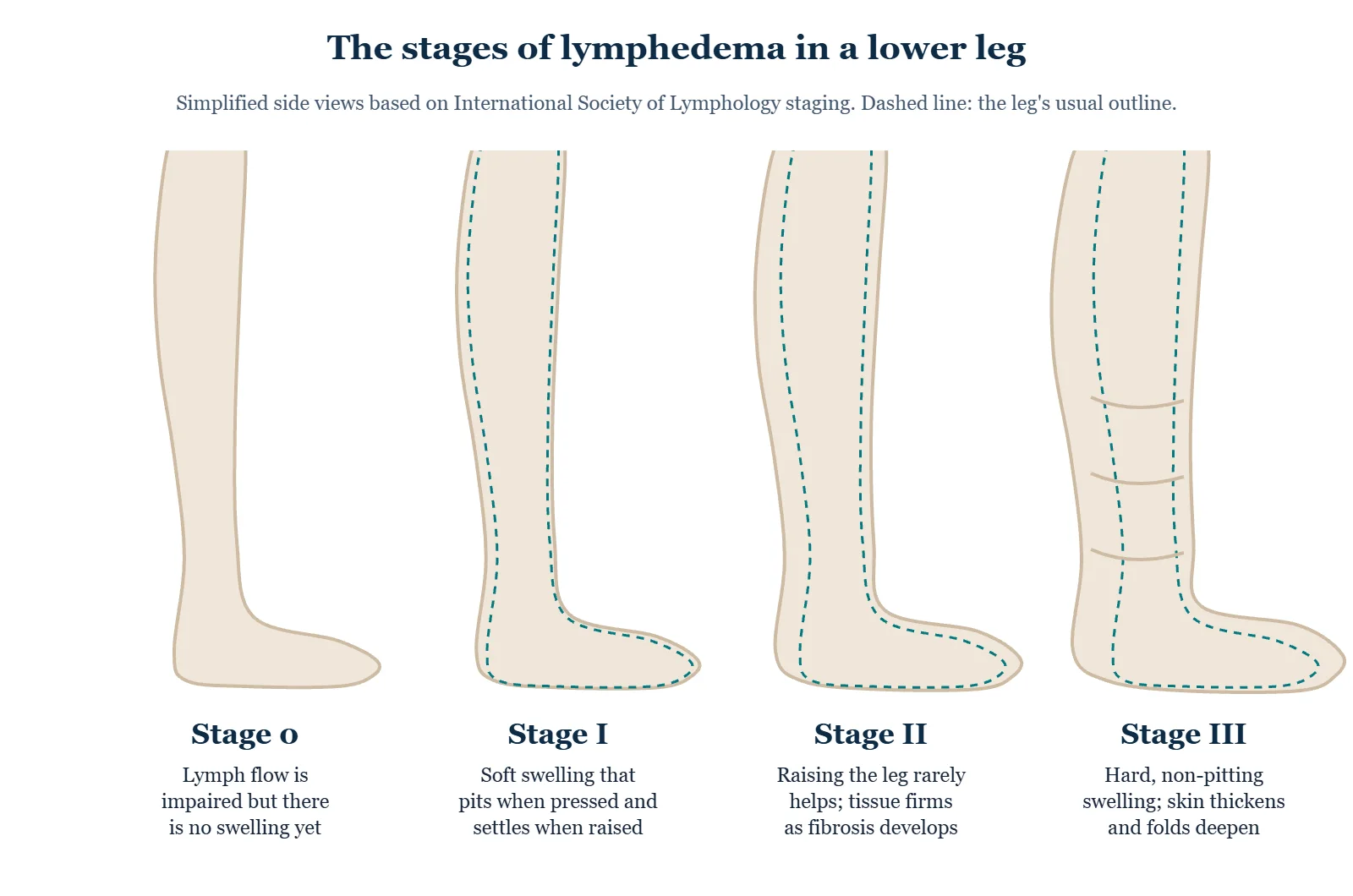
| Stage | What is happening | What it feels like |
|---|---|---|
| Stage 0 | Lymph transport is already impaired, but there is no visible swelling | Heaviness or tightness only; reversible |
| Stage I | Protein-rich fluid collects; it goes down with elevation and may pit when pressed | Soft swelling, often better by morning; usually reversible |
| Stage II | Fat and fibrous tissue are laid down; elevation alone rarely reduces the swelling | Firmer swelling that pits less as it hardens; may still improve if treated early |
| Stage III | Lymphostatic elephantiasis: hard, non-pitting swelling with skin changes | Thick, sometimes warty skin and deep folds; usually not reversible |
Clinicians also grade severity by how much larger the limb has become: minimal is under 20% extra volume, moderate 20 to 40%, and severe more than 40%.
Early signs
- A feeling of heaviness, tightness or fullness in the leg before swelling is obvious
- Socks leaving deeper marks than they used to, or shoes feeling tight
- Swelling that involves the top of the foot and the toes
- Skin that feels thicker or less easy to pinch
- Reduced flexibility at the ankle
- Numbness or tingling in the leg
If you have had lymph nodes removed or radiotherapy to the groin or pelvis, report these early. Treatment started at this point is simpler and more effective than treatment started once the leg has changed shape.
How it differs from venous swelling
| Lymphedema | Venous swelling | |
|---|---|---|
| Overnight change | Improves little once established | Usually much better by morning |
| Foot and toes | Involved — the toes look square or swollen | Often spared; swelling is around the ankle |
| Pinching the skin at the base of the second toe | Difficult or impossible (a positive Stemmer sign) | Usually possible |
| Texture | Firm; pits early, non-pitting later | Soft and pitting |
| Skin | Thickened, sometimes warty, deep folds | Brown staining, eczema, ulcers at the inner ankle |
| Ulcers | Less typical | Characteristic |
The two coexist often enough to have a name — phlebolymphedema — where long-standing venous disease eventually overloads the lymphatics. Lymphedema is also different from lipedema, a fat disorder that spares the feet.
Assessment
Diagnosis is largely clinical: the history, the distribution, the texture, and whether the skin at the toe base can be pinched. Limb volume or circumference measurements track change over time. A difference between the legs of 2 cm in circumference, or 200 mL in volume, is considered significant. A positive Stemmer sign strongly suggests lymphedema, although a negative one does not rule it out. Lymphoscintigraphy — imaging after a small injection of tracer — is the standard test of lymph function, and ICG lymphography maps the surface lymph vessels in real time, which matters when surgery is being considered. Where the cause is not obvious, investigation looks for what is obstructing drainage rather than assuming, and a venous ultrasound is often done to check for vein disease or clot.
Management
The established approach is a package called complete decongestive therapy, delivered by a trained lymphedema therapist, usually in an intensive phase of daily treatment over a few weeks followed by long-term maintenance at home.
- Manual lymphatic drainage — a specific light-touch technique that encourages fluid toward working lymphatics. It is not ordinary massage, and firm massage can be counterproductive.
- Compression bandaging, then garments. Multi-layer bandaging reduces volume in the intensive phase; fitted garments maintain it. Garments for lymphedema are specified differently from standard venous compression socks, often flat-knit and custom-made.
- Exercise. Movement drives lymph flow. Specific programs are usually taught, often performed while wearing compression.
- Meticulous skin and foot care. The single most effective thing for reducing infection risk — daily washing and drying, emollients, prompt attention to any break, care between the toes, and toenails cut straight across. See a podiatrist rather than digging at an ingrown nail, and do not walk barefoot.
- Infection management. Prompt antibiotics for cellulitis, and for some people a standby supply or preventive course. In a trial of people who had had two or more episodes of leg cellulitis, low-dose penicillin taken for a year cut recurrences from 37% to 22% — though the protection faded once it was stopped.
- Pneumatic compression pumps at home, for some people, as an add-on to the above. Medicare covers a home pump for lymphedema only after a four-week trial of compression, exercise and elevation has not helped enough, and pumps do not suit everyone — in the legs they can push fluid up into the genital area. Pumps compared →
- Surgery in selected cases — lymphovenous bypass, lymph node transfer, or liposuction for established fatty swelling — as an adjunct rather than a replacement for the above.
Garment coverage changed
Since January 2024, Medicare Part B has covered compression garments for lymphedema: up to three daytime garments every six months and two nighttime garments every two years for each affected limb, standard or custom-made, plus wraps and bandaging applied in clinic. It needs a lymphedema diagnosis and a prescription, and you pay the usual 20% coinsurance after the deductible. Swelling from vein disease without a lymphedema diagnosis does not qualify, so the diagnosis on the prescription matters.
Two things not to do
Do not buy compression on your own for a swollen limb that has not been assessed. Lymphedema garments are specified individually, the wrong ones can make things worse, and the arterial supply still needs checking first.
Do not treat it with diuretics as a default. Water tablets have a role when swelling is driven by the heart or kidneys. For lymphedema they remove water and leave the protein behind, long-term use is discouraged, and no drug is FDA-approved to treat lymphedema itself — that is a decision for the treating clinician, not a self-started one.
From the clinic
Feet are where lymphedema gets into trouble. Swollen toes rub in ordinary shoes, deep skin folds between them stay damp, and a tiny crack or fungal split becomes the entry point for cellulitis. Wide, deep shoes that fit the swollen foot, drying carefully between the toes, and treating athlete’s foot promptly are unglamorous, but they prevent a lot of hospital admissions. Shoes for swollen feet →
Common questions
Can lymphedema be cured?
Generally it is managed rather than cured. What management achieves is substantial: reduced volume, better skin, far fewer infections, and preserved function. Early stages are often reversible — stage 0 and stage I usually, and stage II sometimes when treated early — while stage III usually is not. Surgery can help selected people but is not a complete cure, and garments usually continue afterward.
Is it the same as lipedema?
No. Lipedema is a symmetrical disorder of fat distribution, usually affecting both legs and characteristically sparing the feet, often tender and bruising easily. Lymphedema involves the feet and toes and can be one-sided. They can occur together, and lipedema can eventually lead to lymphatic overload.
Why does my swelling not go down overnight?
Because the fluid is protein-rich and the tissue has changed. Venous swelling is mostly water and drains back when you lie flat; lymphedema fluid does not move as freely, and once fibrosis sets in the tissue itself contributes to the volume.
Can I still exercise?
Yes, and you should — movement is one of the main things that drives lymph flow, and the International Society of Lymphology encourages exercise including strength training. Build up gradually with guidance; whether to wear compression during exercise is decided individually. The old advice to avoid using the limb has been superseded.
Does losing weight help lymphedema?
Higher weight is consistently linked to lymphedema risk, and very severe obesity can cause it by itself. The evidence that weight loss reverses lymphedema is limited, but it lowers the load on an already struggling lymphatic system and makes compression easier to fit and wear, so it is worth pursuing where weight is raised.
Can I fly with lymphedema?
Yes. Wear your compression garment for the journey if you have one, move your ankles and walk the aisle, and keep hydrated. If your swelling is not yet assessed, a long flight is a reason to get advice beforehand rather than buying travel socks on the way. Travel →
How do I find a lymphedema therapist?
Usually by referral, often through physical therapy, oncology or vascular services. Look for a certified lymphedema therapist. Where you start depends on your insurance and local services, so ask your primary care clinician what route exists in your area.
Where to go next
- Lymphangitis: infection in the lymph channels
- Cellulitis: why legs with lymphedema get it, and how to stop it coming back
- Lymphatic drainage massage: what it can and cannot do
- Lipedema vs. lymphedema: how to tell them apart
- Leg compression machines and lymphedema pumps
- Pitting edema: what the dent means
- Daily skin care — the infection-prevention piece
- The full swelling guide
- Which clinician to see
- Vibration plates and leg swelling: what is known
- Lymphedema treatment: what actually works
- Lymphedema products: garments, wraps and night garments
- Shoes for lymphedema and very swollen feet
Sources
- National Cancer Institute. Lymphedema (PDQ) — Health Professional Version.
- National Cancer Institute. Lymphedema and Cancer.
- StatPearls, NCBI Bookshelf. Lymphedema.
- International Society of Lymphology. The Diagnosis and Treatment of Peripheral Lymphedema: 2023 Consensus Document. Lymphology 2023;56:133–151.
- American Cancer Society. Lymphedema.
- Cleveland Clinic. Lymphedema.
- Mayo Clinic. Lymphedema — diagnosis and treatment.
- NHS. Lymphoedema.
- NHS. Lymphoedema — treatment.
- MedlinePlus. Lymphedema — self-care.
- Thomas KS, et al. Penicillin to prevent recurrent leg cellulitis (PATCH I). N Engl J Med 2013;368:1695–1703.
- Cochrane. Interventions for the prevention of recurrent erysipelas and cellulitis.
- Centers for Medicare & Medicaid Services. Pneumatic Compression Devices — provider compliance tips.
- Medicare.gov. Lymphedema compression treatment items.
- Centers for Medicare & Medicaid Services. CY 2024 Home Health Prospective Payment System final rule fact sheet.
- Cleveland Clinic. Lipedema.
Written by Tom Biernacki, DPM, FACFAS. Published 20 September 2026. Updated 15 October 2026. General education, not medical advice. This page has not yet been through the independent clinical review described on our medical review page.