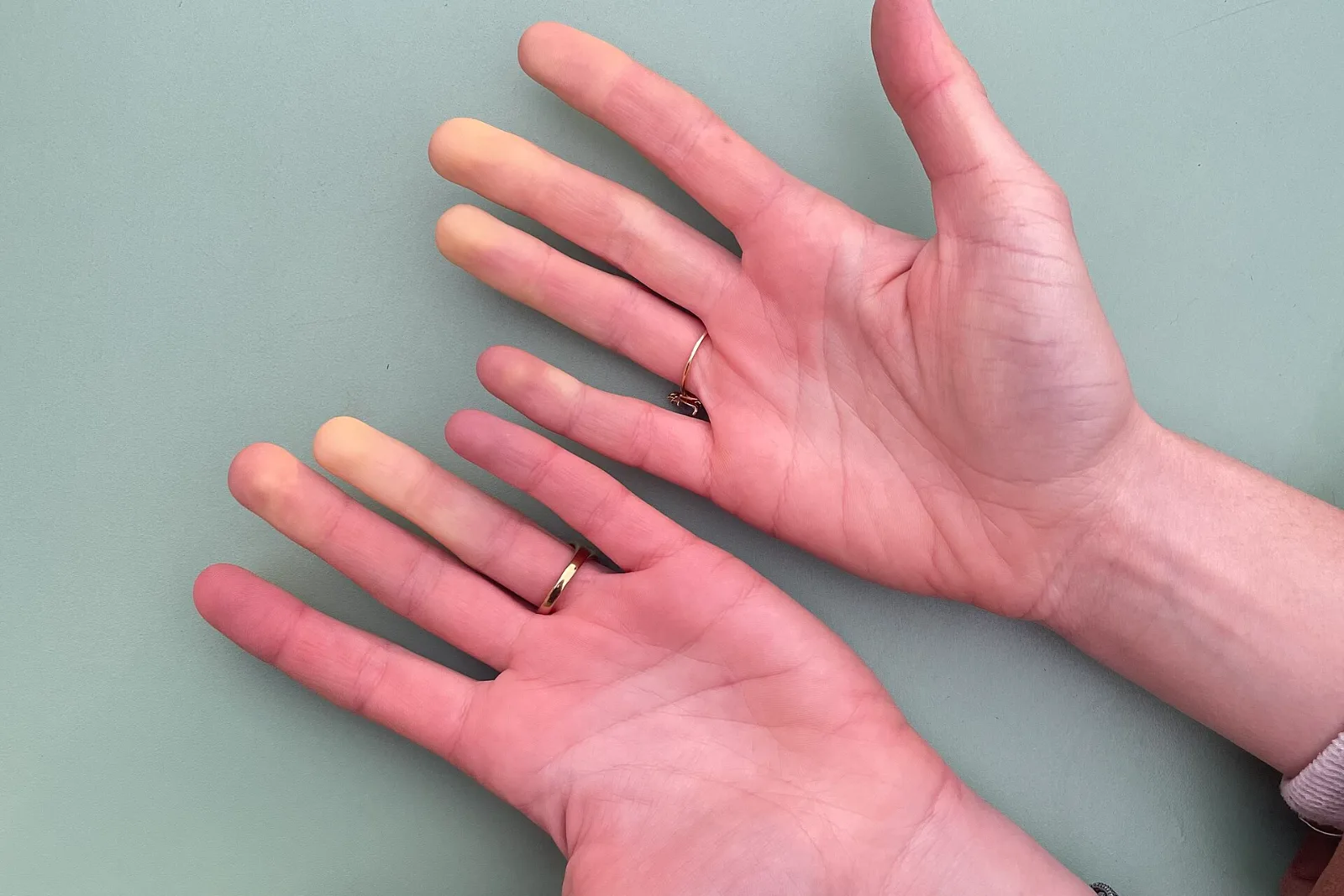
Raynaud’s syndrome is a temporary spasm of the small blood vessels in the fingers and toes, set off by cold or stress, that turns the skin white, often blue, then red as blood flows back. Most people have primary Raynaud’s, a nuisance rather than a danger that is managed mainly with warmth. A smaller group have secondary Raynaud’s, a sign of another condition, and a few warning signs help tell the two apart.
When a cold, discolored finger or toe is urgent
Call 911 if a foot or leg, or a hand or arm, suddenly becomes cold, pale or mottled, numb, weak or severely painful over minutes to hours. Unlike a Raynaud’s attack, which affects fingers and toes and eases with warmth, that can mean the limb’s blood supply has been cut off, and time is critical.
Be seen today if a finger or toe stays white, blue or purple after you have warmed it, or if a sore shows spreading redness, warmth or pus. Call 911 if a wound with spreading redness comes with fever, chills, confusion, a rapidly worsening appearance or a foul smell.
Be seen the same day or the next for a dark, black or leathery patch of skin, or for a sore, ulcer or crack on a fingertip or toe that has not closed or is getting bigger. With diabetes or known artery disease, be seen the same day. Care thresholds →
Raynaud’s syndrome symptoms: what happens in an attack
Cold, or sometimes emotional stress, makes the small blood vessels in the skin narrow. In Raynaud’s that normal response is exaggerated into a spasm, called vasospasm, and blood flow to the affected fingers or toes drops sharply.
Common triggers are touching something cold, such as ice water or frozen food, walking into air conditioning on a warm day, sudden changes in temperature, and stress.
| Phase | What you see | What you feel | What is happening |
|---|---|---|---|
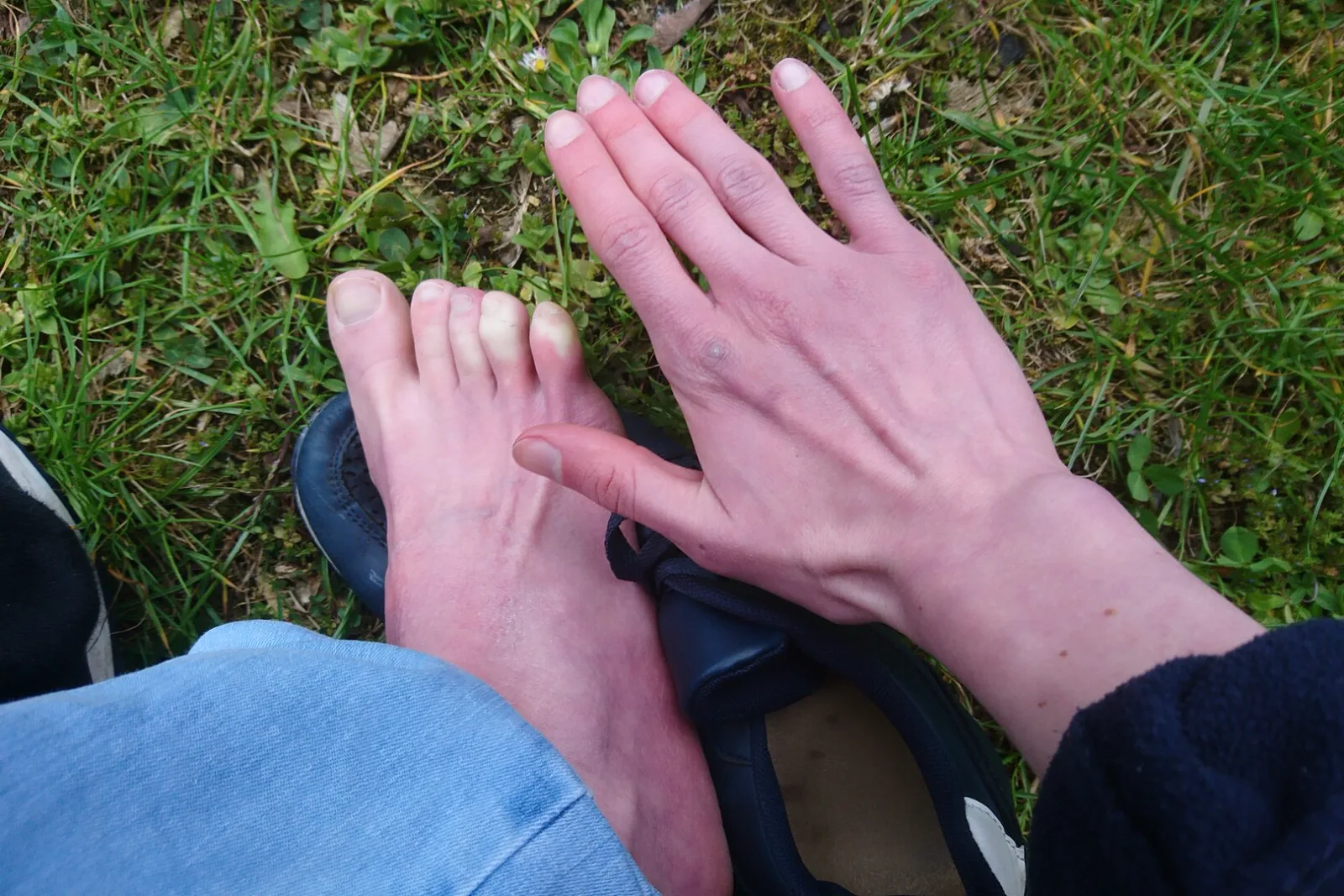
| White | Fingers or toes turn white, or much paler than usual | Cold and numb, as if the part has fallen asleep | The spasm has cut the blood flow |
| Blue | A bluish or purplish tinge; not everyone has this phase | Still cold and numb, sometimes pins and needles | Blood is moving sluggishly |
| Red | Red, sometimes swollen | Throbbing, tingling, burning or stinging | Blood is flowing back in |
Many people see only one or two of the colors. Mayo Clinic notes the changes may be harder or easier to see depending on skin color; the NHS says fingertips may look paler on brown or black skin.
A typical attack lasts around 20 minutes, but it can be a few minutes or a few hours, and after warming, blood flow can take about 15 minutes to return. Fingers and toes are affected most often; the nose, lips, ears and nipples can be too.
Syndrome, disease or phenomenon?
Specialists often call the primary form Raynaud’s disease and the secondary form Raynaud’s phenomenon, with Raynaud’s syndrome covering either, but most people use all three for both.
Who gets it
Raynaud’s is common: it affects an estimated 3 to 5 percent of adults worldwide. It is more common in women, in people with a family history of it, and in people who live in cold climates.
Primary Raynaud’s often begins between the ages of 15 and 30. Secondary Raynaud’s tends to start later, often around age 40.
Primary vs secondary Raynaud’s
Primary Raynaud’s occurs on its own, with no underlying disease, and its exact cause is unknown. It is the more common form, usually mild, and not dangerous: it can be painful and disruptive, but attacks are usually completely reversible.
Secondary Raynaud’s is caused by another condition, a medicine or an exposure. It tends to be more severe: repeated attacks can cause skin sores and, rarely, gangrene, and the outlook depends on the underlying disease, which may be serious in its own right.
| Cause | Examples | Worth knowing |
|---|---|---|
| Autoimmune and connective tissue diseases | Scleroderma, lupus, rheumatoid arthritis, Sjögren’s syndrome | Most people with scleroderma have Raynaud’s. Other clues may include joint pain, rashes or thickening skin |
| Medicines | Beta blockers; migraine medicines containing ergotamine; decongestants containing phenylephrine or pseudoephedrine, and diet pills containing pseudoephedrine; stimulants such as methylphenidate; some cancer medicines | Ask the prescriber before stopping anything; stopping a culprit drug can bring rapid improvement |
| Artery disease | Atherosclerosis, including peripheral artery disease; Buerger’s disease; vasculitis | A particular consideration in smokers |
| Vibration and repetitive hand work | Years of using vibrating tools; long hours of typing or piano playing | The vibration form is sometimes called vibration white finger |
| Smoking and nicotine | Cigarettes, vaping, secondhand smoke | Nicotine narrows blood vessels |
| Other | Carpal tunnel or thoracic outlet syndrome, an underactive thyroid, some blood disorders, an injury or frostbite in the hand or foot, vinyl chloride exposure | A thyroid blood test is often part of the workup |
Raynaud’s in the feet and toes
Most pictures of Raynaud’s show white fingers, but the toes are the other usual site. Toe attacks bring the same color changes and numbness.
Feet are cold for many reasons, and cold feet walks through them. What marks out Raynaud’s is the pattern: episodes of color change, brought on by cold or stress, that reverse on warming.
Looking after your feet
- Wool socks in roomy shoes, as MedlinePlus advises, and shoes whenever you are outdoors.
- Lined, waterproof boots in winter, socks on cold floors at home, and socks in bed if your feet get cold at night (cold feet at night).
- Look after the skin. Moisturize, keep your feet dry and treat cracks promptly; damaged skin on a toe with poor blood flow can be slow to heal.
- Check your toes after time in the cold. A sore on an affected toe needs prompt attention from your doctor or a podiatrist.
Heated socks and insoles press a heat source against the skin, so the cautions in heated socks and insoles apply, especially with diabetes, numbness or artery disease. Plain warm socks are the safer first step; socks for swollen feet covers warm, non-binding options.
Warning signs that point to secondary Raynaud’s
Most of these call for a booked visit, but sores and color that does not come back after warming are urgent (see the box at the top):
- It started after about age 30, particularly if you never had cold hands and feet before.
- Attacks on one side of the body only. Primary Raynaud’s usually affects both sides, often the same fingers on each hand.
- Sores, ulcers or cracks on the fingertips or toes.
- Color that does not come back after warming, or attacks that last for hours.
- Other symptoms: painful or swollen joints, rashes, muscle weakness, fevers, or sores in the mouth or nose.
- Skin changes: thickening or hardening of the skin on the fingers or toes, or thin, tapered fingers with shiny skin and slow-growing nails.
- Attacks that are severe, worsening or limiting your life, or any Raynaud’s in a child under 12.
Raynaud’s in a smoker deserves attention, because artery disease is one possible cause; PAD symptoms covers the leg signs that go with it.
How it is diagnosed, and is there a blood test?
No single test, blood or otherwise, diagnoses Raynaud’s. The diagnosis rests on your description of typical attacks, so a photo taken during one helps. The tests that follow mostly ask whether something else is behind it:
- Nailfold capillaroscopy. A magnified look at the skin at the base of a fingernail. Enlarged or abnormal tiny vessels there suggest secondary Raynaud’s.
- Blood tests. An antinuclear antibody (ANA) test, where a positive result often points to an autoimmune process; an erythrocyte sedimentation rate (ESR) for inflammation; and a thyroid test (TSH).
- Blood flow tests, such as a cold challenge, a pulse volume recording or a vascular ultrasound, when artery disease or another vessel problem is possible.
When all of this is normal, the label is primary Raynaud’s. Rheumatologists are the specialists most involved, particularly when secondary Raynaud’s is suspected.
How Raynaud’s is treated
Treatment aims for fewer and milder attacks, no tissue damage, and control of any condition behind it. For most people with primary Raynaud’s, avoiding cold and other triggers is enough.
Warmth and trigger control
- Dress the whole body: layers, a hat, two layers of gloves or mittens in real cold, warm socks and boots, and a car warmed up before winter drives.
- Use gloves or oven mitts for the freezer and refrigerator, take a sweater into air-conditioned places, and avoid sudden temperature swings.
- Stop smoking and vaping, and avoid secondhand smoke; NIAMS warns that smoking may permanently damage blood vessels. Building a quit plan →
- Go easy on caffeine, which the NHS says may trigger attacks, and manage stress, for example with breathing exercises or yoga.
- Stay active. With secondary Raynaud’s, check with your clinician before exercising outdoors in the cold.
- Review your medicines with your prescriber, including over-the-counter decongestants and diet pills.
Raynaud’s medication
No medicine is approved by the US Food and Drug Administration specifically for Raynaud’s, so doctors use medicines approved for other conditions.
- Calcium channel blockers, such as nifedipine or amlodipine, are a first-line choice for primary Raynaud’s, according to DermNet. They open the small blood vessels in the hands and feet and can help finger and toe sores heal. Some people take nifedipine every day, others only in cold weather.
- Other medicines that relax blood vessels include losartan, sildenafil or tadalafil, nitroglycerin ointment, alpha blockers and fluoxetine.
- For severe attacks or ulcers, prostacyclin-type medicines can be given through a drip, usually during a few days in hospital, with wound care and treatment of any infection.
Several are blood pressure medicines, so a prescriber starts and adjusts them.
Procedures for severe Raynaud’s
Injections of a numbing medicine or botulinum toxin (Botox) can block the nerves that tighten the vessels; some people need repeat injections. A sympathectomy cuts or destroys those nerves. Sources differ on it: NIAMS says it often relieves symptoms but may need repeating after a few years, while DermNet reserves it for a very small number of severe cases and describes a fairly low success rate. Rarely, dead tissue has to be removed, and in very severe untreated cases part of a finger or toe may be lost.
Can Raynaud’s be cured? The honest answer
There is no known cure, but for most people avoiding cold keeps symptoms under control, and in some people primary Raynaud’s goes away on its own. Removing a trigger also helps: quitting smoking, cutting down on vibrating tools, or changing a medicine that narrows blood vessels, with the prescriber’s help. Mayo Clinic says fish oil, ginkgo, acupuncture and biofeedback might help but need more study.
What to do during an attack
- Get somewhere warmer. Move indoors or out of the air conditioning, and add a layer to warm your whole body.
- Get the blood moving. Wiggle your fingers and toes, make wide circles with your arms, or tuck your hands under your armpits.
- Use warm, not hot, water over your fingers or toes. If your skin is numb, test the water with your elbow first. NIDDK’s 90 to 95°F is a foot-washing range for diabetic nerve damage, not a Raynaud’s rewarming target.
- Keep direct heat off numb skin. Oxford Health NHS says to keep hands and feet away from radiators and hot water bottles. NIDDK and MedlinePlus advise against heating pads on feet with diabetic nerve damage, and the same caution suits any numb foot or one with artery disease, where a burn can go unfelt and heal slowly.
- If stress set it off, step away from it, slow your breathing, and warm your hands or feet.
- Give it time. After warming, blood flow can take about 15 minutes to return. Color that does not come back despite warming is not a normal attack; see the box at the top.
- Check your skin afterward, toes included, for cracks or sores.
Raynaud’s vs PAD, chilblains and frostbite
Four different problems can leave cold toes pale, blue or purple, with very different urgency.
| Condition | What is going on | What you notice | Urgency |
|---|---|---|---|
| Raynaud’s | A temporary spasm of small blood vessels, brought on by cold or stress | White, blue, then red; numbness, then throbbing; each attack lasts minutes to hours | A routine appointment; urgent if color does not return after warming or a sore appears (see the box at the top) |
| Peripheral artery disease (PAD) | A fixed narrowing of the leg arteries by plaque; warmth does not switch it off | Leg pain on walking; one foot colder than the other; pale, bluish or shiny skin; slow-healing sores; foot pain at rest | Routine for walking pain; the same day or the next for pain at rest, sores or dark patches; 911 if sudden |
| Chilblains | Inflamed small blood vessels after damp cold above freezing | Itchy or burning red-purple swellings that appear hours after the cold and last one to three weeks | Usually self-care; a doctor if not better in two to three weeks, infected, or you have diabetes |
| Frostbite | Skin and deeper tissue freezing, at 0°C (32°F) or below | Cold, hard, waxy skin, white or blue-gray; blisters after rewarming; can later turn black | Medical care for all but the mildest; emergency care for hard frozen skin, blisters or loss of feeling |
For other color patterns, see red, blue, pale or purple feet; chilblains have their own page, chilblains on toes.
Common questions
Can Raynaud’s syndrome be cured?
There is no known cure, but most people with primary Raynaud’s control it well with warmth and by avoiding triggers, and in some it goes away on its own. Secondary Raynaud’s can improve when the underlying condition is treated or a trigger is removed.
What is the main cause of Raynaud’s disease?
In primary Raynaud’s the cause is unknown: the small blood vessels in the hands and feet overreact to cold or stress. Secondary Raynaud’s has an identifiable cause, often an autoimmune disease such as scleroderma or lupus, but also certain medicines, vibrating tools, smoking and artery disease.
Is there a blood test for Raynaud’s disease?
No single blood test can diagnose it; the diagnosis is based on your description of the attacks. Blood tests such as an ANA, ESR and thyroid test look for a condition behind it, alongside a magnified look at the tiny vessels at the base of the fingernails.
Can you die from Raynaud’s disease?
Primary Raynaud’s is not life-threatening. Secondary Raynaud’s can cause ulcers and, rarely, gangrene, and its outlook depends on the underlying disease, which can be serious on its own. That is why Raynaud’s that starts after 30, affects one side or causes sores deserves a check-up.
Is Raynaud’s a sign of lupus?
Usually not, because primary Raynaud’s is the more common form. But Raynaud’s is a recognized symptom of lupus, and lupus is one cause of secondary Raynaud’s. If yours comes with painful or swollen joints, rashes, fevers, mouth sores or frequent tiredness, tell your doctor, who may check an ANA.
Does Raynaud’s affect your feet?
Yes. Fingers and toes are the parts most often affected. Wool socks in roomy shoes, slow rewarming with warm rather than hot water, and a look at your toes after time in the cold are the basics, and a sore on a toe needs prompt attention.
Where to go next
Sources
- National Institute of Arthritis and Musculoskeletal and Skin Diseases. Raynaud’s Phenomenon, Symptoms and Causes and Diagnosis, Treatment, and Steps to Take; also Scleroderma and Lupus.
- Mayo Clinic. Raynaud’s disease — Symptoms and causes and Diagnosis and treatment; Frostbite — Symptoms and causes.
- Cleveland Clinic. Raynaud’s Syndrome; Health Essentials, 7 Reasons Why Your Hands and Feet Are Always Cold.
- NHS. Raynaud’s, Chilblains and Frostbite.
- American College of Rheumatology. Raynaud’s Phenomenon.
- MedlinePlus. Raynaud phenomenon, Peripheral artery disease – legs and Diabetes – taking care of your feet; MedlinePlus Genetics. Raynaud phenomenon.
- Johns Hopkins Medicine. Raynaud’s Phenomenon.
- DermNet. Raynaud phenomenon and Chilblains.
- Oxford Health NHS Foundation Trust. Podiatry: Raynaud’s phenomenon.
- National Institute of Diabetes and Digestive and Kidney Diseases. Diabetes and Foot Problems.
- Society for Vascular Surgery. Acute Limb Ischemia and Peripheral Artery Disease.
Written by Tom Biernacki, DPM, FACFAS. Published 18 October 2026. General education, not medical advice.