Skechers for swollen feet can work when the swelling is mild and builds through the day, provided the style comes in a wide fitting, has a stretch upper or an adjustable closure, and fits when you try it on late in the day. New Balance, Brooks, Hoka and Kizik make comparable shoes, and this page compares them on widths, stretch, insoles and entry. It is a research-based comparison from the makers’ product pages, not a hands-on test.
Swelling that needs a clinician before a shoe shop
- Call 911 for swelling with shortness of breath, chest pain or tightness, coughing up blood or fainting, or for any wound with spreading redness plus fever, chills, confusion, a rapidly worsening appearance or a foul smell.
- Be seen today if one leg or foot has newly swollen and the other has not, if a swollen leg or foot is red or hot, or if swelling comes with a fever.
- Be seen the same day or the next day if swelling is getting worse and you have heart, kidney or liver disease, or if a cut, blister or sore on the foot has not closed or is getting bigger, wetter or more painful. With diabetes, make it the same day.
More warning signs are on our when to seek care page.
How this guide was made, and how the site is paid. This is a research-based comparison of everyday shoe brands for swollen feet, built from manufacturers’ published specifications and public guidance; we have not tested these products hands-on. Some links go to Amazon. As an Amazon Associate I earn from qualifying purchases. Commissions do not change which products are listed or what we say about them, and no manufacturer provided products, samples or payment for this guide. Our methodology · Disclosure
Why a roomier everyday shoe helps with mild swelling, and where it stops
Feet are largest late in the day, which is why NIDDK advises buying shoes then. For swollen ankles and feet, the NHS suggests wide, comfortable shoes with a low heel and a soft sole, and nothing too tight. Standing or sitting for long periods is a common cause of mild swelling, and MedlinePlus adds long flights and car rides.
A shoe changes how much room a swollen foot has, not why it swells; the NHS says treatment depends on the cause. If the cause is unclear, start with the swelling guide. For footwear made for swelling, start with our guide to shoes for swollen feet.
None of the product descriptions or feature lists we read mentions swelling. They list features that give a foot room instead: widths, stretch uppers, removable insoles and easy entry. Those are what this page compares.
Who should get advice before buying
For ordinary end-of-day swelling with a known cause, choosing a roomier shoe yourself is reasonable. See a clinician first if you have:
- Unexplained swelling, or swelling that leaves a dent. Cleveland Clinic says swelling that stays dented when pressed (pitting edema) is usually a sign of a chronic and often serious condition, and should be seen, especially if it is unexpected. See pitting edema.
- Heart, kidney, liver or leg-vein disease, or a medicine that swells the feet. The NHS advises seeing a GP for swelling in both legs with a heart, kidney or leg-vein condition. MedlinePlus advises contacting a provider if heart or kidney disease comes with worsening swelling, or liver disease with new leg swelling. Both advise it when home care does not help. MedlinePlus says never to stop a suspected medicine without asking first. Medicines that can contribute to swelling.
- Diabetes, numb feet or a wound. The NHS lists swollen feet with diabetes among the reasons for an urgent appointment, and NIDDK notes that without feeling you may not notice a blister or a pebble in your sock. Ask whether you need special shoes with more room, and do the daily foot check; a wound that will not heal needs attention first.
If you plan to wear compression socks in these shoes, the NHS says it is not safe to apply compression if the ankle artery pressures are low. With diabetes, symptoms of peripheral artery disease, numbness, a wound, kidney disease or heart failure, have your arterial circulation checked first, usually with an ankle-brachial index. Compression safety explains who needs the check.
What to compare in everyday shoes
The table below asks the same questions of every shoe. Here is why each matters.
- Widths offered. The letters are not standard. Skechers says its Wide Fit equals W or D in women’s sizes and 2E or 3E in men’s. Hoka calls D wide for women and EE wide for men. Brooks says D is typically wide for women and 2E is extra wide. Compare each maker’s chart, not the word “wide.”
- Stretch upper. Only the Skechers N-Joy (“Stretch Fit”) and the Kizik (“4-way stretch knit”) have uppers described as stretching; the leather and mesh uppers come with no stretch claim. We quote each maker’s wording rather than rate stretch.
- Removable insole and depth. A removable insole lets a prescribed insert take its place, which NIDDK says bunions, hammertoes or a changed foot shape may call for. No page we read gives interior depth, so depth stays a guess until you try the shoe on.
- Closure or hands-free entry. Laces and hook-and-loop straps can be let out on a bad day. Hands-free heels are easy to get into but leave little to adjust.
- Compression socks. No page we read says whether a shoe works over them, so the table says “not stated.”
How to try a pair on
- Try them late in the day, when your feet are largest, wearing the socks you will wear. Use compression socks only if a clinician has cleared them.
- Check room, not only length. NIDDK says shoes should feel good and leave enough room for your toes.
- Do not count on stretch. MedlinePlus says never to buy shoes that are tight, even if you think they will stretch.
- Break them in slowly. NIDDK says to wear new shoes only a few hours at first, and MedlinePlus suggests 1 or 2 hours a day for the first 1 or 2 weeks. Either way, check your feet for areas of soreness afterward.
Everyday shoes for swollen feet, side by side
Everything here comes from the makers’ product pages, read in October 2026; “not stated” means the page is silent. Widths, colors and stock change, so check before you order.
| Model | Widths offered | Stretch upper | Removable insole / depth | Closure or hands-free entry | Works over compression socks? | Limits |
|---|---|---|---|---|---|---|
| Skechers Slip-ins Relaxed Fit: GO WALK Arch Fit N-Joy (women’s) | Medium, Wide (Wide in some colors only) | Engineered knit, “Stretch Fit” | Removable Arch Fit insole; depth not stated | Hands-free Slip-ins, laceless | Not stated | Nothing to loosen |
| Skechers Slip-ins: GO WALK Arch Fit 2.0 (men’s) | Medium, Extra Wide (Extra Wide in some colors only) | Circular knit | Removable Arch Fit insole; depth not stated | Hands-free Slip-ins; stretch laces | Not stated | Little to adjust |
| Skechers Slip-ins: Arch Fit 3.0 (men’s) | Medium, Extra Wide | Jacquard mesh; no stretch claim | Removable Arch Fit insole; depth not stated | Hands-free Slip-ins plus adjustable laces | Not stated; laces can be let out | No stretch claim |
| Kizik Lima 2 (men’s and women’s) | Men’s: Standard, Wide (EE), X-Wide (4E). Women’s: Standard, Wide (D), X-Wide (2E) | 4-way stretch knit | Arch Form insole, removable per Kizik’s care notes; depth not stated | Hands-free step-in (Internal Cage heel) | Not stated; thin socks fit “slightly less snug” | Little to adjust |
| New Balance Fresh Foam X 880v15 (men’s and women’s) | Narrow, Standard, Wide, X-Wide. Men’s: B, D, 2E, 4E. Women’s: 2A, B, D, 2E | Engineered mesh, “structured”; no stretch claim | Not stated | Laces | Not stated | Insole and depth not stated |
| New Balance Hook and Loop Leather 928v3 (men’s) | Narrow (B), Standard (D), Wide (2E), X-Wide (4E); XX-Wide (6E) is in the width selector but not the size chart | Leather upper; no stretch claim | Removable PU foam footbed; depth not stated | Hook-and-loop, “easily adjustable” | Not stated; strap can be let out | No stretch claim; 15.5 oz listed, against 10.5 oz for the men’s 880v15 |
| Brooks Ghost 18 (men’s) | Narrow (1B), Medium (1D), Wide (2E), Extra Wide (4E) | “Lightweight mesh”; no stretch claim | Not stated on the men’s page; a Brooks reply on the women’s page says the factory insoles are removable | Not stated | Not stated | Page gives little beyond widths |
| Hoka Bondi 9 (men’s and women’s) | Regular, Wide, X-Wide (no letter codes) | Knit or engineered mesh; Hoka says “more accommodating fit” | Molded EVA sockliner (removal not stated); depth not stated | Not stated; extended heel pull | Not stated | Closure and sockliner details missing |
Skechers for swollen feet and other everyday brands, by need
These are the models whose maker pages we could open; widths are as those pages listed them in October 2026.
Hands-free entry and a stretch knit
Skechers Slip-ins Relaxed Fit: GO WALK Arch Fit N-Joy (women’s). A laceless engineered knit. Skechers describes its Relaxed Fit as “a roomy comfort fit at toe and forefoot,” and Wide is offered in some colors only. See it on Amazon
Skechers Slip-ins: GO WALK Arch Fit 2.0 (men’s). A circular knit upper with stretch laces that Skechers says never come untied. Extra Wide is offered in some colors only. See it on Amazon
Kizik Lima 2. A hands-free step-in with a 4-way stretch knit and a toe box Kizik calls Relaxed Fit. Its fit guide suggests an extra-wide fitting for very high arches or insteps. Men’s: See it on Amazon · Women’s: See it on Amazon
May suit: mild swelling, or trouble bending and tying laces. Limits: there is little or nothing to open up, so the only real give is the knit and the width you chose, and no page states depth.
An adjustable closure
Skechers Slip-ins: Arch Fit 3.0 (men’s). The Slip-ins heel with adjustable laces on a jacquard mesh upper. See it on Amazon
New Balance Hook and Loop Leather 928v3 (men’s). A leather walking shoe with a closure New Balance calls “easily adjustable,” a removable PU foam footbed and a stability post. See it on Amazon
May suit: swelling that changes between morning and night, or thicker socks. Limits: neither upper is described as stretching.
A cushioned trainer in more widths
New Balance Fresh Foam X 880v15. A laced road-running shoe with an engineered mesh upper; the page does not say whether the insole comes out. Men’s: See it on Amazon · Women’s: See it on Amazon
Brooks Ghost 18 (men’s). A “lightweight mesh” upper; the men’s page does not state the closure, insole or weight, though a Brooks reply on the women’s Ghost 18 page says the factory insoles are removable. Brooks’ widths page lists the women’s Ghost 18 in four widths too. See it on Amazon
Hoka Bondi 9. Hoka says this version “enlisted a knit upper for a more accommodating fit.” The page does not state the closure or whether the sockliner comes out. Men’s: See it on Amazon · Women’s: See it on Amazon
May suit: mild end-of-day swelling, and anyone who wants several widths from one brand. Limits: closure and insole details are missing from several of these pages, and none states depth.
When a medical shoe is the better choice
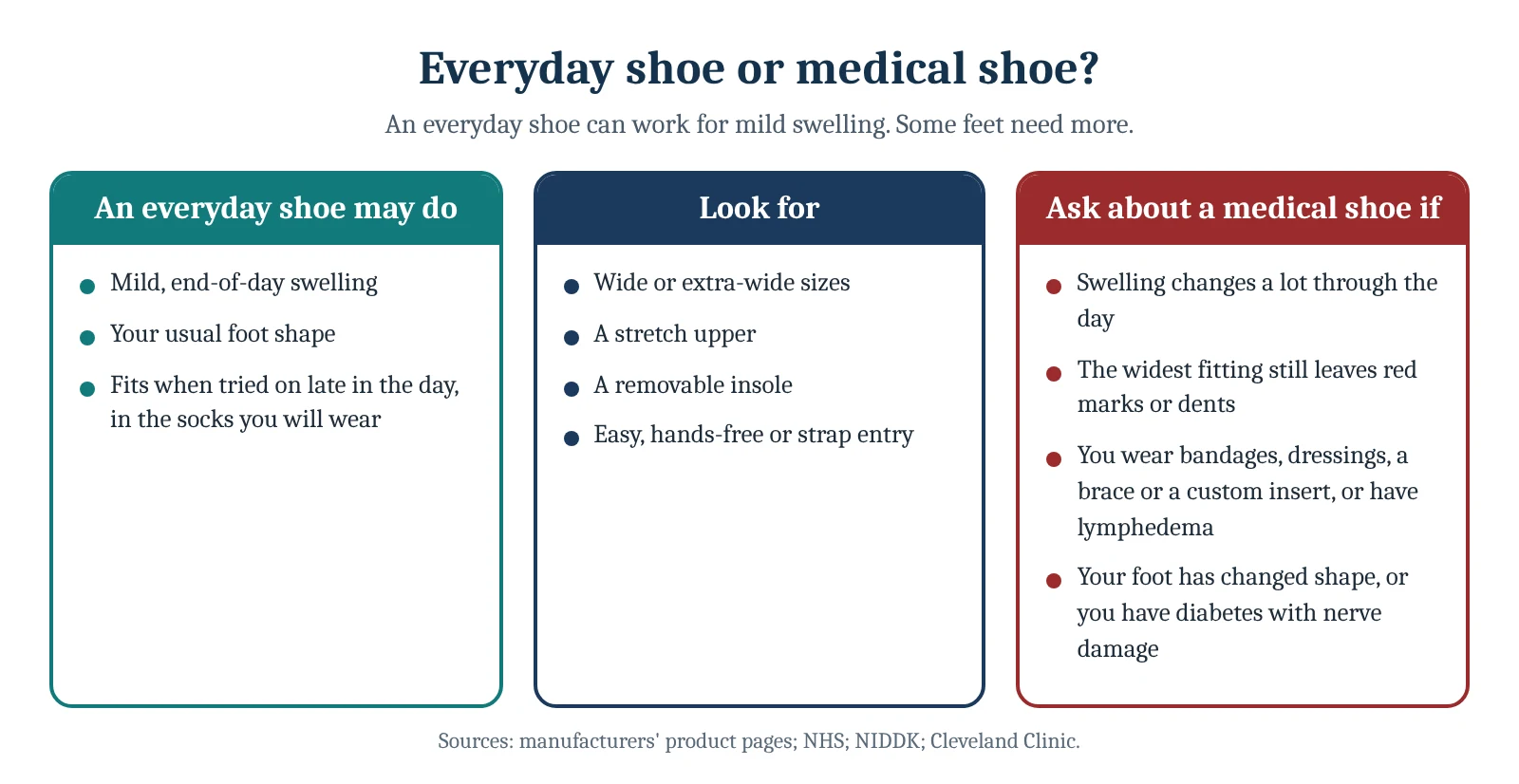
These are everyday shoes with a wide option, not shoes built to open up over a foot that keeps swelling. A medical shoe, meaning extra depth, an extra-wide fitting beyond these brands, or adjustable straps, is worth asking a clinician or fitter about when:
- the widest fitting you can find still leaves red marks or dents when you take the shoe off;
- your swelling changes enough between morning and evening that you need a closure that opens fully;
- you wear bandages, dressings, a brace or a custom insert, or you have lymphedema;
- your foot has changed shape, with a bunion, hammertoes or Charcot foot, or you have diabetes with nerve damage.
Cleveland Clinic notes that special edema shoes exist for people who need adjustable footwear for swelling. NIDDK says bunions or hammertoes may call for extra-wide or deep shoes, and a changed foot shape such as Charcot foot for special shoes or inserts. See our guides to extra-wide shoes for swollen feet and shoes for lymphedema and very swollen feet.
With diabetes, Medicare’s therapeutic-shoe benefit covers extra-depth or custom-molded shoes only for severe diabetes-related foot disease, and shoes you buy on your own sit outside it.
Downsides and limits
- No shoe reduces swelling. These make a swollen foot easier to fit. The cause still needs attention.
- Wide is not always available. At Skechers, Wide on the N-Joy and Extra Wide on the Arch Fit 2.0 appear in some colors only, so check the exact style and color.
- Depth is a gap. Widths are listed, but interior depth and volume are not.
- Seals are not swelling claims. The Skechers, New Balance and Hoka pages mention the American Podiatric Medical Association’s Seal of Acceptance, and Skechers calls its insole podiatrist-certified. None speaks to swelling, and we have not checked what APMA evaluates.
- Buying online skips the fitter. With diabetes or numbness, have a podiatrist or pedorthist check the fit, and read the return terms before you order.
Alternatives, including not buying
- Keep the shoes you have. If swelling is mild and clears overnight, and your shoes loosen enough to leave no marks, you may not need new ones.
- Look for the cause. The NHS lists some medicines, too much salt, and long periods of standing or sitting among the common causes. How to reduce swelling in feet, ankles and legs.
- Move and raise your legs. The NHS suggests walking and raising the legs on a chair or pillows when you can. Raising the legs is not right for everyone; the elevation guide covers who should check first.
- Compression, after an arterial check. See how to choose compression socks and how they should fit, then fit your shoes with the socks on.
- Roomier footwear for the evening. Slippers and sandals and non-binding socks take pressure off at home. With diabetes, NIDDK advises never going barefoot or in socks alone, even indoors.
Common questions
What are the best shoes for swollen feet?
The best pair is the one that fits your foot at its largest. The NHS suggests wide, comfortable shoes with a low heel and a soft sole, and nothing too tight. If an everyday brand is not roomy enough, see our guide to shoes for swollen feet.
Are Skechers good for swollen feet?
Some styles can be, for mild swelling. The Slip-ins models we checked list a Wide or Extra Wide fitting (in some colors only for two of the three), a knit or mesh upper, a removable insole and a hands-free heel. Skechers does not claim they treat swelling, and its pages give no interior depth, so try them on late in the day.
Are New Balance, Hoka or Brooks shoes good for swollen feet?
All three sell cushioned everyday shoes in wider fittings, and we found no swelling claims in their product descriptions. The New Balance 880v15 runs to X-Wide. The men’s hook-and-loop 928v3 has a removable footbed and lists XX-Wide (6E) in its width selector, though its size chart stops at X-Wide. Neither the Hoka Bondi 9 nor the Brooks Ghost 18 page says how the shoe closes. Hoka does not say whether the sockliner comes out; a Brooks reply on the women’s Ghost 18 page says the insoles do.
Are slip-on or hands-free shoes good for swollen feet?
They are easier to get into, which helps if bending is hard. But with little or nothing to loosen, they depend on stretch and on the width you chose. If your swelling changes a lot through the day, a shoe with an adjustable closure is the safer choice.
Can I wear compression socks with these shoes?
No maker page we read says. Kizik’s fit guide says only that thin socks can provide a slightly less snug fit. Try the shoes on with the socks you will wear. With diabetes, symptoms of artery disease, numbness, a wound, kidney disease or heart failure, get your arterial circulation checked first; see compression safety.
How do I know if I need a medical shoe instead?
If the widest fitting you can find still leaves red marks or dents, if swelling changes a lot through the day, or if you wear bandages, a brace or a custom insert, a medical shoe with extra depth or adjustable straps is worth asking a clinician or fitter about.
Where to go next
Sources
- NHS. Swollen ankles, feet and legs (oedema).
- MedlinePlus. Foot, leg, and ankle swelling.
- Cleveland Clinic. Pitting Edema.
- National Institute of Diabetes and Digestive and Kidney Diseases. Diabetes & Foot Problems.
- MedlinePlus. Diabetes – taking care of your feet.
- NHS. Venous leg ulcer – diagnosis.
- National Heart, Lung, and Blood Institute. Peripheral Artery Disease – Diagnosis.
- Medicare.gov. Therapeutic shoes & inserts.
- Skechers (manufacturer information). GO WALK Arch Fit N-Joy, GO WALK Arch Fit 2.0 and Arch Fit 3.0.
- Kizik (manufacturer information). Men’s Lima 2 and Women’s Lima 2.
- New Balance (manufacturer information). Men’s 880v15, women’s 880v15 and men’s Hook and Loop Leather 928v3.
- Brooks (manufacturer information). Men’s Ghost 18, women’s Ghost 18 and shoes in widths.
- Hoka (manufacturer information). Men’s Bondi 9, women’s Bondi 9 and men’s wide sizes.
Written by Tom Biernacki, DPM, FACFAS. Published 18 October 2026. Research-based comparison; product details and retailer links checked 18 October 2026. General education, not medical advice.