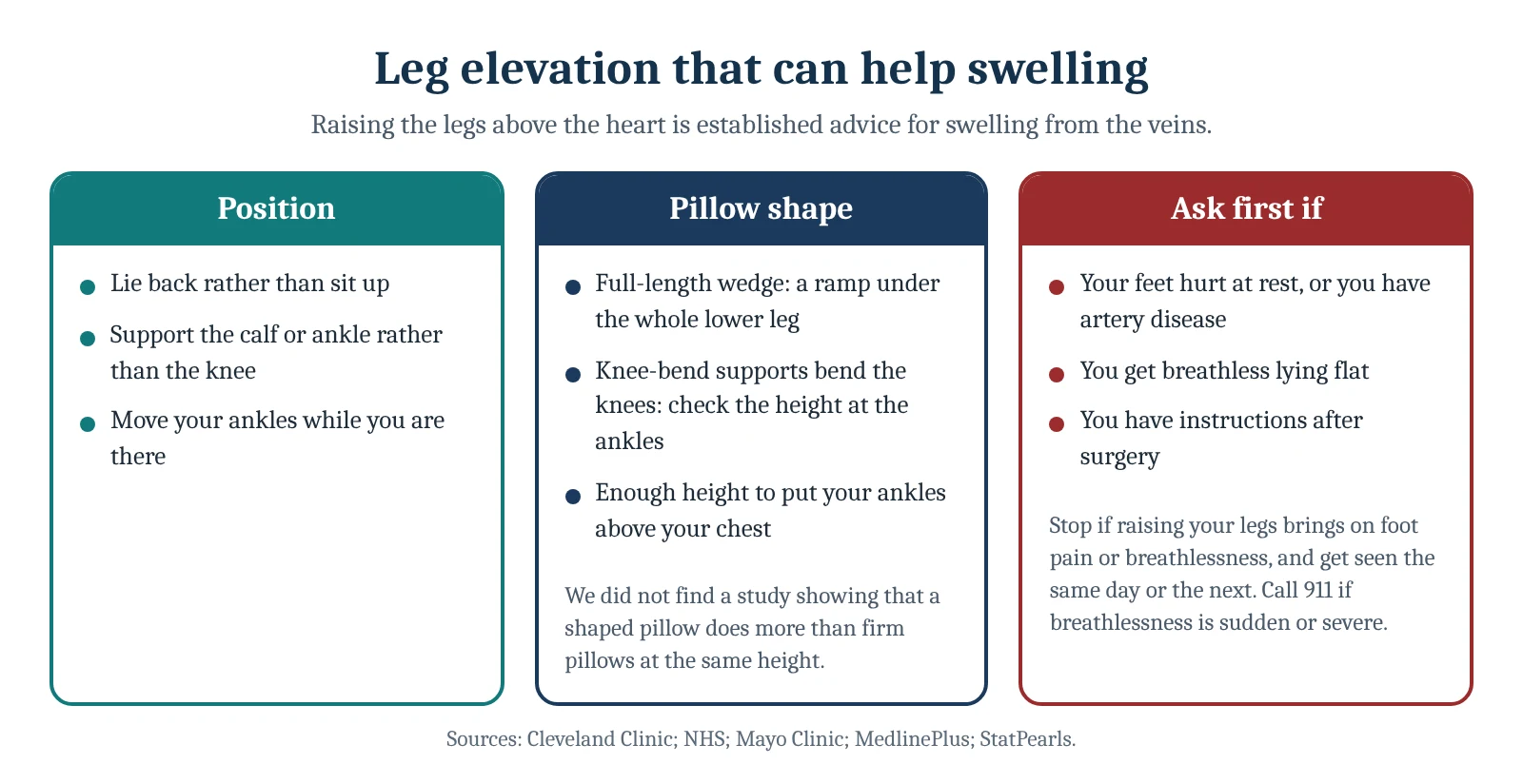
A leg elevation pillow can help swelling when it holds your ankles above the level of your heart while you lie back, so check its height first. It can make that position easier to hold, but we did not find a study showing that it does more than firm pillows stacked to the same height. If raising your legs brings on foot pain or breathlessness, stop and get checked.
When a pillow is the wrong answer
- Call 911 for sudden trouble breathing, chest pain that is worse with a deep breath or cough, coughing up blood, a racing or irregular heartbeat, fainting, or swelling with shortness of breath or chest pain. Also call for a leg or foot that suddenly turns cold, pale or mottled, numb, weak or severely painful.
- Be seen today if one leg has newly become swollen, especially with pain, warmth or a change in skin color. A clot has to be ruled out first. Why one swollen leg is different.
- Be seen the same day or the next if raising your legs brings on toe or forefoot pain that eases when you hang the foot down, if lying back makes you breathless (call 911 if it is sudden or severe), or if swelling is getting worse and you have heart, kidney or liver disease. Care thresholds.
How this guide was made, and how the site is paid. This is a research-based comparison of leg elevation pillows and wedges, built from manufacturers’ published specifications and public guidance; we have not tested these products hands-on. Some links go to Amazon. As an Amazon Associate I earn from qualifying purchases. Commissions do not change which products are listed or what we say about them, and no manufacturer provided products, samples or payment for this guide. Our methodology · Disclosure
Does a leg elevation pillow help swelling?
For swelling from the veins, or from long hours of sitting or standing, raising the legs is standard advice. The NHS suggests raising your legs on a chair or pillows when you can, and Mayo Clinic says to hold the swollen part above the level of the heart several times a day.
What the evidence does and does not say
Raising the legs above the heart is established advice for venous swelling. We did not find a study comparing a shaped leg pillow with ordinary pillows at the same height, so any case for buying one rests on comfort, stability and convenience rather than proven extra treatment. Elevation also does not treat the cause; if nobody has explained your swelling, the swelling guide covers what to have checked.
Who should check before raising their legs
- Foot pain at rest. In advanced artery disease, pain in the forefoot or toes comes on when the legs are elevated, because gravity no longer helps blood reach the foot, and it eases when the foot hangs down (StatPearls). See rest pain and limb-threatening ischemia. If you know you have artery disease, ask your clinician before using any elevation device.
- Heart failure, or breathlessness lying down. Cleveland Clinic explains that lying flat shifts blood from the legs toward the lungs, which a weak heart may not pump out, and the NHS advises an urgent appointment for breathlessness when lying down. MedlinePlus says not to keep the legs above heart level if you get shortness of breath, and to see your provider instead. If lying back with your legs up makes breathing harder, stop and tell your care team. See swelling from the heart, kidneys or liver.
- Diabetes with swollen feet. The NHS advises an urgent appointment for swollen feet, ankles or legs in someone with diabetes.
- After an operation. For any leg pillow after surgery, follow your surgical team’s instructions. After a knee replacement, MedlinePlus advises a pillow under the heel or ankle, not the knee, with the knee kept straight, so a pillow that bends the knee needs your surgeon’s agreement.
- Reduced feeling in the feet, or long hours in bed. MedlinePlus advises lifting the heels with a pillow under the calves, not the knees, and changing position every one to two hours. Check your heels daily (the two-minute foot check).
Worth asking your clinician: whether your heart and arteries allow raising your legs, how high and how long, and what is causing the swelling.
How high is high enough
The target is your heart, and your heart sits inside your chest. Three plain consequences follow.
- Sitting up rarely gets there. Upright, your heart is well above your knees, so a footstool leaves your feet below it.
- Lying back is the reliable way. If your ankles are clearly higher than your chest, they are above your heart.
- Propping up your top half raises the bar. Lifting your head and shoulders lifts your heart too.
The NHS advice for venous leg ulcers sets a lower minimum, toes above your hips; Mayo Clinic, Cleveland Clinic and StatPearls say above the heart. Compare a pillow’s stated height with the depth of your own chest lying down, and allow for foam sinking under your legs.
How long to elevate your legs
Recommendations differ. For chronic venous insufficiency, Cleveland Clinic says 30 minutes or longer, at least three times a day, and StatPearls says at least 30 minutes, three times a day. For venous leg ulcers the NHS suggests 30 minutes, three to four times a day, and for stasis dermatitis the American Academy of Dermatology suggests 15 minutes every 2 hours. Sitting upright with a footstool does not count.
Move your ankles while you are there; Mayo Clinic notes that using the leg muscles may help move fluid back toward the heart. Swelling that has not improved after a few days of home care, or that is getting worse, is a reason to get the cause assessed (the NHS says to see a GP), not to elevate harder. Leg elevation, and when not to has the full technique.
Sleeping with your legs raised
The NHS suggests pillows under your feet and legs while you sleep if you have a venous leg ulcer, and Mayo Clinic and the American Academy of Dermatology also mention raising the legs during sleep. Whether it works depends on how you sleep.
- On your back, support the calves and keep the heels just clear of the wedge.
- On your side, or if you turn a lot, a wedge will not stay under your legs all night; daytime sessions may be more realistic.
- Stop if it brings on foot pain or breathlessness, and get seen the same day or the next.
What matters when choosing a leg elevation pillow
| Feature | Why it matters | What to check |
|---|---|---|
| Height at the feet | Ankles must end up above your heart, higher if you are propped up | The stated height against your chest depth lying down |
| Shape | A straight ramp keeps the knee straight; knee-bend supports bend it | Your surgeon’s instructions |
| Length and width | Whole-calf support spreads the load, and both legs need room | Reaches from below the knee to the ankle; fits your sofa or bed |
| Firmness | Soft foam sinks and loses height | High-density foam where the maker states it |
| Cover | Sweat, creams and weeping skin soil covers | Removable and machine washable |
| Returns | Height and firmness are hard to judge online | The return policy once the foam is unpacked |
Full-length wedge or knee-bend?
A full-length wedge pillow for legs is a ramp under the whole lower leg, highest at the feet, with the leg straight. That fits MedlinePlus’s advice to support the calf or ankle rather than the knee.
A knee-bend support, whether a contoured leg rest or a wedge under the knees, bends the knees. Check the height under the ankles, not just the overall height.
Leg elevation pillow options by shape
These six come from makers whose own product pages publish dimensions. Sizes, foams and care are as those pages listed them in October 2026, not our measurements; we have not used any of them.
| Product | Published size (inches) | Shape | Foam | Cover and care |
|---|---|---|---|---|
| Xtra-Comfort Leg Rest Pillow (Vive Health) | 16.5 wide, 23.25 deep, 8.25 high | Ramp, 12-inch slope at 45 degrees | High-density base, gel memory foam top | Zippered knit; cover machine washable, foam spot clean |
| Brentwood Home Zuma Foam Wedge Pillow | 24 by 24; 7, 10 or 12 high | Wedge; no angle given | Support foam, 1.8 lb density, 30 ILD | Rayon knit; removable, machine washable |
| Avana Align Wedge and Ramp set | Ramp 34 long, 24 wide, 12 high; wedge 14 by 24 by 7 | Ramp at 27 degrees, plus wedge | Polyurethane | Removable cover; care not stated |
| Lounge Doctor Leg Rest | 18 wide (24 on three sizes), 10.5 to 13.5 high, 20.75 to 25.25 long | Contoured, bent knee | Open-cell foam | Zippered cover; care not stated |
| Xtra-Comfort Knee Elevation Pillow (Vive Health) | 13 wide, 32 long, 9.5 high; channel 7 wide, 3 deep | One leg, 35-degree incline | High-density, latex-free | Zippered knit; cover machine washable, foam spot clean |
| Core Products Deluxe Knee Wedge | 20.75 by 13.5 by 10 (axes not labeled) | Under the knees | Polyurethane, latex-free | Polyester; spot clean (the page also calls the cover removable) |
Wedges for both legs
Xtra-Comfort Leg Rest Pillow (Vive Health, SKU CSH1027). A ramp wide enough for both legs. May suit: a first wedge with a washable cover. Limits: 8.25 inches may not clear your chest if you are propped up. See it on Amazon
Brentwood Home Zuma Foam Wedge Pillow. A general-purpose wedge that Brentwood says can also raise the legs. May suit: choosing your own height. Limits: no leg shaping, and Brentwood’s own site treats the 10- and 12-inch sizes as final sale. See it on Amazon
A taller, longer ramp
Avana Align Wedge and Ramp set (SKU 18353). A 12-inch ramp sold with a 7-inch wedge; Avana lists leg elevation among its uses. May suit: real height under both legs. Limits: a two-piece set marketed for recovery and stretching, and its page never mentions swelling. See it on Amazon
Contoured support with a bent knee
Lounge Doctor Leg Rest. A contoured support that, by its maker’s description, holds the thigh, a bent knee and the lower leg, in four sizes; a gel foam version and an inflatable travel version are also sold. May suit: whole-leg support matched to leg length. Limits: the maker’s claims about ideal angles are its own, the inflatable can lose air, and after a knee replacement a bent knee needs your surgeon’s agreement. See it on Amazon
One leg, or under the knees
Xtra-Comfort Knee Elevation Pillow (Vive Health, SKU CSH1050). A single-leg wedge with a leg channel, made for recovery after surgery or injury. May suit: raising one leg, including in a bandage or cast. Limits: it holds one leg only, and the page lists both a 9.5-inch height and 6.5 inches of elevation. See it on Amazon
Core Products Deluxe Knee Wedge (SKU LTC-5406-BL). A foam wedge that unfolds and sits under the knees, with the slope supporting the lower legs. May suit: comfort on your back with the knees bent. Limits: the page gives no incline or ankle height, a wedge under the knees may leave the ankles below heart level, and MedlinePlus advises against pillows under the knees when you need to protect your heels. See it on Amazon
Downsides and limits
- No proven extra benefit. We did not find a study showing that a shaped pillow does more than other support at the same height.
- Stated heights are for the foam at rest. Your legs press it down, and soft foam presses down more.
- Maker claims are not findings. Statements about ideal angles, circulation or healing come from the makers.
- It is the wrong tool for some people: rest pain from artery disease or breathlessness lying down. A leg that might have a clot needs to be seen today first.
Alternatives, including not buying
- What you already own. Firm pillows or sofa cushions under the calves, or the arm of a sofa, do the same job if they get your ankles above your chest.
- Movement. The NHS advice for swollen legs includes gentle exercise such as walking and not standing or sitting still for long.
- Compression during the day, but have your arteries checked first, usually with an ankle-brachial index, if you have diabetes, artery disease symptoms, numbness, a wound, kidney disease or heart failure (compression safety; choosing compression socks). If socks are hard to put on, see zipper socks and donning aids.
- Finding the cause. Medicines, the heart, kidneys and liver, and the veins all swell legs. How to reduce swelling covers the options in order.
Common questions
Do leg elevation pillows work for swelling?
They help when they hold your ankles above your heart while you lie back, which Mayo Clinic, Cleveland Clinic and StatPearls describe for swelling from the veins. We did not find a study showing that a shaped pillow beats ordinary pillows at the same height; its likely advantages are comfort and stability.
What is the best leg elevation pillow for swelling?
The one that puts your ankles above your chest when you lie back, fits your leg length and is comfortable for half an hour. We have not tested any, so height, length, firmness and your surgeon’s instructions narrow the choice more than brand does.
How high should you elevate your legs to reduce swelling?
Above the level of your heart, according to Mayo Clinic, Cleveland Clinic and StatPearls; the NHS minimum for venous leg ulcers is toes above your hips. Lie back and check that your ankles are clearly higher than your chest.
How long should you elevate your legs?
Cleveland Clinic says 30 minutes or longer, at least three times a day, for chronic venous insufficiency; the NHS suggests 30 minutes, three to four times a day, for venous leg ulcers. After surgery, follow your surgical team’s instructions.
Is it OK to sleep with your legs elevated on a pillow?
For many people with venous swelling, yes; the NHS suggests pillows under the feet and legs at night for venous leg ulcers. Support the calves, not the knees, keep the heels clear, and stop if it causes foot pain or breathlessness.
Who should not elevate their legs?
People with foot pain at rest from artery disease, which raising the legs makes worse, and anyone who becomes breathless lying back, which can signal heart failure. A newly swollen single leg needs to be seen today for a possible clot.
Where to go next
Sources
- NHS. Swollen ankles, feet and legs (oedema).
- NHS. Venous leg ulcer – treatment.
- NHS. Heart failure.
- Mayo Clinic. Edema – diagnosis and treatment.
- Cleveland Clinic. Chronic venous insufficiency (CVI).
- Cleveland Clinic. Orthopnea.
- American Academy of Dermatology. Stasis dermatitis self-care.
- StatPearls, NCBI Bookshelf. Venous Insufficiency.
- StatPearls, NCBI Bookshelf. Peripheral Arterial Disease.
- MedlinePlus. Swelling.
- MedlinePlus. Preventing pressure injuries.
- MedlinePlus. Knee joint replacement – discharge.
- Centers for Disease Control and Prevention. About Venous Thromboembolism (Blood Clots).
- Vive Health. Leg Rest Pillow, product page read October 2026.
- Vive Health. Knee Elevation Pillow, product page read October 2026.
- Brentwood Home. Zuma Foam Wedge Pillow, product page read October 2026.
- Avana Comfort. Align Wedge and Ramp, product page read October 2026.
- Lounge Doctor. Lounge Doctor Leg Rest and Inflatable Travel Leg Rest and How to use, pages read October 2026.
- Core Products. Deluxe Knee Wedge, product page read October 2026.
Written by Tom Biernacki, DPM, FACFAS. Published 18 October 2026. Research-based comparison; product details and retailer links checked 18 October 2026. General education, not medical advice.