Vein treatment has changed completely in the last twenty years. The operation most people picture — stripping, general anesthetic, weeks off — has largely been replaced by procedures done under local anesthetic in an afternoon. Here is what each one does, and the questions that separate a good recommendation from a sales pitch.
Two things happen before any procedure
A duplex ultrasound mapping which veins are leaking and in which direction. Without it, nobody knows what they are treating. What the scan looks for →
A conversation about compression. Many insurers require a documented trial of stockings, often around three months, before they will cover treatment. The 2023 guideline from the Society for Vascular Surgery, the American Venous Forum and the American Vein and Lymphatic Society suggests against that three-month trial for people with symptomatic varicose veins who are candidates for a procedure and want to go ahead, and for reflux in the main surface veins it recommends a procedure over long-term stockings. Your plan’s rules still apply, so ask the clinic how they handle it. Getting compression right →
The options
| Procedure | What it does | Worth knowing |
|---|---|---|
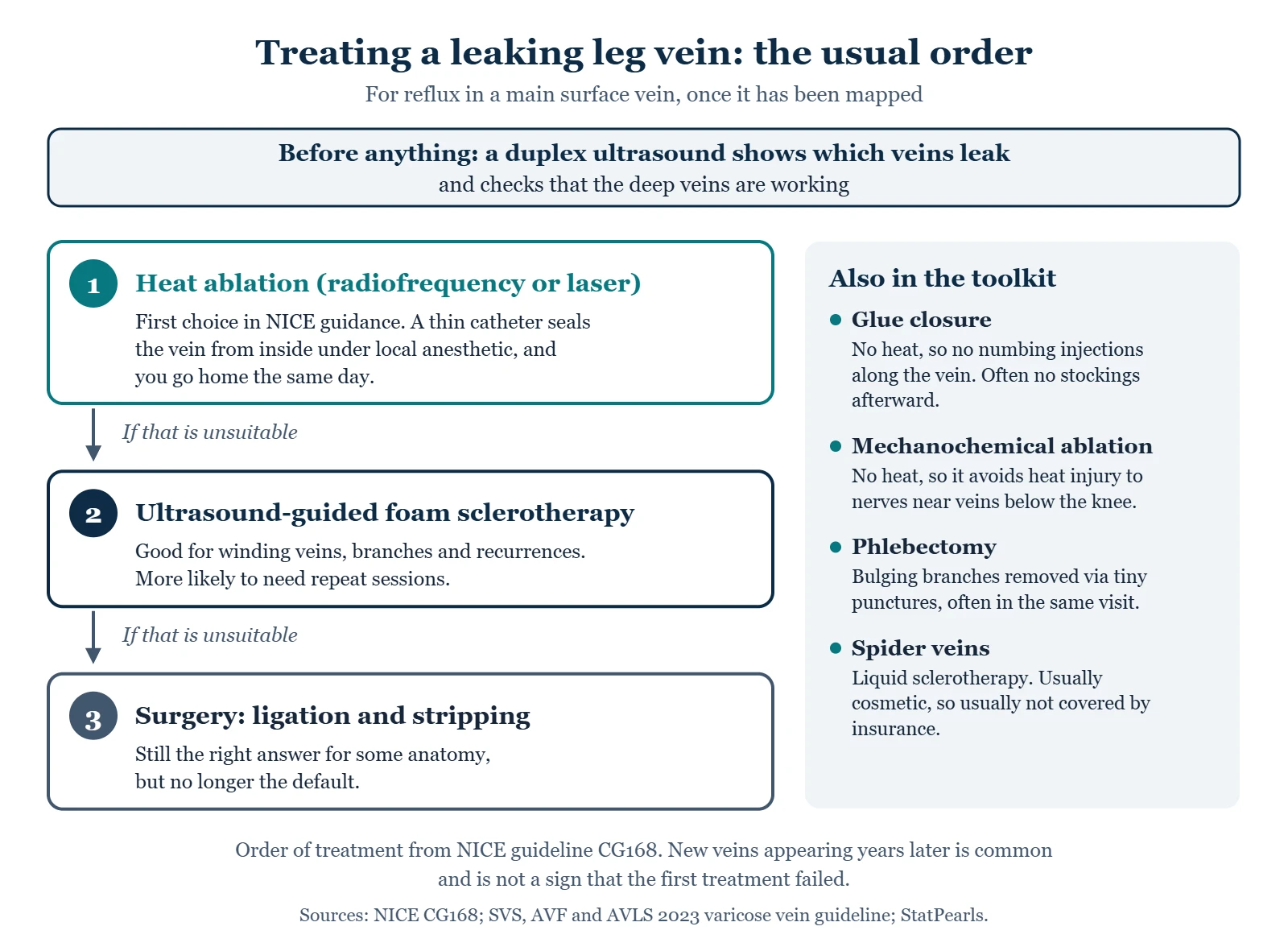
| Endovenous thermal ablation (laser or radiofrequency) | A fine catheter inside the vein heats and seals it shut. Local anesthetic, walk out the same day | NICE recommends it as the first choice for a leaking main trunk vein; StatPearls reports closure at two years in about 85% after radiofrequency and 93% after laser. Needs fluid injected around the vein to protect surrounding tissue, which is the part that stings |
| Cyanoacrylate closure (medical adhesive) | Glue seals the vein. No heat, so no tumescent anesthetic injections | More comfortable during the procedure; a small number of people get an inflammatory reaction to the adhesive. Often no compression stockings afterward |
| Mechanochemical ablation | A rotating wire scuffs the vein wall while a sclerosant is delivered. No heat | Avoids the nerve-injury risk of heat near certain veins, such as below the knee |
| Foam sclerotherapy | A foamed solution injected into the vein makes it scar shut | NICE’s next option when heat ablation is unsuitable. Good for tributaries, recurrences and tortuous veins that a catheter cannot navigate. More likely to need repeat sessions |
| Liquid sclerotherapy | Injection treatment for spider veins and small surface veins | Cosmetic in most cases, so usually not covered by insurance |
| Ambulatory phlebectomy | Bulging surface veins removed through tiny punctures under local anesthetic | Often combined with ablation of the feeding trunk in the same visit |
| Surgical stripping and ligation | The traditional operation | Still occasionally the right answer for particular anatomy, but no longer the default; NICE places it after ablation and foam |
| Iliac vein stenting | Opens a blocked or compressed pelvic vein | A different problem entirely — for obstruction rather than reflux, and reserved for selected severe cases. More → |
What recovery is actually like
For the catheter-based treatments: walking the same day and encouraged, back to desk work within a day or two, heavy exercise after about a week, compression for a few days to a couple of weeks depending on which technique was used. Expect bruising along the treated vein, tightness or a cord-like feeling as it scars down over a few weeks, and some tenderness. Numb patches on the skin happen occasionally and usually recover.
Get same-day care, with an ultrasound, for calf pain or swelling that is new and one-sided; go to an emergency department now for spreading redness with a fever or chills; call 911 for breathlessness or any chest pain. Serious complications are uncommon, but the first of those is the one worth knowing about because the treated leg is briefly at slightly higher clot risk.
When there is an ulcer
Treating the reflux is not just about comfort when the skin has broken down. In the EVRA trial of 450 people with venous leg ulcers, closing the refluxing vein within two weeks healed ulcers in a median of 56 days, against 82 days when treatment waited until the ulcer had closed, and longer follow-up found fewer recurrences. Vascular surgery guidelines recommend adding surface vein treatment to compression to reduce ulcer recurrence. Venous ulcers →
Questions worth asking
- Which specific veins are refluxing, and can I see the ultrasound report? Treatment should follow a map, not a general impression.
- Is this being done for symptoms or for appearance? The honest answer determines what insurance does and what you should expect afterward.
- What happens if I do nothing? Varicose veins are not dangerous in themselves for most people; the argument for treating is symptoms, skin changes, bleeding, or a healed or open ulcer.
- How many sessions is this likely to be in total? Ask before starting, not after the first one.
- What is the chance of new veins appearing later? Recurrence over the years is normal and not a sign the procedure failed.
- Will I still need compression afterward? Often yes, particularly if there is skin damage or a previous ulcer.
- What does this cost me, in total, including follow-up? Get it in writing. This is a field where costs vary widely.
- Who does the procedure and how many do they do? A fair question anywhere and a particularly fair one here.
A word about clinics
Vein treatment is profitable, largely elective, and heavily marketed, and standards vary. Signs worth slowing down for: a treatment plan offered before a duplex ultrasound, a package of many sessions sold upfront, pressure to decide at the first visit, treatment of spider veins presented as medically necessary, or a claim that untreated varicose veins will cause a dangerous clot. That last one is the most common overstatement in the field. Get a second opinion if any of it feels like a sale.
From the clinic
The vein referrals I am most comfortable making are for legs that are telling a story: aching by evening, ankle swelling, staining or itchy skin above the ankle, or a healed ulcer. The ones I slow down are the ones where the only problem is appearance and someone has used the word “dangerous”. Ask for the ultrasound report, and ask what each recommended session is treating.
Common questions
Is it safe to close a vein? Do I not need it?
The veins treated are superficial ones that are already failing — blood in them is falling backward rather than returning to the heart. The deep veins, which carry the great majority of the return, take over, and closing a refluxing superficial vein generally improves overall flow rather than reducing it. Your team confirms the deep system is working on the ultrasound beforehand, which is one reason the scan is not optional.
Will my varicose veins come back?
The treated vein stays closed in the large majority of cases. What happens over the years is that other veins can become varicose, because the underlying tendency has not gone away. Some people need a top-up session years later. That is expected rather than a failure, and it is a fair thing to ask about before you start.
Does insurance cover it?
Usually yes for symptomatic varicose veins with documented reflux, and usually no for spider veins and cosmetic work. Most insurers want a documented trial of compression first, often around three months, and a duplex ultrasound report — even though the 2023 US vein guideline suggests against a three-month compression trial before treatment for people who want to go ahead. Ask the clinic to handle the pre-authorization and to tell you in writing what you will owe.
Will treating my veins heal my ulcer?
It helps considerably. In the EVRA trial, closing the refluxing veins early sped healing and reduced recurrence. Compression is still doing the primary work on the wound itself, and current practice is to treat the veins early rather than waiting for the ulcer to close. More →
Which technique is best?
They have broadly similar closure rates for the main trunk veins, so the choice comes down to your anatomy, the position of nearby nerves, whether you want to avoid post-procedure stockings, and what the person treating you does most often and does well. Anyone presenting one technique as categorically superior is overstating what the evidence shows.
Where to go next
Sources
- Society for Vascular Surgery. Varicose Veins.
- Society for Vascular Surgery. Chronic Venous Insufficiency.
- MedlinePlus, National Library of Medicine. Varicose Veins.
- Society for Vascular Surgery, American Venous Forum and American Vein and Lymphatic Society. 2023 clinical practice guidelines for varicose veins of the lower extremities, part II.
- NICE. Varicose veins: diagnosis and management (CG168).
- StatPearls. Venous Insufficiency.
- EVRA trial. A randomized trial of early endovenous ablation in venous ulceration. N Engl J Med 2018.
- EVRA trial. Long-term clinical and cost-effectiveness of early endovenous ablation in venous ulceration. JAMA Surg 2020.
- Society for Vascular Surgery and American Venous Forum. 2011 clinical practice guidelines for varicose veins and associated chronic venous diseases.
- Centers for Disease Control and Prevention. About Blood Clots.
Written by Tom Biernacki, DPM, FACFAS. Published 21 September 2026. Updated 16 October 2026. General education, not medical advice.