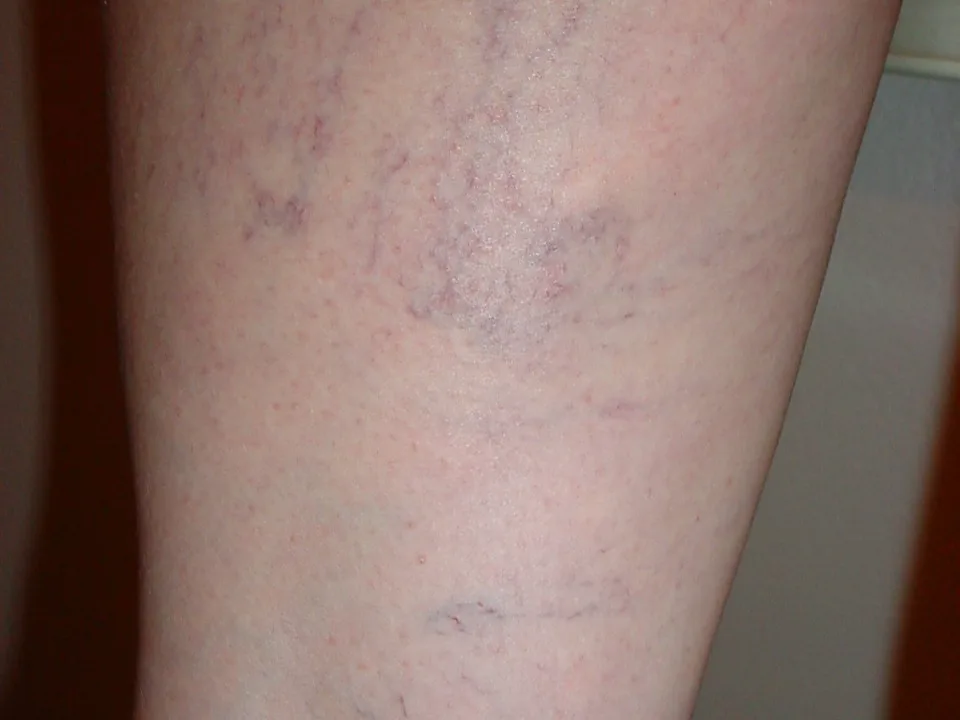
Spider veins on legs are tiny widened blood vessels in the skin — fine red, blue or purple threads, often in a web or branching pattern. They are very common and usually harmless, so treating them is mostly a cosmetic choice. Now and then they are the visible edge of a vein problem underneath, and a few specific signs tell you when a scan is worth having.
What spider veins are
The medical name is telangiectasias: clusters of widened tiny veins within the skin, each less than 1 millimeter across. They lie flat, sit closer to the surface than varicose veins, and appear mainly on the legs and face, sometimes the hands.
Reticular veins are the next size up — about 1 to 3 millimeters, bluish, often zigzagging just under the skin. Vein specialists put both in the mildest visible class of their classification system (C1), with the explicit note that either can occur without chronic venous insufficiency.
They are extremely common. In a study of 1,566 randomly selected adults in Scotland, 88% of women and 79% of men had spider veins on the right leg.
Spider veins vs varicose veins
| Spider veins | Varicose veins | |
|---|---|---|
| Size | Less than 1 millimeter (reticular veins 1–3) | 3 millimeters or more |
| Look | Flat red, blue or purple threads, webs or branches | Raised, bulging and twisted; blue, purple or skin-colored |
| Symptoms | Usually none | Sometimes aching, heaviness, itching or ankle swelling |
| What they usually mean | Often nothing beyond appearance | Leaking valves in the surface veins |
| Usual treatment | Sclerotherapy or surface laser | Compression, ablation, phlebectomy or sclerotherapy, guided by a scan |
| Insurance | Usually treated as cosmetic | Often covered when symptoms persist despite a trial of compression |
If yours bulge or ache, start with the varicose veins guide instead.
What causes spider veins on legs
Nobody fully knows. One idea is that they come from the same failing valves behind varicose veins, but in one study fewer than 1 in 4 people with spider veins (23%) had leaking veins underneath. Hormones, genes, sun and minor injury all appear to play a part. The recognized risk factors:
- a family history of spider or varicose veins
- being female, and hormonal change — pregnancy, hormonal birth control, menopausal hormone therapy
- older age
- long stretches of standing or sitting, especially more than 4 hours at a time
- overweight or obesity
- a lot of time in the sun
- smoking, now or in the past
- a previous blood clot, or an injury to the area
Crossing your legs does not appear on any of the medical lists. Pregnancy deserves a note: the Office on Women’s Health says varicose veins that appear in pregnancy shrink or disappear after the birth for some women, while more can appear with each pregnancy. Treatment is usually postponed until after pregnancy and breastfeeding.
Are spider veins a sign of something deeper?
Usually not, but sometimes. Spider veins themselves are not dangerous. Occasionally they are an early sign of chronic venous insufficiency — leaking valves in the larger leg veins, which over years can bring swelling, skin changes and ulcers. A venous duplex ultrasound, a scan that maps the leg veins and checks their valves, is worth asking for when spider veins come with:
- aching, heaviness, burning, cramping or tired legs, especially after standing
- ankle swelling
- skin changes near the ankle: brown staining, itchy eczema-like patches, hardening, or a sore
- a dense fan of tiny veins around the inner or outer ankle or the side of the foot — specialists call this corona phlebectatica and classify it with the skin changes of venous disease, not with ordinary spider veins
- bulging varicose veins as well
If any of these apply and you are planning treatment, have the scan first, so a leaking vein underneath is found rather than left in place. Chronic venous insufficiency explained → · What the duplex scan shows →
When it is not a spider-vein question
A vein that becomes swollen, red, warm or tender — a hard, sore line under the skin — can mean a clot in a surface vein (superficial thrombophlebitis) and should be seen the same day or the next. One leg newly swollen or painful needs assessment today, because a deep vein clot is possible. Sudden breathlessness or chest pain is 911.
Cosmetic or medical, and who pays
For most people, treating spider veins is about appearance. That is a reasonable choice, as long as it is called what it is. Treatment done only to change how the legs look is cosmetic and is generally not covered: Medicare does not pay for most cosmetic procedures, and one of its regional coverage policies for vein treatment describes spider veins as most often treated for cosmetic purposes. Some private plans cover vein treatment when there are symptoms such as pain or swelling, so ask your plan before you start.
Ask the clinic for the total cost in writing and how many sessions it expects. Spider-vein treatment presented as medically necessary on its own, or a large package of sessions sold before anyone has examined your legs, is a reason for a second opinion. Vein procedures and the questions to ask →
Spider veins treatment: what to expect
Sclerotherapy
The usual first choice for spider veins on the legs. A very fine needle delivers a solution into the vein that scars it shut, so it fades. It is done in the office without anesthesia, usually takes under an hour, and may sting or cramp briefly.
- Sessions: often 2 or 3 for the best result, about 6 weeks apart.
- Results: treated spider veins usually fade over 3 to 6 weeks; some may not clear completely.
- Afterward: walking straight away is encouraged, and most people are back at work the next day. Compression stockings or bandages are commonly advised for about 2 weeks, along with avoiding hard exercise and sun on the treated skin for about 2 weeks, or using SPF 30 or higher.
- Side effects: bruising, small skin sores and darkened skin, usually fading over days to weeks, sometimes longer. In trials, about 3 in 10 treated people had skin darkening afterward, against about 1 in 40 given a sham injection, and about 7 in 100 developed matting — new tiny vessels after treatment. Less commonly, a clot forms in a treated vein, the solution causes an allergic reaction, or tiny air bubbles cause symptoms.
- Not now if: you are pregnant or breastfeeding.
Surface laser
Light energy is aimed at the vein through the skin, with no needles or incisions, and its heat closes the vessel. It is used for veins under about 3 millimeters. Small spider veins may vanish immediately; larger ones darken and can stay visible for 1 to 3 months before fading. Plan on 3 or more sessions for full clearing, and protect the treated skin from sun for 3 to 4 weeks. Laser is avoided in pregnancy and in people taking blood thinners.
Which works better?
A Cochrane review of 35 randomized trials, covering 3,632 people, found injection treatment better than a sham, but no clear difference in clearance between the various injected solutions, or between injections and laser. Laser may cause less skin darkening. The evidence was low to moderate in certainty, and none of the trials measured how often veins came back.
Will they come back?
Treated veins usually stay closed, but treatment does not stop new ones forming, so further sessions may be needed over the years.
Creams, supplements and the limits of self-care
We have not found good evidence that any cream removes spider veins, and none of the medical sources behind this page lists one as a treatment. Vein supplements fare little better: a Cochrane review of these products (flavonoid-type “phlebotonics”) in chronic venous disease found they probably reduce swelling slightly and probably cause more side effects, mainly stomach upset — and none of the trials reported any effect on spider veins. Self-care can help prevent new spider veins; it does not remove existing ones.
Preventing new spider veins: what helps, and the limits
No routine guarantees prevention. With a family history or during pregnancy you may not be able to prevent them at all, and the sources behind these steps say they may lower the risk, not that they will. Still, they are worth knowing:
- If you sit or stand for long periods, move every 30 minutes.
- Exercise regularly; walking counts.
- Keep to a healthy weight.
- Protect your legs from the sun year-round.
- Skip long soaks in hot baths.
- Avoid high heels and clothing that is tight around the waist, groin or legs.
- Raise your legs above heart level for short spells — unless you have known artery disease, or foot pain that eases when you hang your leg down. In advanced arterial disease, lying with the legs up can make foot pain worse. Leg elevation →
If you take estrogen-containing contraception or hormone therapy, that is a conversation for your prescriber; do not stop a prescribed medicine for the sake of spider veins.
Where compression fits
Compression stockings are not how spider veins are cleared — that takes injections or laser. Their role is narrower:
- They can ease aching and swelling when venous insufficiency lies underneath.
- They are commonly advised for about 2 weeks after sclerotherapy, although the evidence that they improve clearing is weak.
- They may help prevent new spider veins, though the evidence is limited.
Compression is not safe for every leg. If you have diabetes, leg pain on walking or other signs of PAD, numbness in your feet, a wound on your leg or foot, kidney disease, or heart failure, have your arterial circulation checked first — usually with an ankle-brachial index, which compares blood pressure at the ankle and arm. Who needs an assessment first → Once you are cleared, fit and pressure matter more than brand. Fit and pressure labels →
From the clinic
Spider veins are one of the most common things I am asked about, and for most people they are cosmetic. What changes my view is what sits around them: aching or swelling by evening, bulging varicose veins, or brown staining near the ankle suggest the larger veins are leaking, and that deserves an ultrasound before anyone injects the small ones. Treating only the surface when there is reflux underneath is a common reason they come back.
Common questions
What causes spider veins on legs?
Usually a mix of inherited tendency, hormones (pregnancy, birth control, menopausal hormone therapy), age, long hours standing or sitting, excess weight, sun and smoking. In a minority, leaking valves in the larger veins are part of the story, which is when a duplex scan helps.
Do spider veins go away on their own?
Do not count on it. Self-care can help prevent new ones but does not remove the ones you have, and the medical sources describe treatment, not waiting, as the way to clear them. Pregnancy is a partial exception: some varicose veins that appear then shrink after the birth, and treatment is usually postponed until after pregnancy and breastfeeding anyway.
Are spider veins a sign of poor circulation?
Not on their own. “Poor circulation” is a loose term that can mean narrowed arteries, struggling veins or a lymphatic problem (what it can mean). Spider veins are a surface-vein finding and say nothing about your arteries. Occasionally they are an early sign of venous insufficiency, particularly with aching, ankle swelling, skin changes or veins fanning around the ankle, and that is when a venous duplex scan is worth having.
What is the difference between spider veins and varicose veins?
Size and shape. Spider veins are under 1 millimeter, flat, and red, blue or purple; varicose veins are 3 millimeters or more, raised and twisted, and usually reflect leaking valves. Spider veins are usually a cosmetic matter; varicose veins with symptoms or skin changes are a medical one.
Do compression socks help spider veins?
They will not clear existing spider veins. They can ease aching and swelling from underlying venous insufficiency, may help prevent new spider veins, and are often advised briefly after sclerotherapy, though the evidence that they improve clearing is weak. Have your arteries checked first if you have diabetes, PAD symptoms, numbness, a wound, kidney disease or heart failure.
Does insurance cover spider vein treatment?
Usually not, because treatment for appearance alone counts as cosmetic, and Medicare does not cover most cosmetic procedures. Coverage is more likely for symptomatic vein disease, so if you have symptoms, the scan and a documented diagnosis come first. Ask your plan, and get the cost in writing.
Where to go next
Sources
- Cleveland Clinic. Spider Veins.
- StatPearls, NCBI Bookshelf. Spider Veins.
- StatPearls, NCBI Bookshelf. Varicose Veins.
- MSD Manual Professional Version. Clinical Classification of Chronic Venous Insufficiency.
- Office on Women’s Health, U.S. Department of Health and Human Services. Varicose veins and spider veins.
- Mayo Clinic. Varicose veins — symptoms and causes and diagnosis and treatment.
- Mayo Clinic. Sclerotherapy.
- American Academy of Dermatology. Leg veins: Why they appear and how dermatologists treat them.
- Cochrane. Treatment for telangiectasias and reticular veins.
- Cochrane. Phlebotonics for venous insufficiency.
- Medicare.gov. Cosmetic surgery coverage.
- Centers for Medicare & Medicaid Services. Local Coverage Determination L33575: Varicose Veins of the Lower Extremity, Treatment of.
- Society for Vascular Surgery. Varicose Veins and Chronic Venous Insufficiency.
- NHS. Varicose veins.
- NHS. Phlebitis (superficial thrombophlebitis).
- Centers for Disease Control and Prevention. About Venous Thromboembolism (Blood Clots).
- National Heart, Lung, and Blood Institute. Peripheral Artery Disease — Diagnosis.
- American Family Physician (American Academy of Family Physicians). Chronic Critical Limb Ischemia: Diagnosis, Treatment and Prognosis.
Written by Tom Biernacki, DPM, FACFAS. Published 9 October 2026. Updated 16 October 2026. General education, not medical advice.