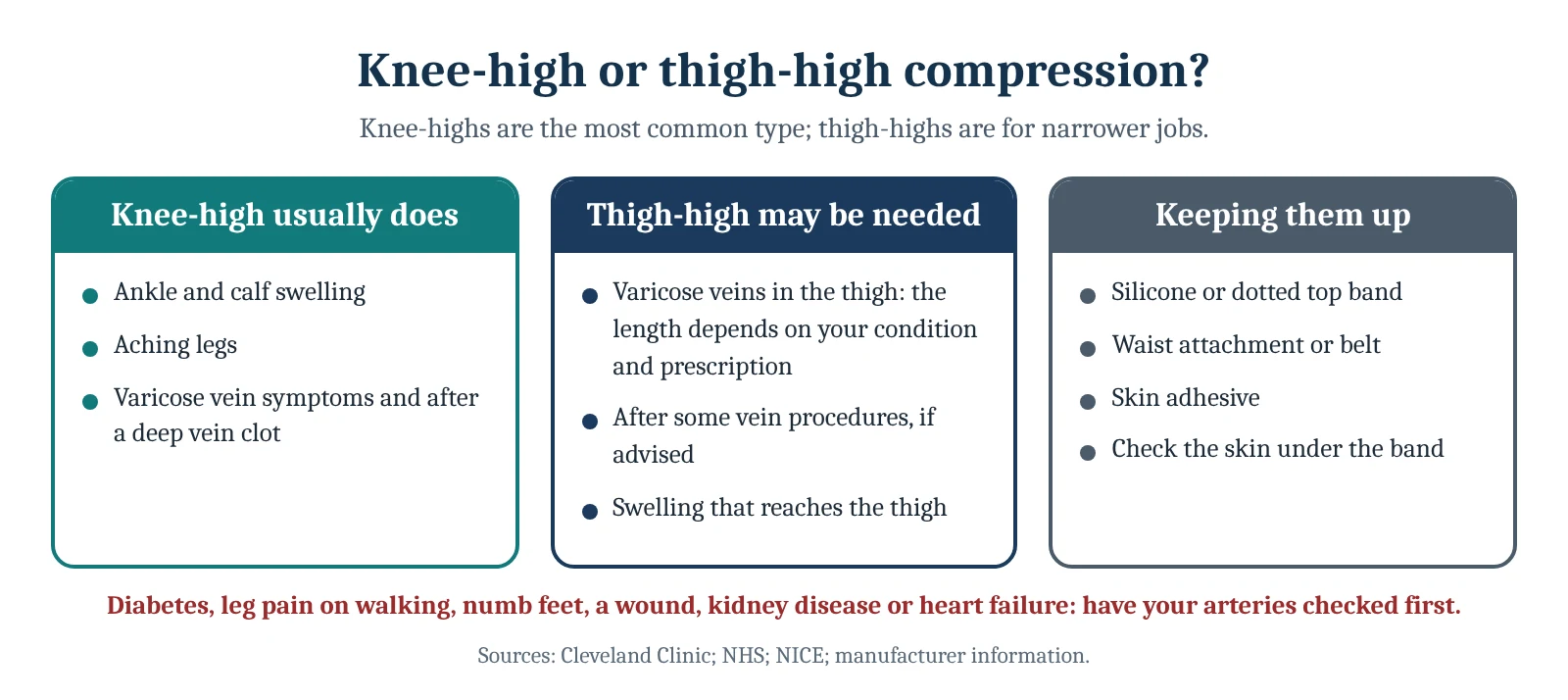
Knee-highs are the most common compression stockings. Thigh high compression socks are for narrower jobs: swelling that reaches above the knee, lymphedema that involves the thigh, the days after some vein procedures when your treating team asks for them, or lightheadedness on standing that a clinician wants to treat. They take more effort to put on and keep up, so the top band matters too.
Before you buy, and while you wear them
Arteries first. If you have diabetes, leg pain when you walk, numb feet, a foot or leg wound, kidney disease or heart failure, have your arterial circulation checked before any compression, usually with an ankle-brachial index. The NHS is plain that compression is not safe when the artery pressures at the ankle are low. Who needs an assessment first.
A new change in one leg. One leg that becomes newly swollen, painful, warm or discolored needs to be seen today, including in the days after a vein procedure. Call 911 for sudden breathlessness, chest pain or discomfort, coughing up blood, a racing heart or fainting, or for a leg or foot that suddenly becomes cold, pale or mottled, numb, weak or severely painful.
Take the stockings off and get advice if your toes tingle, go numb or change color, or the skin under the band blisters or breaks.
How this guide was made, and how the site is paid. This is a research-based comparison of thigh-high compression stockings, built from manufacturers’ published specifications and public guidance; we have not tested these products hands-on. Some links go to Amazon. As an Amazon Associate I earn from qualifying purchases. Commissions do not change which products are listed or what we say about them, and no manufacturer provided products, samples or payment for this guide. Our methodology · Disclosure
Knee-high vs. thigh-high: what changes
| Knee-high | Thigh-high | |
|---|---|---|
| Covers | Foot and ankle to just below the knee | Foot to the top of the thigh |
| Usual uses | Lower-leg swelling and aching, varicose vein symptoms, after a deep vein clot | Swelling above the knee, some lymphedema, after some vein procedures when advised, lightheadedness on standing |
| Measurements | Ankle, calf, floor to knee | Ankle, calf, thigh, and floor to the point that chart names |
| Staying up | Rests below the knee | May need a grip band, a waist attachment, an adhesive or a pantyhose style |
| Putting on | Easier | More fabric to work up the leg, more effort |
| Trials comparing the two | No significant difference in the small trials that compared lengths | No clear advantage for clots after surgery or post-thrombotic syndrome |
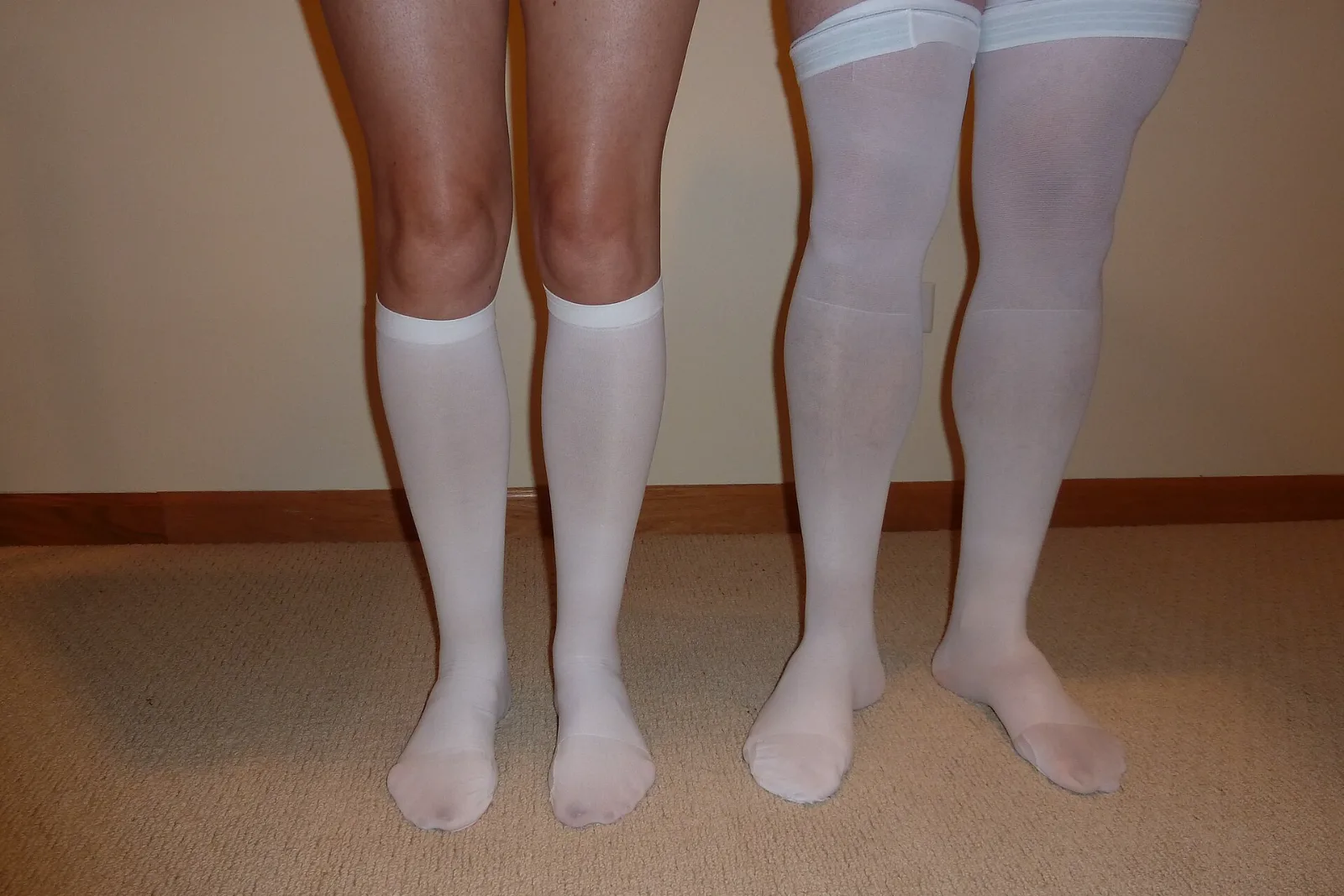
What the evidence says about length
Limited or conflicting evidence: after surgery, a Cochrane review of three small trials with 496 patients found no significant difference between knee-length and thigh-length stockings in preventing deep vein clots, but the authors say there is not enough high-quality evidence to tell whether the two differ. Its searches ended in 2012. The authors expect the choice in practice to rest on how well people keep them on, ease of use and cost.
Limited or conflicting evidence: after a deep vein clot, the one trial comparing lengths in another Cochrane review, with 267 people, found thigh-length stockings no better than knee-length at preventing post-thrombotic syndrome.
Useful in selected circumstances: Mayo Clinic says that thigh-high or waist-high stockings help reduce pooling of blood in the legs and help prevent lightheadedness or falling when you stand up.
Cleveland Clinic puts the practical rule this way: knee-high stockings are the most common type, and if swelling extends above the knee you may need longer stockings or tights that come up to the waist.
Who needs thigh high compression socks
- Swelling above the knee. If the thigh swells as well as the ankle, a knee-high stops where the problem continues. Find the cause first.
- Lymphedema involving the thigh. The NHS lists stockings and tights among lymphedema garments and says you will be taught to put them on correctly. Lymphedema treatment goes further.
- After a vein procedure, if your team asks. Whether you need compression at all, and for how long, is your treating team’s call. In England, NICE advises that any compression after varicose vein treatment (heat ablation, foam sclerotherapy or surgery) be used for no more than 7 days, and the NHS says you may need stockings for about a week. Follow your own team’s instructions. Vein procedures.
- Lightheadedness when you stand up. This is a clinician’s decision, sometimes with waist-high stockings rather than thigh-highs.
- Varicose veins in the thigh. An NHS leaflet notes that the length you are given depends on your condition and prescription. Ask whether thigh length is worth the extra effort for you; compression for varicose veins covers the rest.
The common reasons people buy compression, such as aching legs, ankle swelling and life after a clot, are usually knee-high territory.
Measuring for a thigh-high
- Measure first thing in the morning, when your legs are least swollen; Truform and Mayo Clinic both advise this, and Truform adds measuring against bare skin.
- Ankle and calf as for a knee-high: the ankle at its narrowest, just above the ankle bone, and the calf at its widest.
- Thigh at the point the chart names. JOBST, for example, measures the fullest part of the thigh.
- Length to the point the chart names. JOBST measures from the floor to the fold under the buttock; Truform measures to mid-thigh. The same leg gives two different numbers.
- Measure both legs and write every number down.
- Match all four to one size on that product’s chart. If your thigh falls outside the size your ankle and calf need, try another maker, a waist-high style or a made-to-measure garment.
| Product | Sizes | Thigh range across sizes | Lengths |
|---|---|---|---|
| JOBST Relief thigh-high | Small to X-large | 40–81 cm (15¾–32 in) | Petite (under 27 in) or regular, floor to buttock fold |
| mediven plus thigh, silicone top band | I to VII | 16½–29 in | Petite 23–28 in or standard 28–34 in |
| Truform medical thigh-high | Small to 2X-large | Up to 20 in (small) to up to 32 in (2X-large) | One per size, 22–33 in to mid-thigh |
| Therafirm 15–20 mmHg thigh-high | Small to 2X-large | 15–23 in | One per size, 23–36 in |
SIGVARIS shows its ranges in a size-guide tool that we could not read, so check it on the product page before ordering.
Keeping the top band up, and comfortable
A thigh-high has to hold onto the thigh all day. One NHS hospital’s guidance is that thigh-length stockings may need a suspender belt or silicone backing to stay in place, and that you should never roll the top over, because that increases the compression and could cause circulation problems.
| Option | How it holds | Worth considering if | Watch for |
|---|---|---|---|
| Silicone dot or beaded band | Silicone inside the top grips the skin | You have no problem with silicone; most thigh-highs here use it | Creams, lotion and hair build up on the band; JOBST advises hand-washing it |
| Softer or lace silicone band | Silicone in a lace or woven band; JOBST says its Sensitive band is woven into the fabric rather than coated on | A standard band leaves red, irritated skin | It is still silicone |
| Waist attachment | A strap to the waist holds the stocking up | Silicone does not suit you, or bands keep slipping | One more piece to put on; often open toe only |
| Skin adhesive | A clear adhesive holds the top to the skin | A stocking without a grip band needs holding, or a band needs help | Any new skin reaction |
| Waist-high (pantyhose) style | Fabric runs to the waist | Both legs need compression, or swelling reaches the hips | More steps to put on |
Slipping can be a fit problem as well as a band problem: the wrong length or size, or a stocking that has stretched out, which Mayo Clinic says is a reason to replace it. Mayo also advises making sure your skin is dry, especially after applying lotion, and an NHS leaflet suggests moisturizing in the evening after you take the stockings off.
Cleveland Clinic lists skin irritation among the problems people have with compression. One NHS hospital leaflet says red marks should fade once the stockings are off; if they do not, stop wearing them and ask for a review. A blister, rash or other skin reaction is also a reason to take them off and get the fit checked.
Thigh-high options by need
These are examples of each type, not a ranking. Sizes, strengths and features come from each maker’s own page or size chart in October 2026, not from our measurements.
A plain medical thigh-high in three strengths
JOBST Relief thigh-high with silicone dot band, 15–20, 20–30 or 30–40 mmHg. JOBST’s unisex medical stocking with a reinforced heel and toe, in beige or black, open or closed toe, petite or regular length, sizes small to X-large. See it on Amazon
May suit: anyone advised to wear thigh length who wants the conventional version. Limits: four sizes and no full-calf thigh-high, so a large calf with a slimmer thigh may not fit, and the dot band is the only top.
A wider range of sizes
mediven plus thigh with silicone top band, 20–30, 30–40 or 40–50 mmHg. medi’s strong, opaque stocking for moderate to severe venous disease, in seven sizes, standard or petite length, open or closed toe, beige only. A version with a waist attachment is made with an open toe. See it on Amazon
Truform medical thigh-high with silicone dot top, 15–20 (8878, beige only), 20–30 (8868) or 30–40 mmHg (8848). Latex-free, with a knit-in heel and a closed toe box that applies no compression to the toes; Truform lists an open-toe version on its own page. The 2X-large takes calves of 21½ to 24 inches and thighs up to 32 inches. See it on Amazon
May suit: legs outside four-size charts, including large calves. Limits: mediven plus starts at 20–30 mmHg, and Truform’s 2X-large expects an ankle of 12½ to 13½ inches. Our wide-calf guide covers knee-highs for large calves.
Lighter compression
Therafirm Unisex Mild Support Thigh High Stockings with Silicone Dot Band, 15–20 mmHg. Made in the USA, with a closed, reinforced toe and heel; Therafirm says the band means no garter belt is needed. Sizes small to 2X-large. Hand wash and lay flat to dry. See it on Amazon
May suit: people told that a lighter thigh-length stocking is enough. Limits: the largest size stops at a 23-inch thigh.
Opaque, with petite and plus lengths
SIGVARIS Essential Opaque Thigh-High with Grip-Top, 20–30 or 30–40 mmHg. Formerly Select Comfort; non-latex nylon and spandex; open or closed toe; small to X-large in short, long and petite lengths, with a “long plus” option. SIGVARIS lists it for several kinds of edema, including early lymphedema, and for use after vein treatment. See it on Amazon
May suit: people who want an opaque look in sizes outside the standard lengths. Limits: no 15–20 mmHg version.
If a silicone band does not suit you
SIGVARIS Essential Opaque Thigh with Waist Attachment, 20–30 or 30–40 mmHg. The same stocking held up from the waist instead of by a grip-top; open toe only, small to large, short or long. See it on Amazon
medi it stays, skin adhesive. A clear, 2-ounce adhesive that medi says holds knee-high and thigh-high stockings and arm sleeves in place, and describes as odorless, hypoallergenic and easy to wash away. See it on the maker’s site
May suit: skin that reacts to silicone, or a band that slips despite the right size. Limits: neither fixes a stocking that is too big, and a new skin reaction means stop and ask. JOBST’s Opaque and UltraSheer thigh-highs also come with its Sensitive band.
Compression pantyhose
JOBST Relief waist-high, 15–20, 20–30 or 30–40 mmHg. The unisex Relief stocking in a pantyhose style, beige or black, open or closed toe, regular or petite, small to X-large for hips of 28 to 65 inches across the range. You measure ankle, thigh and hip. See it on Amazon
May suit: swelling of both legs that reaches the thighs, or thigh-highs that will not stay up. Limits: more steps to put on: JOBST’s instructions are to work it up to mid-thigh, stand, then pull it to the waist. In pregnancy, see compression socks in pregnancy.
Downsides and limits
- More effort every morning. There is more fabric to work up the leg, and a stocking that stays in the drawer does nothing.
- Bands mark and slip. Expect to manage the top band, and never fold it over.
- Replacement. An NHS leaflet says to replace stockings every three to six months; Mayo Clinic adds sooner if they bunch up, wrinkle, slide down or stretch out.
- Thin evidence on length. The trials comparing lengths are few and small, and they measured clots and post-thrombotic syndrome, not everyday swelling.
Alternatives, including not buying
- Knee-high compression. If no one has asked you to wear thigh length, start here: it is the most common type and easier to put on.
- Wraps. An NHS leaflet describes compression wraps as a calf piece alone or combined with foot or thigh wraps, and Cleveland Clinic notes that Velcro wraps may be easier to apply for people who have difficulty putting on socks. Your nurse or doctor advises whether they suit you. Lymphedema products covers them.
- Donning help. MedlinePlus suggests rubber dishwashing gloves to help adjust and smooth the stockings, and a stocking donner to slide the stocking over your foot. Zipper socks and donning aids covers the options.
- Coverage. If you have lymphedema, Medicare Part B may cover standard and custom-fitted garments and wraps your clinician orders; after the deductible you pay 20% of the Medicare-approved amount.
Questions to ask your clinician
- Have my arteries been checked, and is compression safe for me?
- Do I need thigh length, or would knee-high do the same job?
- What strength, and for how long each day, or after my procedure?
- Should I be measured for a made-to-measure garment?
Common questions
Are thigh high compression socks better than knee high?
Not usually. Knee-highs are the most common type and are easier to wear, and the small trials comparing lengths for clot prevention after surgery and for post-thrombotic syndrome found no clear advantage for thigh length. Thigh high compression socks are for swelling or problems above the knee, or when a clinician asks for them.
When should you wear thigh high compression stockings?
When swelling reaches above the knee, for some lymphedema, after a vein procedure if your team asks, or for lightheadedness on standing if a clinician recommends it. Have your arteries checked first if you have diabetes, artery symptoms, numbness, a wound, kidney disease or heart failure.
How do you keep thigh high compression stockings from rolling down?
Start with the right size and length, measured in the morning. Keep lotion and hair off the silicone band and wash the band, never fold the top over, and replace stockings that have stretched. If a band still slips or irritates, try a waist attachment, a skin adhesive or a pantyhose style.
How do you measure for thigh high compression stockings?
First thing in the morning, on bare skin: the ankle at its narrowest, the calf at its widest, the thigh and the leg length at the points that maker’s chart names. JOBST measures length to the fold under the buttock and Truform to mid-thigh.
How long do you wear compression stockings after vein surgery?
As long as your treating team says, and some people are not asked to wear any. In England, NICE advises that any compression after varicose vein treatment last no more than 7 days, and the NHS says you may need stockings for about a week. Get new one-sided calf pain or swelling seen today.
Can you sleep in thigh high compression stockings?
Usually not. An NHS vascular leaflet says compression should be worn during waking hours, and standard stockings come off at bedtime unless you were told otherwise. Sleeping in compression socks explains the exceptions.
Where to go next
Sources
- Cleveland Clinic. Compression Therapy: Types and Benefits.
- Mayo Clinic News Network. Mayo Clinic Q and A: Tips for using compression stockings.
- Cochrane. Knee length versus thigh length graduated compression stockings for prevention of deep vein thrombosis in postoperative surgical patients.
- Cochrane. Compression therapy for prevention of post-thrombotic syndrome.
- National Institute for Health and Care Excellence. Varicose veins: diagnosis and management (CG168), recommendations.
- NHS. Varicose veins.
- NHS. Venous leg ulcer – diagnosis.
- NHS. Lymphoedema – treatment.
- Centers for Disease Control and Prevention. About Venous Thromboembolism (Blood Clots).
- Society for Vascular Surgery. Acute Limb Ischemia.
- East Sussex Healthcare NHS Trust. Guidelines for the use of compression hosiery/stockings.
- University Hospitals Birmingham NHS Foundation Trust. Compression Stockings and Wraps: Patient Information Leaflet.
- MedlinePlus. Compression stockings.
- Medicare.gov. Lymphedema compression treatment items.
- JOBST (manufacturer information). JOBST Relief, JOBST Opaque and 2026–2027 compression catalog (sizing charts).
- medi USA (manufacturer information). mediven plus thigh, mediven plus sizing chart and medi it stays.
- Truform (manufacturer information). Thigh High Closed Toe Stockings / Unisex.
- Therafirm (manufacturer information). Unisex Mild Support Thigh High Stockings with Silicone Dot Band.
- SIGVARIS (manufacturer information). Essential Opaque Thigh-High and Opaque Thigh w/Waist Attachment.
Written by Tom Biernacki, DPM, FACFAS. Published 18 October 2026. Research-based comparison; product details and retailer links checked 18 October 2026. General education, not medical advice.