The best compression garment is the one you actually wear every day. Fit and getting it on are not conveniences — they are the whole difference between a drawer full of expensive socks and a leg that improves.
First, the assessment
This page assumes a clinician has checked your arterial circulation and told you that compression is appropriate, and at roughly what strength. If that has not happened, start there instead. Compression safety →
What the pressure numbers mean
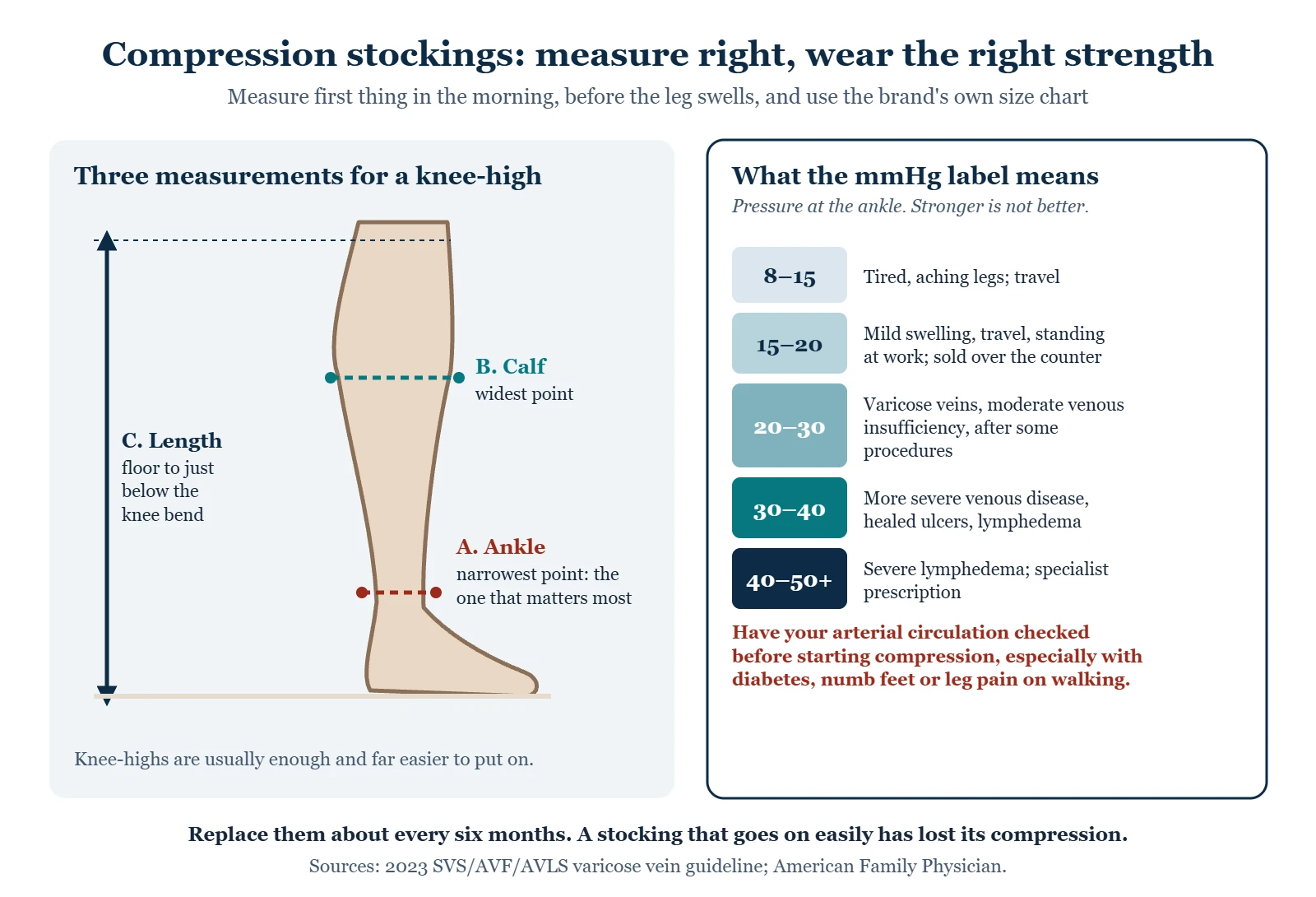
Compression is labeled in millimeters of mercury (mmHg), as a range — the pressure at the ankle. “Graduated” means the pressure is highest at the ankle and decreases up the leg, which is what encourages flow upward.
| Range | Commonly used for |
|---|---|
| 8–15 mmHg | Mild tired, aching legs; travel; no medical indication |
| 15–20 mmHg | Mild swelling, travel, occupational standing; widely sold over the counter |
| 20–30 mmHg | Varicose veins, moderate venous insufficiency, after some procedures, post-thrombotic symptoms |
| 30–40 mmHg | More severe venous disease, healed ulcers, lymphedema |
| 40–50 mmHg and above | Severe lymphedema and specific situations; specialist prescription |
Clinical guidelines group these more simply: the 2023 US varicose vein guideline describes class 1 as under 20 mmHg, class 2 as 20 to 30 and class 3 as over 30. For a healing or healed venous ulcer, American Family Physician guidance advises at least 20 to 30 mmHg, and preferably 30 to 40.
Stronger is not better. It is a different prescription, and the wrong one can be uncomfortable enough that you stop wearing it — or harmful if your arterial supply is limited. Wear the strength you were told.
Getting the size right
- Measure in the morning, before the leg swells. Afternoon measurements produce garments that are too big by the next morning.
- Ankle circumference at the narrowest point, just above the ankle bones. This is the measurement that matters most.
- Calf circumference at the widest point.
- Length from the floor to just below the bend of the knee, for knee-highs.
- Thigh measurements as well, for thigh-highs or tights.
- Compare against the specific brand’s chart. Sizes are not interchangeable between manufacturers, and “large” means different things in different catalogs.
Knee-high is usually enough
For most venous problems the pressure that matters is at and just above the ankle, and knee-highs deliver it. They are also far easier to put on, which means they are worn more. Thigh-highs and tights have their uses but are not automatically better, and a thigh-high that rolls down becomes a tourniquet at the point it stops.
Getting them on
- First thing in the morning, before the leg swells and while you are still lying down or just up.
- Dry skin, dry sock. Moisturizer goes on at night, not just before.
- Turn the sock inside out to the heel, slide the foot in, position the heel, then roll the rest up the leg rather than pulling it.
- Rubber gloves make an enormous difference to grip, and stop fingernails snagging the fabric.
- Smooth out every wrinkle. A fold creates a band of much higher pressure in one line, which is how skin damage happens.
- Do not fold or roll the top band down. Same problem.
- Donning aids — frames, slippery sleeves, gadgets — exist for exactly this, and they are the difference between wearing them and not for many people with limited reach, grip or balance.
Looking after them
Wash after each wearing; body oils and skin cells degrade the elastic. Warm water, mild detergent, no fabric softener or bleach. Air dry, not on a radiator. Replace them about every six months, as American Family Physician guidance advises, and sooner if they go on easily — a sock that is easy to put on has lost its compression, which is the most common reason people find compression has “stopped working”.
Two pairs in rotation makes daily wear realistic and lets one dry.
From the clinic
The fitting mistake I see most often starts with an afternoon measurement: a swollen calf, a garment ordered a size up, and by the next morning it bunches and wrinkles at the ankle, which is exactly where the pressure is supposed to be. Measure first thing, ideally before you have been on your feet, and bring those numbers to whoever is fitting you.
Common questions
How long do I wear them each day?
Typically on in the morning and off at bedtime. Lying down removes most of the venous pressure they are countering, so overnight wear is usually unnecessary unless you were specifically told otherwise.
They leave marks on my skin. Is that a problem?
Light indentation from the top band that fades within an hour is normal. Deep grooves, marks that persist, blisters or any break in the skin are not — stop wearing them and get the fit checked.
I cannot get them on. What are my options?
Rubber gloves first, then a donning aid, then a lower-pressure garment or an adjustable wrap with hook-and-loop fastening — which many people find far easier and which can be adjusted as swelling changes. A garment you can manage at 20 mmHg beats one you cannot manage at 30.
Can I buy them without a prescription?
Lighter grades are widely sold over the counter, while the tightest stockings need a prescription. Availability is not the same as suitability — the assessment and the sizing are what make them work, and neither happens at a checkout.
Why do mine roll down?
Usually the wrong length or the wrong calf size, sometimes a garment that has lost its elasticity. A rolled band concentrates pressure into a narrow line, which is worse than not wearing them, so it is worth solving rather than tolerating.
Does my insurance require three months of stockings before a vein procedure?
Many insurers do, but the 2023 guideline from the Society for Vascular Surgery, the American Venous Forum and the American Vein and Lymphatic Society suggests against making a compression trial a condition of treating symptomatic reflux, noting the lack of evidence behind the rule. Your plan’s rules still apply, so ask the clinic how they handle it. Venous insufficiency treatment →
Where to go next
- Lipodermatosclerosis: compression when the skin is hard and sore
- Choosing compression socks: strength, fit and options
- TED hose vs. compression stockings
- Compression socks for flying
- Compression safety
- Why compression helps venous disease
- Compression in lymphedema
- Zipper and open-toe compression socks, and donning aids
- Wide-calf and plus-size compression socks
- Thigh-high compression socks and stockings
Sources
- NHS. Leg ulcer — treatment.
- NHS. Lymphoedema — treatment.
- Society for Vascular Surgery. Chronic Venous Insufficiency.
- Society for Vascular Surgery, American Venous Forum and American Vein and Lymphatic Society. 2023 clinical practice guidelines for varicose veins of the lower extremities, part II.
- American Family Physician. Venous ulcers: diagnosis and treatment (2019).
- Cleveland Clinic. Chronic venous insufficiency (CVI).
- StatPearls. Venous insufficiency.
Written by Tom Biernacki, DPM, FACFAS. Published 20 September 2026. Updated 15 October 2026. General education, not medical advice. Wear the strength your clinician specified.