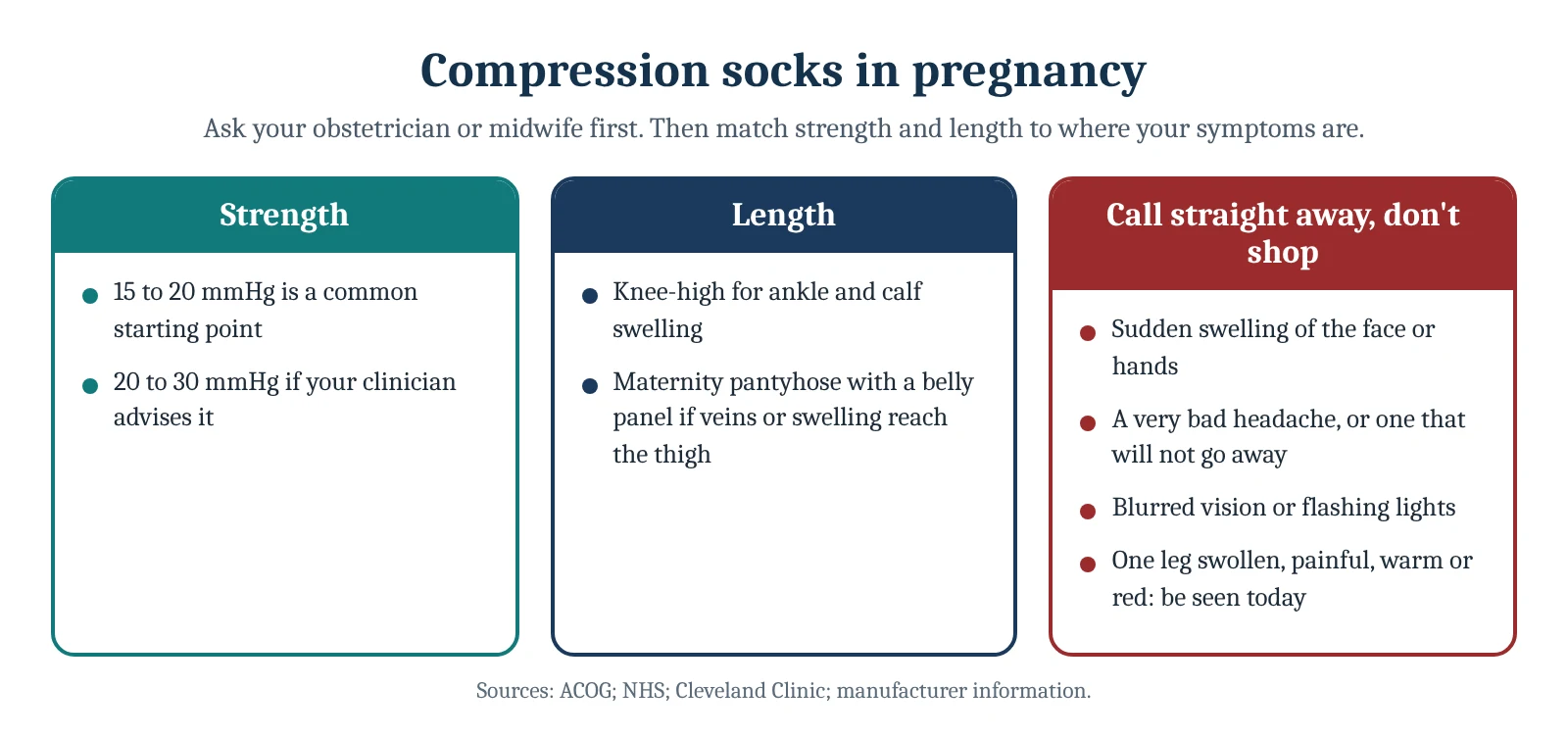
Compression socks for pregnancy may ease swollen, aching legs and varicose veins if your arteries are healthy and your obstetrician or midwife agrees, and NHS advice suggests them for journeys of more than about four hours, although the one small trial of stockings for swollen legs found no significant difference from resting. A common starting point is 15–20 mmHg knee-highs, or maternity pantyhose if veins or swelling reach above the knee. Sudden swelling of the face or hands, or one painful swollen leg, needs a call to your care team, not socks.
Swelling that needs a call, not compression
- Call 911 for a seizure, or for sudden trouble breathing, chest pain, a fast or irregular heartbeat, coughing up blood, or fainting. A blood clot in the lungs is one possible cause of the breathing and chest signs, and the CDC says clot risk stays raised for three months after delivery.
- Call your obstetrician, midwife or labor and delivery unit straight away for a sudden increase in swelling of the face, hands or feet, a very bad headache or one that will not go away, blurred vision or flashing lights, severe pain just below the ribs, or nausea and vomiting. These can be signs of preeclampsia, which usually starts after 20 weeks and can also appear after the birth, most often within 48 hours but up to six weeks later.
- Be seen today if one leg becomes swollen, painful, warm or red, in pregnancy or after the birth. More on DVT.
How this guide was made, and how the site is paid. This is a research-based comparison of maternity compression socks, stockings and pantyhose, built from manufacturers’ published specifications and public guidance; we have not tested these products hands-on. Some links go to Amazon. As an Amazon Associate I earn from qualifying purchases. Commissions do not change which products are listed or what we say about them, and no manufacturer provided products, samples or payment for this guide. Our methodology · Disclosure
Why legs swell and veins appear in pregnancy
Your body holds more water in pregnancy, and the extra fluid collects in the lowest parts of the body; the pressure of the growing womb can also affect blood flow in the legs. The NHS notes that swelling tends to be worse at the end of the day, later in pregnancy, in hot weather and after a lot of standing.
Veins change too. The Office on Women’s Health explains that blood volume rises and the uterus presses on veins, so varicose veins can appear in the legs and also around the vagina and buttocks. For some women they shrink or disappear after the birth; for others they stay, and more can appear with each pregnancy.
What is normal, and when swelling is a warning, is covered in swollen feet in pregnancy.
What compression can and cannot do in pregnancy
Using the evidence labels from our methodology:
| Use | Evidence label | What it means |
|---|---|---|
| Easing swollen, aching legs or varicose veins | Limited or conflicting evidence | A Cochrane review concluded there is not enough evidence on treatments for varicose veins and leg swelling in pregnancy: seven small trials, 326 women. The only trial of stockings, in 35 women, found no significant difference in lower-leg volume compared with resting. Cleveland Clinic still calls low-compression stockings possibly a good choice in pregnancy. |
| Flights and drives of more than about four hours | Useful in selected circumstances | NHS pregnancy advice suggests graduated compression or support stockings, and the CDC lists pregnancy and the postpartum period among risk factors for travel clots. See compression socks for flying. |
| Lowering clot risk for women at higher risk | Useful in selected circumstances | The Royal College of Obstetricians and Gynaecologists lists graduated compression stockings among ways to lower the risk; some women are also advised blood-thinning injections. Your maternity team decides. |
| In hospital after a cesarean, when you will be much less mobile for days | Useful in selected circumstances | For women likely to be much less mobile for three or more days after surgery, including a cesarean, NICE says to consider injections plus mechanical prevention: inflatable leg sleeves first, or anti-embolism stockings if those cannot be used. These are a different product: TED hose vs. compression stockings. |
The honest reading
The only trial of stockings for swollen legs was small and found no significant difference from resting. If your arteries are healthy, your obstetrician or midwife agrees and your legs feel better in them, they are a reasonable comfort measure, not a treatment, and never a reason to ignore swelling that changes suddenly.
Are compression socks safe during pregnancy? Who should ask first
ACOG’s travel advice says to talk with your ob-gyn before trying compression stockings: some people should not wear them (for example, with diabetes or other circulation problems), and stockings that are too tight or worn incorrectly can raise DVT risk. The cautions are the ones that apply to anyone, plus a few of pregnancy’s own:
- Diabetes, leg pain when you walk, numb feet, a foot or leg wound, kidney disease or heart failure. Have your arterial circulation checked first, usually with an ankle-brachial index, which compares blood pressure at the ankle and arm. The NHS is plain that compression is not safe when the artery pressures at the ankle are low. Who needs an assessment first.
- A previous clot, a clotting disorder, or a clot risk your team has called high. Ask before relying on socks. The CDC notes that women at high risk may be prescribed heparin injections during and after pregnancy.
- A heart condition. The Office on Women’s Health warns that stronger stockings can be unsafe for some people with certain heart conditions.
- Infected, broken or inflamed skin on the legs. Makers such as Therafirm list skin infections and acute dermatitis among reasons not to wear compression.
- Any of the warning signs at the top of this page. Get assessed first.
Strength and length
Strength. For swelling and aching, 15–20 mmHg is a common starting point; Truform’s own chart lists minor varicose veins in pregnancy at 15–20 mmHg and moderate ones at 20–30 mmHg, marked “prescription recommended”. Cleveland Clinic classes 20 mmHg and above as prescription strength, so choose 20–30 mmHg with your obstetrician or midwife, usually for varicose veins they have looked at.
Length. Cleveland Clinic suggests longer stockings or waist-high tights when swelling extends above the knee; in pregnancy, that means thigh-highs or maternity pantyhose with a belly panel.
| Style | Good for | Watch for |
|---|---|---|
| Knee-high | Ankle and calf swelling; no waistband; easiest to put on as the bump grows | Does nothing for veins above the knee |
| Thigh-high | Veins above the knee without covering the belly | A band that rolls down becomes a tight line; refit rather than fold it |
| Maternity pantyhose | Veins or swelling that reach the thigh | Hardest to put on; the size must fit your legs, hips and stage of pregnancy |
Wearing them through pregnancy
- Start when you need them. None of the sources listed below sets a week to begin. Swelling tends to build later in pregnancy, so start when your ankles swell, your legs ache or veins appear, or before a long journey.
- Measure in the morning, and again as you grow. Mayo Clinic advises measuring when legs are least swollen, usually early morning; Truform sizes its maternity pantyhose from ankle, thigh and hip. Re-measure if a pair starts to dig in or slide.
- Put them on before you get up, as MedlinePlus advises, and take them off at bedtime unless you were told otherwise. Mayo Clinic notes that some people are prescribed day-and-night wear; see sleeping in compression socks.
- Wash and rotate. MedlinePlus advises washing them each day, keeping two pairs and replacing them every three to six months.
- Get help with your feet. Late in pregnancy, a donning aid or another pair of hands may make daily wear possible; see zipper socks and donning aids.
Compression socks for pregnancy: options by need
These are examples of each type, not a ranking. Each comes from a maker whose own product page states the pressure in mmHg; sizes, colors and strengths are what those pages listed in October 2026.
Maternity pantyhose in colors, with knee-highs in the same line
JOBST Maternity Opaque, 15–20 mmHg. A waist-high maternity panty with an elastic “Soft-Flex Zone” that JOBST says adapts to the growing belly. The line also comes as knee-highs and thigh-highs, in 15–20 or 20–30 mmHg, closed or open toe, sizes small to extra-large, in navy, caramel, black, cranberry or anthracite. Pantyhose: See it on Amazon. Knee-high: See it on Amazon.
May suit: veins or swelling above the knee, or a matching knee-high for ankle swelling. Limits: the Flex Zone belongs to the pantyhose only, and JOBST does not say how far it expands or whether it is adjustable.
A belly panel that folds under the bump or over it
Preggers by Therafirm Mild Support Opaque Maternity Pantyhose, 15–20 mmHg. Therafirm says the belly panel fits all stages of pregnancy and can be folded under the bump or worn over it. Reinforced, rounded toe; small to large, each short or long; black or sand; made in the USA. The Preggers range also has sheer pantyhose, tights and 20–30 mmHg versions. See it on Amazon
May suit: one pair through changing stages of pregnancy. Limits: three sizes, closed toe only, and hand wash and lay flat to dry.
Sheer, for the second and third trimesters
Truform 1777 Ladies’ Sheer Maternity Pantyhose, 15–20 mmHg. A latex-free, sheer pantyhose with a tummy panel Truform designs for the second and third trimesters, a reinforced heel pocket and a roomy toe box that puts no compression on the toes, in beige or black. Sized from ankle, thigh and hip measurements. See it on Amazon
May suit: work and dressier clothes. Limits: one strength, two colors, and a tummy panel described for the second and third trimesters only.
Firmer support, when it has been advised
SIGVARIS Sheer Maternity Pantyhose, 20–30 mmHg. Non-latex sheer pantyhose (65% nylon, 35% spandex) with a cotton-lined gusset and a closed toe, small to large, each in short or long, in honey or black. SIGVARIS lists early chronic venous disease and use before and after vein treatment among its uses. See it on Amazon
May suit: varicose veins for which a clinician has advised 20–30 mmHg. Limits: listed only at 20–30 mmHg, and the maker’s page does not describe the belly panel.
Knee-high socks, if you would rather wear socks
Bombas Women’s Everyday Compression Knee High, 15–20 mmHg. A midweight, cushioned sock with graduated compression, sold singly or in packs, in three sizes chosen by shoe size. See it on Amazon
May suit: ankle and calf swelling, and anyone who finds pantyhose too much late in pregnancy. Limits: knee-highs do not reach veins above the knee, Bombas’s product page does not mention pregnancy, and it sizes by shoe size and gives no calf measurements for this sock, so if your calves are large or swelling, use a size chart that includes calf measurements.
For everyday styles outside pregnancy, see compression socks for women.
After the birth
Clot risk does not end with delivery. The CDC says it stays raised for three months afterward, and the RCOG says it is highest just after the birth.
- If the hospital gave you stockings, for example after a cesarean, they are anti-embolism stockings. NICE guidance continues them until you are no longer much less mobile than usual or you leave hospital; follow what your team told you.
- For swelling or veins at home, ask your care team first. 15–20 mmHg knee-highs or ordinary compression pantyhose are common choices; the belly panel is no longer needed, and knee-highs keep a waistband off a healing incision.
- Keep watching for warning signs. Preeclampsia can begin after the birth, and the CDC lists severe swelling, redness or pain in a leg among its urgent maternal warning signs. Swollen feet after birth covers what is expected.
Downsides and limits
- Thin evidence. Cochrane found only one small trial of stockings for pregnancy swelling.
- Harder to manage as you grow. Pantyhose in particular take more bending and pulling late in pregnancy, and a pair that fit earlier may not fit later.
- Side effects. Cleveland Clinic lists skin irritation, discomfort, skin infection and swelling of the foot and toes as the usual problems, with nerve or soft-tissue damage rare. Take them off and get advice if your toes tingle, go numb or change color, or the skin blisters or breaks.
Alternatives, including not buying
For ordinary pregnancy swelling, the NHS’s first advice costs nothing:
- Avoid standing for long periods, and take regular walks.
- Do foot exercises: flex your feet up and down and rotate them.
- Rest with your feet up when you can. If raising your legs brings on foot pain, or lying flat makes you breathless, stop and tell your care team.
- Wear comfortable shoes and socks, and avoid tight straps or anything that pinches.
Cochrane found water immersion and reflexology promising, but the data were too few to judge. More ideas are in how to reduce swelling.
Questions to ask your obstetrician or midwife
- Is my swelling the expected kind, and is my blood pressure normal?
- Would compression help me, and in what strength and length?
- Is my clot risk raised now or after the birth, and do I need anything besides stockings?
- If I have diabetes or numb feet, should my leg circulation be checked first?
Common questions
Are compression socks safe during pregnancy?
They are commonly suggested, but ask your obstetrician or midwife first: ACOG warns that stockings that are too tight or worn incorrectly can raise the risk of DVT. If you have diabetes, numb feet, leg pain on walking, a wound, kidney disease or heart failure, have your arteries checked first.
When should I start wearing compression socks when pregnant?
None of the sources listed below sets a week. Start when your ankles swell, your legs ache or veins appear, or before a journey of more than about four hours. Swelling tends to build later in pregnancy, and Truform designs its maternity pantyhose for the second and third trimesters.
What are the best compression socks for pregnancy?
The best compression socks for pregnancy match where your symptoms are: 15–20 mmHg knee-highs for ankle and calf swelling, maternity pantyhose with a belly panel if veins or swelling reach the thigh, and 20–30 mmHg only when your obstetrician or midwife advises it. Size them from your own measurements, and re-measure as you grow.
Do compression socks help swollen feet during pregnancy?
They may make your legs feel better, but a Cochrane review found only seven small trials of any treatment, and the one trial of stockings, in 35 women, found no significant difference from resting. Moving, foot exercises and rest with your feet up are the NHS’s first steps. Sudden swelling of the face, hands or feet needs a call straight away, not socks.
Should I wear compression socks after giving birth?
If the hospital gave you stockings, wear them for as long as your team said. For swelling or vein symptoms at home, ask your care team first; 15–20 mmHg knee-highs are a common low-compression choice. The CDC says clot risk stays raised for three months after delivery, so one swollen, painful leg still needs to be seen today.
Can I sleep in compression socks while pregnant?
Daytime compression socks are usually taken off at bedtime unless your clinician says otherwise; some people are prescribed day-and-night wear. If you sleep in them by accident, check your skin for deep marks or color changes in the morning.
Where to go next
Sources
- NHS. Swollen ankles, feet and fingers in pregnancy.
- NHS. Travelling in pregnancy.
- Cochrane. Interventions for varicose veins and leg oedema in pregnancy (plain language summary and abstract, 2015).
- Royal College of Obstetricians and Gynaecologists. Reducing the risk of venous thrombosis in pregnancy and after birth.
- American College of Obstetricians and Gynecologists. Travel During Pregnancy.
- Centers for Disease Control and Prevention. Understanding Your Risk for Blood Clots with Pregnancy.
- Centers for Disease Control and Prevention. Urgent Maternal Warning Signs and Symptoms.
- Centers for Disease Control and Prevention. CDC Yellow Book: Deep Vein Thrombosis and Pulmonary Embolism.
- National Institute for Health and Care Excellence. Venous thromboembolism in over 16s: reducing the risk of hospital-acquired deep vein thrombosis or pulmonary embolism (NG89), recommendations.
- MedlinePlus. Preeclampsia.
- Association of Women’s Health, Obstetric and Neonatal Nurses (AWHONN). Save Your Life: Get Care for These POST-BIRTH Warning Signs (patient handout, hosted by Iowa Health and Human Services).
- MedlinePlus. Compression stockings.
- Cleveland Clinic. Compression Therapy: Types and Benefits.
- Office on Women’s Health, U.S. Department of Health and Human Services. Varicose veins and spider veins.
- Mayo Clinic News Network. Mayo Clinic Q and A: Tips for using compression stockings.
- NHS. Venous leg ulcer – diagnosis.
- NHS. Deep vein thrombosis (DVT).
- National Heart, Lung, and Blood Institute. Heart Failure – Symptoms and Pulmonary Embolism.
- MedlinePlus. Peripheral artery disease – legs.
- JOBST (manufacturer information). JOBST Maternity Opaque.
- Therafirm (manufacturer information, Thuasne store). Preggers Mild Support Opaque Maternity Pantyhose and Preggers range; contraindications as listed on Therafirm product pages.
- Truform (manufacturer information). 1777 Ladies’ Sheer Maternity Pantyhose.
- SIGVARIS (manufacturer information). Sheer Maternity Pantyhose.
- Bombas (manufacturer information). Women’s Everyday Compression Knee High Sock 3-Pack.
Written by Tom Biernacki, DPM, FACFAS. Published 18 October 2026. Research-based comparison; product details and retailer links checked 18 October 2026. General education, not medical advice.