Compression socks for women work exactly like any graduated compression sock: firmest at the ankle, easing toward the knee. What differs is sizing, style and the reasons women wear them, so choose by the mmHg figure and your own ankle and calf measurements rather than the word “women’s”, and have your arteries checked first if you have diabetes, numb feet, leg pain when you walk, a wound, kidney disease or heart failure.
When socks are the wrong answer
- Call 911 for sudden trouble breathing, chest pain, coughing up blood, a racing heart or fainting. These can be signs of a blood clot in the lungs.
- Be seen today if one leg has newly swollen, especially with pain, warmth or redness. A clot is one possible cause, and socks do not treat it. Why one swollen leg is different.
- Pregnant, or gave birth in the last six weeks? Call your obstetric team straight away for a sudden increase in swelling of the face, hands or feet, a very bad headache, or blurred vision or flashing lights. These can be signs of preeclampsia. Call 911 for a seizure. Swelling in pregnancy.
How this guide was made, and how the site is paid. This is a research-based comparison of compression socks, stockings and pantyhose sold for women, built from manufacturers’ published specifications and public guidance; we have not tested these products hands-on. Some links go to Amazon. As an Amazon Associate I earn from qualifying purchases. Commissions do not change which products are listed or what we say about them, and no manufacturer provided products, samples or payment for this guide. Our methodology · Disclosure
What is actually different about compression socks for women
The squeeze is not. A sock sold for women and a unisex sock with the same mmHg rating are labeled for the same pressure at the ankle. Three other things do differ.
- Sizing. Many women’s lines come in short or petite lengths. Medical makers such as Truform size from ankle and calf measurements and leg length. Lifestyle brands often size by shoe size: VIM & VIGR adds a calf range to each size.
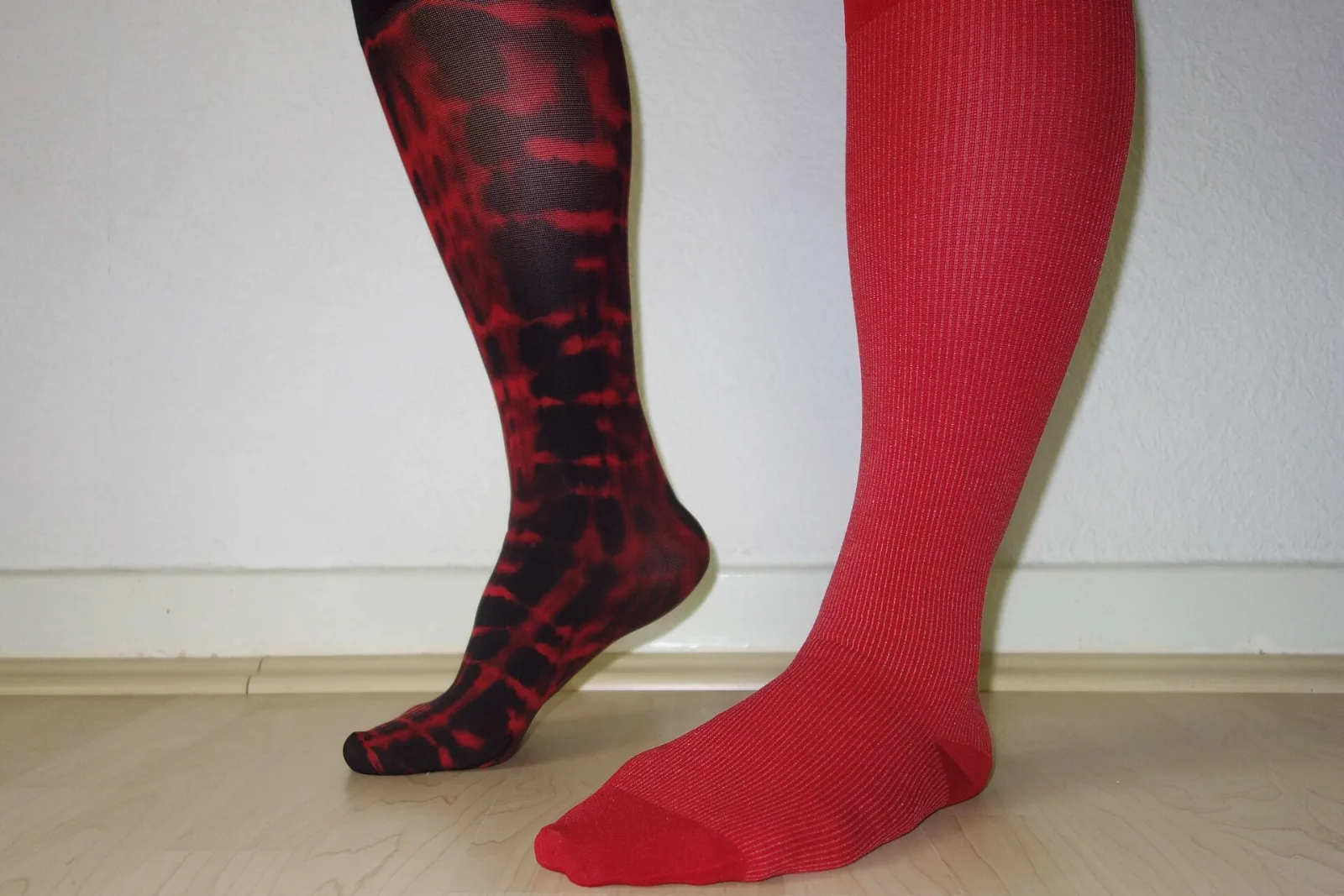
- Style. Sheer and opaque stockings, ribbed trouser socks, patterned casual socks, thigh-highs with lace or silicone bands, and pantyhose. Style matters more than it sounds, because a pair you will not wear does nothing.
- Reasons for wearing them. According to the Office on Women’s Health, varicose veins affect almost twice as many women as men, and spider veins may affect more than half of women. Estrogen may weaken vein valves, pregnancy raises blood volume while the growing uterus presses on veins, and hormonal birth control and menopausal hormone therapy may raise the risk of both kinds of vein.
Two more reasons come up. Cleveland Clinic describes low-compression stockings as possibly a good choice for people who stand or sit for long periods, as on long shifts. And the National Cancer Institute notes that people with vulvar, vaginal, ovarian, endometrial or cervical cancer may develop lymphedema in the leg, genitals or abdomen; a nurse or certified lymphedema therapist helps find compression garments that fit.
Who should get advice before buying
For tired legs, or mild ankle swelling at the end of the day with a known, harmless cause, light compression is sold over the counter, but Cleveland Clinic advises checking with a healthcare provider before buying. Get advice first if any of these apply:
- Diabetes, leg pain when you walk, numb feet, a foot or leg wound, kidney disease or heart failure. Have your arterial circulation checked first, usually with an ankle-brachial index, which compares blood pressure at the ankle and arm. The NHS is plain that compression is not safe when the artery pressures at the ankle are low. Who needs an assessment first.
- A heart condition. The Office on Women’s Health warns that stronger stockings can be unsafe for some people with certain heart conditions.
- Broken, infected or inflamed skin on the legs. Even for its 10–15 mmHg socks, Therafirm lists skin infections and acute dermatitis among its reasons not to wear compression, along with severe arterial insufficiency and uncontrolled congestive heart failure.
- Swelling after treatment for a gynecologic cancer. Read our lymphedema guide before buying anything.
- Pregnancy, or the weeks after birth. The styles, strengths and warning signs are different enough for their own guide: compression socks in pregnancy.
Choosing a strength honestly
Compression is labeled by the pressure at the ankle in millimeters of mercury (mmHg). Makers do not use the same words for the same numbers: Therafirm calls 15–20 mmHg “mild support”, while Truform and Sockwell call it “moderate”. Compare the figures, not the adjectives; a pack with no mmHg figure cannot be compared at all. Our fit and pressure labels page has the full scale. For most women buying their own, it comes down to four bands.
| Pressure | Commonly used for | Buying it |
|---|---|---|
| 8–15 or 10–15 mmHg (light) | Tired, achy legs with no medical diagnosis. The Office on Women’s Health lists support pantyhose as the lowest-pressure option. | Over the counter; the arterial-check rule still applies |
| 15–20 mmHg | Mild swelling, long hours on your feet or in a seat, travel, pregnancy | Over the counter; Cleveland Clinic counts anything under 20 mmHg as low compression |
| 20–30 mmHg | Varicose veins, moderate venous insufficiency, after some vein procedures | Cleveland Clinic classes 20 mmHg and above as prescription strength; many are sold online without one, so get a clinician’s view first |
| 30–40 mmHg and above | More severe venous disease, healed ulcers, lymphedema | Prescribed, measured and fitted |
Stronger is not better. A 15–20 mmHg sock you wear every day does more than a 30–40 mmHg stocking that stays in the drawer, and the wrong strength can harm a leg with poor arterial supply.
What matters when choosing
| Feature | Look for | Why it matters |
|---|---|---|
| Sizing system | A chart that uses your ankle and calf, measured first thing in the morning | Charts do not transfer between brands, and a chart based on shoe size alone cannot allow for a larger or slimmer calf. Mayo Clinic advises measuring when legs are least swollen, usually early morning. |
| Length | Short or petite and long or tall versions | A knee-high should finish about two finger-widths below the bend of the knee, as MedlinePlus describes |
| Coverage | Knee-high for ankle and calf; pantyhose or waist-high when swelling or veins reach above the knee | Cleveland Clinic suggests longer stockings or waist-high tights when swelling extends above the knee |
| Top band | A soft knit band; silicone dots or lace on thigh-highs; a “sensitive” band if silicone bothers your skin | The band should lie flat. One that rolls down usually means the wrong size or length. |
| Fabric and care | Nylon and spandex for sheer and firm knits; cotton or wool blends for casual socks; “latex-free” if you need it | Comfort and care decide whether you keep wearing them. Check the label: some sheer pairs are hand wash only. |
Compression socks for women: options by need
These are examples of each style, not a ranking. Each comes from a maker whose own product page states the pressure in mmHg; sizes, colors and strengths are what those pages listed in October 2026, and not every combination is made.
Sheer compression stockings, for dresses and skirts, or as pantyhose
JOBST UltraSheer, 15–20 mmHg, knee-high or waist-high. A fine, satin-touch sheer stocking, also made in 20–30 and 30–40 mmHg. It comes as knee-highs (including petite and full-calf sizes), thigh-highs with dot, lace or sensitive bands, and waist-high pantyhose, closed or open toe, sizes small to extra-large, in about ten colors and a diamond pattern. Knee-high: See it on Amazon. Pantyhose: See it on Amazon.
May suit: work and special occasions, and the pantyhose if veins or swelling reach above the knee. Limits: sheer knits need gentle care. JOBST advises washing them daily or every other day without wringing, and Mayo Clinic notes that a run or tear usually means a pair needs replacing.
Opaque, for work and cooler months
SIGVARIS Style Soft Opaque calf, 15–20 mmHg. A soft, non-latex microfiber knee-high (79% nylon, 21% spandex), also made in 20–30 and 30–40 mmHg, closed or open toe, in small, medium and large, each in short or long, and seven colors including black, espresso and mulberry. SIGVARIS pitches it for professional and everyday wear. See it on Amazon
May suit: office wear, and anyone who would rather the stocking did not show. Limits: no extra-large size on the maker’s page; for larger calves, see wide-calf compression socks.
Under trousers
Therafirm Women’s Mild Support Ribbed Trouser Socks, 15–20 mmHg. An over-the-calf ribbed sock in a nylon and spandex blend with a soft knit-in band, in khaki, white, black or navy, sizes small to extra-large, made in the USA. Therafirm also sells 10–15 and 20–30 mmHg trouser socks. See it on Amazon
May suit: workdays in trousers, when a sheer stocking would show at the ankle. Limits: closed toe only, hand wash only, and the product page lists no length options.
A pattern, but still dressy
Truform Ladies’ Pattern Sheer Knee High, 15–20 mmHg (1782 dot or 1783 diamond). A latex-free sheer knee-high with a knit-in dot or diamond pattern, a non-compressive soft top band, a reinforced heel and a roomy toe box, in black, espresso, charcoal or nude. Truform sizes it from ankle and calf measurements and leg length, taken soon after waking. See it on Amazon
May suit: first-time wearers, whom Truform names among its usual users, and anyone who wants a little texture. Limits: one strength only, and closed toe only.
Cute, casual patterns, with calf-based sizing
VIM & VIGR Rugby Stripe cotton compression socks, 15–20 mmHg. A striped knee-high in a latex-free blend of 48% cotton, 42% nylon and 10% spandex, also made in 20–30 mmHg. Sizes S/M to L/XL are chosen by shoe size and calf circumference, and wide-calf versions fit calves of 17 to 21 inches. See it on Amazon
May suit: anyone who wants compression that looks like an ordinary sock. Limits: this pattern comes in one colorway, and stock varies by size and strength. If your calf falls between the standard and wide ranges, VIM & VIGR suggests trying the standard size first.
Light support for tired legs
Core-Spun by Therafirm Fashion Light Support Socks, 10–15 mmHg, 2-pack. One black and one patterned knee-high, sold for men and women, latex-free and machine washable, sizes small to 2X-large (the patterned pair to extra-large), made in the USA. See it on Amazon
May suit: tired, achy legs with no diagnosis, or trying compression for the first time. Limits: too light for diagnosed vein disease, and even at this strength the maker lists severe arterial insufficiency and uncontrolled congestive heart failure as reasons not to wear it.
Other needs
Thigh-highs, zipper styles and donning aids have their own guides, linked at the end of this page. For plain medical knee-highs, see our main compression socks guide.
Downsides and limits
- They manage symptoms; they do not remove veins. The Office on Women’s Health says compression helps manage symptoms and may help prevent new veins; removing existing ones takes a procedure. Spider veins explains the options.
- Side effects. Cleveland Clinic lists skin irritation, discomfort, skin infection and swelling of the foot and toes as the usual problems, with nerve or soft-tissue damage rare. Take them off and get advice if your toes tingle, go numb or change color, or the skin reddens, blisters or breaks.
- They wear out. MedlinePlus advises replacing them every three to six months, and Mayo Clinic adds that a pair may need replacing if it begins to bunch up, wrinkle or slide down, or stretches out over time.
- They are not a diagnosis. Swelling that settles with socks still has a cause. The NHS advises seeing a doctor if swelling in both legs has not improved after a few days, is getting worse, or comes with a heart, kidney or vein condition.
Alternatives, including not buying
- Move, and break up long spells. The NHS suggests gentle exercise such as walking, and avoiding long periods of standing or sitting.
- Raise your legs on a chair or pillows when you sit, unless you have advanced artery disease, where raised legs can bring on foot pain, or heart failure that makes you breathless lying flat. Leg elevation.
- Loosen what is tight. The NHS advises avoiding tight clothes, socks and shoes, and choosing wide shoes with a low heel and a soft sole.
- Treat the veins themselves if appearance or symptoms are the real issue, after a clinician has examined your legs.
- Buy nothing if your legs feel fine. A sock marketed to women is not something every woman needs.
Questions to ask your clinician
- Is compression right for what is causing my symptoms, and have the arteries in my legs been checked?
- What strength and length should I wear: knee-high, thigh-high or pantyhose?
- Should I be measured and fitted, and would my plan cover a prescribed pair?
- How many hours a day should I wear them, and should they ever stay on overnight?
Common questions
What are the best compression socks for women?
There is no single best pair. The best compression socks for women are the right strength for your reason for wearing them, sized from your own ankle and calf measurements, in a style you will actually wear: sheer or opaque for work, patterned for casual days, pantyhose if veins or swelling reach above the knee. Look for a stated mmHg figure and the word “graduated”.
What strength compression socks should a woman wear?
For tired legs, 8–15 or 10–15 mmHg. For mild swelling, long days on your feet or travel, 15–20 mmHg is a common starting point. 20–30 mmHg is for diagnosed varicose veins or venous insufficiency, ideally on a clinician’s advice, and 30–40 mmHg is prescribed and fitted. With diabetes, numb feet, leg pain on walking, a wound, kidney disease or heart failure, have your arteries checked before any of them.
What is the difference between compression socks and compression stockings?
Mostly the look. “Socks” usually means a knit like an ordinary sock, often patterned or cushioned; “stockings” usually means sheer or opaque hosiery. Both are graduated compression labeled in mmHg, and a 15–20 mmHg pair of either is rated for the same pressure at the ankle.
Is compression pantyhose better than knee-high socks?
Not for ankle and calf swelling, where knee-highs are the most common choice and easier to put on. Pantyhose make sense when swelling or veins extend above the knee, which is when Cleveland Clinic suggests longer stockings or waist-high tights.
Is it OK to wear compression socks every day?
Yes, if they are the right strength and size and your arteries are healthy. Put them on in the morning, take them off at bedtime unless you were told otherwise, wash them after each wear and replace them every three to six months. Stop and get advice if they leave deep marks, blister or discolor the skin, or your toes tingle or go numb.
Do compression socks help spider veins and varicose veins?
They can ease aching and swelling and may help prevent new veins, but they do not remove the veins you have; that takes a procedure. For varicose veins, 20–30 mmHg is common, ideally after a clinician has examined your legs.
Where to go next
Sources
- Office on Women’s Health, U.S. Department of Health and Human Services. Varicose veins and spider veins.
- Cleveland Clinic. Compression Therapy: Types and Benefits.
- National Cancer Institute. Lymphedema.
- NHS. Venous leg ulcer – diagnosis.
- NHS. Deep vein thrombosis (DVT).
- NHS. Swollen ankles, feet and legs (oedema).
- NHS. Swollen ankles, feet and fingers in pregnancy.
- MedlinePlus. Preeclampsia.
- Association of Women’s Health, Obstetric and Neonatal Nurses (AWHONN). Save Your Life: Get Care for These POST-BIRTH Warning Signs (patient handout, hosted by Iowa Health and Human Services).
- Centers for Disease Control and Prevention. Understanding Your Risk for Blood Clots with Pregnancy.
- MedlinePlus. Compression stockings.
- Mayo Clinic News Network. Mayo Clinic Q and A: Tips for using compression stockings.
- MedlinePlus. Peripheral artery disease – legs.
- National Heart, Lung, and Blood Institute. Heart Failure – Symptoms and Pulmonary Embolism.
- JOBST (manufacturer information). JOBST UltraSheer.
- SIGVARIS (manufacturer information). Style Soft Opaque Calf.
- Therafirm (manufacturer information, Thuasne store). Women’s Mild Support Ribbed Trouser Socks and Core-Spun Fashion Light Support Socks 2 Pack.
- Truform (manufacturer information). Ladies’ Pattern Sheer Knee High.
- VIM & VIGR (manufacturer information). Rugby Stripe Cotton Compression Socks and Sizing, Fabric and Compression Guide.
- Sockwell (manufacturer information). Women’s Circulator Moderate Graduated Compression Socks.
Written by Tom Biernacki, DPM, FACFAS. Published 18 October 2026. Research-based comparison; product details and retailer links checked 18 October 2026. General education, not medical advice.