Swelling is a symptom, not a diagnosis. The same puffy ankle can come from veins, lymphatics, a medication, the heart, the kidneys, the liver, an injury, an infection or a clot — and the pattern of the swelling narrows that list far more than its severity does.
Swelling that needs prompt attention
- One leg swollen and the other not, particularly if it came on over hours to days, or comes with pain, warmth or color change. See someone today.
- Swelling with breathlessness, chest pain, or an inability to lie flat. Call 911 for sudden breathlessness or chest pain.
- Swelling with fever, spreading redness, or a break in the skin.
- Swelling that appeared suddenly with no explanation.
The questions that actually sort it out
| Question | Why it helps |
|---|---|
| One leg, or both? | One leg points toward something local — clot, vein disease on that side, lymphatic obstruction, injury, infection. Both legs points more toward systemic causes or medication. |
| How fast did it come on? | Hours to days raises the urgency considerably. Months usually means a chronic process. |
| Better in the morning? | Venous swelling typically improves overnight. Established lymphedema improves much less. |
| Does it pit? | A dent that stays after pressing suggests fluid that moves freely. Firm, non-pitting swelling suggests longer-standing tissue change — but pitting tells you about the fluid, not the cause. |
| Does it involve the toes? | Swelling that includes the toes and the top of the foot, so the skin there cannot be pinched up, points toward the lymphatic system. |
| What changed recently? | New medicines are a common and easily missed cause. |
The major categories of cause
Venous
Leaky vein valves raise pressure in the lower leg and push fluid into the tissue. Classically both ankles, soft, worse in the evening, better overnight, often with visible veins or brown staining. More on venous disease →
Lymphatic
The lymphatic system drains protein-rich fluid out of tissue. When it is damaged, missing or overwhelmed, that fluid stays. Lymphedema tends to be firmer, involves the foot and toes, responds less to elevation, and has its own assessment and management pathway. More on lymphedema →
Medicines
A number of commonly prescribed drug classes can cause or worsen leg swelling — some blood pressure medicines, some diabetes medicines, steroids, certain hormones and several anti-inflammatories among them. This is worth raising with the prescriber precisely because it is often fixable. It is not a reason to stop a medicine on your own; some of them are doing important work, and stopping abruptly carries its own risks.
Heart, kidney and liver
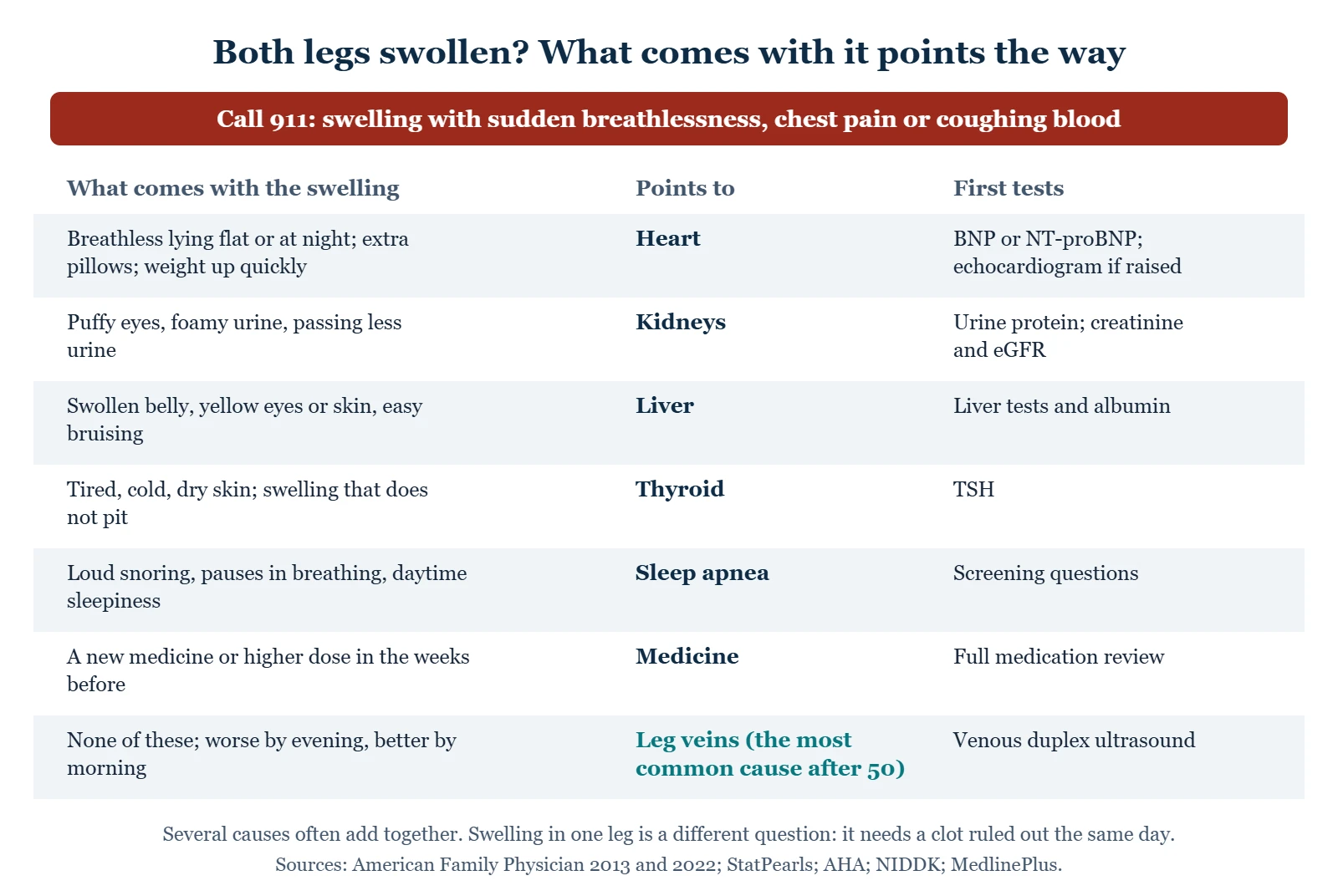
When the heart cannot clear fluid efficiently, when the kidneys retain salt and water, or when the liver cannot maintain blood protein levels, fluid collects in the lowest parts of the body. This swelling is usually in both legs, often creeps upward, and is accompanied by other clues — breathlessness, weight change, or changes in urine.
Local causes
Injury, infection, a ruptured Baker’s cyst behind the knee, a mass pressing on veins or lymphatics, or a clot. These are usually one-sided and often have a story attached.
Other
Prolonged sitting or standing, long flights, pregnancy, heat, and salt intake all shift the balance. Lipedema — a separate condition involving symmetrical fat distribution that typically spares the feet — is frequently mistaken for lymphedema.
Why we will not give you a symptom quiz
A checklist that outputs “you probably have X” would be more satisfying to use and worse for you. The categories above overlap heavily, several can be present at once, and the difference between “wait and watch” and “go today” often comes down to findings a clinician gets by examining the leg. What this site can do is help you describe the pattern accurately when you get there.
Swelling from the knee down
Leg swelling commonly starts at the ankles and may work its way up, because gravity makes the lower legs the easiest place for fluid to collect. So swelling from the knee down is the usual shape of leg swelling rather than a clue in itself: almost every cause above can produce it. What narrows it down is the pattern.
- One calf and shin, newly swollen. Especially over hours to days, or with pain, warmth or redness, a clot or an infection has to be ruled out today. One swollen leg →
- Both lower legs, worse by evening and better by morning. Gravity, leaky leg veins and medicines are common explanations; heart, kidney and liver causes need ruling out if it persists. Swollen ankles and feet →
- Brown staining, itching or thickened skin around the ankles. These point toward venous insufficiency. Stasis dermatitis →
- The foot and toes swollen too. Swelling that includes the toes can point toward the lymphatic system. Early lymphedema is soft and can ease overnight; without treatment it usually becomes more severe and persistent. Lymphedema →
- Swelling that climbs to the thighs or reaches the abdomen can mean the body is holding too much fluid overall. Heart, kidney, liver and thyroid causes →
- Worse in hot weather, especially after a lot of standing or walking. Heat edema →
- Skin that has started to leak clear fluid, or a break in the skin that is not closing, should be seen the same day or the next. Weeping legs →
Raising the legs and compression can ease the swelling in several of these, with two provisos. If you have diabetes, symptoms of artery disease, numb feet, a wound, kidney disease or heart failure, have your arterial circulation checked first, usually with an ankle-brachial index, before starting compression: with narrowed leg arteries compression can cut blood flow further, and in advanced disease raising the leg can make foot pain worse. And if lying back makes you breathless, say so rather than pushing through. Compression safety → How to reduce swelling →
What an assessment usually involves
- The history: which leg, how long, what changed, what medicines, what other conditions.
- Examining both legs — comparing them is often the most informative single step.
- Checking the arterial circulation, because that determines whether compression is safe.
- Blood tests for heart, kidney, liver and thyroid function where the picture suggests it.
- Ultrasound if a clot or vein reflux is in question.
- Referral onward — vein, vascular, lymphedema, cardiology or nephrology — depending on where the findings point.
How to prepare for that appointment →
From the clinic
When someone shows me a swollen leg, I ask three questions before anything else: one leg or both, how fast it came on, and what else is going on — breathlessness, a new medicine, recent travel or surgery. Those answers sort most swelling faster than any test. One newly swollen leg means a same-day ultrasound; two legs that swell slowly usually point to the veins, the heart, the kidneys or the medicine cabinet.
Common questions
Are thick ankles (cankles) the same as swelling?
Not necessarily. Ankles can look thick because of build — where the body stores fat and where the calf muscle ends — and build does not dent when pressed and looks the same morning and evening. Fluid swelling usually dents, builds through the day and eases overnight or with the legs raised. Lipedema, a fat disorder that stops at the ankle and spares the foot, is a third possibility. Cankles: build, swelling or lipedema →
Why are both my ankles swollen at the end of the day?
Evening swelling in both ankles that clears overnight is most often venous, or related to prolonged sitting or standing. It can also be the first visible sign of a medication effect or a systemic problem, which is why persistent or worsening swelling is worth a routine appointment rather than indefinite leg elevation.
Does pitting mean it is serious?
No. Pitting tells you the fluid in the tissue moves easily under pressure. It does not distinguish a harmless cause from a serious one, and non-pitting swelling is not automatically milder — established lymphedema is typically non-pitting.
Should I stop the medicine I think is causing it?
Talk to the prescriber first. Some medicines that cause ankle swelling can be swapped easily, and others are preventing something considerably more serious than a puffy ankle. Bringing a list of what you take and when the swelling started is far more useful than stopping anything.
Will compression socks fix swelling?
For venous swelling, correctly fitted compression often helps a great deal. For lymphedema it is part of a wider specialist program. For swelling caused by the heart, kidneys or a medication, compression treats the appearance while the cause continues. And when arterial supply is poor, compression can do harm. The assessment is what decides.
Is one swollen leg always a clot?
No, but a clot is on the list and it is the one where delay costs the most. That is why the advice for a newly swollen single leg is to be seen today rather than to try to reason it out at home.
What causes swelling in the legs from the knee down?
Common causes are long hours of sitting or standing, leaky leg veins (venous insufficiency), hot weather and medicines, which tend to swell both lower legs. Heart, kidney, liver and thyroid problems can do the same. New swelling below one knee is a different question: a clot or an infection needs ruling out the same day. Whether it clears overnight, whether the foot and toes are involved and how high it climbs narrow it down from there.
Is leg swelling a sign of heart failure?
It can be. Heart failure tends to swell the feet, ankles and legs, sometimes the abdomen too, and often comes with other changes: breathlessness on exertion or lying flat, tiredness, or weight gain. Older adults who are not very active may feel tired or confused rather than breathless. Swelling alone does not mean heart failure, but new, persistent swelling deserves basic tests, which usually include a blood test for a heart-strain marker (BNP), with an echocardiogram if that is raised. Sudden breathlessness or chest pain is a 911 call. Swelling from the heart, kidneys, liver or thyroid →
Where to go next
- Cankles: thick ankles, swelling or lipedema?
- One swollen leg: why it needs particular attention
- Both legs or ankles swollen: common causes
- Medicines that can contribute to swelling
- Pitting edema: what an indentation tells you
- Lymphedema: assessment and daily management
- Lymphatic drainage massage: what it can and cannot do
- Lipedema vs. lymphedema: how to tell them apart
- When swelling comes from the heart, kidneys, liver or thyroid
- When symptoms need urgent attention
- Compression socks for swelling: how to choose
- Shoes for swollen feet: what to look for
- How to reduce swelling in the feet, ankles and legs
- Can edema kill you? When leg swelling is dangerous
- Heat edema: why feet swell in hot weather
- Swollen feet in pregnancy: normal or a warning sign
- Swollen feet after birth: how long it lasts and when to worry
- Weeping legs: when swollen legs leak fluid
- Lymphedema treatment: what actually works
- Lymphedema products: garments, wraps and night garments
- Socks for swollen feet: non-binding, wide and warm
Sources
- NHS. Oedema.
- NHS. Lymphoedema and its treatment.
- National Cancer Institute. Lymphedema.
- Centers for Disease Control and Prevention. About Venous Thromboembolism.
- StatPearls, NCBI Bookshelf. Physiology, Edema, and Peripheral Edema.
- American Family Physician (Patel, Skok and DeMarco, 2022). Peripheral Edema: Evaluation and Management in Primary Care.
- American Family Physician (Trayes, Studdiford, Pickle and Tully, 2013). Edema: Diagnosis and Management.
- Society for Vascular Surgery. Chronic Venous Insufficiency.
- MedlinePlus, National Library of Medicine. Foot, leg, and ankle swelling, and Swelling.
- National Heart, Lung, and Blood Institute. Heart Failure — Symptoms.
Written by Tom Biernacki, DPM, FACFAS. Published 20 September 2026. Updated 18 October 2026. General education, not medical advice.