Acrocyanosis is a persistent, usually painless blue or purple discoloration of the hands, the feet or both; the skin feels cool, is often sweaty, and looks worse in the cold or when the hands or feet hang down. In newborns, bluish hands and feet in the first hours after birth are normal, and the color can come and go for weeks when a baby gets cold. Blue or gray lips, tongue or chest are a different and urgent problem, because they can mean the blood is short of oxygen. In adults, acrocyanosis with no underlying cause is harmless and tends to fade by middle age, but sometimes it is a clue to another condition, and feet that turn purple only when you stand or sit (dependent acrocyanosis) are common in POTS and after paralysis, although in older adults blocked leg arteries must be ruled out first. This guide covers what is normal, the look-alikes, which tests are worth doing and what helps.
When blue hands, feet or lips need urgent care
- Blue or gray lips, tongue, gums, face or chest, especially if it comes on suddenly: call 911; it usually means the blood is short of oxygen. Call 911 too for blue skin anywhere along with trouble breathing, chest pain, confusion, dizziness or unusual drowsiness.
- A baby whose tongue, gums, face or chest look blue or gray when calm, or whose lips stay blue once the baby is calm and warm: call 911. Call 911 too, whatever the baby’s color, for fast or labored breathing, grunting, floppiness, trouble waking, not feeding, cold and clammy skin, pale, gray or blotchy skin that does not fade with warming, or a temperature below 96.8°F (36°C). Hard crying can briefly turn a newborn’s face, tongue and lips a little blue, but the American Academy of Pediatrics (AAP) says the color should quickly return to normal once the baby is calm; blue color that persists is a sign the heart or lungs are not working properly.
- A hand or foot that suddenly turns cold, pale or blue and is painful, numb or weak: call 911. A suddenly blocked artery is an emergency.
- One leg that becomes swollen and painful, with red, blue or darker skin: get same-day care to rule out a blood clot (deep vein thrombosis), and call 911 if you are also short of breath or have chest pain.
- Toes that suddenly turn purple and painful, especially after a heart catheterization or other artery procedure: get same-day care; debris from a larger artery may be blocking the toes’ tiny arteries (blue toe syndrome).
- Fingers or toes that turn dark, or a sore or blister on a discolored finger or toe: get same-day care. Go to an emergency department now if a finger or toe turns black, gray or dark purple, or looks dead, and call 911 if any of these follows freezing cold and the skin is hard, frozen or blistered (frostbite). Acrocyanosis does not damage the skin, so these changes point to another cause.
On brown or black skin, blue may look gray or just darker, so check the lips, gums, inside of the eyelids and nail beds, and in babies the inside of the cheeks; bluish palms and soles alone are common in healthy newborns. The FDA says pulse oximeters can be less accurate on darker skin, and a 2020 study found that falsely high readings hid low oxygen about three times as often in Black patients as in White patients, so never let a normal home reading stop you from calling 911.
What is acrocyanosis?
The Merck Manual, a standard medical reference, defines it this way: “Acrocyanosis is persistent, painless, symmetric cyanosis of the hands, feet, or face caused by vasospasm of the small vessels of the skin, and it is typically exacerbated by cold temperatures.” In plain words, the small arteries in the skin stay tightened while the capillaries and small veins downstream widen, so blood creeps through, gives up more of its oxygen and looks dark blue-red. The problem is local. The Merck Manual adds that acrocyanosis “does not involve decreased arterial oxygen saturation”, so a pulse oximeter on a warm finger reads normally. Primary acrocyanosis has no cause found after a proper check; secondary acrocyanosis comes with another disease or a medicine.
What acrocyanosis looks and feels like
- Color and place: an even blue, purple or dusky red-blue over the fingers and toes, sometimes the whole hands, feet or forearms, usually on both sides; less often the tip of the nose or the ears. Some reviews list the lips too, but blue lips should never be put down to acrocyanosis without an oxygen check.
- Cold, sweaty and sometimes puffy: almost everyone with acrocyanosis has clammy palms and soles, the fingers or toes may be slightly swollen, and the sweating can get worse in warm weather even as the color improves.
- Position, cold and season: darker when the hands or feet hang down and better when they are level or raised; worse with cold, stress and winter, better with warmth and summer.
- Pain and skin: usually painless, with no sores. DermNet, a dermatology reference, notes: “Arterial pulses are normal, and there is no proximal pallor, ulceration or gangrene.”
- On darker skin: the Merck Manual notes that “In patients with dark skin, the skin may not appear blue, but there is still a distinct contrast in color”.
Acrocyanosis vs cyanosis: what is the difference?
Cyanosis is the general word for blue skin. A StatPearls chapter defines the serious kind: “Central cyanosis is a generalized bluish discoloration of the body and visible mucous membranes.” Mucous membranes are the lips, tongue, gums and inside of the mouth, and central cyanosis means the blood is short of oxygen, usually from a heart or lung problem. Peripheral cyanosis affects the hands, fingertips and toes, usually spares the mouth, and is rarely an emergency. Acrocyanosis is one long-lasting form of it; hands that turn blue in cold water and recover on warming are simply reacting to cold.
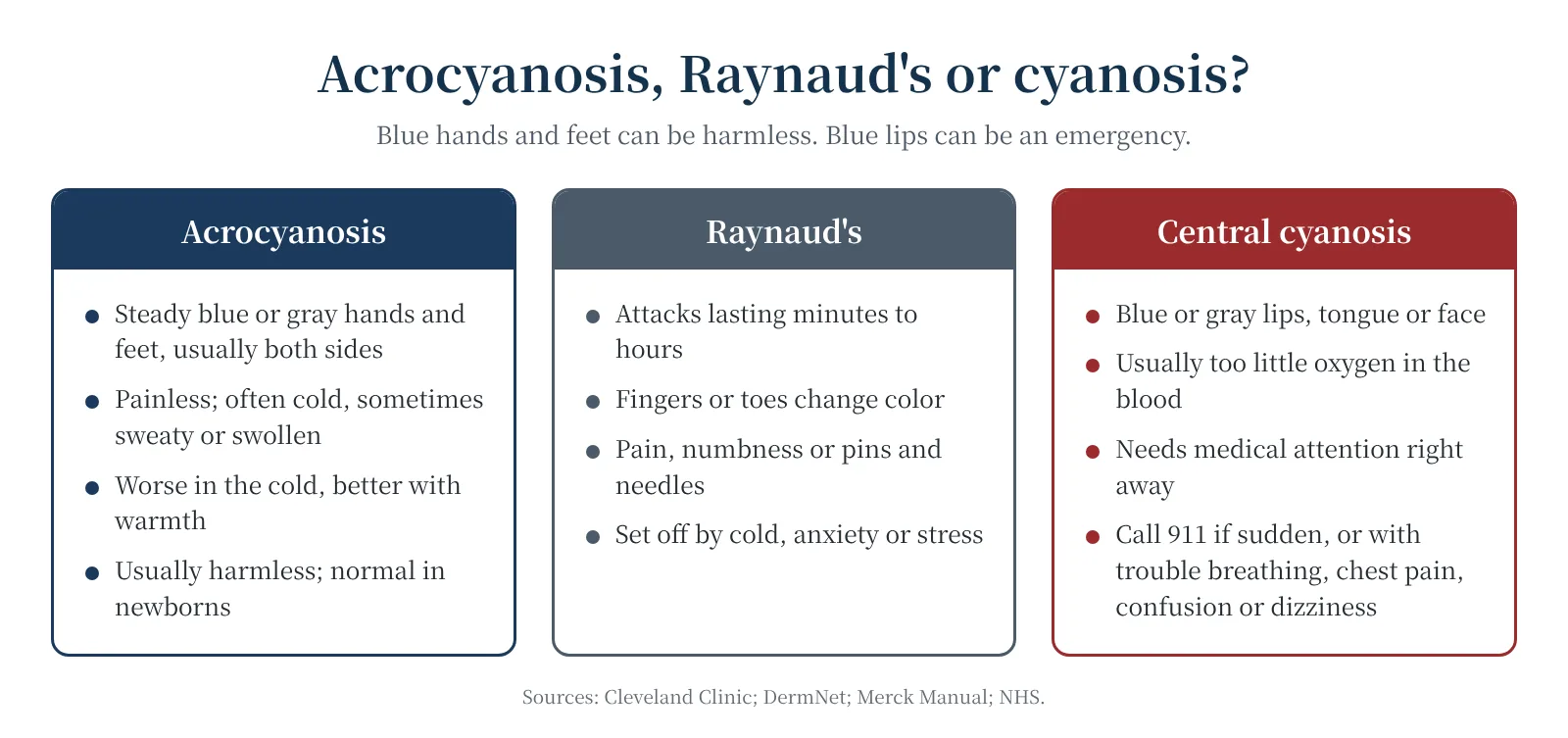
The NHS, England’s health service, puts it plainly: “Blue or grey skin that includes your lips and mouth is usually a sign that someone is not getting enough oxygen and is a serious problem.” It adds: “Blue and grey fingers, toes, hands and feet are usually because of a problem with blood circulation.” Even so, the NHS says to get urgent advice for blue or gray fingers, toes, hands or feet, and MedlinePlus notes that sudden cyanosis is more likely to be an emergency than long-standing cyanosis.
| Feature | Acrocyanosis | Central cyanosis |
|---|---|---|
| Where | Hands and/or feet, sometimes the nose or ears | Lips, tongue, gums, face or body, often the fingers and toes too |
| Blood oxygen | Normal | Low |
| How it starts | Gradually; lasts months or years; eases with warmth | Often suddenly; slowly in long-term heart or lung disease |
| Other symptoms | Cool, sweaty hands and feet; otherwise well | Breathlessness, chest pain, confusion or drowsiness; in babies, fast breathing or poor feeding |
| What to do | Same-day advice if new or sudden; routine if long-standing and you feel well | Call 911 |
Pulse oximeters, cold fingers and darker skin
A fingertip pulse oximeter helps tell the two apart, but the FDA lists poor circulation, skin temperature and skin pigmentation among the things that can throw off a reading, so warm the hand and keep it below heart level first. The FDA also describes “ongoing concerns that pulse oximeters may be less accurate in individuals with darker skin pigmentation.” A 2020 study at the University of Michigan and in intensive care units at 178 hospitals showed which way the error runs. Among patients whose oximeter read 92% to 96%, the oxygen measured directly in arterial blood was below 88% in 11.7% of measurements in Black patients and 3.6% in White patients at Michigan, and in 17.0% against 6.2% in the multicenter group: the readings were falsely high. For adults, MedlinePlus advises calling your provider at 92% or lower and getting immediate care at 88% or lower. These numbers do not apply to babies: a 2020 expert panel recommended a newborn heart-screen pass mark of 95% or more in both a hand and a foot. Many over-the-counter oximeters are wellness products the FDA has not evaluated for medical decisions, and for anyone, symptoms always outrank the number.
Primary vs secondary acrocyanosis: is it dangerous?
Primary acrocyanosis, the usual kind in teenagers and young adults, is considered benign: a 2011 review of the medical literature says it typically needs no specific treatment, does not turn into connective tissue disease or other serious illness, and may resolve on its own. Secondary acrocyanosis is a sign of something else, such as an autoimmune disease, a blood disorder, a medicine or, rarely, a cancer, and it can be the first sign of that condition.
How common is acrocyanosis?
Nobody knows. The 2011 review concluded: “Thus, while the best definitions of acrocyanosis focus on clinical description, there is no uniform definition of acrocyanosis.” A 2025 dermatology review calls acrocyanosis extremely rare compared with related conditions such as Raynaud’s, while a 1998 French review, which we could read only as an abstract, reported: “Acrosyndromes with vasoconstriction are highly prevalent in France: 10 to 15% for Raynaud’s phenomenon and acrocyanosis; 2 to 6% for chilblains.” We found no figures for the United States.
Who gets acrocyanosis?
Primary acrocyanosis usually starts in adolescence and continues into adult life. Most reported patients are women, although the reported excess of six to eight women for every man may partly reflect which patients get studied. Cold climates, outdoor work and low body weight raise the risk. Few cases persist into middle age, and almost none are seen after menopause.
Clues that point to secondary acrocyanosis
DermNet sums up the difference: “Secondary acrocyanosis is often asymmetrical and is associated with pain and tissue damage (blue toe syndrome).” In a 2025 series of 53 people with acrocyanosis aged 15 to 82, “Secondary acrocyanosis was identified in 24 patients (45.3%).” Being 40 or older raised the risk about two and a half times, and connective tissue diseases made up 71% of the secondary cases. It was one small study, but the age pattern is worth heeding. Look more closely if acrocyanosis:
- starts in adulthood, especially at 40 or older, or starts suddenly
- affects one side, or only one or a few fingers or toes
- hurts, or comes with sores, blisters or black areas
- comes with weak foot or wrist pulses, a broken net-like purple pattern on the skin (livedo racemosa), joint pain, rashes or muscle weakness
- began after a new medicine, or appears on standing with a racing heart (see dependent acrocyanosis below)
Acrocyanosis in newborns and babies
MedlinePlus lists what a healthy newborn’s skin has at birth: “Deep red or purple skin and bluish hands and feet.” The skin lightens by the second or third day, but the hands and feet, and sometimes the lips, may turn bluish or blotchy again when the baby is cold. They should pink up quickly once your baby is warm; lips still blue after warming, a blue tongue or gums in a calm baby, or a temperature below 96.8°F (36°C) needs 911. The American Academy of Pediatrics agrees: “Babies may have mildly blue or purple hands and feet, which is usually normal.” As the circulation switches from the fetal pattern, a newborn also protects its core temperature by sending less blood to the hands and feet. In a survey of 1,000 newborns examined in their first 4 weeks at a hospital in India, 30.9% had acrocyanosis.
How long does acrocyanosis last in newborns?
Sources disagree, and we found no study that has measured it.
| Source | What it says |
|---|---|
| MedlinePlus (US National Library of Medicine) | Bluish hands and feet at birth; the skin lightens by day 2 or 3, but the hands and feet may turn bluish again when the baby is cold |
| American Academy of Pediatrics | Hands and feet that turn blue from cold should return to pink as soon as the baby is warm |
| Merck Manual, newborn examination | Common in the first few hours; may persist for months, especially on and off |
| Merck Manual, acrocyanosis chapter | Typically resolves within days to weeks, but can persist through infancy |
Put together, steady blueness is most common in the first hours to days, while blueness that comes and goes with cold can recur for weeks or months in a healthy baby. The rest of the baby matters more than the calendar. What different foot colors can mean →
When to worry: blue hands and feet, or blue lips and body?
What matters is where the blue is and whether it passes. The AAP explains: “Occasionally the face, tongue, and lips may turn a little blue when the newborn is crying hard, but once she is calm, her color should quickly return to normal.” It goes on: “However, persistently blue skin coloring is a sign the heart or lungs are not operating properly”, which needs immediate medical attention. The NHS treats blue, gray, pale or blotchy skin, lips or tongue in a child under 5 as an emergency sign, adding that on black or brown skin it may show best on the palms and soles. In a well newborn, though, bluish hands and feet are expected, as is a lacy, blotchy pattern in the cold that fades with warmth (cutis marmorata, which is common in healthy infants). Blue or gray legs with pink arms are different: StatPearls notes that this kind of cyanosis usually signals a serious heart or lung problem, so call 911. Look at the whole baby, and if in doubt, call your pediatrician, or 911 if you see any emergency sign.
| Usually normal in a newborn | Call 911 |
|---|---|
| Bluish hands and feet, especially in the first hours or when cold, that pink up once warm | Tongue, gums, face or chest that look blue or gray when the baby is calm, or lips that stay blue once the baby is calm and warm |
| Face, tongue and lips a little blue during hard crying, normal again soon after calming | Breathing faster than about 60 breaths a minute when calm, grunting, flaring nostrils or sucking in at the ribs, whatever the baby’s color |
| A lacy, blotchy pattern in the cold that fades with warmth | A baby who is floppy, hard to wake or not feeding, has a seizure, feels cold and clammy, has pale, gray or blotchy skin that does not fade with warming, or has a temperature below 96.8°F (36°C) |
Call your pediatrician the same day if the hands or feet stay blue after your baby has been warm for a while, or if your baby is rarely alert or seems too tired to feed but has none of the emergency signs.
The newborn heart screen: what a pass means
About 7,200 US newborns a year are diagnosed with a critical congenital heart defect (CCHD), and MedlinePlus Genetics warns: “Although babies with CCHD may appear healthy for the first few hours or days of life, signs and symptoms soon become apparent.” Every state has a newborn screening program that uses a painless pulse oximeter test, usually at 24 hours of age or later, or just before an earlier discharge, and the CDC reports that mandated screening has cut early infant deaths from these defects by 33%. A pass is reassuring but not a guarantee; in the CDC’s words, “Thus, it is possible for a baby who passes the screen to still have a critical CHD or other CHD.” Ask whether the screen was done and passed, and if your baby later turns blue around the mouth, breathes fast or struggles to feed, call 911 whatever the result was.
Acrocyanosis in toddlers and older children
Beyond the newborn period, sources disagree: DermNet says acrocyanosis is rarely seen in children, while other reviews say it is more common in children and young adults. A toddler whose hands and feet go blue in the cold and recover once warm is reacting normally. In a large Italian series of children seen at one center, acrocyanosis was mostly primary, rarely due to rheumatic disease, and closely tied to an inactive lifestyle. Stimulant medicines for ADHD are a possible trigger to know about: at one children’s hospital, 11 of 43 children (25%) with cold-sensitivity problems such as Raynaud’s or acrocyanosis had taken them; talk to the prescriber rather than stopping one. In teenagers, think also of POTS and eating disorders, covered below. See the pediatrician if the color persists when your child is warm, is one-sided or painful, or comes with fainting, unusual tiredness or weight loss.
Dependent acrocyanosis: blood pooling when you stand or sit
Dependent acrocyanosis is blue, purple or red-blue color of the feet and lower legs that appears when they hang down and clears within minutes of lying flat or raising the legs; it describes a pattern rather than a separate disease. A 2022 review of POTS describes it: “Some patients with dependent acrocyanosis may present with a dusky red-blue discoloration of the feet and calves while standing with skin that is cool to the touch.” The color can extend above the knees.
Dependent acrocyanosis and POTS
Postural orthostatic tachycardia syndrome (POTS) is diagnosed when the heart rate rises by 30 beats a minute or more (40 or more in 12- to 19-year-olds) within 10 minutes of standing, without a fall in blood pressure, after at least 3 months of symptoms on standing, with no other cause found. It mainly affects women aged 15 to 50 and brings lightheadedness, a racing heart, fatigue and foggy thinking when upright. A 2006 review stated that “A striking physical feature of POTS is the dependant acrocyanosis that occurs in 40–50% of patients with POTS”. That figure is an expert’s estimate, not a measured rate: the 2022 review calls the sign common, but the few small studies that recorded it give no reliable percentage.
Blood pooling is the usual description, and blood does shift into the legs, but small studies suggest the veins themselves are not the main problem. In a study of 15 teenagers with POTS and 11 healthy teenagers, the leg veins behaved normally, and the author concluded: “The findings suggest that pooling in POTS is due to blunted arterial vasoconstriction, which produces passive redistribution of blood within peripheral venous capacitance beds.” In plain words, the small leg arteries fail to tighten on standing, and the 2006 review adds that blood flow through the skin falls. So this is neither vein disease nor blocked arteries, although the studies were small and in adolescents.
If your feet darken when you stand and you also get a racing heart or lightheadedness, ask about POTS; the first test is heart rate and blood pressure lying and then standing. Treatment targets POTS itself. The 2022 review starts with extra fluids and salt under medical guidance and waist-high compression garments, which reduced the rise in heart rate on standing in a 2021 trial; have your foot pulses checked before using compression of any strength. Some people are prescribed a beta-blocker such as propranolol for POTS. Beta-blockers can make blue hands and feet worse, but never stop or change one yourself; tell your prescriber. Compression safety: who needs a check first →
Paralysis, stroke and long periods of sitting
Acrocyanosis is described as not infrequent in people with paralysis or other major nerve damage, though reports after spinal cord injury are few. A case report describes a man who had been paraplegic for 20 years: “The discoloration and swelling precipitated when he sat with his legs down and improved significantly with a few minutes of leg elevation.” Ultrasound showed healthy arterial blood flow, and he was advised to raise his legs on his wheelchair’s supports. After a stroke, the paralyzed arm is often cold: in a survey of 75 stroke survivors, 53% reported coldness in the paralyzed arm, linked with numbness and color change. We found no study of long periods of sitting or standing in otherwise healthy people. The NHS advises getting up and moving around every hour or so and says regular exercise helps circulation. A new cold, blue, painful or swollen limb on one side still needs checking for a clot or a blocked artery. Deep vein thrombosis: signs and when to act →
Before you raise your legs: rule out artery disease
Raising the legs helps dependent acrocyanosis but is the wrong advice for severe peripheral artery disease (PAD). The Merck Manual explains: “When below heart level, the foot may appear dusky red or darker than usual (called dependent rubor).” And when the foot is raised: “In some patients, elevating the foot causes loss of color and worsens ischemic pain; when the foot is lowered, venous filling is prolonged (> 15 seconds).” People with this rest pain often hang the foot over the side of the bed at night for relief.
| Dependent acrocyanosis | Dependent rubor (severe PAD) | |
|---|---|---|
| Legs down | Dusky blue-purple or red-blue, cool | Dusky red or darker than usual, cool |
| Pain | Usually none | Rest pain, often at night, eased by hanging the foot down |
| Legs raised | Color returns to normal | Foot goes pale and pain worsens |
| Foot pulses | Normal | Weak or absent |
| What helps | Moving, and raising the legs once the arteries are checked | Prompt assessment by a vascular specialist |
So before making leg raising a habit, have a clinician feel your foot pulses, and ask for an ankle-brachial index (ABI) if they are weak or if you have diabetes, smoke or get calf pain when walking; an ABI of 0.90 or less means PAD, while one above 1.40 can mean stiff, calcified arteries that hide PAD and call for a toe pressure test. If raising your foot makes it paler or more painful, stop and get assessed. The ankle-brachial index test →
Other signs of PAD include calf pain on walking that eases with rest, hair loss on the legs and feet, and foot sores that do not heal. Peripheral artery disease symptoms →
With healthy arteries, lie down with your feet above the level of your heart, or use leg supports when sitting. How to raise your legs properly →
What causes secondary acrocyanosis?
Published lists run to more than a hundred conditions and drugs, many resting on a single case report. These are the main groups.
- Connective tissue and autoimmune diseases, the most common cause in the 2025 series, including lupus, rheumatoid arthritis, systemic sclerosis (scleroderma) and vasculitis. A 2025 review notes that acrocyanosis can appear years before Raynaud’s attacks and skin thickening in systemic sclerosis, and the 2011 review reports it in almost a third of people with antiphospholipid antibodies, which make the blood clot more easily.
- Blood proteins that react to cold. In cold agglutinin disease, antibodies clump red blood cells in cooled skin; in a Norwegian study of 86 people with it, onset was usually later in life (median age 67) and 91% had circulation symptoms in the cold. Cryoglobulins, linked to hepatitis C and to blood cancers such as myeloma, are suspected when there are skin ulcers, purple spots, joint pain, kidney disease or nerve damage.
- Cancer, mainly in older adults. A 2002 study that pooled 2 new cases with earlier published reports, 68 people in all with finger and toe circulation problems linked to cancer (16 with acrocyanosis), advised: “A neoplastic origin of acral vascular syndrome should be considered in elderly patients, especially men, in the absence of usual causative conditions.” The problem regressed after cancer treatment in 48%.
- Eating disorders and very low body weight. Cold, blue hands and feet are a recognized sign of anorexia nervosa and other eating disorders. In one series, acrocyanosis was found in 32 of 155 people with anorexia nervosa, more often in those who were most unwell, and in a small follow-up it improved with recovery. If you notice it along with weight loss or struggles with eating, in yourself or someone you care for, that is a reason to see a doctor.
- Medicines. The NHS lists beta-blockers among the causes of blue hands and feet, and a 2025 review warns that they “may paradoxically aggravate AC through vasoconstrictive effects” (AC is the authors’ shorthand for acrocyanosis). ADHD stimulants, some antidepressants, interferon and the transplant drug sirolimus have also been linked, mostly in case reports. The UK’s Primary Care Dermatology Society (PCDS) notes that “Drug-induced acrocyanosis will improve on cessation of the causal drug”, but never stop or change a prescribed medicine without talking to your prescriber.
- Other causes include low blood oxygen from lung disease or smoking (the lips are then usually blue too), infections such as hepatitis C, HIV and COVID-19, and spinal cord injury.
Acrocyanosis or something else?
Several conditions color the hands or feet; the table shows how they differ.
| Condition | What you see | Key difference | How urgent |
|---|---|---|---|
| Acrocyanosis | Even blue-purple color of both hands and/or feet; cool, often sweaty | Constant; no white phase; painless; normal pulses | Same-day advice if new or sudden; routine if long-standing |
| Raynaud’s phenomenon | Attacks of white, then blue, then red, with a sharp border | Comes and goes over minutes to hours with cold or stress; numbness or throbbing | Routine; prompt appointment if only one side is affected; same day for a sore, a new dark patch, or a toe that stays dusky blue or purple after warming; emergency department now for a toe that is black, gray or dark purple or looks dead |
| Chilblains | Itchy or burning red-purple swellings on the toes or fingers | Appear hours after damp cold; clear in 2 to 3 weeks | Self-care for itchy red or purple patches that are fading; same day if a toe stays dusky blue or purple, for pus or spreading redness, or for a sore with diabetes, numb feet or poor circulation; emergency department now for a toe that is black, gray or dark purple or looks dead, redness spreading fast, or a fever or chills |
| Livedo reticularis | Net-like purple pattern around pale skin, mostly on the legs | Lacy rather than even; the harmless form fades with warmth | Routine; prompt if persistent with sores |
| Peripheral artery disease | Pale or bluish feet, red when hanging down in severe disease; hair loss; slow-healing sores | Weak pulses; calf pain on walking; ABI 0.90 or less | Routine; same day for rest pain, a dark patch or a new sore; emergency department now for a toe that is black, gray or dark purple or looks dead |
| Erythromelalgia | Red, hot, burning hands or feet | Flares with warmth or hanging down; eased by cooling | Routine |
| Blue toe syndrome | Sudden blue or purple toe or toes | Painful at rest; often after an artery procedure | Same day; emergency department now if a toe turns black, gray or dark purple, or looks dead |
| Frostbite | Hard, frozen skin that is white, blue or blotchy | Exposure to 32°F (0°C) or below | Emergency |
| Central cyanosis | Blue or gray lips, tongue, gums, face or body | Low blood oxygen; often breathless | 911 |
- Raynaud’s phenomenon causes reversible, sharply bordered attacks, typically white, then blue, then red as blood returns, and it can occur on top of acrocyanosis. The PCDS explains: “Acrocyanosis is differentiated from Raynaud’s phenomenon by relative persistence of skin color changes, and absence of paroxysmal pallor.” Paroxysmal pallor means sudden white attacks. Raynaud’s phenomenon →
- Chilblains can occur alongside acrocyanosis. Chilblains →
- Livedo reticularis that persists, or forms a broken, irregular net, deserves a check for an underlying disease. Livedo reticularis →
- Erythromelalgia flares are hot and red, but between flares the feet can be cool and discolored, like acrocyanosis. Erythromelalgia →
- One blue toe or one blue foot is never just acrocyanosis. DermNet notes that blue toe syndrome most often affects an older man who has had a vascular procedure. Blue toe syndrome: why one blue toe needs same-day care →
- Methemoglobinemia, a change in hemoglobin that stops it delivering oxygen properly, turns the skin bluish; it can be inherited or caused by medicines such as the numbing drug benzocaine or the antibiotic dapsone, and babies 6 months or younger are more prone to it. Call 911 for bluish skin with severe shortness of breath.
Tests for acrocyanosis: when you need them
For a young, healthy person with the typical picture, DermNet advises only limited tests, and the PCDS suggests a blood count and standard blood chemistry. It recommends a fuller workup, along the lines of that for connective tissue disease and vasculitis, when acrocyanosis starts in adulthood or comes with pain, asymmetry, ulcers, dead tissue, livedo or other significant skin changes. No test proves primary acrocyanosis; tests look for a cause.
| Test | What it looks for | When it is usually done |
|---|---|---|
| Pulse oximetry on a warm finger | Low blood oxygen | Most visits |
| Foot pulses; ankle-brachial index | Peripheral artery disease | Blue feet; before leg raising or compression |
| Blood count and standard blood chemistry | Blood, kidney or liver disease | Usually, even in young people |
| ESR, CRP, urinalysis, antinuclear and other antibodies, including antiphospholipid antibodies | Inflammation and connective tissue disease; a tendency to clot | Adult onset, joint pain, rashes, livedo |
| Cold agglutinins, cryoglobulins, protein electrophoresis, hepatitis B and C | Cold-reacting blood proteins and their causes | Older adults; purple spots or ulcers |
| Nailfold capillaroscopy | Early systemic sclerosis | Raynaud’s attacks as well |
| Heart rate and blood pressure lying and standing; tilt-table test | POTS | Color change on standing with a racing heart |
| Duplex ultrasound | Blood clots and blocked arteries | Color, swelling or pain on one side |
Capillaroscopy, a magnified look at the tiny vessels at the base of the nails, is the most studied test, but the 2011 review concluded that after almost a century of use it has not become the gold standard for diagnosing acrocyanosis. Before your appointment, photograph your hands or feet sitting, standing and lying down, and list your medicines. Preparing for a circulation appointment →
Acrocyanosis treatment
The Merck Manual is brief: “Treatment, other than reassurance and avoidance of cold, is usually unnecessary.” The 2011 review adds: “There is no consensus on therapeutics and all recommendations for the treatment of acrocyanosis reflect individual practices and lack of clinical trials.” No medicine is approved for acrocyanosis, and we found no modern randomized trial of any treatment. What helps is practical:
- Know that it is harmless. Once a clinician has confirmed primary acrocyanosis, with normal pulses and normal oxygen, the color itself does no damage.
- Keep your whole body warm. Wear gloves or mittens, wool socks, slippers indoors, layered clothing and insulated boots in winter.
- Avoid cold and warm up gently. Gentle warming and massage are reasonable, but never rub skin that may be frostbitten, and avoid direct heat on skin that has lost normal feeling.
- Do not smoke, and go easy on caffeine. The NHS says both can affect the flow of blood in the fingers and toes. Building a quit plan →
- Keep moving. Change position often and move your ankles and toes when sitting. For dependent acrocyanosis, raise your legs once your clinician has confirmed that your arteries are healthy.
- Treat any cause. Secondary acrocyanosis improves when the underlying condition is treated, and a medicine that may be responsible should be reviewed with the prescriber, not stopped on your own.
What about medicines and surgery?
Vasodilators such as calcium channel blockers, which often help Raynaud’s, are usually ineffective for acrocyanosis, according to the Merck Manual, DermNet and the PCDS; a 2013 review reports improvement in some patients, but there are no trials. Beta-blockers, once suggested as a treatment, may make it worse. Nicotinic acid or minoxidil creams, bioflavonoids and ultraviolet light have little evidence, and sympathectomy, cutting the nerves that tighten the vessels, is reserved for very severe cases and has not fully cured it.
Does acrocyanosis go away?
Usually, with time. DermNet’s summary: “Primary acrocyanosis is a benign condition that usually resolves in middle age with no long-term sequelae.” Many people find it eases every summer. Secondary acrocyanosis follows its cause, improving when the underlying disease is treated or the prescriber changes a responsible drug.
Caring for cold, blue feet
A few habits help cold, damp, blue feet.
- Warm, dry socks. Wear warm wool or synthetic socks; for outdoor work in the cold, a 2013 review suggests thin polypropylene liners underneath to wick moisture away. Change damp socks promptly, and wear socks in bed if your feet get cold.
- Sweaty feet. Dry well between the toes. The NIDDK’s diabetes foot-care advice, sensible for anyone with damp feet, is to use talcum powder or cornstarch between the toes and keep lotion out of those spaces.
- Roomy, lined footwear. Shoes and boots should fit over warm socks without squeezing; lined, waterproof boots keep feet warm and dry in winter. Avoid tight socks, since the NHS lists tight clothing among the causes of blue hands and feet.
- Gentle heat only. If you have diabetes or numb feet, follow the NIDDK’s advice not to put a hot water bottle or heating pad on your feet, because you could burn them without feeling it; the same caution sensibly applies to heated socks and foot warmers. Heated socks: who should skip them →
- Check your feet. Acrocyanosis does not cause sores, so a blister or a dark spot on a blue toe needs same-day care, a crack that has not healed in 2 weeks needs prompt care, not a routine wait, and a toe that turns black, gray or dark purple, or looks dead, needs an emergency department now. Daily foot and leg skin checks →
When to see a doctor or podiatrist
Get same-day advice if blue hands or feet are new or sudden. If the color is long-standing, make an appointment if it first appeared in adulthood, shows any of the clues listed earlier, or comes with calf pain on walking or feet that turn pale when raised, and see the pediatrician if a child’s hands or feet stay blue even when warm. A primary care doctor can start the assessment and refer you, as needed, to a dermatologist, rheumatologist, hematologist, vascular specialist or POTS specialist. A podiatrist can check the pulses, skin and sensation of your feet, look after sores and advise on footwear. When to seek care for circulation symptoms →
Near Howell or Bloomfield Township, Michigan?
The author of this site practices podiatry at Balance Foot & Ankle, which he owns, so this is a disclosed option rather than an independent referral. If your feet or toes stay blue, purple or cold, first changed color in adulthood, or turn dark when you sit or stand, an evaluation can check the pulses and blood flow in your feet, look for skin damage, advise on warm, dry footwear, and coordinate tests or a referral when a cause needs ruling out. Michigan evaluation →
Common questions
What is acrocyanosis?
Acrocyanosis is a persistent, usually painless blue or purple color of the hands, the feet or both, caused by small blood vessels in the skin that stay narrowed. The skin is cool and often sweaty, and the color deepens in the cold or when the hands or feet hang down. Pulses and blood oxygen are normal. It is normal in newborns and usually harmless in adults.
What is the difference between acrocyanosis and cyanosis?
Cyanosis is any blue color of the skin. Central cyanosis affects the lips, tongue, gums, face or body, usually means the blood is short of oxygen, and needs 911. Acrocyanosis is a long-lasting form of peripheral cyanosis, mainly of the hands and feet, with normal blood oxygen and normal pulses. It is usually harmless, but acrocyanosis that first appears in an adult deserves a check.
Is acrocyanosis normal in newborns?
Yes. Bluish or purple hands and feet are normal at birth and in the first hours, and they can return whenever a baby gets cold; they should pink up once the baby is warm. A blue or gray tongue, gums, face or chest in a calm baby, lips that stay blue after warming, labored breathing, floppiness, poor feeding, difficulty waking, or cold, clammy or blotchy skin are not normal: call 911.
How long does acrocyanosis last in newborns?
Sources disagree, and we found no study that has measured it. Steady blue hands and feet are most common in the first hours and usually settle within days, and the Merck Manual says newborn acrocyanosis typically resolves within days to weeks. Blueness when the baby is cold can come and go for weeks or months. Normal lip color, easy breathing and good feeding matter more than the date.
When should I worry about my baby’s blue hands or feet?
Call 911 if the tongue, gums, face or chest look blue or gray while your baby is calm, if the lips stay blue after warming, or if your baby is breathing fast or hard, grunting, floppy, hard to wake, not feeding, cold and clammy, pale or blotchy all over, or has a temperature below 96.8°F (36°C). Call your pediatrician the same day if the hands and feet stay blue once your baby is warm. Blueness during hard crying should clear quickly after calming.
What is dependent acrocyanosis?
It is blue, purple or dusky red-blue color of the feet and lower legs that appears when they hang down and clears within minutes of lying down or raising the legs. It is common in POTS and also occurs with paralysis. In POTS, small studies point to small leg arteries that fail to tighten on standing, rather than weak veins. Have your foot pulses checked before relying on leg raising.
Is acrocyanosis dangerous?
Primary acrocyanosis is considered harmless: it does not damage the skin, it is not thought to turn into another disease, and it usually fades by middle age. Secondary acrocyanosis can signal an autoimmune disease, a blood disorder, a medicine or, rarely, cancer, so color that first appears in adulthood, color on one side, pain or sores deserve a check. Blue lips, tongue or chest are a different and dangerous problem: call 911.
Does acrocyanosis go away, and what is the treatment?
Primary acrocyanosis usually fades by middle age and often eases each summer. Treatment is reassurance, keeping the whole body warm with gloves, wool socks and layers, avoiding cold, not smoking and treating any cause. No medicine is approved or proven for it: calcium channel blockers usually fail, and beta-blockers may make it worse. Secondary acrocyanosis improves when its cause is treated.
What is the difference between acrocyanosis and Raynaud’s?
Raynaud’s comes in attacks: the fingers or toes turn white, then blue, then red, with a sharp border, and recover within minutes to hours, often with numbness or throbbing. Acrocyanosis is a steady blue or purple color with no white phase and usually no pain. Both worsen with cold and stress, and they can occur together. Calcium channel blockers often help Raynaud’s but rarely help acrocyanosis.
Where to go next
- Red, blue, pale or purple feet: what color changes can mean
- Raynaud’s phenomenon: color attacks in the fingers and toes
- Cold feet: common causes and when to get checked
- Peripheral artery disease symptoms
- Leg elevation: when it helps and when it does not
- Livedo reticularis: net-like purple skin
- Erythromelalgia: hot, red, burning feet
Sources
- Merck Manual Professional Version. Acrocyanosis; Physical examination of the newborn; Peripheral artery disease.
- Kurklinsky AK, Miller VM, Rooke TW. Acrocyanosis: the Flying Dutchman. Vascular Medicine 2011;16:288–301.
- Demircioğlu D, Öztürk Durmaz E. Acrocyanosis: the least known acrosyndrome revisited with a dermatologic perspective. Dermatology Research and Practice 2025;2025:2904301.
- Das S, Maiti A. Acrocyanosis: an overview. Indian Journal of Dermatology 2013;58:417–420.
- DermNet. Acrocyanosis; Livedo reticularis; Erythromelalgia; Blue toe syndrome.
- Primary Care Dermatology Society. Acrocyanosis.
- NHS. Blue or grey skin or lips (cyanosis); When to get urgent medical help for babies and children under 5; Raynaud’s; Chilblains; Frostbite; Peripheral arterial disease (PAD); DVT (deep vein thrombosis).
- MedlinePlus, US National Library of Medicine. Blue discoloration of the skin; Skin findings in newborns; Pulse oximetry; Arterial embolism; Methemoglobinemia; MedlinePlus Genetics. Critical congenital heart disease.
- American Academy of Pediatrics, HealthyChildren.org. 11 common conditions in newborns.
- Centers for Disease Control and Prevention. Screening for critical congenital heart defects.
- Martin GR, Ewer AK, Gaviglio A, et al. Updated strategies for pulse oximetry screening for critical congenital heart disease. Pediatrics 2020;146:e20191650.
- US Food and Drug Administration. Pulse oximeters; Pulse oximeter basics.
- Sjoding MW, Dickson RP, Iwashyna TJ, Gay SE, Valley TS. Racial bias in pulse oximetry measurement. New England Journal of Medicine 2020;383:2477–2478.
- Pahal P, Goyal A. Cyanosis; Zhao S, Tran VH. Postural orthostatic tachycardia syndrome; Killeen RB, Awais M, Mikes BA. Cryoglobulinemia. StatPearls.
- Carpentier PH. Definition and epidemiology of vascular acrosyndromes [in French]. La Revue du Praticien 1998;48:1641–1646.
- Bilancini S, Lucchi M, Trevisan G, Di Pino L, Tucci S. Acrocyanosis: primary or secondary form? An observational study. Acta Dermatovenerologica Alpina, Pannonica et Adriatica 2025;34:177–180.
- Haveri FT, Inamadar AC. A cross-sectional prospective study of cutaneous lesions in newborn. ISRN Dermatology 2014;2014:360590.
- PediatricEducation.org. What looks like acrocyanosis? 27 September 2021.
- Soscia F, Ardenti Morini F, Cortis E, et al. Acrocyanosis in a large Italian pediatric series during the Covid-19 pandemic. Minerva Pediatrics 2022.
- Coulombe J, Powell J, Hatami A, et al. Diseases of abnormal sensitivity to cold in children on psychostimulant drugs. Journal of Cutaneous Medicine and Surgery 2015;19:121–124.
- Raj SR. The postural tachycardia syndrome (POTS): pathophysiology, diagnosis & management. Indian Pacing and Electrophysiology Journal 2006;6:84–99.
- Raj SR, Fedorowski A, Sheldon RS. Diagnosis and management of postural orthostatic tachycardia syndrome. CMAJ 2022;194:E378–E385.
- Stewart JM, Gewitz MH, Weldon A, Munoz J. Patterns of orthostatic intolerance: the orthostatic tachycardia syndrome and adolescent chronic fatigue. Journal of Pediatrics 1999;135:218–225.
- Adler BL, Kuchinad K, Jeong SJ, et al. Colour changes in the feet: a sign of autonomic symptoms in systemic sclerosis. Rheumatology 2025;64:3080–3084.
- Stewart JM. Pooling in chronic orthostatic intolerance: arterial vasoconstrictive but not venous compliance defects. Circulation 2002;105:2274–2281.
- Ruiz-Rodríguez JF, Fernández-de Thomas RJ, De Jesus O. Secondary acrocyanosis in a paraplegic patient with spinal cord injury. Cureus 2022;14:e29420.
- Wanklyn P, Forster A, Young J, Mulley G. Prevalence and associated features of the cold hemiplegic arm. Stroke 1995;26:1867–1870.
- Berentsen S, Ulvestad E, Langholm R, et al. Primary chronic cold agglutinin disease: a population based clinical study of 86 patients. Haematologica 2006;91:460–466.
- Poszepczynska-Guigné E, Viguier M, Chosidow O, et al. Paraneoplastic acral vascular syndrome: epidemiologic features, clinical manifestations, and disease sequelae. Journal of the American Academy of Dermatology 2002;47:47–52.
- Bhanji S, Mattingly D. Acrocyanosis in anorexia nervosa. Postgraduate Medical Journal 1991;67:33–35; Strumìa R, Varotti E, Manzato E, Gualandi M. Skin signs in anorexia nervosa. Dermatology 2001;203:314–317.
- Ture HY, Lee NY, Kim NR, Nam EJ. Raynaud’s phenomenon: a current update on pathogenesis, diagnostic workup, and treatment. Vascular Specialist International 2024;40:26.
- National Institute of Diabetes and Digestive and Kidney Diseases. Diabetes and foot problems; National Heart, Lung, and Blood Institute. Peripheral artery disease: diagnosis.
Written by Tom Biernacki, DPM, FACFAS. Published 12 November 2026. General education, not medical advice.