Livedo reticularis is a purple or red-blue, lace- or net-like pattern on the skin, most often on the legs; many people simply call it mottled skin. The common form appears when the skin gets cold and fades as it warms, and it is harmless: it shows up in about half of healthy babies and in many adults, especially young women. Less often, the net is a sign of something else. A pattern that stays when you are warm, looks broken, or comes with painful lumps or sores can point to a clotting disorder called antiphospholipid syndrome, to lupus or inflamed blood vessels, to cholesterol debris after an artery procedure, or to a medicine such as amantadine, and purple patches that do not fade when pressed need an emergency department now, or 911 if they appear suddenly or spread quickly, or come with a fever. This guide explains why the net forms, how to tell the harmless pattern from the others, what causes it and what is known about how common each cause is, and what tests and treatment can do.
When livedo or a purple rash needs emergency or same-day care
- Purple patches with a branching or net-shaped edge that do not fade when pressed, often painful: go to an emergency department now. This is retiform purpura, from blocked or damaged small vessels. Call 911 if the patches appear suddenly or spread quickly, or come with a fever or with feeling unwell.
- A purple rash with a fever, or with feeling unwell: go to an emergency department now. Call 911 if the rash does not fade when pressed or spreads quickly, or there is also blotchy, cold or clammy skin, confusion or slurred speech, very fast breathing, a racing heartbeat, uncontrollable shivering, a stiff neck, a very bad headache, a seizure, or blue, gray or pale skin or lips: sepsis and meningococcal infection can kill within hours.
- An arm or leg that suddenly turns cold, pale, numb or very painful: call 911. A blocked artery needs treatment at once.
- Painful blue, purple or dark toes after a heart catheterization, angiogram or other artery procedure, or after starting a blood thinner: get same-day care. Cholesterol debris can block the small vessels of the toes and damage the kidneys, even when the foot pulses feel normal. A toe that turns black, gray or dark purple, or looks dead needs an emergency department now.
- Livedo with signs of a stroke, such as sudden numbness or weakness of the face, arm or leg, especially on one side, a drooping face, an arm that drifts down, sudden loss of balance or vision, slurred speech, confusion or a sudden severe headache: call 911 and note the time. If the symptoms pass within minutes, still tell a clinician right away.
- Painful lumps, sores or ulcers in or near the net: see a clinician within a few days, and get same-day care if they are growing or look infected, or if you have diabetes, numb feet or poor circulation. They can mean inflamed or blocked vessels.
We found no study of how livedo looks on brown or black skin. UK health guidance says the lace-like rash can be harder to see, and case reports describe retiform purpura on darker skin as darker purple; we expect the net to look darker and less red, an expectation rather than a finding. Check an emergency rash on paler areas such as the palms and soles.
What livedo reticularis is, and why the skin makes a net
Although it is often called a rash, livedo is a change in skin color: rings of red-blue to purple surround paler centers, so the skin looks netted or marbled. It is usually on the legs, may come and go or stay, is often more obvious in the cold, and may or may not fade with warming. Cold can also make the affected skin tingle or feel numb.
The net comes from the way blood reaches the skin. As DermNet, a dermatology reference, explains, “Cutaneous vasculature is comprised of a series of 1–3 cm cones.” Each cone is fed at its tip, deep in the skin, by a small artery rising toward the surface, so its center gets the freshest blood; toward its edge the arterial supply thins and small surface veins are more prominent. When flow slows, more oxygen is used up and the darker, oxygen-poor blood shows at the edges, so many pale centers ringed with purple join into a net. In the cold, small skin arteries narrow for a while and the net comes and goes. When vessels stay narrowed, fill with clots or carry blood that is too thick, the net becomes fixed. How arteries, veins and lymph vessels work →
Four patterns to tell apart
Doctors separate the patterns by shape, by whether they fade with warmth or pressure, and by what comes with them. A 2022 review in a vascular medicine journal puts the key point this way: “Livedo reticularis is a benign condition characterized by net-like lesions caused by clinically insignificant, and often transient, interruptions in blood flow that do not lead to ulceration.” Livedo racemosa and retiform purpura, by contrast, are fixed, and they come from lasting blockage of vessels.
Physiologic livedo (cutis marmorata)
A fine, even, unbroken net, usually on both legs, that appears in the cold, fades gradually with warming and does not hurt. Primary and idiopathic livedo reticularis look the same but depend less on temperature: the primary form comes and goes, the idiopathic form persists, and both are diagnosed once other causes have been ruled out.
Livedo racemosa vs reticularis
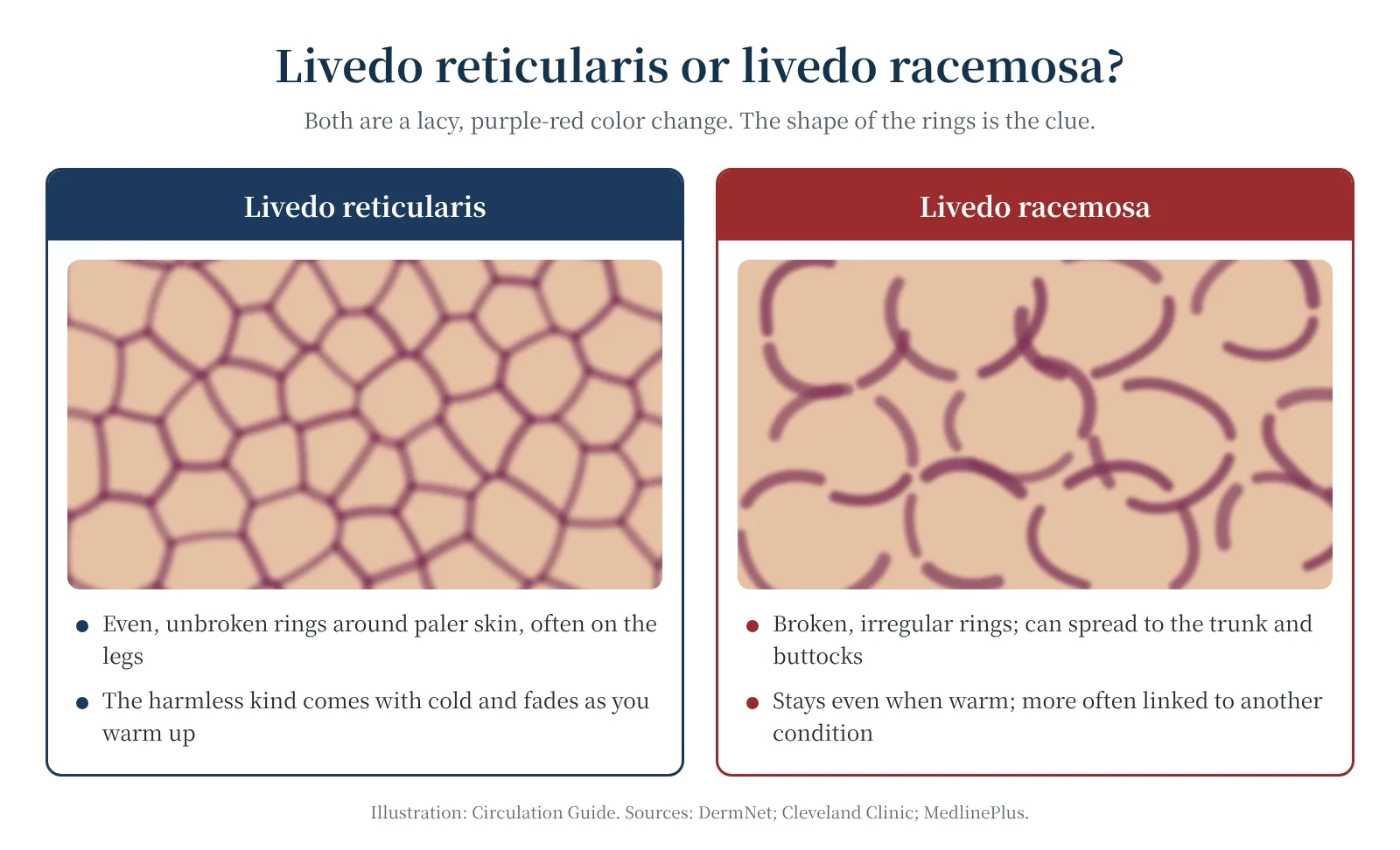
Livedo racemosa is an irregular, broken net that stays when the skin is warm and often reaches the trunk and buttocks. American medical writing often calls both patterns livedo reticularis, a 2014 review notes, although one comes from temporary narrowing of vessels and the other from lasting blockage of small arteries. A US rare-disease charity explains why the difference matters: “These two dermatologic conditions are separated because livedo reticularis is much more frequent, but the association with strokes exists for livedo racemosa only”. A 2015 review advises antiphospholipid antibody tests for everyone with livedo racemosa, though it is not always a sign of disease: in a hospital series of 33 people with it, 12 (36.4%) had no cause found.
Retiform purpura
DermNet defines it this way: “It comprises non-blanching, purpuric patches or plaques that are angulated or branching (reticular), often accompanied by skin necrosis and ulceration.” The patches are painful, range from 1–2 cm to more than 10 cm (4 inches) across, and come from blocked or damaged small vessels, for example from clots, infection, calciphylaxis or cholesterol debris. They need an emergency department now, and “The acute, widespread development of retiform purpura (termed ‘purpura fulminans’) represents a rare, life-threatening emergency.”
Livedoid vasculopathy
Painful red-purple spots around the ankles, shins and tops of the feet, usually on both legs, that can break down into small, very painful sores and heal over months into white, star-shaped scars called atrophie blanche. Clots in tiny skin vessels cause it, and it comes and goes for years. It is rare, affecting about 1 in 100,000 people a year and women three times as often as men, and in one review the median delay to diagnosis was 3.4 years. Unlike venous leg ulcers, which are larger and shallow on the inner lower leg with swelling, these sores are small and sit around the ankle bones and on the top of the foot. Venous leg ulcers →
| Pattern | What it looks like | Warmth and pressure | What it means and what to do |
|---|---|---|---|
| Physiologic livedo (cutis marmorata) | Fine, even, complete net, mostly on the legs; painless | Comes with cold, fades with warming | Normal; keep warm, no tests needed |
| Primary or idiopathic livedo | The same even net; comes and goes, or stays | Changes less with temperature | Usually harmless; a check-up if it persists |
| Livedo racemosa | Irregular, broken rings, often on the trunk and buttocks too | Stays when warm | Often an underlying condition; review and blood tests |
| Retiform purpura | Painful purple patches with branching edges; may blister or blacken | Does not fade when pressed | Blocked or damaged vessels; emergency department now; 911 if it appears suddenly or spreads quickly, or with a fever or feeling unwell |
| Livedoid vasculopathy | Painful spots and small sores at the ankles and feet, healing into white scars | Fixed | Prompt review and skin biopsy |
The press test
Press the side of a clear glass firmly on the patch and look through it. Early livedo from slow blood flow can pale under pressure; retiform purpura does not. The UK’s NHS uses the same test for the rash of meningitis: “The rash does not fade if you press the side of a clear glass firmly against the skin.” It is a guide, not a diagnosis: a purple patch that does not fade needs an emergency department now, and one that comes with a fever, or in someone who seems unwell, needs 911. Any purple rash with a fever needs an emergency department now even if it fades, and blotchy skin with a fever needs 911, and not everyone with meningitis or sepsis gets a rash.
Mild livedo reticularis: the common, harmless kind
Most livedo is harmless. DermNet says: “Cutis marmorata causes temporary or physiological livedo in about 50% of healthy infants and many adults, particularly young women when exposed to the cold.” MedlinePlus, from the US National Library of Medicine, adds that cold, tobacco and emotional upset can bring on primary livedo, most often in women aged 20 to 50. No study has counted the causes of livedo in the general adult population, but a 2015 case report names idiopathic livedo from vessel spasm as the most common, and a 2015 review says the idiopathic form only rarely turns out to be an early sign of antiphospholipid or Sneddon syndrome. A fine, even net that comes with cold and fades with warmth, without pain, sores or lumps, in someone otherwise well, needs no tests.
Livedo reticularis after a shower
We found no study of livedo after a shower or bath, so this is an explanation rather than a finding: temperature change is the likely trigger. Wet skin cools as you dry off, and DermNet notes that cutis marmorata is most pronounced when the skin is cooled. Heat can also bring out a brief lacy pattern: “Limited exposure to heat, insufficient to cause a direct burn, causes a mild and transient red rash resembling lacework or a fishing net,” in DermNet’s words. A painless, even net that fades as you warm up fits the harmless kind; one that stays when you are warm, looks broken, hurts or comes with sores is not explained by the shower.
Does livedo reticularis go away?
We found no study that has followed people with the common kind of livedo over time, and sources differ. The cold-related net fades each time you warm up and becomes less evident with age, and MedlinePlus says primary livedo often improves or disappears with age. But DermNet warns: “Over time, in primary livedo reticularis and livedo racemosa, the vessels become permanently dilated, and livedo reticularis becomes permanent regardless of the surrounding temperature.” Livedo caused by amantadine usually fades within months of stopping it, although long-standing drug-related livedo can persist.
Is livedo reticularis dangerous?
The net itself is rarely harmful; DermNet’s summary is that “Livedo reticularis itself is relatively benign.” The risk lies in what it signals. A fine net that fades with warmth in a healthy person is not dangerous. A broken, persistent net, purple patches that do not fade, painful sores, or a net with stroke-like symptoms, past clots, kidney problems or a recent artery procedure can point to serious conditions: a review of Sneddon syndrome reports 9.5% mortality over an average of 6.2 years, and in one study 4 of 25 people with cholesterol emboli after a heart catheterization died in hospital.
What causes livedo reticularis
Most livedo is the cold-related or idiopathic kind described above. The rest of the long list of causes are uncommon or rare, and in adults the important ones damage vessel walls or block vessels from inside. No study has measured how often each cause is behind livedo in the general population; the figures below come from people who already have each condition, so read them as clues, not as your odds.
Antiphospholipid syndrome (APS)
In APS, antibodies make the blood clot too easily, in veins and in arteries. The NHS calls it rare, more common in women and in people with lupus, and lists among its symptoms “a reddish-blue, lace-like rash on your lower legs – this may be harder to see on black or brown skin”. Livedo is one of its commonest skin signs: 24.1% of the 1,000 patients in the Euro-Phospholipid project, according to a 2016 review; 25.5% of 200 consecutive patients examined by a dermatologist; and 16% of 308 in another cohort. Some reference pages give much higher figures, such as 70% or 80%; reported figures vary widely, and we rely on the large cohorts. In the 200-patient series, livedo went with strokes and blocked eye arteries (odds ratio 10.8), seizures and heart valve changes rather than with vein clots, and the 308-patient cohort found no link with pregnancy loss. Blood clots in the leg veins →
Plain livedo reticularis is not part of the formal definition of APS. The 2023 classification criteria of the American College of Rheumatology and EULAR, the European rheumatology alliance, give points for livedo racemosa as a sign of small-vessel disease, but not for the ordinary net; a 2025 review warns that “Livedo racemosa, though well defined, can be confused with livedo reticularis, which lacks clinical relevance, potentially leading to false positives.” These criteria are written for research, and international laboratory guidance notes that some people diagnosed with APS do not meet them. Untreated APS raises the risk of miscarriage and preeclampsia, and the NHS offers testing after 3 or more miscarriages or a clot with no obvious cause.
Sneddon syndrome
Sneddon syndrome is livedo racemosa with strokes or mini-strokes. A 2014 review estimates about 4 new cases per million people a year, mainly in women aged 20 to 42. The skin usually comes first; the US National Organization for Rare Disorders (NORD) says: “Generally, livedo reticularis develops before the neurological symptoms by as much as 10 years, although sometimes the onset of skin symptoms may occur at approximately the same time.” (NORD uses livedo reticularis for the pattern European doctors call livedo racemosa.) The net reaches the trunk or buttocks in nearly everyone affected, headaches and dizziness can come years before any stroke, high blood pressure is common, and about 40% to 50% of patients have antiphospholipid antibodies. A broken, lasting net in a young adult with headaches or high blood pressure deserves prompt assessment, usually including brain imaging; spells of weakness, numbness, or trouble speaking or seeing are stroke warnings, so call 911 if they are happening now and tell a clinician right away if they have passed.
Lupus and livedo reticularis
Livedo is common in lupus, and antiphospholipid antibodies roughly double the chance of it. A 2022 analysis pooling 27 studies of 4,810 people with lupus found: “The frequency of livedo was 25.5% in aPL-positive patients and 13.3% in aPL-negative patients.” (aPL means antiphospholipid antibodies.) The NHLBI, part of the US National Institutes of Health, estimates that 20% to 30% of people with lupus have these antibodies and that about 1 in 3 of them develop clots, and a 2015 review adds that in lupus, livedo with anticardiolipin antibodies marks a higher risk of serious brain-vessel and kidney disease. If you have lupus and livedo, ask whether you have been tested for the antibodies.
Vasculitis
Inflamed small or medium-sized arteries can cause livedo, especially the broken pattern. Polyarteritis nodosa inflames medium-sized arteries, in some people throughout the body. In its skin-limited form, cutaneous polyarteritis nodosa, tender lumps 4–15 mm across follow the arteries of the thighs and lower legs, with livedo, purple or black patches of dead skin and ulcers. It often starts in childhood or adolescence, is usually set off by an infection, and generally runs a long but relatively benign course. Lupus, rheumatoid arthritis, dermatomyositis and other autoimmune diseases that inflame vessels can also cause livedo. Painful lumps or ulcers within the net are the clue, and a skin biopsy is often needed.
Cholesterol emboli and blue toe syndrome
Hardened, fatty arteries can shed cholesterol crystals that lodge in small arteries of the skin, kidneys and gut, most often after an angiogram, a heart catheterization, artery surgery, or blood-thinning or clot-dissolving treatment. In a study of 1,786 people who had a left-heart catheterization, 25 (1.4%) developed the syndrome; 48% of them had skin signs, 64% kidney damage, and in-hospital mortality was 16.0%, against 0.5% in those without it. In a series of 223 patients, livedo was the commonest skin sign, in 49% of those with skin changes. The typical patient is an older man with painful toes after a vascular procedure, and DermNet notes: “The affected toes are cold compared to unaffected parts of the foot, which are warmer and appear well-perfused.” The foot pulses may be normal. A StatPearls review advises that “Cholesterol emboli should be suspected in patients with worsening renal function, hypertension, acute multisystem dysfunction, or distal ischemia after an invasive arterial procedure.” Blue toe syndrome: causes, tests and treatment →
Blood proteins, thick blood and calciphylaxis
In cryoglobulinemia, abnormal antibody proteins clump in the cold, causing purple spots, livedo and joint pain; the essential mixed form affects about 1 in 100,000 people, and hepatitis C is the commonest cause of mixed cryoglobulinemia. In cold agglutinin disease, which about 16 people per million have, mostly aged 40 to 80, cold can turn the fingers, toes, ankles and wrists painfully blue or red. Blood thickened by polycythemia vera, essential thrombocythemia or myeloma can also cause livedo. Calciphylaxis, mainly in kidney failure and in about 1% a year of people on dialysis, starts as very painful purple mottling that blackens and ulcerates; StatPearls calls it “a highly fatal condition with 1-year mortality rates greater than 50%, most often due to sepsis.”
Medicines: amantadine
Amantadine, used for Parkinson’s disease and influenza A, is the medicine most clearly linked to livedo. Its immediate-release label lists livedo among side effects reported in 1% to 5% of people. The label for Gocovri, an extended-release form, reports it in 6% of 100 people taking the drug in trials and none of 98 taking placebo (13% of women, 0% of men). A 2026 case report cites 7.6% in an open-label trial, so reported rates vary. The net usually appears months to years after starting, mostly on the legs, and “The rash typically resolves within 6 months after discontinuation of amantadine.” Tell the prescriber if a net appears, since it can occasionally progress to ulcers, but do not stop the drug on your own. DermNet and other sources also name minocycline, gemcitabine, interferon and norepinephrine, but the evidence is thinner, and the US labels we checked for these four do not list livedo, though some list related blood-vessel problems such as vasculitis or gangrene. Cocaine cut with levamisole can cause painful purple patches, often on the ears, that need an emergency department now.
Infections, heat and other causes
Livedo can come with serious infections such as meningococcal or streptococcal sepsis, and with hepatitis C, parvovirus, syphilis and tuberculosis. Repeated heat below burning level, from a space heater on the shins, a laptop on the thighs or a heating pad, causes erythema ab igne: a net that comes and goes at first, then turns into fixed brown marks only where the heat reached the skin. Mild cases fade over months once the heat stops. Livedo has also been reported with an underactive thyroid, where it may clear with treatment. As for vitamins, a 2015 review states that “Pellagra is the only nutritional disorder associated with LR.”
Mottled skin: livedo reticularis vs mottling and other look-alikes
Mottled skin is the everyday term for blotchy color, and livedo reticularis is one kind of it: a net. Mottling has a different, serious meaning in critical illness. In septic shock, mottling that starts around the knees and spreads outward reflects failing circulation, and in a study of 60 patients, more extensive mottling was strongly linked with death within 14 days. That person is usually very ill, with a fever or a low temperature, confusion or fast breathing, and needs 911. In people with dementia the signs can be harder to notice, and older adults are less likely to have a high temperature. In someone who is well, with warm hands and feet, a lacy net on the legs is usually livedo.
| Condition | What it looks like | How it differs from livedo |
|---|---|---|
| Raynaud’s phenomenon | Fingers or toes turn white, then blue, then red | Attacks set off by cold or strong emotion, lasting minutes to hours |
| Acrocyanosis | Steady, painless blue fingers and toes on both sides | Even color rather than a net; pulses normal |
| Chilblains | Red, swollen patches on the toes or fingers | Swellings set off by cold, not a flat net |
| Erythromelalgia | Red, hot, burning feet or hands, sometimes mottled | Brought on by warmth, eased by cooling |
| Erythema ab igne | Net-like red, then brown, marks | Only on skin repeatedly exposed to a heat source |
| Peripheral arterial disease | Legs paler or bluer than usual, with leg pain on walking | Also hair loss, shiny skin and slow-growing toenails |
| Blue toe syndrome | One or more painful, cold, blue-purple toes | Sudden; often after a procedure; pulses may be normal |
- Acrocyanosis turns the hands and feet an even blue rather than a net. Acrocyanosis →
- Chilblains are swollen patches after cold exposure. Chilblains →
- Peripheral arterial disease can turn the legs pale or blue. Signs of peripheral artery disease →
Livedo reticularis on the legs, feet and hands
MedlinePlus says that in most cases livedo affects the legs. Our explanation is position and temperature: blood pools in the legs when you stand or sit, and the lower legs and feet are usually cooler than the rest of the skin. Two observations fit. In a 2026 case report, after amantadine was stopped the net “was still present in the lower extremities, but only when her legs were in a dependent position”, meaning hanging down; and in early blue toe syndrome, livedo can fade when the leg is raised.
Livedo reticularis on the hands
A net on the hands is less common. The hands or feet are involved in about half of people with Sneddon syndrome, and the NHLBI describes the rash of APS as a lacy red rash on the wrists and knees. Cold, blue fingers without a net are more often Raynaud’s phenomenon, attacks of white, then blue, then red fingers lasting minutes to hours, or acrocyanosis. A net on the hands that stays when they are warm deserves a check. Raynaud’s phenomenon →
When the toes turn blue
Blue or purple toes with a net on the foot can come from cholesterol emboli, antiphospholipid syndrome, blood disorders such as cryoglobulinemia or polycythemia, or calciphylaxis. Blue toe syndrome is painful and often sudden, and it needs same-day care: untreated, further emboli in the following weeks can lead to gangrene. What foot color changes can mean →
Looking after your feet and legs
- Keep warm. Keeping warm, especially your legs, is the main treatment for the harmless net. For cold-sensitive feet, MedlinePlus suggests wool socks, roomy shoes and always wearing shoes outdoors.
- Keep direct heat off your skin. Heaters, heating pads and hot-water bottles used on the same spot can cause erythema ab igne. If your feet are numb or your circulation is poor, we advise against heated socks and foot warmers. Heated socks: who should skip them →
- Protect the skin. DermNet’s advice for livedoid vasculopathy suits any fixed net on the feet: “Protect the area from all knocks, abrasions, known allergens/irritants and ill-fitting shoes to avoid ulceration.”
- Check your feet daily for sores, painful spots, lumps, dark areas or color changes. Have a sore seen promptly, and the same day if it is growing or looks infected, if a toe has a new dark patch, or if you have diabetes, numb feet or poor circulation; go to an emergency department now for a toe that has turned black, gray or dark purple, or looks dead. After a heart catheterization or artery procedure, check your toes daily for a few weeks; that is our advice, not a tested rule. Daily foot and leg skin checks →
- Do not smoke. DermNet calls stopping smoking essential to reduce the risk of strokes and other artery events. Building a quit plan →
- Do not use compression to treat livedo. We found no study showing that compression helps the harmless net, although one review suggests it for troublesome symptoms. It does have a place in healing livedoid vasculopathy sores and in vein disease, under a clinician’s care. If you have poor circulation, numb feet, or blue, cold or painful toes, have your arteries checked before using any compression; UK NICE guidance on preventing clots in hospital advises against anti-embolism stockings for people with artery disease or nerve damage that dulls feeling. Who needs a check before compression →
When to see a doctor about livedo
A cold-related net that fades with warmth needs no visit; for emergencies, see the box at the top. Make an appointment if:
- the net stays when you are warm; Mayo Clinic’s first reason to see a doctor is when “The discolored, mottled skin doesn’t go away with warming”
- it looks broken or irregular, or spreads to your trunk or buttocks
- painful lumps or sores develop in it
- you have had a blood clot, a stroke or mini-stroke, or 3 or more miscarriages (a mini-stroke that has not yet been checked needs a clinician right away)
- you also have headaches, dizziness or high blood pressure as a young adult, or lupus, joint pain, rashes or Raynaud’s
- it appeared after you started a medicine such as amantadine, or you have poor circulation in your legs or kidney failure
Your doctor will ask about past clots, pregnancy problems, neurological symptoms, recent procedures, infections and medicines; nodules or ulcers in the net suggest vasculitis. Preparing for your appointment →
Tests for livedo reticularis
Livedo is diagnosed by looking at it; tests look for a cause and follow your story and examination. A 2015 review warns that “With a few exceptions, extensive screening studies are extremely unlikely to be useful.” A net clearly brought on by cold, in someone otherwise well, needs no tests. The main exception is antiphospholipid testing: DermNet advises that “The lupus anticoagulant panel should be ordered in acquired livedo that is not induced by the cold.” Depending on the clues, tests may include:
- Antiphospholipid antibodies: lupus anticoagulant, anticardiolipin and anti-beta-2 glycoprotein I. A positive result has to be confirmed on a second test at least 12 weeks later; the NHS describes two tests 3 months apart. Mention any blood thinner, because the lupus anticoagulant test may need to be timed around it.
- Antinuclear antibodies (ANA), to look for lupus and related diseases.
- A complete blood count (CBC) with platelets, and clotting tests, for low platelets and other blood disorders.
- Kidney and liver function and a urine test, especially when emboli, vasculitis or lupus are possible.
- Inflammation markers (ESR and CRP), which can rise with emboli or vasculitis but are not specific.
- Cryoglobulins, cold agglutinins and protein electrophoresis, with hepatitis C tests when the story fits.
- Imaging when needed: brain MRI for suspected Sneddon syndrome; artery scans, an echocardiogram or a vein ultrasound for emboli or clots. Vascular imaging tests →
Skin biopsy
The vessels that matter sit deep, where the skin meets the fat beneath, and the changes are patchy, so one small sample often misses them. The feeding artery sits under each pale center, so that is the main target: a 2015 review calls for “A large elliptical biopsy from the nondiscolored skin in the center of the net pattern”. Sources differ, though, and the same review and DermNet also suggest a sample from a red-blue area; retiform purpura is sampled at its purple rim instead. In 15 people with Sneddon syndrome who each had five deep punch biopsies, “The method had a sensitivity of 27% with one biopsy, 53% with two biopsies and 80% with three biopsies taken from white areas in all cases.” A normal result does not rule out a cause: in the Sneddon series, one biopsy found the typical changes in only 27% of people known to have the disease, and DermNet notes that even a large biopsy from the center of a livedo racemosa ring may be reported as normal. Biopsies on the leg and foot can heal slowly where the circulation is poor.
Livedo reticularis treatment
For the harmless net
DermNet says plainly: “There is no specific treatment for livedo reticularis, except for cold avoidance.” A 2011 review agrees: “No evidence-based medicine exists to guide therapy for this disorder, but most patients with primary and secondary livedo reticularis are asymptomatic and do not require treatment.” Keep warm, especially your legs, and do not smoke. If the color bothers you, camouflage makeup or a self-tanning product can hide it (our suggestion, not a tested treatment); keep them off broken skin. For troublesome numbness or tingling, the 2011 review suggests a carefully dosed medicine that widens blood vessels, such as a calcium channel blocker; for appearance alone, a 2015 review calls such medicine a last resort.
Treating the cause
When livedo signals another condition, treatment aims to protect the brain, heart, kidneys, limbs and pregnancies; clearing the skin is not the goal. For antiphospholipid syndrome, the 2019 EULAR recommendations for adults say, in plain terms:
- manage other clot and heart risk factors, such as smoking, high blood pressure and high cholesterol
- low-dose aspirin for people with a high-risk antibody profile who have never had a clot, including people with lupus, and women whose only problem has been pregnancy complications, when not pregnant
- long-term warfarin-type medicine after a first unprovoked clot in a vein, and warfarin after a clot in an artery, such as a stroke, at an intensity set by weighing bleeding risk against clot risk
- “Rivaroxaban should not be used in patients with APS with triple aPL positivity”, meaning all three antibody tests are positive; rivaroxaban is one of the newer pill blood thinners, so if you have APS, ask your specialist before starting or switching to any of the newer pill blood thinners
- low-dose aspirin plus heparin injections during pregnancy for women who have had APS-related pregnancy complications
The authors note that “High-quality evidence is limited, indicating a need for more research.” Newer guidance may have appeared since 2019, so follow your specialist’s advice. If you have APS, ask your doctor before using birth control pills or any new medicine: DermNet lists avoiding birth control pills among the ways to lower clot risk, and the NHS advises checking before starting any new medicine, including contraception. Livedo alone is not a reason to start a blood thinner, and never stop or change one without your prescriber. Sneddon syndrome has no proven treatment: aspirin, warfarin or a newer pill blood thinner is used to prevent strokes, and anyone with antiphospholipid antibodies should ask their specialist before starting or switching to one of the newer pills; not smoking and avoiding estrogen-containing birth control pills may lessen the neurological problems. Livedoid vasculopathy is treated with a blood thinner, aspirin or pentoxifylline plus wound care, on evidence from case series and small uncontrolled trials; cholesterol emboli by controlling risk factors and caring for the toes; calciphylaxis by specialist kidney and wound care; and cryoglobulinemia by avoiding cold and treating causes such as hepatitis C.
What treatment cannot do
A 2011 review is blunt: “Although antiplatelet and/or anticoagulant therapy is often required when treating a patient with the antiphospholipid antibody syndrome or Sneddon’s syndrome, the attendant livedo racemosa typically remains unchanged or progresses despite this treatment.” The skin is not the measure of whether treatment is working; preventing clots, strokes and organ damage is.
Livedo in babies and children
A marbled net on a baby who is cool is usually cutis marmorata: DermNet says it affects about half of children, fades on rewarming, improves with age and needs no treatment. Cutis marmorata telangiectatica congenita (CMTC) is different. It is an uncommon birthmark made of malformed small vessels: a fixed blue to purple net, present at birth, often confined to one area, most often a leg. In DermNet’s words, “Unlike physiological cutis marmorata, the marks do not fade with warming.” The affected limb may be thinner or shorter; DermNet states, “Limbs: 50% of patients will present with a limb length discrepancy and asymmetry”. A 2026 review of 22 recent cases found eye problems were the commonest associated condition and supported routine eye checks. CMTC fades slowly over the first years of life, but a net that does not fade when the baby is warm needs a pediatric check. A child with a fever and a purple rash needs an emergency department now, and 911 if the rash does not fade when pressed, the skin is blotchy, or the child seems very unwell.
Near Howell or Bloomfield Township, Michigan?
The author of this site practices podiatry at Balance Foot & Ankle, which he owns, so this is a disclosed option rather than an independent referral. If a lacy or purple pattern on your legs or feet stays when you are warm, or you have painful sores around your ankles, or toes that have changed color, an evaluation can check the circulation, sensation and skin of your feet and lower legs, care for any sores, and coordinate tests or referral to the right specialist. Michigan evaluation →
Common questions
What is livedo reticularis?
It is a purple or red-blue, net- or lace-like pattern on the skin, most often on the legs, often called mottled skin or a lacy rash. It forms when blood flow through the skin slows and oxygen-poor blood collects at the edges of the small cone-shaped units that supply the skin. The common, cold-related form fades with warming and is harmless.
What causes livedo reticularis?
Most often, cold: the normal net called cutis marmorata appears in about half of healthy babies and many adults, and sometimes no cause is found. Less often it comes from antiphospholipid syndrome, lupus, Sneddon syndrome, vasculitis, cholesterol emboli after artery procedures, blood disorders, infections, calciphylaxis, repeated heat, or the medicine amantadine.
Is livedo reticularis dangerous?
Usually not: the cold-related net is harmless, and the net itself rarely causes damage. See a doctor if it stays when you are warm, looks broken, spreads to your trunk, or comes with painful lumps or sores, past clots, miscarriages or neurological symptoms. Purple patches that do not fade when pressed need an emergency department now, and so does a purple rash with a fever, even if it fades; call 911 if the patches appear suddenly or spread quickly, or come with a fever, or the person seems unwell.
Can livedo reticularis go away?
The cold-related kind fades whenever you warm up and often becomes less noticeable with age. Livedo from amantadine usually clears within about 6 months of stopping the drug, a decision for the prescriber. Long-standing primary livedo can become permanent, and livedo racemosa often persists even when its cause is treated.
What is the difference between livedo reticularis and mottling?
Mottling, or mottled skin, means blotchy color; livedo reticularis is a mottled pattern shaped like a net. In a well person, a lacy net that comes with cold is usually livedo. In someone who is unwell, with a fever or a low temperature, confusion or fast breathing, mottling that spreads from the knees can mean septic shock and is an emergency: call 911.
What is the difference between livedo racemosa and livedo reticularis?
Livedo reticularis is a regular net of complete rings that comes and goes with cold and is mostly harmless. Livedo racemosa is an irregular, broken net that stays when you are warm and often reaches the trunk and buttocks. It comes from lasting blockage of small arteries, is the pattern linked to antiphospholipid syndrome and strokes, and calls for tests.
Is livedo reticularis a sign of lupus?
It can be, but most people with livedo do not have lupus. Among people who do, a pooled analysis of 4,810 patients found livedo in 25.5% of those with antiphospholipid antibodies and 13.3% of those without. If you have lupus and livedo, ask about antibody testing; if you have livedo with joint pain or rashes, ask whether lupus tests make sense.
Why do I get livedo reticularis after a shower?
We found no study of this; temperature change is the likely explanation. Wet skin cools as you dry off, and cooling brings out the normal net, while heat can cause a brief lacy redness. A painless, even net that fades as you warm up fits the harmless kind. One that stays when you are warm, looks broken or hurts needs a check.
What is the treatment for livedo reticularis?
For the harmless kind, warmth: avoid getting chilled, keep your legs warm and do not smoke, and use camouflage makeup if the color bothers you. When livedo signals another condition, treatment targets that condition, such as blood thinners for antiphospholipid syndrome. Compression stockings have not been shown to help. Never stop a medicine without talking to your prescriber.
Where to go next
- Red, blue, pale or purple feet: what color changes can mean
- Raynaud’s phenomenon: fingers and toes that change color in the cold
- Acrocyanosis: persistently blue hands and feet
- Chilblains: itchy, swollen toes after cold
- Cold feet: common causes and when to get checked
- When to seek care for circulation symptoms
Sources
- DermNet. Livedo reticularis; Cutis marmorata; Cutis marmorata telangiectatica congenita; Retiform purpura; Livedoid vasculopathy; Blue toe syndrome; Calciphylaxis; Cryoglobulinaemia; Cutaneous polyarteritis nodosa; Antiphospholipid syndrome; Erythema ab igne; Acrocyanosis; Erythromelalgia.
- Sajjan VV, Lunge S, Swamy MB, Pandit AM. Livedo reticularis: a review of the literature. Indian Dermatology Online Journal 2015;6:315–321.
- Eswaran H, Googe P, Vedak P, et al. Livedoid vasculopathy: a review with focus on terminology and pathogenesis. Vascular Medicine 2022;27:593–603.
- Dean SM. Livedo reticularis and related disorders. Current Treatment Options in Cardiovascular Medicine 2011;13:179–191.
- Quaresma MV, Gomes AC, Serruya A, et al. Amantadine-induced livedo reticularis: case report. Anais Brasileiros de Dermatologia 2015;90:745–747.
- MedlinePlus, US National Library of Medicine. Livedo reticularis; Arterial embolism; Raynaud phenomenon.
- Mayo Clinic. Livedo reticularis: when is it a concern?
- NHS. Antiphospholipid syndrome (APS); Meningitis; Sepsis; Peripheral arterial disease (PAD).
- National Institute for Health and Care Excellence. Venous thromboembolism in over 16s: reducing the risk of hospital-acquired deep vein thrombosis or pulmonary embolism (NG89): recommendations.
- National Heart, Lung, and Blood Institute. Antiphospholipid syndrome (APS).
- Centers for Disease Control and Prevention. Meningococcal disease symptoms and complications; Signs and symptoms of stroke.
- Gómez-Puerta JA, Espinosa G, Cervera R. Antiphospholipid antibodies: from general concepts to its relation with malignancies. Antibodies (Basel) 2016;5:E18.
- Francès C, Niang S, Laffitte E, et al. Dermatologic manifestations of the antiphospholipid syndrome: two hundred consecutive cases. Arthritis and Rheumatism 2005;52:1785–1793.
- Toubi E, Krause I, Fraser A, et al. Livedo reticularis is a marker for predicting multi-system thrombosis in antiphospholipid syndrome. Clinical and Experimental Rheumatology 2005;23:499–504.
- Loiseau P, Foret T, DeFilippis EM, et al. Risk of livedo with antiphospholipid antibodies in patients with systemic lupus erythematosus: a systematic review and meta-analysis. Lupus 2022;31:1595–1605.
- Barbhaiya M, Zuily S, Naden R, et al. 2023 ACR/EULAR antiphospholipid syndrome classification criteria. Annals of the Rheumatic Diseases 2023;82:1258–1270.
- Alijotas-Reig J, Miro-Mur F, Hoxha A, et al. 2023 ACR/EULAR classification criteria for antiphospholipid syndrome: more lights rise but shade remains. RMD Open 2025;11:e006014.
- Devreese KMJ, Bertolaccini ML, Branch DW, et al. An update on laboratory detection and interpretation of antiphospholipid antibodies for diagnosis of antiphospholipid syndrome: guidance from the ISTH-SSC Subcommittee on Lupus Anticoagulant/Antiphospholipid Antibodies. Journal of Thrombosis and Haemostasis 2025;23:731–744.
- Crowther M, Erkan D. A new approach to antiphospholipid antibody syndrome. Research and Practice in Thrombosis and Haemostasis 2023;7:102226.
- Tektonidou MG, Andreoli L, Limper M, et al. EULAR recommendations for the management of antiphospholipid syndrome in adults. Annals of the Rheumatic Diseases 2019;78:1296–1304.
- Wu S, Xu Z, Liang H. Sneddon’s syndrome: a comprehensive review of the literature. Orphanet Journal of Rare Diseases 2014;9:215.
- National Organization for Rare Disorders (NORD). Sneddon syndrome; Cold agglutinin disease.
- Wohlrab J, Fischer M, Wolter M, Marsch WC. Diagnostic impact and sensitivity of skin biopsies in Sneddon’s syndrome. A report of 15 cases. British Journal of Dermatology 2001;145:285–288.
- Pincelli MS, Echavarria AMJ, Criado PR, et al. Livedo racemosa: clinical, laboratory, and histopathological findings in 33 patients. International Journal of Lower Extremity Wounds 2021;20:22–28.
- Fukumoto Y, Tsutsui H, Tsuchihashi M, et al. The incidence and risk factors of cholesterol embolization syndrome, a complication of cardiac catheterization: a prospective study. Journal of the American College of Cardiology 2003;42:211–216.
- Tartari F, Di Altobrando A, Merli Y, et al. Blue toe syndrome: a challenging diagnosis. Indian Journal of Dermatology 2019;64:506–507.
- Shah N, Nagalli S. Cholesterol emboli; Westphal SG, Plumb T. Calciphylaxis; Killeen RB, Awais M, Mikes BA. Cryoglobulinemia; Sathe NC, Roach JP. Erythema ab igne. StatPearls.
- DailyMed, US National Library of Medicine. Amantadine hydrochloride capsules (Zydus) label; Gocovri (amantadine) extended-release capsules label; Minocycline hydrochloride capsules (Actavis) label; Betaseron (interferon beta-1b) kit label; Gemcitabine injection solution (Hospira) label; Norepinephrine bitartrate injection (Baxter) label.
- Shima A, Yoshikawa S, Ueda T. Amantadine-induced livedo reticularis. CMAJ 2026;198:E596.
- Cappel MA, Cappel JA, Wetter DA. Pernio (chilblains), SARS-CoV-2, and COVID toes unified through cutaneous and systemic mechanisms. Mayo Clinic Proceedings 2021;96:989–1005.
- Ait-Oufella H, Lemoinne S, Boelle PY, et al. Mottling score predicts survival in septic shock. Intensive Care Medicine 2011;37:801–807.
- Kamholtz I, Gaumond SI, Schachner LA, Jimenez JJ. Clinical presentation, risk factors, and comorbidities of cutis marmorata telangiectatica congenita: a systematic review. Pediatric Research 2026;100:120–125.
Written by Tom Biernacki, DPM, FACFAS. Published 12 November 2026. General education, not medical advice.