Buerger’s disease, also called thromboangiitis obliterans, is a rare disease in which small and medium-sized arteries and veins of the hands and feet become inflamed and blocked by clots, cutting off blood flow to the fingers and toes. It is not the ordinary hardening of the arteries behind most peripheral artery disease: it mainly affects adults under 50, most of them men, and almost everyone who has it smokes or uses tobacco in another form. It usually starts with cold, numb or tingling fingers and toes and pain in the arch of the foot when walking, and it can lead to painful sores, gangrene and amputation. The hopeful fact is that people who stop all tobacco completely rarely go on to need an amputation. This guide covers the symptoms, look-alikes, diagnosis, treatment, including the unsettled question of nicotine replacement, foot protection and the outlook.
When Buerger’s disease needs urgent care
- A hand, foot, arm or leg that suddenly turns cold, pale or numb, or becomes weak or very painful: call 911. A suddenly blocked artery is an emergency; muscle tolerates only about 4 to 6 hours without blood flow.
- Chest pain, pressure or discomfort, sudden breathlessness, or a leg that suddenly becomes massively swollen, very painful and blue or white: call 911. These can be signs of a clot in the lungs or a severe clot in the leg veins.
- Signs of sepsis, such as confusion, fast breathing, a racing heartbeat, fever with shivering, or cold, clammy, pale or blotchy skin: call 911.
- A toe or finger that has turned black, gray or dark purple, or looks dead: go to an emergency department now, and ask someone to drive you or call 911 rather than driving yourself. It can be gangrene.
- Any redness spreading from a sore, red streaks, blood-filled blisters, redness or a wound with a fever or chills, or redness still spreading after 2 days of antibiotics: go to an emergency department now. Infection spreads quickly in skin with a poor blood supply, and an infected limb sharply raises the risk of amputation. Cellulitis of the legs and feet →
- Pain in your foot, toes or fingers at rest, especially at night; a new dark patch on a toe or finger that is still soft; a sore that is growing or looks infected; new red, hot, painful or swollen skin; or a finger or toe that stays white, blue or very cold after warming: get same-day care from your vascular specialist, podiatrist or doctor, or at urgent care. In Buerger’s disease a sore can start from a tiny injury and spread fast. Rest pain and limb-threatening ischemia →
- One leg that is newly swollen: get same-day care; if a doctor suspects a deep-vein clot, you should have an ultrasound within 24 hours. Deep vein thrombosis (DVT) →
- A new red, hard, painful cord along a surface vein: get same-day care; an ultrasound is often needed to check for a clot in a deeper vein. Superficial thrombophlebitis →
- A sore that has not healed in 2 weeks: get prompt medical care, not a routine wait. If you have Buerger’s disease, diabetes, numb feet or poor circulation, get any new sore, blister or crack on a hand or foot checked the same day. A wound that will not heal →
On brown or black skin, redness, purple tones and early gangrene are harder to see, so compare with the same finger or toe on the other side and watch for coldness, pain, shine or any break in the skin.
What is Buerger’s disease?
A 2006 review gives a compact definition: “It is a non-atherosclerotic inflammatory disease affecting small and medium sized arteries and veins of upper and lower extremities.” Unlike ordinary artery disease, there is no fatty, calcified plaque. Instead, short segments of the vessels from the forearm to the hand and from below the knee to the foot fill with an inflamed clot, with normal stretches in between. The US National Heart, Lung, and Blood Institute counts it as a type of vasculitis (inflamed blood vessels), but an unusual one: the vessel wall keeps its structure, and blood tests for inflammation are usually normal.
Do not confuse it with the Buerger test, in which a foot that turns pale when raised and bright red when lowered suggests poor arterial circulation of any cause. Types of vascular disease →
Who gets Buerger’s disease
Mainly younger adults who use tobacco. In the largest Western study, of 224 people treated in France between 1970 and 2016, the median age when symptoms began was 36, and 221 (98.7%) used tobacco. Most patients are men, but women made up 22.8% of the French group, and Japan’s guideline puts their share at 11% to 23%, a rise it presumes is due to more women smoking. The disease is far more common in the Middle East and Asia than in North America and Western Europe.
How common is Buerger’s disease in the US?
Nobody knows. The figure often quoted, about 13 per 100,000 (12.6 in some papers), matches a 1989 report on how often the diagnosis was made at a major medical center in 1986; that is a hospital diagnosis rate, not a count of Americans with the disease, and we found no modern US estimate. The disease is rare and appears to be declining as smoking declines.
What causes Buerger’s disease?
The exact cause is unknown, but tobacco is central. The CDC says: “Almost everyone diagnosed with Buerger’s disease smokes cigarettes or uses other forms of tobacco, such as cigars and chewing tobacco.” US vascular specialist Jeffrey Olin wrote in 2018: “There has never been a well‐documented case of Buerger’s disease published in a patient proven not to be using tobacco or cannabis in some form”, with proof meaning urine tests. Flares and relapses follow tobacco use closely. Yet only a small number of the world’s millions of smokers develop the disease, so something about the person, perhaps the immune system or an inherited susceptibility, has to combine with tobacco.
Tobacco in every form, and secondhand smoke
Cigars and chewing tobacco count too. In a 2008 case report, a patient whose disease had been confirmed by biopsy switched from cigarettes to smokeless tobacco and kept getting worse until both legs were amputated below the knee. The authors concluded: “The association of smokeless tobacco with progressive limb ischemia should lead clinicians to discourage the substitution of smokeless tobacco for cigarette smoking in patients with Buerger’s disease.”
Japan’s guideline and Mayo Clinic also advise avoiding secondhand smoke, though the direct evidence is thin: in a 1991 study that tested 40 patients’ urine for cotinine, none of 9 people exposed only to others’ smoke got worse, but one apparent nonsmoker relapsed after smoke exposure at work.
Cannabis and vaping
Cannabis is the other strong link. About 23% of the French patients used it as well as tobacco, and in a 2021 study, those who used both developed the disease younger. Some doctors call the cannabis-linked form cannabis arteritis, and a 2023 review notes: “Distinction between TAO and CA is challenging, given that most patients use tobacco and marijuana products concomitantly.” (TAO is thromboangiitis obliterans; CA, cannabis arteritis.) In a 2025 case report, a 31-year-old man with almost no tobacco exposure developed walking pain while vaping high-potency THC; it improved within 4 weeks of stopping cannabis and starting aspirin, a statin and exercise, although his artery tests did not change.
We found no published case of Buerger’s disease blamed on nicotine e-cigarettes alone, but that does not make vaping safe. A 2026 review, which we could see only by its title, names vaping as an emerging risk for the disease, and Mayo Clinic, noting that nicotine is thought to irritate blood vessels, advises people with Buerger’s disease to avoid vaping and marijuana as well as tobacco.
Buerger’s disease symptoms
How it usually starts
Merck’s professional manual describes the beginning: “Onset is gradual, starting in the most distal vessels of the upper and lower extremities with coldness, numbness, tingling, or burning.” The fingertips and toes are affected first, sometimes before anything shows on the skin. Numb toes: causes and when to worry →
Pain in the arch of the foot when walking
Walking pain that eases with rest, called claudication, is usually felt in the calf in ordinary artery disease. In Buerger’s disease, Merck notes, it is “usually in the arch of the foot or in the leg; rarely in the hand, arm, or thigh”, and when the arms are affected the hand or forearm cramps with use. If you smoke or use cannabis and get arch pain on walking that fades within minutes of rest, mention your tobacco use and ask for your foot pulses to be checked. Claudication: leg pain when walking →
Rest pain, sores and gangrene
As blood flow falls further, pain comes on at rest, often at night. Japan’s guideline warns: “Ulcer and gangrene can develop beginning from small injury and extend rapidly.” Sores cluster at the tips of the fingers and toes and around the nails, and a tight shoe or a nick while trimming a nail can be enough to start one.
Migrating vein inflammation
Many people have bouts of superficial thrombophlebitis: a red, tender cord or lump along a vein just under the skin, usually on a foot or leg, that settles and then appears somewhere else. A 2016 review notes: “Thrombophlebitis – if present – is often of migratory type and precedes or parallels arterial disease activity.” It affected 18% to 43% of patients in different series, and it can be an early clue. A new red, hard, painful vein needs same-day care. A 2024 review that lists Buerger’s disease among the causes notes: “While the clinical diagnosis is generally straightforward, additional diagnostic evaluations are often necessary.” Ultrasound is the usual test, and in one study of outpatients with surface-vein clots, 13% also had a deep-vein clot, rising to 33% when the vein was not varicose. Buerger’s disease affects veins that are not varicose, but no figure is available for it specifically. Superficial thrombophlebitis →
More than one limb, often the hands
The disease rarely stays in one limb, and almost all patients have two or more affected limbs. The hands are involved far more often than in ordinary artery disease. Raynaud’s phenomenon, in which fingers or toes turn white or blue in the cold, affected 41.5% of the French patients, and joint pain in the wrists or knees occasionally comes first. Rarely, the disease affects arteries of the brain, heart, kidneys or bowel, and bowel problems, such as a narrowed or perforated colon, can appear long before severe limb symptoms. Raynaud’s: symptoms, triggers and treatment →
What Buerger’s disease looks like
Described in words:
- Color. Fingers or toes that look pale, red, bluish or purplish and feel cold. Merck’s consumer manual describes digits that “become pale or grey when raised above the heart and red or darker than usual when lowered.” Blue suggests a critical lack of blood.
- Sores. Small, very painful sores at the tips or around the nails, often dry and dark, sometimes with infection under the nail.
- Gangrene. Tissue that turns dark red, purple or black, usually starting at one tip; infected gangrene can swell, blister and smell bad.
- Veins and skin. Tender red cords that move from place to place, thin fingertips, poorly growing nails, and blotchy or lacy skin.
The UK’s National Health Service (NHS) notes that gangrene’s color changes can be harder to see on brown or black skin. Compare the affected digit with the same one on the other side, and look for a gray or ashen tone, a digit darker than usual, coldness, shine or any break in the skin. What foot color changes can mean →
Buerger’s disease vs peripheral artery disease
Buerger’s disease is sometimes called a rare type of peripheral artery disease (PAD), but it behaves very differently from the common, atherosclerotic kind.
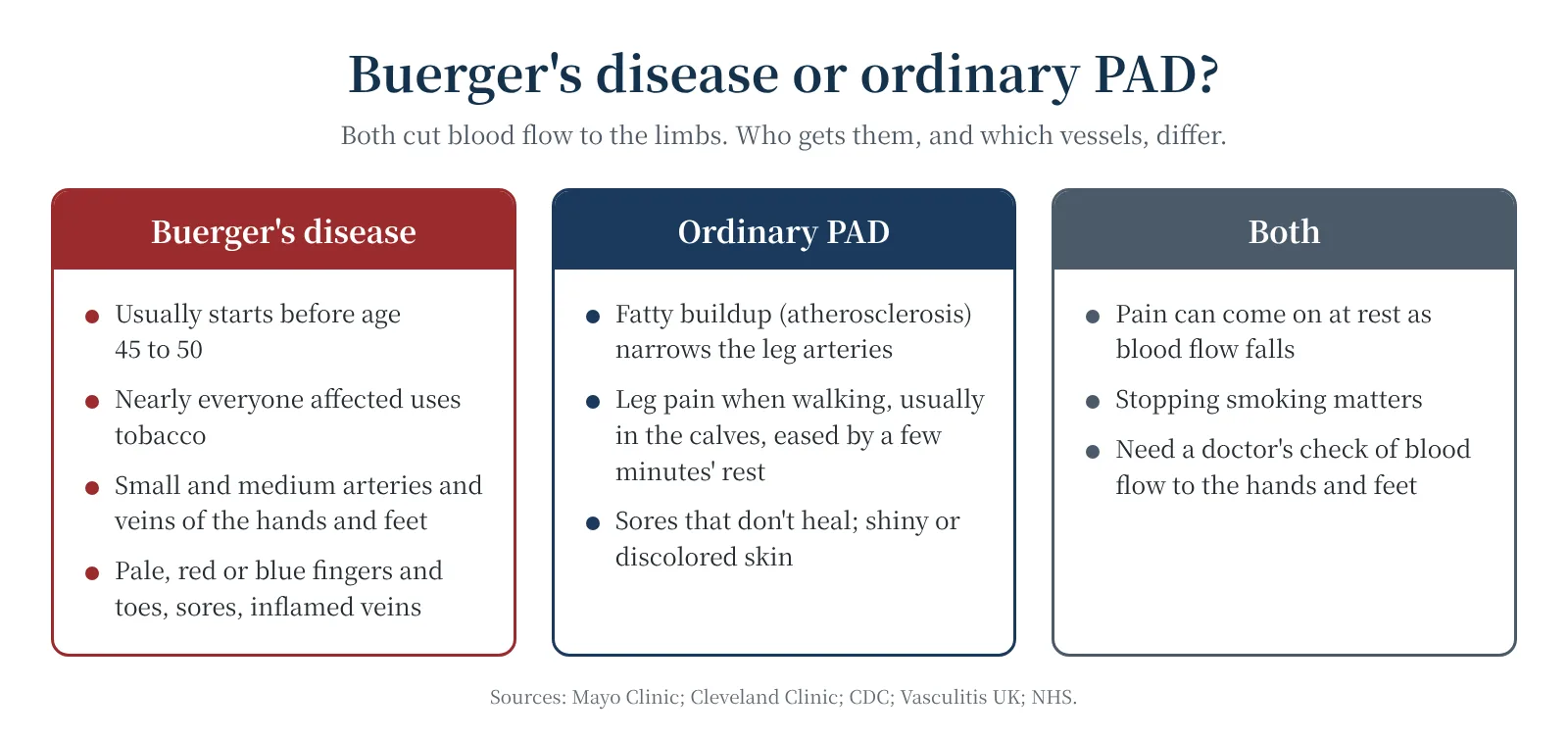
| Feature | Buerger’s disease | Atherosclerotic PAD |
|---|---|---|
| Age at onset | Usually under 45 to 50 | Usually older; more common from 65 |
| Risk factors | Tobacco, often cannabis; few others | Smoking, diabetes, high blood pressure, high cholesterol |
| Arteries | Small arteries of the hands, feet and lower legs, blocked in short segments | Larger arteries of the pelvis, thigh and leg |
| Veins | Migrating surface-vein inflammation | Not a feature |
| Pain with use | Arch of the foot when walking; sometimes the hand or forearm | Calf, thigh or buttock |
| Ankle-brachial index | Can be normal | Usually reduced |
| Course | Usually stops advancing when all tobacco stops | Gradual; heart attack and stroke are the main dangers |
| Main treatment | Stopping all tobacco; procedures rarely possible | Risk-factor medicines, exercise and stopping smoking; angioplasty or bypass for stubborn walking pain or limb-threatening disease |
Treatment advice for one does not automatically transfer to the other. The 2024 US guideline on PAD states that “It does not address other nonatherosclerotic causes of lower extremity arterial disease, such as vasculitis”. The only formal guideline we found with a section on Buerger’s disease comes from the Japanese Circulation Society, and all of its treatment recommendations rest on expert consensus rather than trials. Peripheral artery disease explained →
Other conditions that can look like Buerger’s disease
Much of the diagnosis consists of ruling these out.
| Condition | Clues | How urgent |
|---|---|---|
| Atherosclerotic PAD | Older; diabetes, high blood pressure or cholesterol; calf pain on walking | Routine; same day for rest pain, a dark patch or a new sore; emergency department now for a toe that is black, gray or dark purple or looks dead |
| Raynaud’s phenomenon | White, blue, then red attacks lasting minutes to hours; color returns fully; no sores in the primary form | Routine; same day for a sore, a dark patch, or a finger or toe that stays white, blue or very cold after warming; emergency department now for one that is black, gray or dark purple or looks dead |
| Scleroderma, lupus and other connective tissue diseases | Raynaud’s with tight skin, small red spots, reflux, rashes or joint pain; positive antibody tests; mostly women | Prompt; same day for a sore |
| Other vasculitis | Fever, weight loss, tiredness or rash; raised inflammation markers | Prompt; same day if unwell or a sore appears |
| Cholesterol emboli (blue toe syndrome) | Sudden painful purple toes, often in an older man after an artery procedure; the rest of the foot stays warm | Same day; emergency department now if a toe turns black, gray or dark purple, or looks dead |
| Embolism from the heart | Sudden, often one limb; often atrial fibrillation | 911 for a limb that suddenly turns cold, pale or numb |
| Antiphospholipid syndrome | Clots in arteries or veins, pregnancy loss; antibody tests stay positive | Prompt; same day for a newly swollen leg; 911 for chest pain or sudden breathlessness |
| Frostbite | After freezing cold, 32°F (0°C) or below; hard, white, blue or blotchy skin | Emergency department now; call 911 with confusion, slurred speech, slow breathing or constant shivering |
| Chilblains | Itchy or burning red or purple patches a few hours after cold; they usually go away on their own in 2 to 3 weeks | Self-care if the skin is unbroken; same day if a toe stays dusky blue or purple, if the skin breaks and you have diabetes, numb feet or poor circulation, or if there is pus; emergency department now for a toe that is black, gray or dark purple or looks dead, redness spreading fast, a fever or chills; see a doctor if not better after 2 to 3 weeks |
| Diabetic foot disease | Numb feet and unnoticed sores; diabetes rules out Buerger’s disease under most criteria | Same day for any new sore |
| Cannabis arteritis | Cannabis use; affects only one leg more often than Buerger’s disease does; improves when cannabis stops | As for Buerger’s disease |
Chilblains and Raynaud’s attacks are common and usually harmless on their own, but a sore or a dark patch on a finger or toe never is. Chilblains: causes and treatment →
How Buerger’s disease is diagnosed
There is no single test for Buerger’s disease, Mayo Clinic notes. Doctors combine your history, the examination, blood-flow tests and imaging, and rule out the look-alikes. A 2024 teaching case in the Canadian Medical Association Journal (CMAJ) explains why care matters: “It is important to make a timely diagnosis because delays, or the wrong diagnosis, can expose patients to the harms of therapies such as anticoagulation with no established benefit for patients with TAO.”
The examination
Expect a check of the pulses in your feet and wrists, which are often weak or absent, a close look at your fingertips, toes and nails, and the Allen test: the examiner presses on both arteries at the wrist and releases them one at a time. A hand that stays pale suggests small-artery disease, even if only your feet have symptoms.
Why a normal ABI does not rule it out
The ankle-brachial index (ABI), which compares blood pressure at the ankle and arm, is the standard first test for PAD. Because Buerger’s disease starts beyond the ankle, a 2016 review warns: “Ankle brachial index or forearm–brachial index is usually reduced, but might be normal in cases with more distally located disease.” In the CMAJ case, a 58-year-old smoker with blue fingertips and toe gangrene had normal ABIs (1.22 and 1.12), yet his toe pressures were too low to measure and the pulse waveforms in all 20 fingers and toes were flat. A toe-brachial index of 0.70 or less is abnormal, and toe pressures below 30 mm Hg mean severe ischemia. If your toes or fingers have symptoms and your ABI is normal, ask for toe pressures. The ankle-brachial and toe-brachial index tests →
Imaging and blood tests
Ultrasound, CT or MR angiography, or a catheter angiogram typically shows short blockages below the knee and elbow, smooth artery walls without calcium, and small corkscrew-shaped collateral vessels, with normal arteries higher up. Blood tests look for diabetes, autoimmune and connective tissue disease, and clotting disorders such as antiphospholipid syndrome, and an echocardiogram and CT scan look for a source of clots in the heart or aorta. Vascular imaging tests →
Criteria and biopsy
Doctors use several sets of diagnostic criteria. A 2022 study that polled 29 experts from 18 countries began from this point: “Despite multiple published diagnostic criteria for BD, none is universally accepted as a gold standard.” (BD stands for Buerger’s disease.) It found that the criteria differ and are applied selectively around the world. A biopsy is rarely needed and has risks: a 2021 review warns that even surface-vein biopsies can leave a chronic ulcer in a poorly supplied limb. For the same reason, any procedure on an affected toe, even for an ingrown nail, should be planned with the vascular team first.
Buerger’s disease treatment
There is no cure, but there is a treatment that works for most people. The CDC states: “The only way to keep Buerger’s disease from getting worse is to stop using all tobacco products.” Medicines and procedures help save tissue and control pain, but Japan’s guideline notes that patients who keep smoking resist the other treatments.
Stopping all tobacco: the only treatment proven to stop the disease
The evidence comes from long-term follow-up rather than trials, but it is consistent.
| Study | People followed | Stopped tobacco | Kept using tobacco |
|---|---|---|---|
| Cleveland Clinic, 1990 | 89, for an average of 91.6 months | 2 of 43 (5%) had amputations after quitting | 22 people (42%) had amputations while still smoking |
| Japan, 2004 | 110, for an average of 10.6 years | None of 41 had a major amputation | 13 of 69 (19%) had a major amputation |
| France, 2018 | 224, for an average of 5.7 years | No amputations within 4 years of quitting | Of 48 people who had an amputation, 43 (89.6%) were still smoking at the first one |
Olin summed it up in 2018: “As a general rule, if the patient has stopped smoking or using tobacco in any form (as confirmed by urine testing) and there is no gangrene present, amputations do not occur.” Two caveats keep this honest. Smoking status was mostly self-reported, and in the French study 5 of the 48 first amputations were in self-declared ex-smokers. And quitting does not fully reopen arteries that are already blocked, so some walking pain or Raynaud’s attacks can remain.
How complete quitting has to be
Completely. A 2006 review warns: “Even smoking one or two cigarettes per day or using smokeless tobacco (chewing tobacco or using nicotine-containing patches) may keep the disease active”. Cutting down does not work: in a study of 108 patients described in a 2016 review, stopping was highly protective, but “decreasing the number of cigarettes per day did not have any effect on the outcome of the disease”. Some specialists check urine for nicotine, cotinine and cannabis at visits, because self-reports have proved unreliable.
Getting help to quit
Quitting is hard. Brandon, from the CDC campaign, said: “Ultimately, it took 9 years and the amputation of both my legs and several fingertips for me to quit smoking.” Structured programs that start in the hospital, quit-smoking medicines and, for some people, a live-in program can help. Free US support is available at 1-800-QUIT-NOW, or by texting QUITNOW to 333888. Building a quit plan →
Nicotine replacement: an unsettled question
Of the seven FDA-approved quit medicines the CDC lists, five deliver nicotine (patch, lozenge, gum, oral inhaler and nasal spray); the other two are varenicline and bupropion SR. For Buerger’s disease, experts disagree about nicotine replacement, and we found no study that has tested whether it keeps the disease active.
- Avoid all nicotine. Mayo Clinic tells patients: “Nicotine replacement products aren’t an option because they still have nicotine in them.” Two reviews group nicotine patches with tobacco as things that may keep the disease active.
- Prefer non-nicotine medicines. The CMAJ authors advise: “Smoking cessation programs and pharmacotherapy without nicotine, such as varenicline or bupropion, should be offered to every patient.”
- Possible, but unstudied. A 2016 German review says nicotine replacement might be provided, adding: “Whether replacement therapies or adjuvant therapies might prolong disease activity was – to our knowledge – not addressed, but should be examined in further studies.”
- Real-world experience. Marie, in the CDC campaign, quit for good in 2006 with nicotine patches, after losing part of a foot, a lower leg and fingertips.
The goal is no tobacco, no cannabis and ideally no nicotine. Plan your quit with your clinician: varenicline and bupropion avoid the nicotine question, and if nicotine replacement is the only way you can stop smoking, decide with your vascular specialist rather than on your own, and do not keep smoking while you decide.
Medicines
A 2020 Cochrane review found only five randomized trials, with 602 participants, and concluded: “Moderate-certainty evidence suggests that intravenous iloprost (prostacyclin analogue) is more effective than aspirin for eradicating rest pain and healing ischaemic ulcers in Buerger’s disease, but oral iloprost is not more effective than placebo.”
- Intravenous iloprost widens blood vessels. In the main 1990 trial, 85% of 68 patients on iloprost showed ulcer healing or relief of rest pain after 21–28 days, against 17% of 65 on aspirin; sores healed completely in 35% against 13%, and amputation rates at 6 months were not significantly different. In the US, the intravenous form, Aurlumyn, was approved in February 2024 for one use: “AURLUMYN is indicated for the treatment of severe frostbite in adults to reduce the risk of digit amputations.” Using it for Buerger’s disease would therefore be off-label, a decision for a vascular specialist. We found no drug that the FDA has approved for Buerger’s disease.
- Aspirin and clopidogrel are widely used without proven benefit, although Japan’s guideline still recommends them on expert opinion; do not stop one without your prescriber. The Cochrane review found no trials of cilostazol or pentoxifylline.
- Others. Calcium channel blockers can reduce Raynaud’s attacks. Bosentan, tried in a pilot study of 12 patients, is approved in the US only for pulmonary arterial hypertension and carries a boxed warning about liver damage and harm to an unborn baby. Blood thinners and steroids have no established benefit for Buerger’s disease itself, but if you take one, do not stop it without your prescriber; it may be treating something else.
Procedures
Bypass surgery is rarely possible because the disease affects small arteries in short segments; in a Japanese series of 46 bypasses, only 30% of grafts stayed open for 10 years without further procedures (39% with them). Angioplasty has advanced over the past decade: a 2023 pooled analysis of 15 studies with 601 patients reported 89.1% of limbs saved at 36 months, but the patients were selected, only about half of treated arteries stayed open at 3 years without a repeat procedure, and Japan’s 2017 guideline, written before these results, advised against it. Lumbar sympathectomy did worse than iloprost in a randomized trial, and cell and gene therapies remain experimental. When amputation is needed, it is most often of a toe or finger. Artery procedures explained →
Pain and wound care
A 2016 review stresses: “Effective analgesia is crucial as ischemic and neuropathic pain in Buerger’s disease is usually severe.” Pain specialists, combinations of medicines and nerve blocks are often needed. Sores need specialist wound care and heal slowly, and an infection needs care the same day or sooner, as set out at the top of this page: in the French study, an infected limb at diagnosis strongly predicted later amputation. A wound that will not heal →
Protecting your hands and feet
Daily care cannot reopen arteries, but it prevents the small injuries that become sores.
- Keep warm, safely. Avoid cold, and wear gloves and warm socks. The American Diabetes Association’s advice for feet that may not feel heat fits here: “The best way to warm cold feet is to wear warm socks.” Keep heating pads, hot water bottles, heat lamps and hot soaks off numb or poorly supplied hands and feet. Cold feet: causes and safe warming →
- Check your hands and feet every day. Look for cuts, cracks, blisters, color changes and sores, using a mirror for your soles, and clean small cuts with soap and water and cover them; get any new sore, blister or crack checked the same day. Daily foot and leg skin checks →
- Wear roomy, well-fitting shoes with socks. Poorly fitting footwear is a common cause of injury.
- Leave nails, corns and calluses to a podiatrist. Merck’s consumer manual warns against minor surgery such as trimming calluses yourself. Get athlete’s foot treated promptly, since cracked skin lets infection in.
- Review your medicines with your prescriber. Merck lists decongestants such as pseudoephedrine and phenylephrine, cocaine and amphetamines, and estrogen-containing medicines among those to avoid. Never stop a prescribed medicine on your own.
- Stay active. With your clinician’s agreement, regular exercise helps blood flow; ask how to stay active without pressing on any open sore. Walking with artery disease →
- See a dentist regularly. Gum disease has been linked to Buerger’s disease, perhaps partly through heavy smoking and poverty, and Mayo Clinic recommends regular dental care.
- Ask before any compression. A 2018 international consensus statement says compression stockings are contraindicated in critical limb ischemia, when the ankle pressure is below 70 mm Hg, or after arterial bypass, because of the risk of ischemia or skin necrosis. Before using compression stockings, or a compression pump like the one Mayo Clinic describes, have your arterial circulation checked first. In Buerger’s disease the ankle pressure can be normal even when the toes are short of blood, so ask about toe pressures too. Who needs a check before compression →
Outlook and Buerger’s disease life expectancy
Amputation risk
| Study | People and follow-up | Amputations |
|---|---|---|
| France, 2018 | 224, average 5.7 years | Free of any amputation: 85% at 5 years, 66% at 15; free of major amputation: 94% and 91% |
| Mayo Clinic, summarized in 2018 | 111, average 15.6 years | Major amputation in 11% by 5 years and 23% by 20; minor amputations were more common |
| Japan, 2004 | 110, average 10.6 years | 43% had an amputation: 13 major, 34 minor |
Outcomes were better where the disease was milder at diagnosis, and it tends to flare and settle. In the Japanese follow-up study, no new or repeat sores occurred after age 60.
Buerger’s disease life expectancy
The disease threatens limbs far more than life. The French study recorded only 3 deaths among 224 people, and a 2024 survey of 3,220 Japanese patients concluded: “This large survey confirmed that TAO is not a life-threatening but an extremity-threatening disease that threatens patients’ professional lives.” One US study disagrees: Olin noted in 2018 that a Mayo Clinic study of 111 patients was the only one to find shorter lives, with an average age at death of 52. Continued smoking adds its own risks of cancer, heart disease and stroke. Ordinary artery risk factors matter more with age: Japan’s guideline advises managing them according to age, and a 2024 survey found artery-hardening conditions even in patients in their 20s and 30s.
When to see a doctor or podiatrist
Make an appointment, and be open about any tobacco or cannabis use, if:
- your fingers or toes are often cold, numb, tingling or discolored, and you smoke, vape, chew tobacco or use cannabis
- your foot arch, calf, hand or forearm aches with use and eases with rest
- Raynaud’s attacks start after age 30 or affect only one side of your body
- tender red cords keep appearing along different surface veins (a new red, hard, painful one needs a same-day check)
A vascular specialist usually leads care. A podiatrist can check your foot pulses and skin, look after nails, corns and sores, and help prevent injuries. Bring a list of your symptoms, all tobacco and cannabis use, any work with vibrating tools, and your medicines. Preparing for a vascular appointment →
Near Howell or Bloomfield Township, Michigan?
The author of this site practices podiatry at Balance Foot & Ankle, which he owns, so this is a disclosed option rather than an independent referral. If you have cold, color-changing or painful toes, a sore that will not heal, or a diagnosis of Buerger’s disease, a foot-and-ankle evaluation can check your foot pulses and skin, measure toe pressures, care for toe sores and nails in ways that lower the risk of amputation, and coordinate with a vascular specialist and quit-smoking support. Michigan evaluation →
Common questions
Is Buerger’s disease curable?
No. The CDC and MedlinePlus both say there is no cure. But stopping all tobacco halts the disease in most people: symptoms often settle, and amputations become rare, especially if there is no gangrene when you quit. Arteries that are already blocked do not fully reopen, so some walking pain or cold sensitivity may remain.
Can Buerger’s disease be reversed if you stop smoking?
Partly. Quitting completely usually stops the disease advancing, sores can heal and pain eases; in long-term studies, people who stopped rarely needed a major amputation, while in one Japanese study about 1 in 5 who kept smoking did. Arteries that are already blocked do not fully reopen. Quitting before gangrene sets in gives the best chance of keeping your fingers and toes.
Does vaping or nicotine gum cause Buerger’s disease?
We found no published case blamed on nicotine vaping alone, but that does not make vaping safe: vapes deliver nicotine, and Mayo Clinic advises people with Buerger’s disease to avoid vaping and e-cigarettes. We found no study testing whether nicotine gum, patches or vapes keep the disease active; Mayo Clinic says nicotine replacement is not an option, while other experts say it might be offered. Vaping THC has been linked to a similar disease. Plan quitting with your clinician.
Can non-smokers get Buerger’s disease?
Rarely, if ever, when exposure is checked carefully. No well-documented case has been published in someone proven by urine tests not to use tobacco or cannabis. Registries that rely on self-report list some nonsmokers, such as 8% of new patients in Japan, but some apparent nonsmokers turn out to be smoking or exposed to smoke at work.
What does Buerger’s disease look like?
Usually cold fingers or toes that look pale, red, bluish or purplish, turning paler when raised and redder or darker when lowered. Small, very painful sores form at the tips or around the nails and can turn black with gangrene. A toe or finger that turns black, gray or dark purple, or looks dead needs an emergency department now, and a new sore or dark patch needs same-day care. On brown or black skin, compare with the other side and watch for gray, darker or cold digits.
Is Buerger’s disease hereditary?
Not in any known pattern. Differences between regions and links with some immune-system gene types suggest that certain people are more susceptible, but the genetic studies are small and regional, and a 2021 review judged their results not quite reliable. A US government rare-disease database lists recessive inheritance, but we found no family study supporting it.
What is the life expectancy with Buerger’s disease?
In most studies, close to normal. A French study of 224 patients recorded only 3 deaths, and a Japanese survey of 3,220 patients called it extremity-threatening rather than life-threatening. One US study from Mayo Clinic found shorter lives, with an average age at death of 52. Continued smoking adds its own risks to life.
Where to go next
Sources
- Arkkila PE. Thromboangiitis obliterans (Buerger’s disease). Orphanet Journal of Rare Diseases 2006;1:14.
- Klein-Weigel P, Volz TS, Zange L, Richter J. Buerger’s disease: providing integrated care. Journal of Multidisciplinary Healthcare 2016;9:511–518.
- Rivera-Chavarría IJ, Brenes-Gutiérrez JD. Thromboangiitis obliterans (Buerger’s disease). Annals of Medicine and Surgery 2016;7:79–82.
- Olin JW. Thromboangiitis obliterans: 110 years old and little progress made. Journal of the American Heart Association 2018;7:e011214.
- Le Joncour A, Soudet S, Dupont A, et al. Long-term outcome and prognostic factors of complications in thromboangiitis obliterans (Buerger’s disease): a multicenter study of 224 patients. Journal of the American Heart Association 2018;7:e010677.
- Olin JW, Young JR, Graor RA, et al. The changing clinical spectrum of thromboangiitis obliterans (Buerger’s disease). Circulation 1990;82:IV3–8.
- Ohta T, Ishioashi H, Hosaka M, Sugimoto I. Clinical and social consequences of Buerger disease. Journal of Vascular Surgery 2004;39:176–180.
- Watanabe Y, Shimizu Y, Hashimoto T, et al. Demographic traits, clinical status, and comorbidities of patients with thromboangiitis obliterans in Japan. Circulation Journal 2024;88:319–328; Watanabe Y, Miyata T, Shigematsu K, et al. Current trends in epidemiology and clinical features of thromboangiitis obliterans in Japan: a nationwide survey using the medical support system database. Circulation Journal 2020;84:1786–1796.
- Lie JT. The rise and fall and resurgence of thromboangiitis obliterans (Buerger’s disease). Acta Pathologica Japonica 1989;39:153–158.
- Isobe M, Amano K, Arimura Y, et al. JCS 2017 guideline on management of vasculitis syndrome: digest version. Circulation Journal 2020;84:299–359.
- Gornik HL, Aronow HD, Goodney PP, et al. 2024 ACC/
AHA/ . Circulation 2024;149:e1313–e1410.AACVPR/ APMA/ ABC/ SCAI/ SVM/ SVN/ SVS/ SIR/ VESS guideline for the management of lower extremity peripheral artery disease: a report of the American College of Cardiology/American Heart Association Joint Committee on Clinical Practice Guidelines - Lavoie MA, Milot A. A 58-year-old man with subacute digital ischemia of all limbs. CMAJ 2024;196:E1076–E1082.
- Fazeli B, Poredos P, Schernthaner G, et al. An international Delphi consensus on diagnostic criteria for Buerger’s disease. Annals of Vascular Surgery 2022;85:211–218.
- Fazeli B, Ligi D, Keramat S, et al. Recent updates and advances in Winiwarter-Buerger disease (thromboangiitis obliterans): biomolecular mechanisms, diagnostics and clinical consequences. Diagnostics 2021;11:1736.
- Fazeli B, Poredos P, Liew A, et al. The angiography pattern of Buerger’s disease: challenges and recommendations. Journal of Clinical Medicine 2025;14:4841.
- Matsushita M, Shionoya S, Matsumoto T. Urinary cotinine measurement in patients with Buerger’s disease: effects of active and passive smoking on the disease process. Journal of Vascular Surgery 1991;14:53–58.
- Lawrence PF, Lund OI, Jimenez JC, Muttalib R. Substitution of smokeless tobacco for cigarettes in Buerger’s disease does not prevent limb loss. Journal of Vascular Surgery 2008;48:210–212.
- Bergère G, Toquet C, Hoffmann C, et al. Effect of cannabis consumption on characteristics and evolution of thromboangitis obliterans. Vasa 2021;50:301–305.
- Desbois AC, Cacoub P. Cannabis-associated arterial disease. Annals of Vascular Surgery 2013;27:996–1005.
- Pilitsi E, Kennamer B, Trepanowski N, et al. Cannabis arteritis presenting with Raynaud’s and digital ulcerations: a case-based review of a controversial thromboangiitis obliterans-like condition. Clinical Rheumatology 2023;42:1981–1985.
- Colling M, Souri Y, Reifsnyder T. Tetrahydrocannabinol vape-associated cannabis arteritis in a patient with minimal tobacco exposure. Journal of Vascular Surgery Cases and Innovative Techniques 2025;11:101673.
- Cacione DG, Macedo CR, do Carmo Novaes F, Baptista-Silva JC. Pharmacological treatment for Buerger’s disease. Cochrane Database of Systematic Reviews 2020;5:CD011033.
- Fiessinger JN, Schäfer M. Trial of iloprost versus aspirin treatment for critical limb ischaemia of thromboangiitis obliterans. The TAO Study. Lancet 1990;335:555–557.
- Bozkurt AK, Köksal C, Demirbas MY, et al. A randomized trial of intravenous iloprost (a stable prostacyclin analogue) versus lumbar sympathectomy in the management of Buerger’s disease. International Angiology 2006;25:162–168.
- De Haro J, Acin F, Bleda S, et al. Treatment of thromboangiitis obliterans (Buerger’s disease) with bosentan. BMC Cardiovascular Disorders 2012;12:5.
- Galyfos G, Liakopoulos D, Chamzin A, et al. A systematic review and meta-analysis of early and late outcomes after endovascular angioplasty among patients with thromboangiitis obliterans and chronic limb ischemia. Journal of Vascular Surgery 2023;77:1534–1541.e2.
- Ture HY, Lee NY, Kim NR, Nam EJ. Raynaud’s phenomenon: a current update on pathogenesis, diagnostic workup, and treatment. Vascular Specialist International 2024;40:26.
- Amin M, Dubey S, Clark K, et al. Vaping and vascular health: emerging risks for Raynaud’s, chilblains and Buerger’s disease. Rheumatology 2026;65:keag182.
- Balahura AM, Florescu AG, Barboi TM, et al. Current diagnostic and therapeutic challenges in superficial venous thrombosis. Medicina 2024;60:1466.
- Rabe E, Partsch H, Hafner J, et al. Indications for medical compression stockings in venous and lymphatic disorders: an evidence-based consensus statement. Phlebology 2018;33:163–184.
- Shukuzawa K, Ozawa H, Ohki T. Revascularization for acute limb ischemia. Annals of Vascular Diseases 2026;19:26–66.
- Centers for Disease Control and Prevention, Tips From Former Smokers. Smoking and Buerger’s disease; Brandon C.’s story; Marie W.’s story; Quit smoking medicines. Centers for Disease Control and Prevention. Cellulitis; About sepsis; About venous thromboembolism (blood clots); Your feet and diabetes.
- Merck Manual Professional Version. Thromboangiitis obliterans (Buerger disease); Peripheral artery disease. Merck Manual Consumer Version. Thromboangiitis obliterans (Buerger disease); Superficial venous thrombosis.
- Mayo Clinic. Buerger disease: symptoms and causes and diagnosis and treatment.
- MedlinePlus, US National Library of Medicine. Thromboangiitis obliterans. National Heart, Lung, and Blood Institute. Vasculitis. Genetic and Rare Diseases Information Center. Thromboangiitis obliterans.
- National Organization for Rare Disorders. Buerger’s disease. Last updated 23 September 2007.
- DailyMed, US National Library of Medicine. Aurlumyn (iloprost) injection label; Tracleer (bosentan) label. US Food and Drug Administration. FDA approves first medication to treat severe frostbite. 14 February 2024.
- Society for Vascular Surgery. Acute limb ischemia; Peripheral artery disease.
- NHS. Gangrene; DVT (deep vein thrombosis); Cellulitis; Peripheral arterial disease (PAD); Raynaud’s; Chilblains; Frostbite.
- American Diabetes Association. Foot complications.
- DermNet. Blue toe syndrome; Antiphospholipid syndrome; Arterial ulcer.
Written by Tom Biernacki, DPM, FACFAS. Published 12 November 2026. General education, not medical advice.